





 Startups
 Creative agencies
 Onchain teams
 European businesses
 AI
 Software
TL;DR: Under current IRS guidance, stablecoins are generally taxable. The IRS treats them as property for US federal tax purposes, so holding isn't a taxable event, but spending, converting, selling, or off-ramping can create a reportable gain or loss. For USD-pegged stablecoins like USDC, that gain or loss is often small. For EUR-pegged stablecoins like EURC, it can be material, because the asset's USD value moves with the EUR/USD exchange rate. Each disposition generally calls for lot-level records covering acquisition date, cost basis, fair market value at disposition, and the resulting gain or loss. Businesses typically report on Form 8949 and Schedule D, and Form 1099-DA, now final, requires broker reporting on digital asset transactions from January 1, 2025 onward. A monthly account roll-forward, run per account, is a practical baseline for reconciliation, and businesses that keep lot-level records close clean.
The hardest part of stablecoin tax compliance isn't knowing the rules. It's proving, with lot-level records, that you followed them. Any stablecoin disposition creates a taxable event when you spend it, and a missed transaction creates a gap in your cost basis records that compounds with every subsequent disposition.
Manual reconciliation across systems that don't integrate is where most misses occur. This guide answers the direct question, walks through the taxable events, and shows how to build the record-keeping workflow that holds up under IRS scrutiny.
What's changing: the GENIUS Act, the PARITY Act, and Treasury's ANPRM
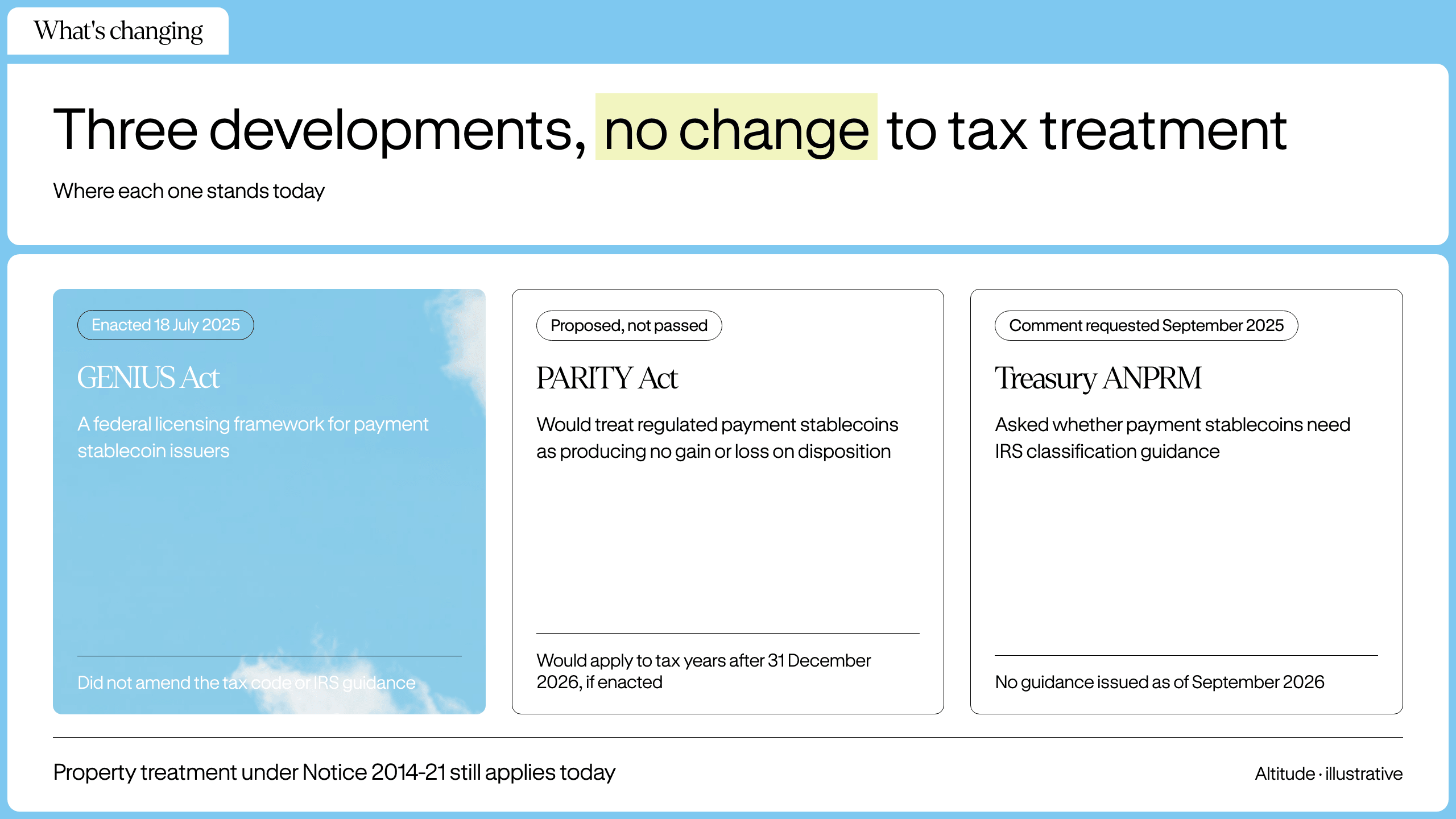
Three developments are active right now. None of them changes how the IRS taxes stablecoins today, but each one affects how long the current framework holds.
- The GENIUS Act (enacted July 18, 2025) established a federal licensing framework for payment stablecoin issuers, setting reserve, redemption, and disclosure requirements for covered issuers. It did not amend the Internal Revenue Code or modify IRS guidance on how stablecoin transactions are taxed. Under current IRS guidance, stablecoins remain property for federal tax purposes. Holding, spending, converting, and off-ramping are all treated the same way after the GENIUS Act as before it.
- The revised PARITY Act would treat regulated payment stablecoins as producing no gain or loss on disposition, unless the holder's cost basis falls below 99% of the stablecoin's redemption value. If enacted, the provision would apply to tax years beginning after December 31, 2026. The bill has not passed. Until it does, every disposition of a stablecoin is a reportable event under current IRS guidance, and lot-level records are still required.
- Treasury's September 2025 ANPRM requested public comment on whether payment stablecoins require IRS classification guidance, including possible treatment as debt instruments rather than property. As of September 2026, no guidance has been issued in response to the ANPRM. The property classification from Notice 2014-21 remains in effect.
The practical implication: the compliance workflow described in this article reflects current law. If the PARITY Act passes or Treasury issues new classification guidance, the taxable-event analysis and record-keeping requirements for regulated payment stablecoins could change materially. Businesses should watch both developments and confirm current treatment with their tax advisor before filing.
IRS guidance on stablecoin tax obligations
Compliance snapshot: Stablecoins are property, not currency, for US federal tax purposes. This classification, established in IRS Notice 2014-21, means every disposition is a reportable event, and general tax principles for property transactions apply.
The IRS published Notice 2014-21 in 2014, stating that virtual currency is treated as property for federal income tax purposes. The IRS digital assets page explicitly lists stablecoins as digital assets subject to this treatment. Under this framework, stablecoins are generally subject to the same tax obligations as other property, even though they peg to the US dollar.
Tax treatment and accounting treatment differ. For tax purposes, stablecoins are property. For US GAAP financial reporting, FASB ASU 2023-08 requires entities to measure qualifying crypto assets at fair value in the statement of financial position each reporting period, with changes from remeasurement recognized in net income.
Whether a specific stablecoin falls within ASU 2023-08's scope depends on its redemption rights: the standard applies only to assets that carry no enforceable rights to underlying goods, services, or other assets, and a redeemable stablecoin such as USDC or EURC, which carries an enforceable 1:1 redemption right against the issuer, may fall outside the standard's scope depending on its specific terms. Businesses should have their accountant assess whether each stablecoin they hold qualifies before applying fair-value measurement under ASU 2023-08.
This fair-value measurement replaces the previous cost-less-impairment model and is effective for fiscal years beginning after December 15, 2024, so most businesses now report crypto assets at fair value each period. Both frameworks matter: tax determines what you owe, and accounting determines how you report it on your financial statements.
How stablecoins are classified and taxed
Defining stablecoins for tax purposes
A stablecoin is generally understood to be a digital asset designed to hold a stable value against a reference asset, typically the US dollar, by maintaining reserves or using algorithmic mechanisms. The IRS treats convertible virtual currency, a category understood to include stablecoins, as property for tax purposes, which means the longstanding tax principles that apply to property transactions apply to stablecoin transactions.
Taxable events for stablecoin transactions
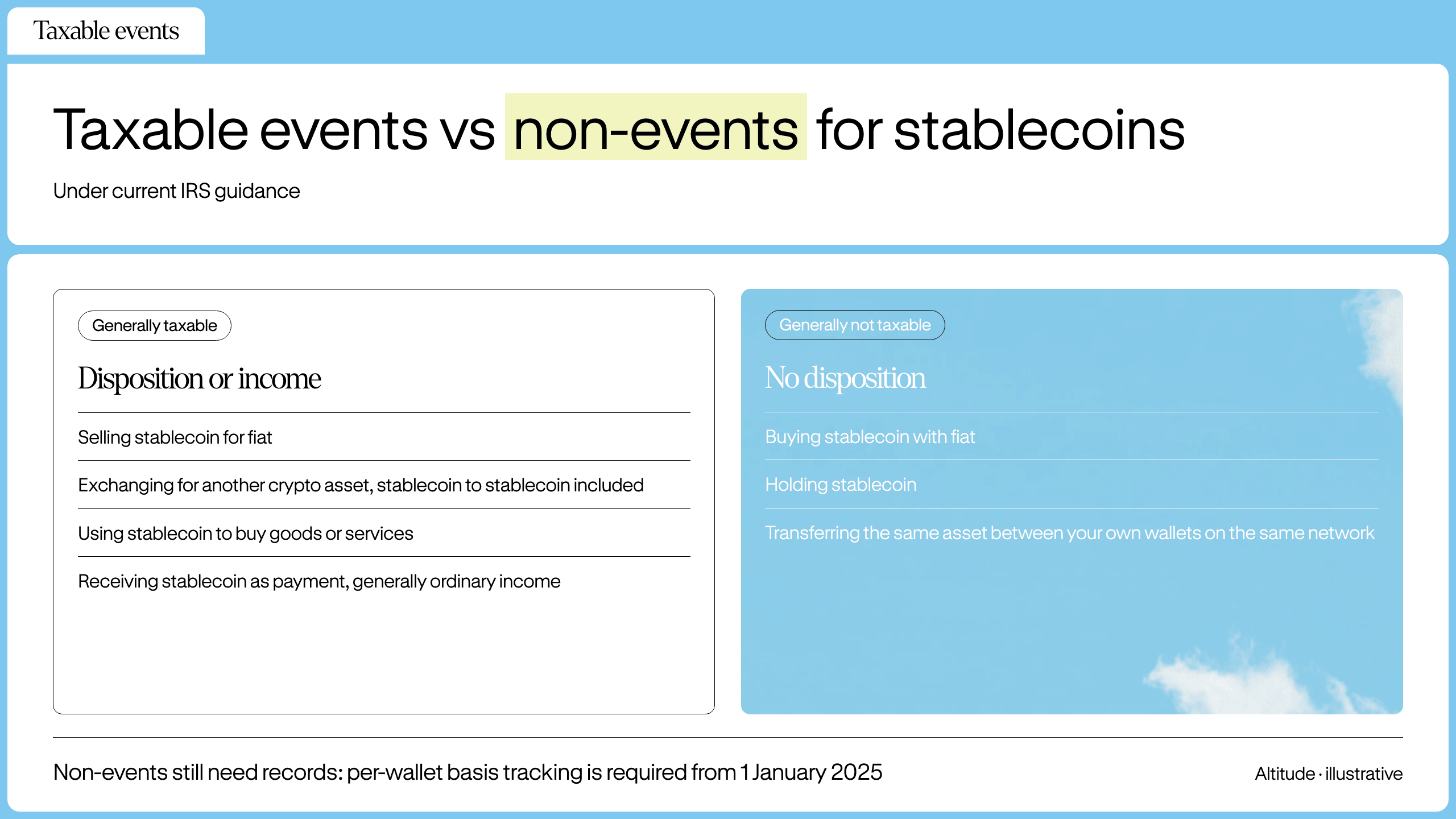
Under current IRS guidance, the following actions generally trigger a taxable event for a business, either as a gain or loss on disposition or as ordinary income:
- Selling stablecoin for fiat currency (US dollars).
- Exchanging stablecoin for another cryptocurrency or digital asset, including swapping one stablecoin for another.
- Using stablecoins to purchase goods or services, including paying a vendor or contractor.
- Receiving stablecoins as payment for goods or services, which is generally ordinary income at fair market value.
These are the key taxable events under current IRS guidance. Non-events generally include buying stablecoin with fiat and holding stablecoin. Transfers of the same asset between your own wallets or accounts on the same network aren't generally treated as taxable events under current IRS guidance, but you must still track them carefully: Rev. Proc. 2024-28 requires taxpayers to track cost basis on a per-wallet or per-account basis beginning January 1, 2025, so the cost basis of each lot must follow the asset from wallet to wallet. The tax treatment of other types of transfers, including movements that change the network or form of an asset, is not settled in the same way and should be confirmed with a tax adviser.
Core IRS standards for stablecoin tax
Capital gains and losses apply to dispositions. The holding period determines short-term versus long-term treatment. Under general tax rules, assets held one year or less are treated as short-term, and assets held more than one year are treated as long-term.
For individuals and pass-through entities, that distinction affects the applicable tax rate. C-corporations pay the same flat corporate rate on capital gains as on ordinary income, so the holding-period distinction carries no rate benefit for them. The character of a stablecoin gain or loss as capital or ordinary can also depend on how the stablecoin is used in the business.
Confirm the treatment with a tax adviser based on your entity type and the role stablecoins play in your operations. Ordinary income applies to stablecoin received as payment for goods or services. Under IRS guidance, you generally include the fair market value of the virtual currency, measured in US dollars, as of the date it was received, in computing gross income.
Tax implications for incoming stablecoin revenue
Calculating stablecoin FMV
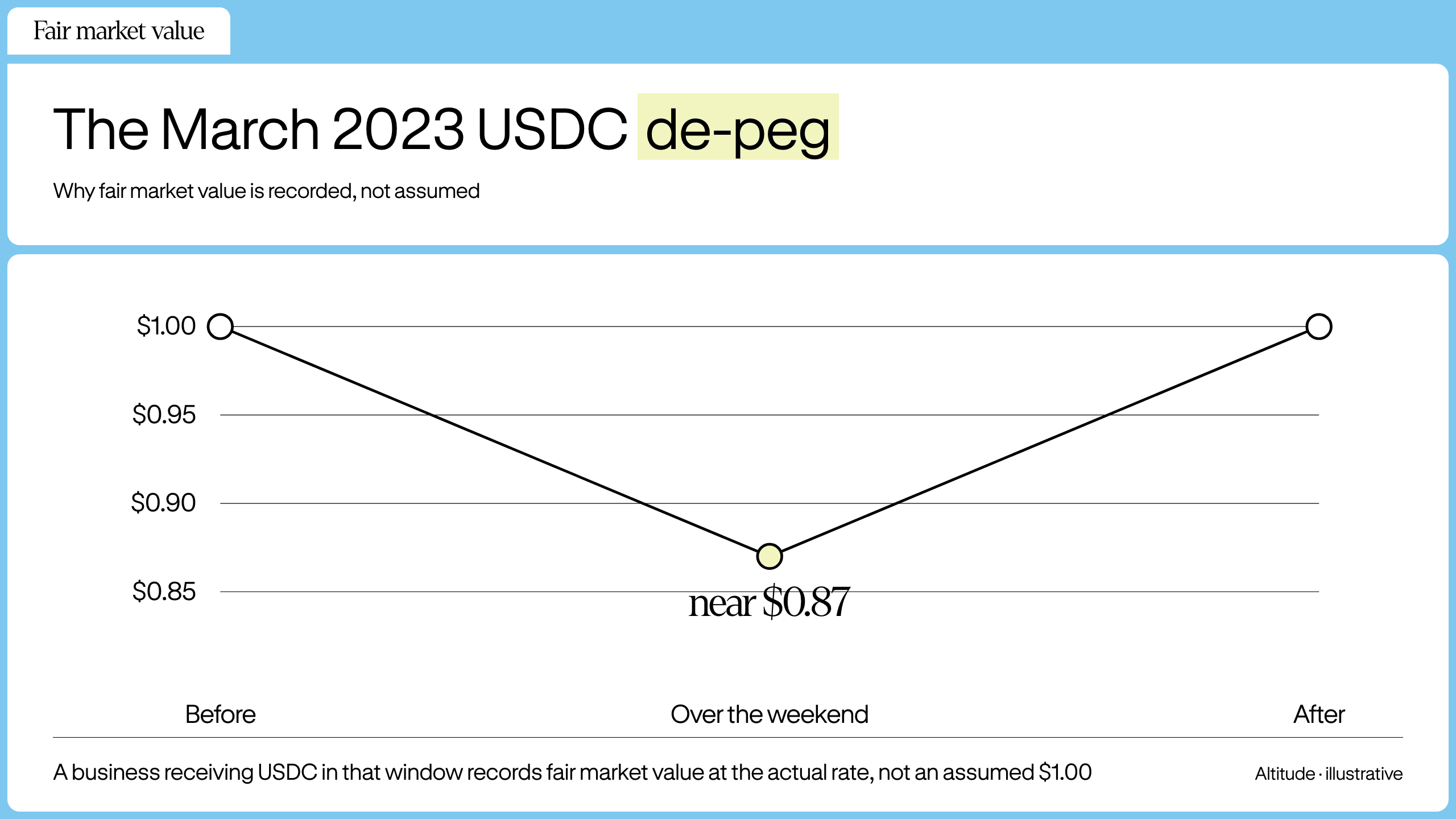
Fair market value (FMV) is the exchange rate at the moment of receipt, denominated in US dollars. For a USD-pegged stablecoin like USDC, FMV is typically close to $1.00, but market anomalies can change this. In March 2023, USDC traded near 87 cents over a weekend amid the failure of Silicon Valley Bank, which held part of Circle's reserves. A business that received USDC during that window would generally have needed to record FMV at the actual market rate rather than assuming $1.00. For a EUR-pegged stablecoin like EURC, FMV in USD moves with the EUR/USD exchange rate, so it is almost never exactly $1.00 and can shift materially between acquisition and disposition.
Managing stablecoin tax documentation
For every inbound stablecoin payment, you need four data fields: date received, FMV in USD at that moment, source, and business purpose. This documentation establishes your cost basis for future dispositions. Without it, you can't calculate gain or loss when you later spend or convert the asset. Altitude's transaction logs capture date, amount, and rail for each inbound stablecoin transfer. FMV must be recorded separately at the time of receipt, since the stablecoin's market rate can deviate from $1.00, as the USDC de-peg event in March 2023 illustrated.
Recording income for tax compliance
When you receive stablecoin as payment for goods or services, the tax treatment depends on your accounting method. Cash-method taxpayers generally recognize ordinary income at the fair market value of the stablecoin on the date it is received.
Accrual-method businesses recognize income when it is earned, which is typically when the goods are delivered or the services are performed, not necessarily when the stablecoin arrives. In either case, the FMV of the stablecoin at the time of receipt establishes its cost basis for purposes of any future disposition.
This is a common point of confusion: receipt fixes the basis regardless of what you do with the stablecoin afterward, but it does not automatically set the income recognition date for accrual-method taxpayers. Confirm the correct timing with your tax advisor based on your accounting method.
Reporting outgoing stablecoin transfers to the IRS
IRS reporting for stablecoin transfers
Spending stablecoin is a disposition. Gain or loss equals FMV at spending minus cost basis. Because stablecoins are designed to hold a stable value, this gain or loss is often small, but it's still reportable. Currently, businesses self-report these dispositions on Form 8949, the IRS form used to report sales and other dispositions of capital assets. Your net gain or loss from Form 8949 flows to Schedule D, which reports your net capital gain or loss from all investments.
Form 1099-DA is final, not draft. Treasury and the IRS issued final regulations in 2024 requiring custodial digital asset brokers (platforms that take possession of customer assets) to report sales and exchanges on Form 1099-DA beginning with transactions on or after January 1, 2025. Decentralized and non-custodial brokers are explicitly excluded from these regulations pending separate rulemaking. The 2025 reporting cycle covers gross proceeds, basis reporting wasn't required for transactions in that year. For qualifying stablecoin sales, broker reporting applies only when aggregate proceeds exceed $10,000 in a calendar year. That threshold determines what your broker reports to the IRS, not what you must report: every disposition of a stablecoin remains a reportable event for the taxpayer regardless of whether a 1099-DA is issued.
Corporations are generally treated as exempt recipients under the broker reporting rules, which means many business readers won't receive a Form 1099-DA at all, even for transactions above the $10,000 threshold. Brokers furnished the first Forms 1099-DA to taxpayers by February 17, 2026 and filed them with the IRS shortly after. Whether your entity qualifies as an exempt recipient should be confirmed with a tax adviser, since the exemption doesn't change your own reporting obligations.
Tracking cost basis for stablecoins
Cost basis is generally what you paid to acquire the stablecoin, including fees. For lot-level records, you typically need to track acquisition date, cost basis, and the disposal method you use (FIFO, LIFO, or specific identification). Form 8949 itself calls for this same level of detail on every transaction: description of the asset, date acquired, date sold or disposed of, proceeds, cost basis, and gain or loss, plus the holding period that determines which part of the form it belongs on.
IRS guidelines for deductible costs
Gas fees and network fees require a policy decision. The 2024 final broker regulations introduced cost-allocation rules for digital asset transactions, including a 50/50 allocation of transaction costs on digital-asset-for-digital-asset exchanges.
Two approaches remain commonly seen in practice for fees outside that specific context: capitalizing fees into the cost basis of the acquired asset, or treating them as period costs and expensing them. Capitalizing fees into cost basis aligns with the acquisition cost principle in IRS Publication 551 and defers the deduction to match the disposition gain or loss. Have a tax adviser confirm the correct treatment for your specific transaction types, since the rules vary depending on how the exchange is structured.
Tax implications of stablecoin off-ramping
Documenting off-ramp tax events
Off-ramping stablecoin to fiat is a sale. Gain or loss equals the fiat received minus your cost basis. This is a taxable event that requires the same lot-level documentation as any other disposition. Altitude's off-ramp is logged like any other transaction, giving you a record of the disposition for your tax records.
Tax implications of crypto swaps
Swapping one stablecoin for another, such as USDC for EURC, is a taxable disposition of the asset given up. The same applies to swapping any stablecoin for another crypto asset. Altitude's USDC to EURC conversion records the executed rate and both amounts, which are shown before you confirm the conversion. Altitude adds no fee to the conversion.
Essential stablecoin ledger requirements
At a minimum, a stablecoin ledger should show each account's opening balance, inflows, outflows, fees, and closing balance. This is best maintained per account and per multisig, rather than consolidated. Consolidated ledgers can obscure the lot-level detail needed for accurate cost basis tracking and make reconciliation difficult when a discrepancy arises. Per-account tracking helps prevent the double-counting errors that occur when you consolidate assets that moved between your own addresses.
Record-keeping requirements for stablecoin transactions
Mandatory tax documentation for stablecoins
Under IRS guidance, records for each transaction should capture specific data fields: (1) the date and time each unit was acquired, (2) your basis and the fair market value of each unit at the time it was acquired, (3) the date and time each unit was sold, exchanged, or otherwise disposed of, and (4) the fair market value of each unit when sold, exchanged, or disposed of, and the amount of money or the value of property received for each unit.
Required data fields checklist:
For every stablecoin transaction, record:
- Date and time of acquisition
- Cost basis and FMV at acquisition
- Date and time of disposition
- FMV at disposition and proceeds received
- Transaction type (receipt, payment, conversion, off-ramp)
- Counterparty
- Business purpose
- Fees paid
Treasury workflow: the account roll-forward
The minimum viable reconciliation for audit-ready stablecoin books is an account roll-forward, run monthly, per account or multisig. The roll-forward formula provides a framework for reconciling balances:
| Opening Balance | + Inflows | − Outflows | − Fees | = Closing Balance |
|---|---|---|---|---|
| 10,000 USDC | 5,000 USDC | 3,000 USDC | 10 USDC | 11,990 USDC |
Roll forwards let you tie token balances to your books. The roll forward should match your books, and it should match what's happening on the network.
Verifying stablecoin tax positions
Failure mode and incident response
Manual reconciliation fails in predictable ways. Use this checklist to troubleshoot common gaps:
- API sync errors: Synchronization problems can occur when an account fails to reflect real-time data, causing discrepancies in balance display, transaction history, or pending status. Verify the sync timestamp against the block explorer.
- Pending vs. confirmed state: A transaction logged as complete before it confirms on the network creates a timing difference. Reconcile pending items separately.
- Multisig reconciliation gaps: If you log a transfer between your own accounts but forget to deduct it from the source account, you can double-count assets, resulting in overpayment or an incorrect balance.
- Missing data from cross-chain movements: Assets that move across multiple accounts, and exchanges are more likely to result in discrepancies or missing data, which can lead to incorrect balances and reporting issues.
- Income vs. purchase basis confusion: Stablecoin received as payment for goods or services generally has a cost basis equal to its FMV at receipt, while stablecoin purchased with fiat generally has a cost basis equal to the purchase price plus fees. Mixing these two acquisition types without separate lot tracking can overstate or understate gain on disposition.
Altitude's CSV export and QuickBooks Online and Xero sync provide the source record for verification. You can export transactions to CSV or PDF for preset periods such as the current month, last month, current quarter, last quarter, or year to date, or for a custom range, across all accounts or a single sub-account. The export is delivered to the requester, and the CSV format is designed to be QuickBooks-compatible. Verification is a monthly review.
Documenting stablecoin tax positions
Stablecoin vs. fiat accounting comparison (illustrative)
| Record source | Reconciliation method | Error surface | Audit trail |
|---|---|---|---|
| Onchain stablecoin (manual) | Manual matching of onchain IDs to bank statements and ERP entries | Higher: manual error, missing data, double-counting | Weaker: spreadsheet-based |
| Traditional bank feed (automated) | Automated bank feed sync | Lower: automated matching | Stronger: system-generated |
| Altitude + QBO/Xero | Automated sync with confirmation before posting | Lower: one-way sync, manual confirmation required | Stronger: system-generated with approval trail |
Altitude's accounting sync is designed as a one-way sync, from your Altitude account to QuickBooks Online and Xero, and you confirm every posting before it applies rather than auto-posting. You review each posting in your Altitude dashboard and approve it before it syncs to QuickBooks Online or Xero, giving you final control over what hits your books. This is intended to provide the audit trail that manual reconciliation can lack. You can also send stablecoins directly from your account, and transactions are logged with date, amount, and rail.
Altitude's help center article documents the sync scope. As of the latest help center documentation, the following aren't yet included in the sync:
- Card transactions
- Rewards (including Earn payouts)
- SOL and cbBTC Holdings
- Transaction splitting
- QBO metadata fields
EUR postings require a QBO multi-currency subscription. Altitude built transaction logging and QuickBooks Online and Xero sync so every synced stablecoin movement produces the lot-level record your CPA needs.
See how Altitude's transaction logs and QuickBooks Online and Xero sync turn stablecoin activity into audit-ready records. Book a demo to walk through the workflow with the Altitude team.
FAQs
Do I pay taxes on stablecoins I just hold?
No. Holding stablecoins isn't a taxable event under current IRS guidance. Buying them with fiat and transferring them between your own accounts are also non-events. Taxable events occur only when you spend, convert, sell, or receive them as payment for goods or services, at which point gain or loss applies.
Are stablecoin conversions always taxable?
Yes, converting one stablecoin to another, or converting stablecoin to any other crypto asset, is a taxable disposition of the asset given up. You calculate gain or loss based on the FMV at the time of the swap minus your cost basis.
Why do I need to track FMV for a stablecoin?
In principle, even a very small price movement, for example $0.001, can create a reportable gain or loss under IRS property rules. The IRS cares about the records and the process, not about the size of the movement.
What forms do I need for stablecoin tax reporting?
Businesses generally self-report stablecoin dispositions on Form 8949, with the net gain or loss flowing to Schedule D. Form 1099-DA is final. Final regulations issued in 2024 require broker reporting on Form 1099-DA for transactions on or after January 1, 2025.
How do I calculate cost basis for stablecoins?
Cost basis is what you paid to acquire the stablecoin, including fees. You must track lot-level records: acquisition date, cost basis, and your chosen disposal method (FIFO, LIFO, or specific identification).
Key terms glossary
Cost basis: What you paid to acquire an asset, including fees.
Fair market value (FMV): The exchange rate of an asset in US dollars at a specific moment in time.
Lot-level records: Transaction-by-transaction records that track acquisition date, cost basis, and disposal method for each unit of an asset.
Position reconciliation: The process of matching internal records against external statements (bank, custodial, onchain) to verify accuracy.
Settlement window: The time between when a payment is initiated and when it is final and irreversible.
Account roll-forward: A reconciliation formula: Opening Balance + Inflows − Outflows − Fees = Closing Balance, run per account.
Off-ramp: The conversion of a stablecoin or crypto asset to fiat currency.
On-ramp: The conversion of fiat currency to a stablecoin or crypto asset.
Disposition: The sale, exchange, or use of an asset. For tax purposes, any disposition of property triggers a gain or loss calculation.
Form 1099-DA: The IRS form digital asset brokers use to report sales and exchanges of digital assets.
ASU 2023-08: The FASB accounting standards update requiring fair-value measurement of crypto assets for US GAAP.
Altitude is a financial technology platform, not a bank or digital asset custodian.