





 Startups
 Creative agencies
 Onchain teams
 European businesses
 AI
 Software

TL;DR: ACH settles in 1 to 3 business days at $0.20 to $1.50 per transaction and supports reversals within NACHA-defined windows. Same-day ACH settles within the business day for roughly $0.70 to $2.50 per transaction. Wire transfers settle same-day through Fedwire at $25 to $50+ per transaction and are final upon credit. International wires stack intermediary deductions of $15 to $50 per correspondent hop on top of the sending fee. Altitude, a global business account, charges no fee on ACH, same-day ACH, and US domestic wire. Run ACH, wire, and international payments from one workspace, with approval thresholds and role-based permissions built in.
A $5,000 international wire can arrive $30 to $50 short after intermediary banks take their cut. The sending fee you see on the confirmation screen isn't the fee you pay. For a finance manager running weekly payment batches across domestic and international corridors, choosing a suboptimal rail costs money, settlement time, and credibility with suppliers.
This article compares the wire transfer vs ACH decision for US domestic payments, which run on the NACHA-governed ACH network and Fedwire, across speed, cost, limits, and reversibility. It also covers international wires for corridors where US rails don't reach, then maps each rail to the payment scenarios where it earns its cost.
ACH vs wire transfer: a side-by-side review
Here is the full ACH vs wire transfer comparison across the dimensions that matter most for payment operations: settlement time, cost, limits, reversibility, and weekend availability.
| Feature | ACH | Wire transfer |
|---|---|---|
| Settlement time | 1 to 3 business days (same-day available) | Same business day |
| Typical industry cost | $0.20 to $1.50 per transaction | $25 to $35 domestic, $25 to $50+ international |
| Altitude charge | $0 | $0 US domestic |
| Transaction limit | $1M per transaction (same-day) | High or unlimited (varies by bank) |
| Reversibility | Yes, within defined NACHA windows | No, final upon settlement |
| Weekend settlement | No | No (Fedwire closed) |
| Best use case | Recurring domestic payments, vendor runs | Time-critical, large-value, international |
Settlement windows and cut-off times
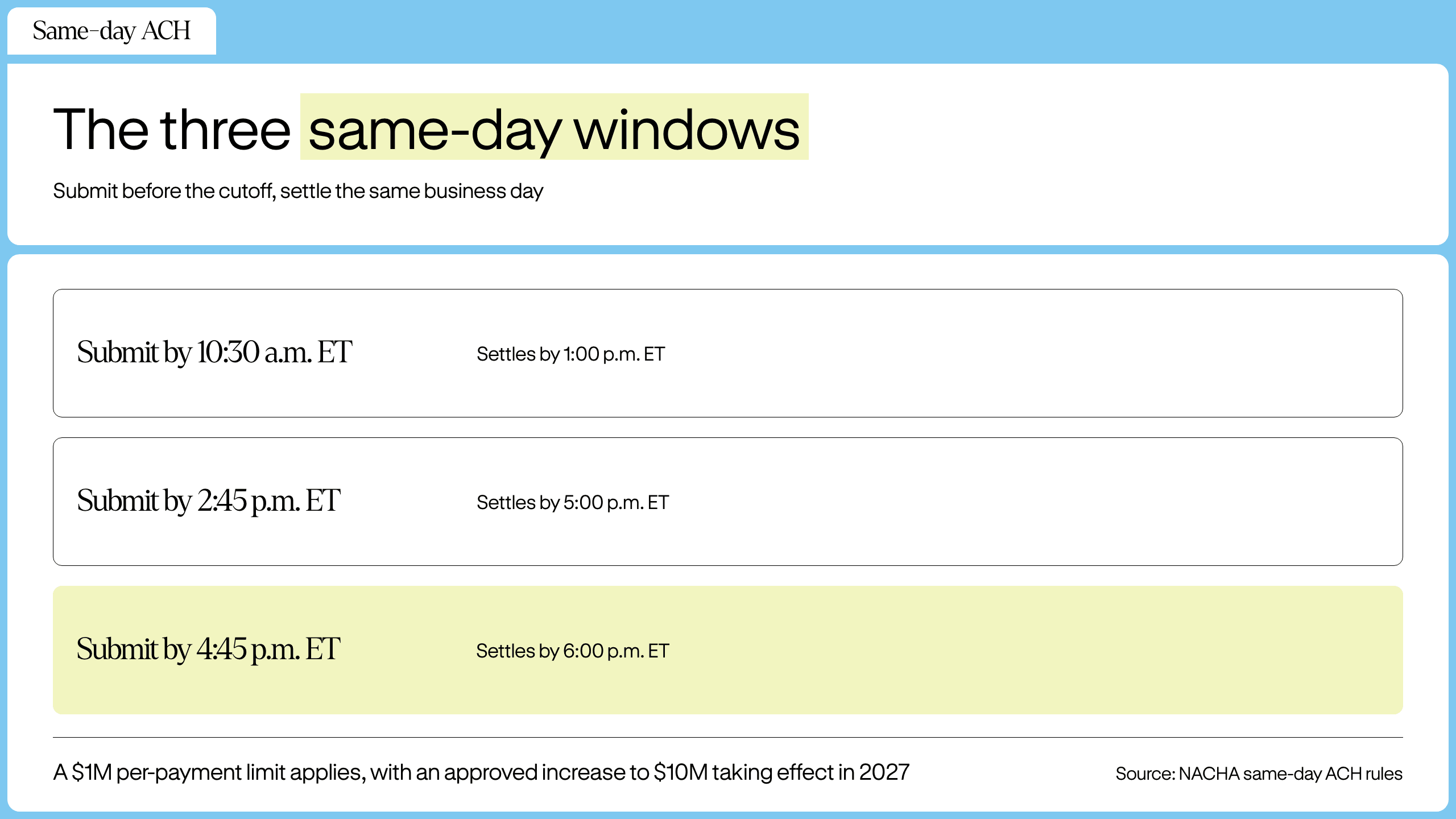
Standard ACH settles in 1 to 3 business days after submission. Cut-off times are bank-specific: most retail banks set them between 2:00 p.m. and 5:00 p.m. local time, and a transfer initiated after your bank's cut-off is treated as if it arrived the next morning. The 6:00 p.m. ET cut-off applies to same-day ACH's third processing window, not standard ACH. Same-day ACH settles by 1:00 p.m., 5:00 p.m., or 6:00 p.m. ET depending on which of the three NACHA submission windows you meet.
Wire transfers settle in near-real time during Fedwire operating hours. The Federal Reserve runs Fedwire 22 hours per day, Monday through Friday, with a customer message cut-off at 6:45 p.m. ET.
Hidden costs in ACH and wire transfers
The fee on the confirmation screen is the first cost layer, not the last. ACH typically carries a per-transaction fee between $0.20 and $1.50 at most institutions. Domestic wires run $25 to $35 for the sender and around $15 for the receiver, per Corpay.
International wires add three layers that most finance teams discover after settlement: intermediary deductions of $15 to $50 per correspondent hop, FX markup embedded in the exchange rate, and a receiving bank fee. The international payments section below breaks each layer down.
Altitude doesn't charge a fee on ACH, same-day ACH, and US domestic wire. Altitude shows the effective exchange rate and both amounts before you confirm a cross-border payment. That visibility lets you compare the offered rate against a mid-market reference before executing. Third-party sending, intermediary, and recipient banks may still charge their own fees on any rail.
Defining ACH and wire transfer limits
NACHA set the same-day ACH per-transaction limit at $1 million, and that limit remains current as of October 2026. Standard next-day ACH has no NACHA-imposed per-transaction cap, but individual banks set their own daily and monthly limits. Wire transfer limits vary by institution, and most banks impose no hard cap on wire amounts for verified business accounts, which makes wire the default rail for seven-figure payments and large settlements.
Reversibility and finality: which rail lets you fix a mistake
ACH and wire differ fundamentally on reversibility. NACHA rules permit ACH reversals within 5 banking days for specific reasons: duplicate entries, wrong receiver, wrong amount, and certain payroll credit errors, per Paycove's ACH reversal guide. The longer 60-calendar-day return window (return codes R05, R07, R10, R11) applies only to unauthorized debits on consumer accounts, according to Column. It doesn't protect a business that pushes a credit to a vendor. Corporate CCD and CTX debits disputed as unauthorized (R29) must be returned within the standard 2 banking days.
Wire transfers are final upon settlement. Once the receiving bank credits the beneficiary's account, the wire is legally complete under UCC Article 4A, a finality Spark Money's glossary contrasts directly with ACH's reversal window. Recovery after settlement requires law enforcement or a court order. If you send an ACH payment to the wrong account, you have a window to correct it. If you send a wire to the wrong account, the money is gone unless the recipient voluntarily returns it.
ACH: batch settlement for routine domestic payments
ACH handles the high-volume, routine domestic payments that make up most of your weekly output: vendor invoices, contractor payments, and recurring obligations. You choose ACH when per-transaction cost matters more than wire-level speed and finality, which is most domestic payments. Same-day ACH covers the cases where a payment needs to settle within the business day.
How ACH transfers work
The ACH network processes your payments in batches at fixed windows throughout the business day. Your payment waits for the next batch window, then waits again for settlement. That batch model keeps per-transaction costs under $2 at most institutions and $0 with Altitude.
Understanding ACH settlement cycles
Standard ACH settles within 1 to 3 business days. A payment submitted Thursday afternoon may not settle until Monday. Reconciliation teams need to account for this lag when matching payments to invoices, especially during month-end close.
Understanding same-day ACH timing
Same-day ACH operates through three daily submission windows: 10:30 a.m., 2:45 p.m., and 4:45 p.m. ET, with settlement at 1:00 p.m., 5:00 p.m., and 6:00 p.m. ET. The $1 million per-transaction limit applies to all same-day entries. Same-day ACH fees typically run $0.70 to $2.50 per transaction at most banks (the standard $0.20 to $1.50 fee plus a $0.50 to $1.00 premium). Altitude doesn't charge a fee on either standard ACH or same-day ACH. For a finance team running 200 ACH payments per month, the difference between a $1 per-transaction bank fee and Altitude's $0 position is $200 per month, or $2,400 per year.
Wire transfers: near-real-time settlement and finality
You choose wire when the payment is time-critical, when the amount exceeds ACH limits, or when the corridor has no local rail and finality matters more than cost.
Step-by-step wire payment process
A domestic wire moves through Fedwire in near-real time and typically settles same business day. An international wire adds a SWIFT messaging layer and routes through one or more correspondent banks before reaching the recipient. Each correspondent can deduct a fee from the principal, which is where the short payment problem originates.
Domestic vs international wire requirements
Domestic wires require the recipient's routing number, account number, and beneficiary name. International wires require a SWIFT BIC code, IBAN (for destinations that use IBAN), beneficiary address, and sometimes an intermediary bank's details. International wires also carry a currency decision: if the destination account holds a different currency, the recipient's bank sets the conversion rate and fees, and that markup can exceed the wire fee itself.
Understanding wire transfer cut-off times
Fedwire accepts customer messages until 6:45 p.m. ET. If you submit after the cut-off, the wire processes the next business day. For international wires, the effective cut-off is earlier because correspondent banks in the chain operate on their own schedules. A wire submitted late in the US business day to a European beneficiary may not begin correspondent processing until the next European business day, which can add a day or more to the settlement window.
When ACH is the right rail for domestic payments
ACH earns its cost advantage on routine, recurring, and high-volume domestic payments. If the payment isn't time-critical and the recipient is a known, verified counterparty, ACH is almost always the right default.
Recurring vendor payments and retainers
Recurring vendor payments, monthly retainers, and scheduled disbursements fit ACH's batch model. The per-transaction cost of $0.20 to $1.50 (or $0 with Altitude) makes ACH the only economically viable rail for businesses running dozens or hundreds of domestic payments per month. Finance teams using Altitude's domestic payment workflow can send ACH and wire from the same interface, removing the need to log into separate portals for different rails.
ACH for domestic payroll and contractors
Contractor payments work well on ACH because they follow predictable schedules and known recipients. Adding a clear payment reference helps contractors reconcile the deposit on their end.
ACH settlement windows for operations
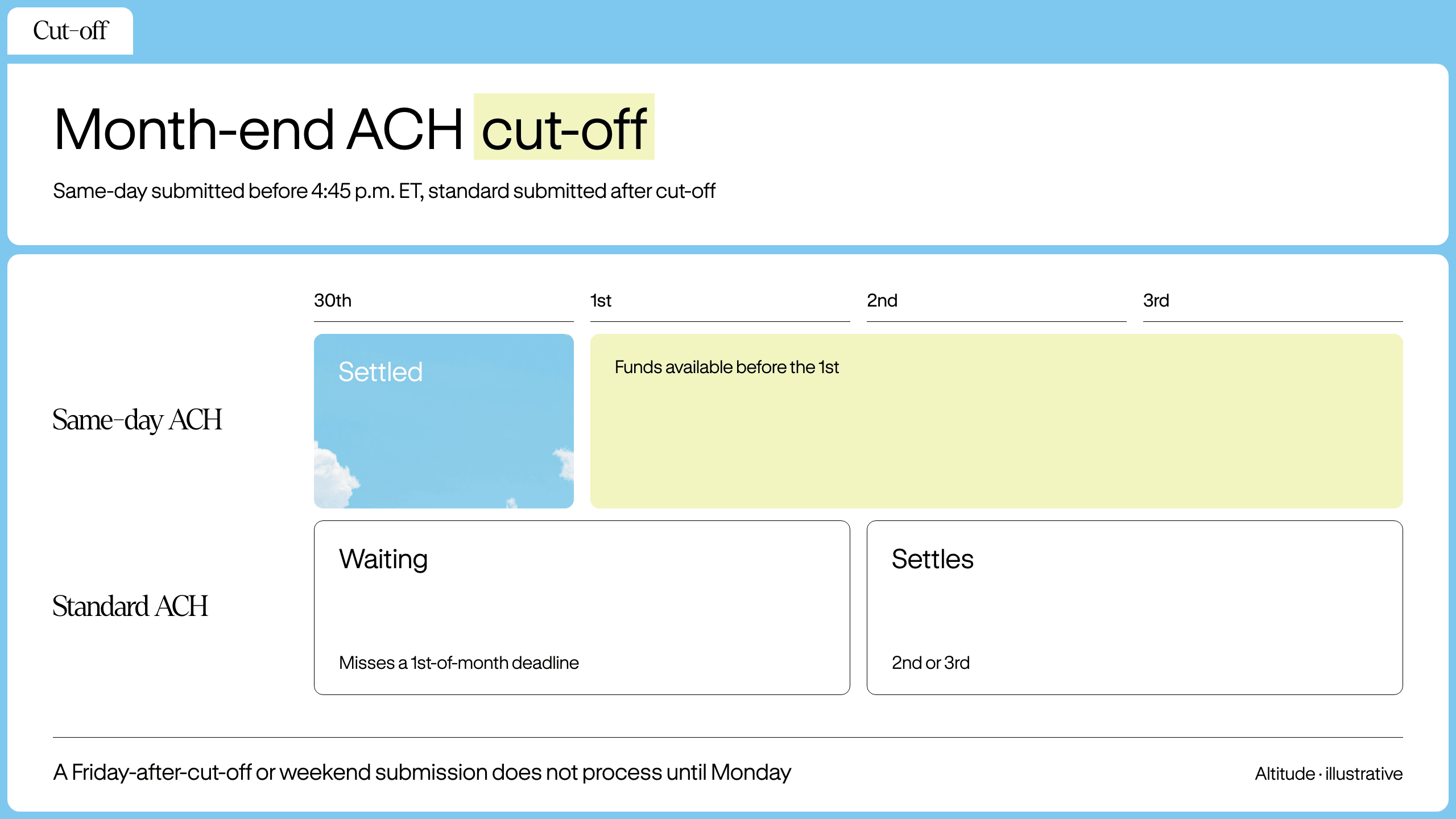
Map your ACH submissions against NACHA's processing calendar. If you submit a payment on Friday afternoon after the cut-off or on a weekend, the network doesn't process it until Monday. If a vendor expects payment by the 1st and you submit ACH on the 30th after cut-off, the payment arrives on the 2nd or 3rd. Same-day ACH closes this gap for a $0.50 to $1.00 premium at most banks, or no Altitude fee. For month-end close, that means a payment submitted on the 30th can still settle on the 30th if you meet the 4:45 p.m. ET window.
When to select wires over ACH for payments
Wire transfers earn their higher cost in three scenarios: when the payment is time-critical, when the amount exceeds ACH limits or risk tolerance, and when the payment is international and no local rail covers the corridor.
Wire transfers for time-critical payments
A supplier threatening to halt shipments or a settlement that must close by end of business: these are wire scenarios. Wire settles within the same business day with finality, which means the recipient can act on the funds immediately. Altitude doesn't charge a fee on US domestic wire, which removes the cost objection for urgent domestic payments.
Same-day ACH settlement criteria
Use same-day ACH when the recipient accepts ACH and the amount is under $1 million. Use wire when the recipient requires finality, the amount exceeds $1 million, or the payment is international.
Executing payments across international borders
Standard ACH doesn't reach international corridors. International ACH (IAT) exists, but not every US bank originates IAT transactions, and coverage varies by institution. That leaves wire and local rails as your international options.
International wire transfer cost breakdown
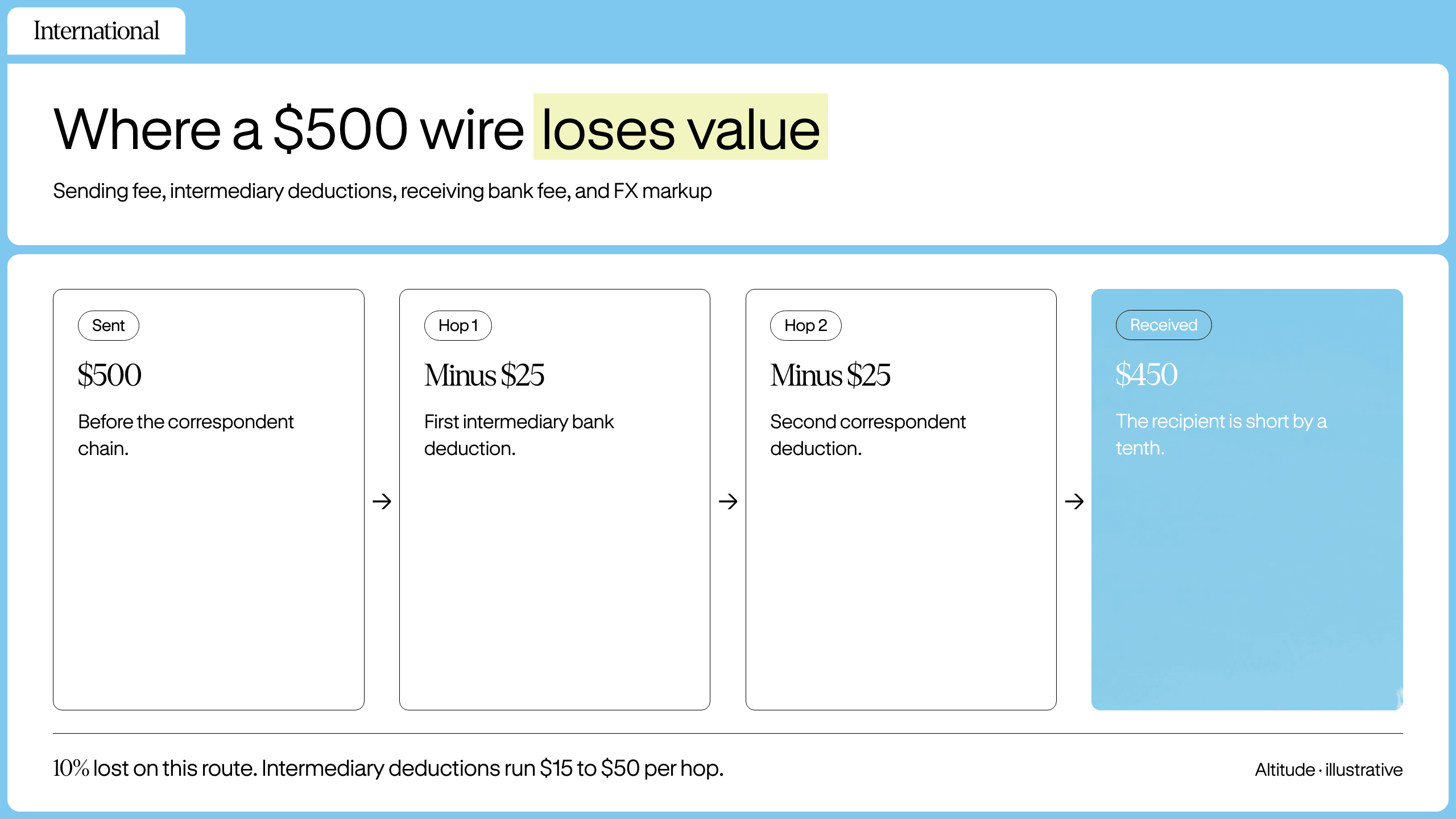
International wires stack fees in layers. The sending fee is visible and quoted up front: typically $25 to $50. Intermediary deductions of $15 to $50 per correspondent bank are taken from the principal in transit, according to Corpay. The receiving bank may charge an inbound fee, and if currency conversion applies, the FX markup is embedded in the exchange rate with no line-item disclosure.
A $500 transfer routed through two intermediary banks charging $25 each leaves the recipient with $450, a 10% reduction, as Skydo illustrates. At $5,000, a $30 to $50 deduction is typical for multi-hop corridors.
Evaluating expense differences for ACH and wire
The fee comparison looks simple on the surface: ACH costs under $2.50, wire costs $25 to $50. The real expense difference shows up in the layers below the stated fee, particularly for international payments. A finance manager is evaluated on whether hidden costs surface in a CFO review, which means identifying FX markup and intermediary deductions before settlement, not after.
ACH fee breakdown for finance teams
| Cost component | Standard ACH | Same-day ACH |
|---|---|---|
| Per-transaction fee (typical bank) | $0.20 to $1.50 | $0.70 to $2.50 |
| Per-transaction fee (Altitude) | $0 | $0 |
| Monthly platform fee (Altitude) | $0 | $0 |
| Minimum per transfer | $5 | $5 |
| Third-party fees | Receiving bank may charge | Receiving bank may charge |
For a finance team running 200 ACH payments per month, the difference between a $1 per-transaction bank fee and Altitude's $0 position is $200 per month, or $2,400 per year, on ACH fees alone.
Factors influencing wire transfer fees
Domestic wire fees range from $25 to $35 for the sender at most US banks. International wire transfer fees run $25 to $50 at the sending end, plus intermediary deductions and receiving fees the sender may not see. Altitude doesn't charge a fee on US domestic wire.
Identifying hidden FX markup costs
A 3% currency markup on a $100,000 payment adds $3,000, which exceeds any visible wire fee by an order of magnitude, per Corpay.
A SWIFT payment leaks in four places: the outgoing fee, the FX spread, correspondent deductions in transit, and the receiving bank's inbound fee, as Corpay's fee breakdown illustrates. Only the outgoing fee is quoted before you confirm. To identify FX markup, compare the rate your bank applied against a real-time mid-market reference. The difference, expressed as a percentage of the transfer amount, is your FX cost.
Altitude shows the effective exchange rate and both amounts before you confirm a cross-border payment, and the quote refreshes every 30 seconds. That visibility lets you compare the offered rate against a mid-market reference before executing.
Payment workflow comparison: separate bank portals vs one Altitude account
The table below shows reduced manual intervention, not full automation. Exception handling and unmatched items remain part of any payment workflow.
| Step | Multi-portal workflow | Altitude single account |
|---|---|---|
| System logins per payment run | 3 to 4 (ACH portal, wire portal, FX platform, accounting) | 1 |
| Manual data re-entry per payment | 2 to 3 (beneficiary details re-entered per portal) | 0 (saved recipient address book) |
| FX rate visibility | After settlement (on statement) | Before confirmation (30-second quote) |
| Approval steps | Email or chat-based, no audit trail | Role-based permissions with audit trail |
| Reconciliation format | CSV exports per portal, manual matching | One-way sync to QuickBooks Online and Xero with user confirmation |
Altitude's accounting sync is one-way, from Altitude to QuickBooks Online and Xero, and requires your confirmation before every posting applies.
If your team runs ACH, wire, and international payments from separate bank portals and reconciles in a spreadsheet, book a demo to see how Altitude handles all three rails from one account with dedicated US routing numbers and SEPA IBANs.
FAQs
Is ACH or wire transfer faster?
Wire transfers settle same-day through Fedwire's real-time gross settlement system, while standard ACH takes 1 to 3 business days through batch processing. Same-day ACH narrows the gap to same-business-day settlement if submitted before the 4:45 p.m. ET window.
Can ACH transfers be reversed?
Yes, within limits. NACHA rules permit reversals within 5 banking days for duplicate entries, wrong receiver, wrong amount, and certain payroll errors, per Paycove. The 60-calendar-day return window for unauthorized debits (R05, R07, R10, R11) applies only to consumer accounts, per Column. Corporate CCD and CTX debits disputed as unauthorized (R29) must be returned within 2 banking days, and the window covers unauthorized debits, not credits you push to a vendor.
What are typical wire transfer fees?
Domestic wire fees range from $25 to $35 for the sender and around $15 for the receiver, per Corpay. International wires run $25 to $50 at the sending end, plus intermediary deductions of $15 to $50 per correspondent bank and potential FX markup, per Corpay.
Can I send international payments via ACH?
International ACH (IAT) exists but isn't widely supported. IAT origination varies by bank, and the corridors where it works (primarily US to Canada, Mexico, and UK) are limited. For most international corridors, wire or local rails are the practical options.
Which method is more secure for large payments?
Both ACH and wire are secure in transit. The difference is reversibility: an ACH credit you push to a vendor can be reversed only within 5 banking days for specific errors, and the 60-day unauthorized-return window applies only to consumer accounts. Corporate CCD and CTX debits disputed as unauthorized (R29) must be returned within 2 banking days. Wire is final upon settlement. For large payments, wire's finality is the security feature, because the recipient can act on the funds immediately without reversal risk, as Spark Money's glossary explains.
Key terms glossary
ACH (Automated Clearing House): A US electronic payment network that processes credit and debit transactions in batches at fixed intervals. Settlement takes 1 to 3 business days for standard ACH and same-business-day for same-day ACH.
Correspondent banking: An arrangement where one bank holds deposits on behalf of another bank to facilitate cross-border payments. In international wires, correspondent banks deduct fees from the payment principal as it passes through each hop.
Fedwire: The Federal Reserve's real-time gross settlement system for US dollar payments. Each wire transfer settles individually and immediately, with no batching or netting, and is final upon credit to the beneficiary's account.
FX markup: The difference between the exchange rate a bank applies to a currency conversion and the mid-market rate. This cost is embedded in the rate and doesn't appear as a separate line item.
NACHA: The National Automated Clearing House Association, which governs the ACH network in the US. NACHA sets the operating rules, return codes, reversal windows, and same-day ACH submission schedules that all participating financial institutions follow.
Real-time gross settlement (RTGS): A settlement model where each payment processes individually and immediately, without batching or netting against other transactions. Fedwire uses RTGS, which is why wire transfers settle same-day and are final upon completion.
SWIFT: The Society for Worldwide Interbank Financial Telecommunication, a messaging network that carries payment instructions between banks. SWIFT itself doesn't move money, the actual funds travel through correspondent banking relationships.
UCC Article 4A: The section of the Uniform Commercial Code that governs funds transfers in the US. Under Article 4A, a wire transfer is legally final once the receiving bank credits the beneficiary's account.
Altitude is a financial technology platform, not a bank or digital asset custodian.