





 Startups
 Creative agencies
 Onchain teams
 European businesses
 AI
 Software
TL;DR: The best business bank account for startups operating internationally depends on your entity structure and payment corridors. Mercury and Brex require US incorporation or US operations. Altitude and Airwallex open accounts for non-US entities, with product availability varying by country. Altitude offers USD and EUR accounts, cross-border payments by local payment rail, international transfer, or stablecoin, and no US entity required but doesn't provide FDIC insurance on balances, a credit line, physical cards, or a native mobile app.
Where a startup is incorporated can determine which business accounts it qualifies for. Mercury, for example, requires a US-registered company, although founders can live elsewhere. Brex requires US incorporation, an EIN, US operations, and a physical US address. Other providers accept businesses registered in a wider range of countries, but not every product is available in every market.
For founders comparing Mercury, Brex, Airwallex, and Altitude, the next questions are practical: can the business open an account, can it send and receive money in the countries it needs, what will each transfer cost, and how long will the money take to arrive?
What makes a business bank account good for international startups?
A startup bank account for international operations needs to do three things well: accept the entity you already have, move money across the corridors you actually use, and show you the real cost before money moves. The criteria below separate accounts that work for borderless teams from accounts that work for US-only businesses.
Managing multiple currency balances
Multi-currency balances reduce conversion frequency, but they don't eliminate FX costs because you still pay a margin or spread when you convert, and you still face timing risk if the rate moves between invoice and payment.
Altitude holds USD and EUR balances as USDC and EURC, and you get dedicated US routing numbers and SEPA IBANs. You can convert between USDC and EURC with no Altitude fee added, though the executed rate depends on market conditions at the moment of conversion and Altitude doesn't guarantee zero spread or slippage. View the supported countries guide for more on what works where, including account details, SWIFT, cards, and rewards.
Cross-border payment capabilities and transfer limits
The payment rails that matter for international startups are ACH, SEPA, SWIFT, Faster Payments, SPEI, Pix, Bre-B, and stablecoin transfers. Settlement timing depends on the rail.
- ACH takes up to three business days, while SEPA settles in one business day.
- SWIFT takes up to five business days, making it the slowest of the supported rails.
- Stablecoin transfers settle in minutes because the network doesn't observe banking cut-off times.
Altitude supports all of these rails from one account, with fees shown before you confirm the payment.
Local payout routes (Faster Payments, SPEI, Pix, Bre-B) are enabled per workspace. Request access from support and payments route to your Inbox for approval. Check the help center for current figures.
Avoiding account rejection for startups
Eligibility is the first filter, and it determines whether you can open an account at all. A provider can have the best feature set in the world, but if it won't open an account for your entity, none of those features matter.
- Mercury requires a US or US-territory registered company with existing or planned US operations.
- Brex documents US incorporation, an EIN, US operations, and a physical US address.
- Altitude opens accounts for eligible businesses from 200+ countries with no US entity required, though product availability varies by country.
- Airwallex serves non-US entities in supported regions.
For Altitude, business-incorporation eligibility, USD account eligibility, EUR account eligibility, payment-destination access, card-issuance eligibility, card merchant-spending access, and rewards eligibility are seven separate scopes, and qualifying for one doesn't guarantee access to another.
Comparing real FX and processing costs
Headline fees are one part of the all-in cost. Intermediary banks can deduct charges on SWIFT transfers even when the sender covers known fees under the OUR convention. FX margins vary by corridor and provider.
Altitude's per-rail fees are published in full in the Transparent fee breakdown section below. Sending, intermediary, and recipient banks may still charge on bank rails.
Evaluating account limits for global founders
The table below compares entity requirements, regional coverage, and cross-border rail support.
| Provider | Entity requirement | Supported regions | Cross-border rails |
|---|---|---|---|
| Mercury | US or US-territory company, existing or planned US operations | US-focused, international founders need US entity | US domestic and international wires in USD or 40+ local currencies |
| Brex | US incorporation, EIN, US operations, physical US address | US-only for primary account | US domestic and international wires to 100+ countries |
| Airwallex | Regional, varies by entity type and market | SWIFT transfers to 200+ countries, local transfers to 120+ countries | Local rails, SWIFT, multi-currency accounts |
| Altitude | Eligible businesses from 200+ countries, no US entity required | 200+ countries, product availability varies | ACH, wire, SEPA, SWIFT, Faster Payments, SPEI, Pix, Bre-B, stablecoin |
Check the supported countries list before you apply to confirm what's available in your country.
Mercury vs Altitude for foreign entities
Mercury is a strong choice for US-incorporated startups with US operations, offering a polished product with a free base plan (Mercury Plus starts at $29.90/month and Mercury Pro starts $299/month on annual billing) and strong US banking integrations. Altitude accepts non-US entities from 200+ countries with no US entity required, charges $0 to open with no monthly platform fee, and offers cross-border settlement on stablecoin transfers that Mercury doesn't provide.
Ideal startup profiles for Mercury
Mercury serves US or US-territory registered companies with existing or planned US operations and offers strong US domestic features including ACH, domestic wire, check deposits, and integrations with US accounting and payroll tools. Foreign founders can qualify by forming a US entity and obtaining an EIN. Altitude accepts non-US entities from 200+ countries, supports the same ACH and wire rails Mercury offers, and adds SEPA and stablecoin transfers from one account.
Requirements for international founders
Mercury accepts applications from founders living outside the US, but the business must be registered in the US or a US territory and have existing or planned US operations.
Applicants need an EIN, company formation documents, and a verifiable principal business address, which can be in the US or another country. P.O. boxes, registered-agent addresses, and virtual addresses aren't accepted as the principal business address. Mercury also restricts applications from founders living in certain countries. Check Mercury's eligibility requirements and prohibited countries list before applying.
What you pay for transfers
Mercury's pricing page lists $0 for USD international wires, a 1% currency exchange fee on non-USD international wires, an optional $15 flat fee for the OUR option, and a 3% fee on non-USD card transactions (as checked October 2026).
Brex vs Altitude for foreign entities
Brex is a strong choice for US-incorporated startups with US operations, offering a polished product with corporate cards, expense management, and strong US integrations. Altitude accepts non-US entities from 200+ countries with no US entity required, charges $0 to open with no monthly platform fee, and offers cross-border settlement on stablecoin transfers that Brex doesn't provide.
Ideal startup profiles for Brex
Brex serves US-incorporated companies with an EIN, US operations, and a physical US address. It offers strong US domestic features including ACH, domestic wire, corporate cards, and integrations with US accounting and expense tools. Foreign founders can qualify by forming a US entity and meeting Brex's address and operations requirements. Altitude accepts non-US entities from 200+ countries, supports ACH and wire rails, and adds SEPA and stablecoin transfers from one account.
Requirements for international founders
Brex requires US incorporation, an EIN, documented US operations, and a physical US address. P.O. boxes and virtual addresses aren't accepted. Founders living outside the US can qualify if the business meets all four requirements.
Eligibility requirements for global founders
Eligibility determines whether you can open the account at all. The checklist below covers the documents and criteria that decide whether a provider will approve your application.
Checklist for account eligibility
- Entity incorporation country: Confirm the provider accepts businesses incorporated in your country. Mercury and Brex require US incorporation. Altitude accepts eligible businesses from 200+ countries. Airwallex supports businesses registered in approximately 69 eligible countries and territories.
- Operating address: A physical business address is required. Virtual office addresses aren't accepted.
- UBO disclosure: Altitude requires disclosure of anyone owning or controlling 25% or more of the business. Mercury and Brex have similar requirements.
- Business category: Altitude prohibits certain categories and requires enhanced review for others. Review prohibited categories before applying.
Country exceptions and product availability
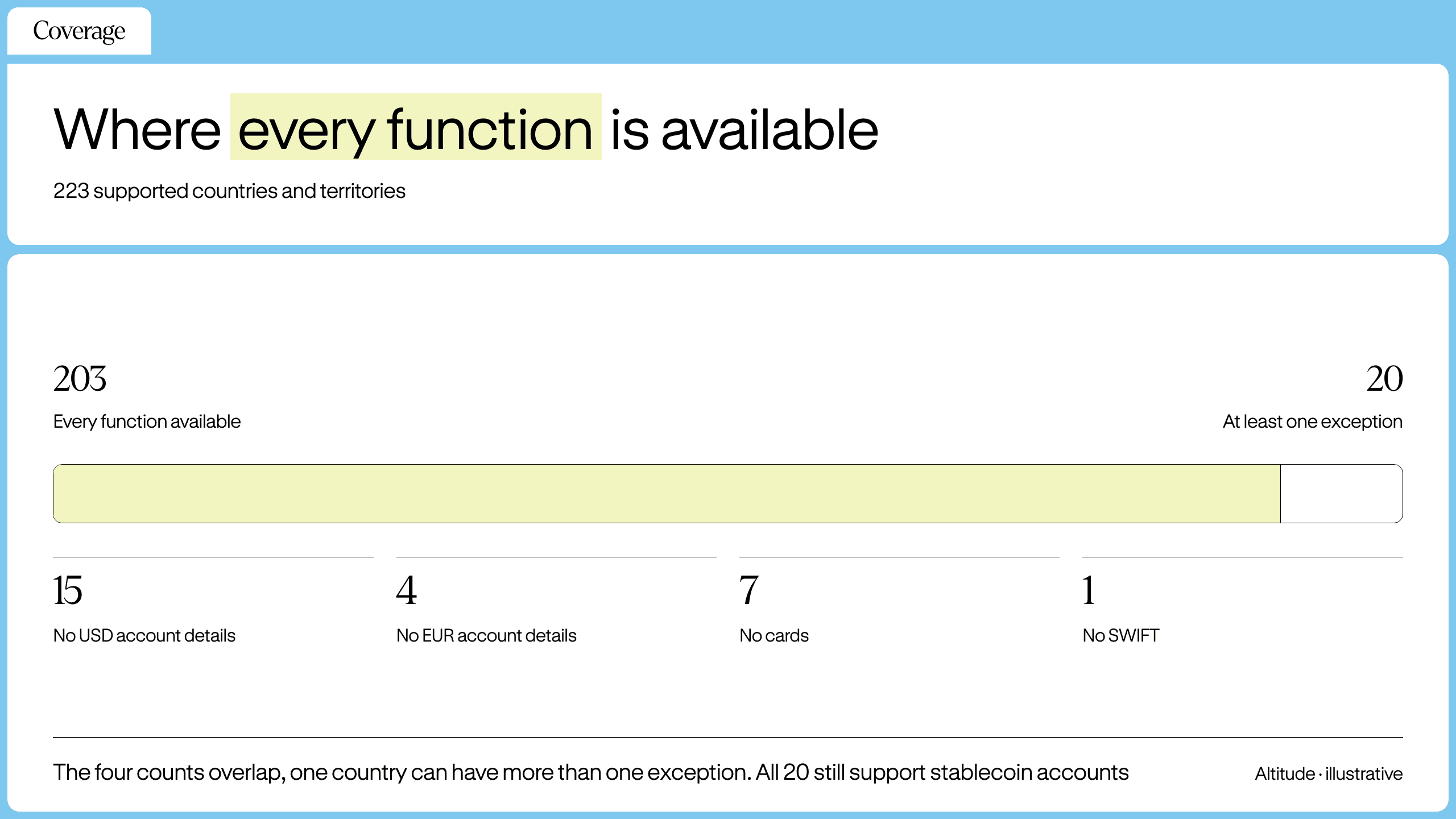
Altitude opens accounts for eligible businesses from 200+ countries, with product availability varying by country. Of the 223 countries and territories on Altitude's public list, 203 have every function and 20 have at least one exception: no USD account details (15 countries), no EUR account details (4 countries), no SWIFT (1 country), or no cards (7 countries). All 20 support stablecoin accounts. Bank rail minimums and batch transfer minimums are documented in the help center. Stablecoin minimums are also documented in the help center.
Global startup account requirements
Altitude onboards businesses only. Individuals aren't onboarded. UBO disclosure is required for anyone owning or controlling 25% or more. Business verification runs in two stages: an initial submission and a follow-up review. Altitude completes most reviews within two business days, as described in the help center. If follow-up documents are needed, Altitude requests them by email.
How Altitude handles cross-border payments
Startups operating across borders typically manage multiple platforms: one for ACH, another for SWIFT, a third for local routes like Pix or SPEI, and sometimes a separate tool for stablecoin transfers. Each adds a login, a fee structure, and a settlement window to track. Altitude consolidates those rails into one account, with USD and EUR balances held in USDC and EURC, and fees shown before you confirm any payment.
The rails Altitude supports cover the corridors that matter most for globally distributed teams: ACH and same-day ACH for US domestic flows, SEPA for euro-denominated transfers, SWIFT for international bank-to-bank transfers, Faster Payments for GBP, SPEI for MXN, Pix for BRL, Bre-B for COP, and stablecoin transfers for any counterparty that accepts USDC or EURC. Each rail carries a different settlement window and fee, documented in the Transparent fee breakdown section below.
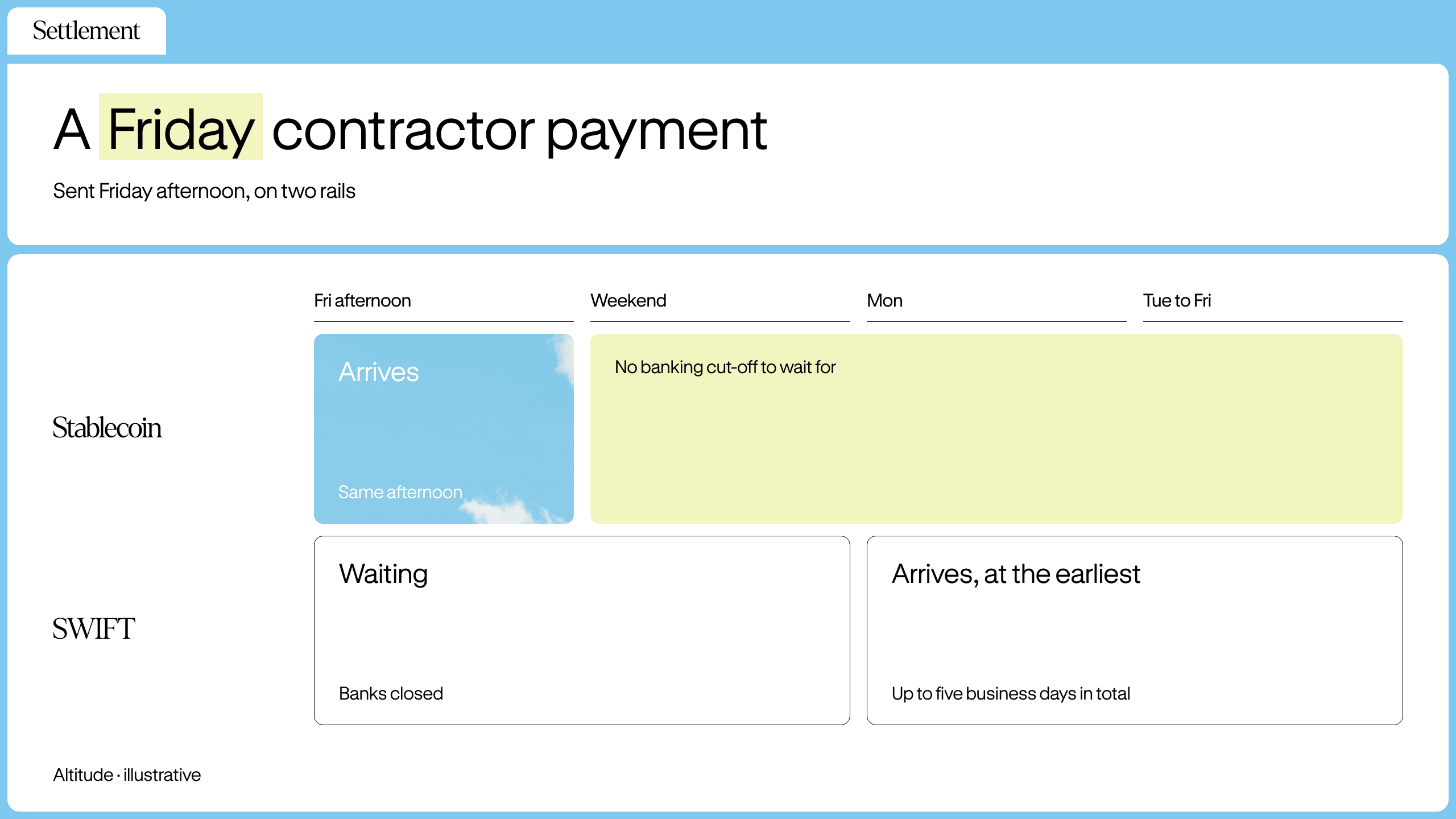
Settlement timing depends on the rail, not on Altitude's processing schedule. ACH takes up to three business days. SEPA settles in one business day. SWIFT takes up to five. Stablecoin transfers settle in minutes because the network doesn't observe banking cut-off times. A payment that needs to reach a contractor on a Friday afternoon can move on a stablecoin rail the same day. The same payment on SWIFT would wait until Monday at the earliest.
Altitude is built for businesses that operate across borders from day one. USD and EUR balances are held in USDC and EURC, and you can pay by local payment system, international transfer, or stablecoin from one account. The sections below cover who uses Altitude successfully, what corridors it supports, and what it costs.
Countries Altitude pays to
Altitude supports payments to 200+ countries, with product availability varying by country. Local payout routes include Faster Payments (GBP), SPEI (MXN), Pix (BRL), and Bre-B or local bank transfer (COP). These routes don't create local-currency balances and work through individual payment creation only, not through bill pay, batch payments, or invoices, and funding is USDC from a USD account. Each linked guide covers the route-specific requirements.
Altitude's eligibility criteria
Altitude accepts eligible businesses from 200+ countries with no US entity required. Every business goes through a verification review. Most complete within two business days. UBO disclosure is required for anyone owning or controlling 25% or more. P.O. boxes and virtual office addresses aren't accepted as operating addresses. Card issuance and merchant spending have separate geographic restrictions documented in the supported countries list.
Breakdown of costs and FX fees
Altitude adds no fee to USDC to EURC conversion through Jupiter, though the executed rate and any Jupiter slippage apply, so the final amount depends on market conditions at execution. For cross-border payments, you fix either "You send" or "Recipient receives," and Altitude shows the effective rate and both amounts, refreshing the quote every 30 seconds. The payment records the agreed source amount, recipient amount, and rate, and executes as a fixed-output transfer. A meaningful share of Altitude's payment volume moves on weekends, because stablecoin transfers don't observe banking cut-off times.
Altitude eligibility for non-US incorporated firms
Altitude is designed for businesses that need USD or EUR accounts without a US or EU entity. The sections below cover fit, supported corridors, qualification requirements, and the full breakdown of fees.
Is Altitude right for your business?
Altitude is right for businesses that need USD or EUR accounts without a US or EU entity, pay contractors across many countries, or get paid from the US and Europe. Altitude isn't right for businesses that need FDIC insurance on operating balances (Altitude's balances are held in fully reserved stablecoins, not as bank deposits), a credit line, physical cards, or a native mobile app (none are available).
Payment rails and route minimums
Altitude supports ACH, US domestic wire, SEPA, SWIFT, Faster Payments (GBP), SPEI (MXN), Pix (BRL), Bre-B or local bank transfer (COP), and stablecoin transfers. Check the help center for current rail minimums. Local payout routes (Faster Payments, SPEI, Pix, Bre-B) don't create local-currency balances and work through individual payment creation only.
Qualifying for an Altitude account
Business verification runs in two stages: an initial submission and a follow-up. Most reviews complete within two business days. If follow-up documents are needed, Altitude requests them by email. UBO disclosure is required for anyone owning or controlling 25% or more. P.O. boxes and virtual office addresses aren't accepted as operating addresses. Altitude onboards businesses only and individuals aren't onboarded.
Transparent fee breakdown
The table below shows Altitude's platform fees per rail. Sending, intermediary, and recipient banks may still charge on bank rails.
| Rail | Altitude charges | Notes |
|---|---|---|
| ACH | $0 | Check help center for minimums and timing |
| Same-day ACH | $0 | Check help center for availability and timing |
| US domestic wire | $0 | Check help center for timing and minimums |
| EURC-funded SEPA | $0 | Check help center for processing times and minimum |
| Outbound SWIFT | $35 | OUR convention applies. Intermediary banks may still deduct charges, so full-value receipt isn't guaranteed |
| Supported stablecoin transfers | $0 | Settles in minutes. Doesn't observe banking cut-off times |
| Non-USD card purchases | 1% FX fee | Applies to purchases made in a currency other than USD |
Non-USD card purchases carry a 1% FX fee. SWIFT conditions: the sender covers known fees under the OUR convention, but some intermediary banks can still deduct charges, so full-value receipt isn't guaranteed.
Airwallex: Global payments for non-US entities
Airwallex serves non-US entities with multi-currency accounts and cross-border payments. It has broad global coverage and publishes FX margins on its pricing page. If you need a multi-currency account with local rails in Asia-Pacific or Europe, Airwallex is worth evaluating alongside Altitude.
Founder fit and requirements
Airwallex serves businesses registered in approximately 69 eligible countries and territories. According to Airwallex's pricing page, SWIFT transfers are available to 200+ countries and local transfers to 120+ countries. Eligibility, product access, and compliance requirements vary by your company's country of incorporation, so confirm your jurisdiction is supported before applying.
Airwallex global coverage and constraints
Airwallex offers multi-currency accounts, local payment rails in supported markets, and cross-border payments via SWIFT and local networks. Constraints for borderless founders evaluating stablecoin workflows: Airwallex supports stablecoin receiving via API with enablement requirements, but there's no equivalent native stablecoin operating account where balances are held as USDC or EURC and controlled by your business. Altitude holds USD and EUR balances as USDC and EURC in an account your business controls, with approval rules your team sets applied automatically.
Operational eligibility criteria
Airwallex eligibility varies by region and entity type. Confirm current requirements on Airwallex's official eligibility page before applying, because regional availability and product access change.
Breakdown of account and FX fees
Airwallex publishes FX margins and account fees on its pricing page, but specific figures vary by corridor and account type. Altitude's fees are published in full in the Transparent fee breakdown section. If you need corridor-specific pricing before money moves, request a quote from Airwallex or test with a small transfer.
How to choose the right account for your startup
The best bank for startups operating internationally is the one that accepts your entity, supports your corridors, and shows you the all-in cost before money moves. The steps below walk through each stage of the evaluation process.
Identify your primary payment corridors
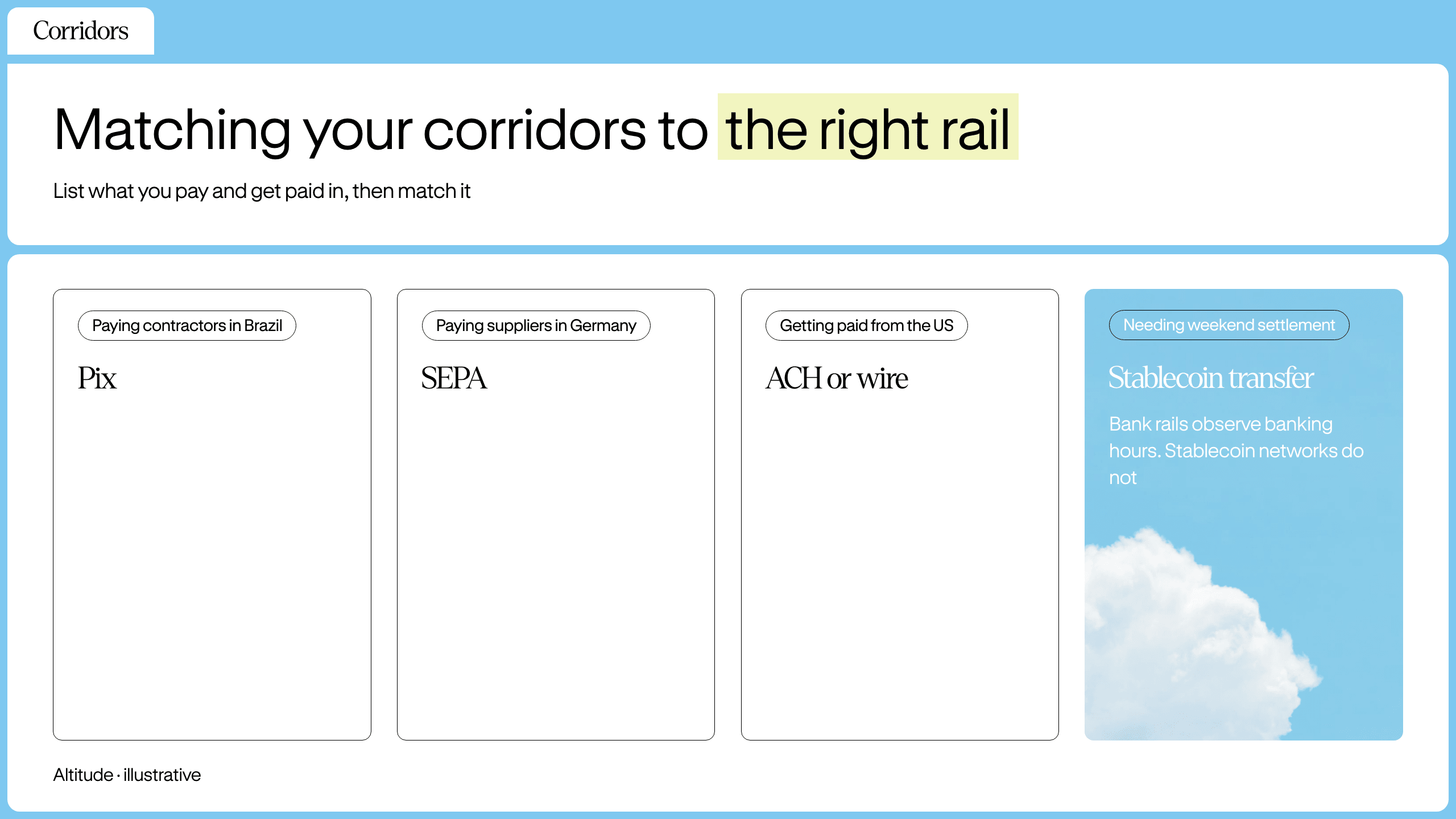
List the corridors you pay and get paid in. Match them to provider-supported rails. If you pay contractors in Brazil, you need Pix. If you pay suppliers in Germany, you need SEPA. If you get paid from the US, you need ACH or wire. If you need weekend settlement, you need stablecoin transfers, because bank rails observe banking hours and stablecoin networks don't.
How to calculate all-in payment fees
All-in cost equals provider fee plus FX margin plus intermediary bank charges plus recipient bank fees. Altitude's per-rail fees are listed in the Transparent fee breakdown section. Note that intermediary banks can still deduct charges on SWIFT even under the OUR convention. Mercury's pricing page lists $0 for USD international wires, a 1% currency exchange fee on non-USD international wires, an optional $15 flat fee for the OUR option, and a 3% fee on non-USD card transactions (as checked October 2026). Airwallex publishes FX margins that vary by corridor, so request corridor-specific quotes or test with small transfers before committing.
Verify eligibility before applying
Check entity requirements, operating address requirements, and business category restrictions before applying. Altitude's public supported-countries list shows what works where: account details, SWIFT, cards, and rewards. Mercury requires a US or US-territory company. Brex requires US incorporation, an EIN, US operations, and a physical US address. Airwallex eligibility varies by region and entity type.
Validate connectivity with a small transfer
Open the account alongside your incumbent, not as an immediate replacement. Prove it on live flows in parallel, then migrate workflows. Position Altitude as the account that handles what your incumbent can't: cross-border settlement, weekend payments on stablecoin transfers, and USD or EUR accounts without a US entity. Keep your existing infrastructure in place until you've established confidence with the new provider.
See how Altitude handles contractor and supplier payments across borders. Book a demo.
FAQs
Can I open a USD business account without a US entity?
Yes, with Altitude or Airwallex. Altitude accepts eligible businesses from 200+ countries with no US entity required, though product availability varies by country. Mercury and Brex require US incorporation or US operations.
What's the difference between a business bank account and a fintech platform?
A bank account holds deposits at a chartered bank and may carry FDIC insurance, while a fintech platform like Altitude holds balances in fully reserved stablecoins, backed one to one by the issuer's reserves, controlled by your business and not lent out.
How long does it take to open a business bank account for startups?
Altitude completes most business verification reviews within two business days and requests any follow-up documents by email.
Do I need separate accounts for each currency?
Not with Altitude. USD and EUR balances are held in USDC and EURC in one account, with dedicated US routing numbers and SEPA IBANs. Local payout routes like Pix and SPEI don't create local-currency balances.
What happens if my business account gets closed?
With Altitude, balances are held in fully reserved stablecoins, controlled by the business and not lent out by Altitude. Stablecoin issuers can freeze addresses under legal orders, and regulated partners can suspend services independently.
Key terms glossary
SEPA: Single Euro Payments Area, a Euro transfer network covering EU and EEA countries. Check the help centre for current processing times on Altitude's SEPA transfers.
SPEI: Mexico's local payment rail for MXN transfers, which requires an 18-digit CLABE with valid check digits.
Pix: Brazil's local payment rail for BRL transfers. Requires a registered Pix key: email, phone number, random EVP key, or CPF/CNPJ.
Bre-B: Colombia's local payment rail for COP transfers, which requires a registered Bre-B key. A bank account number alone isn't sufficient.
Stablecoin transfer: A payment using a fully reserved digital dollar (USDC) or digital euro (EURC) on a blockchain network. Settles in minutes and doesn't observe banking cut-off times.
USDC: USD Coin, a fully reserved stablecoin issued by Circle, backed one to one by US dollar reserves.
EURC: Euro Coin, a fully reserved stablecoin issued by Circle, backed one to one by euro reserves.
UBO: Ultimate Beneficial Owner, meaning anyone owning or controlling 25% or more of a business, whose disclosure is required for account opening.
Altitude is a financial technology platform, not a bank or digital asset custodian.