
TL;DR: The FX markup hidden in the exchange rate is typically the largest cost lever in cross-border payments, and the rail you choose determines how much of the remaining stack you can avoid. Cross-border fees stack in three layers: the FX spread, fixed transfer fees, and intermediary or receiving-bank deductions. Audit your current costs by comparing your effective rate against the mid-market rate and documenting the corridor-specific fee layers.
The cost of a cross-border payment depends on the rail you choose, and the difference rarely appears as a line item on the invoice. Cross-border payment costs stack in layers: the FX spread, the fixed transfer fee, and intermediary or receiving-bank deductions. Each layer varies by corridor, rail, and timing, which means the same payment can cost very different amounts depending on how you route it.
The worked examples below use Mexico, the UK, and Brazil, and the same framework applies across Asia-Pacific and Africa corridors. In those markets, access to local instant rails for foreign payers varies by market and provider, so SWIFT can remain the default where no local route is available, and correspondent deductions then take a larger share of the total.
For finance managers, this creates a specific risk: hidden FX costs that can surface long after a payment is sent. The goal is to make every fee layer visible, auditable, and defensible. The examples below reference Altitude, a global business account, for businesses that pay contractors and suppliers across borders, with fee and settlement figures drawn from its public documentation.
Understanding your international wire transfer fees
The World Bank's Remittance Prices Worldwide methodology counts the transfer fee and the exchange-rate margin, and notes that recipient-side fees may not be captured. It measures consumer remittances, so for business payments, intermediary and receiving-bank deductions are a third layer that shows up in the amount that arrives.
How FX conversion costs are calculated
The mid-market rate is the real-time midpoint between bid and ask prices in the interbank currency market, the rate banks use with each other. It is the exchange rate before any provider markup is applied. The FX spread is the difference between the mid-market rate and the rate you receive, expressed as a percentage.
The spread formula is straightforward: subtract the applied rate from the mid-market rate, then divide by the mid-market rate. For example, if the mid-market rate for USD/BRL is 4.99 and your bank applies 4.87, the spread is (4.99 − 4.87) ÷ 4.99 = 2.4%. On a $5,000 transfer, a 2.4% spread costs you $120.
Banks rarely show the spread as a line item. They embed it in the rate they quote you, which makes it invisible until you compare the received amount against what the mid-market rate would have delivered.
Identifying hidden correspondent fees
When the sending and receiving banks do not have a direct relationship, intermediary banks process the payment and deduct charges. Stripe's explainer on intermediary banks describes these as fees deducted by banks the sender has no relationship with, making the final received amount unpredictable.
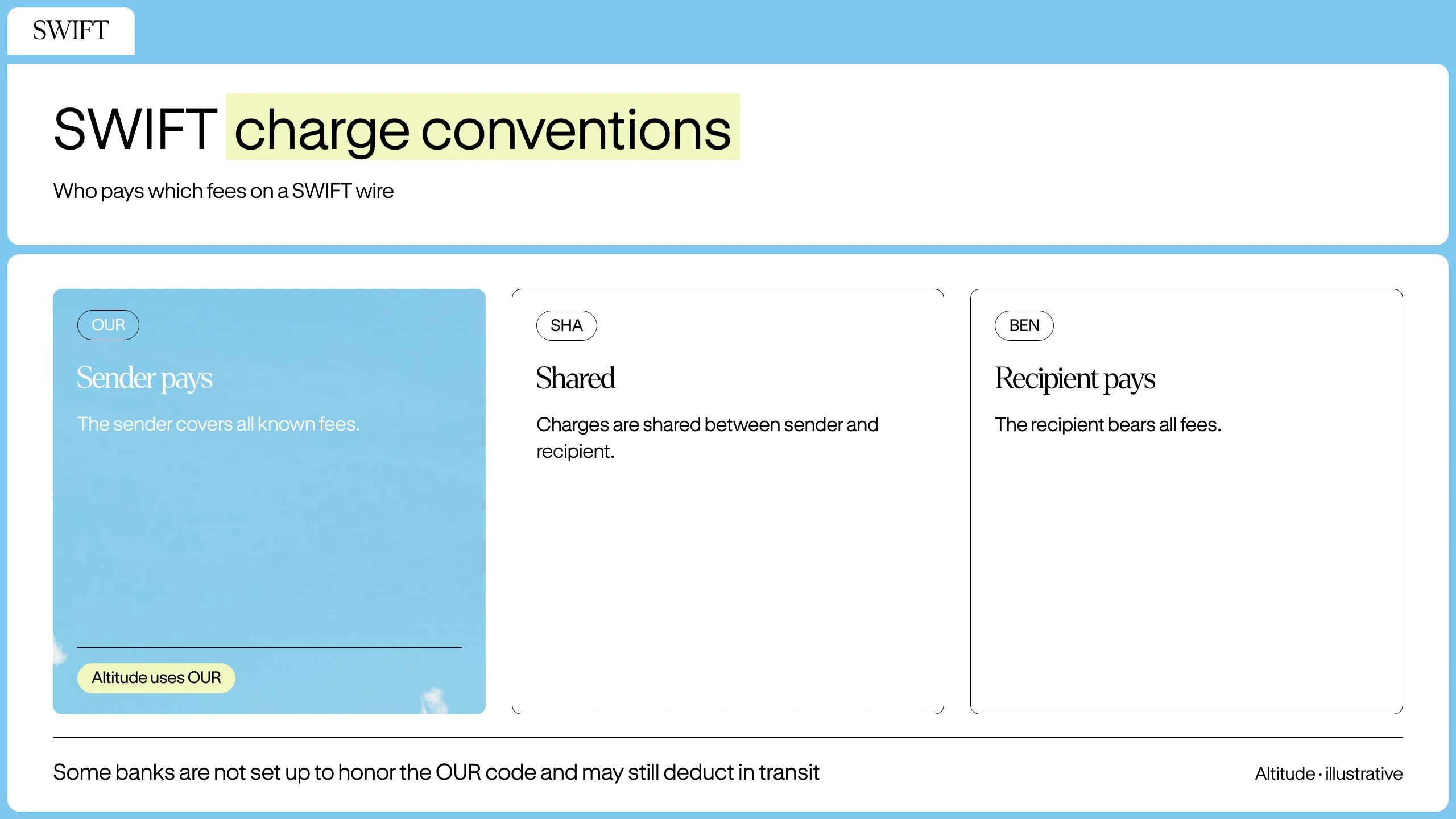
The SWIFT network supports three charge conventions:
- Under OUR, the sender pays all charges, though some providers bill correspondent fees back to the sender after settlement, so the total cost is not always clear upfront.
- Under SHA, charges are shared. Some banks and corridors restrict which conventions they offer, so confirm with your bank whether OUR and BEN are available for your route.
- Under BEN, the recipient bears all fees.
Even under OUR, intermediary banks can still deduct fees in some cases, so confirming your bank's OUR handling in advance reduces the risk of unexpected deductions.
Managing inbound wire transfer costs
The receiving bank often charges an incoming wire fee. At US banks, incoming wire fees often run $0 to $15, with a median of about $15 according to NerdWallet's survey, and some large banks charge nothing. Fees vary by institution, so check your recipient's bank directly. If the destination account is in a different currency, the recipient's bank sets the conversion rate and applies its own fees, which the sender cannot control or predict.
Practical steps: confirm the receiving bank's fee schedule before sending, use the OUR convention where possible to cover known fees upfront, and ask whether the recipient can accept a local rail or stablecoin instead.
If your business is the one receiving payments, a local collection account can remove the SWIFT chain from the payer's side. A USD or EUR account lets payers use ACH or SEPA instead of sending a SWIFT wire to you.
How cross-border fees add up: worked examples
Example 1: calculating SWIFT payment costs
As a worked example, take a $5,000 SWIFT outbound payment to a supplier in Mexico. The fixed fee depends on the provider. At major US banks, outgoing international wire fees typically run $0 to $50 per send, with a median of about $45 according to NerdWallet's survey. Lower fees in foreign currency often mean a wider FX spread, because the bank earns on the exchange rate instead. Altitude's documented fee is $35 for outbound SWIFT, with a $100 minimum per transfer, under the OUR convention where the sender covers known fees.
| Cost layer | Range |
|---|---|
| Fixed transfer fee (bank or provider) | $0 to $50 |
| FX spread (1 to 4% on $5,000) | $50 to $200 |
| Intermediary deductions (illustrative: 1 to 3 banks at $15 to $50 each) | $15 to $150 |
| Receiving bank deposit fee | $10 to $30 |
| Total cost | $75 to $430 |
The FX spread, intermediary, and receiving-bank ranges in this table are illustrative assumptions, not sourced benchmarks. The fixed fee ranges reflect the NerdWallet survey cited above and Altitude's documented fee.
Example 2: UK Faster Payments fee breakdown
For this worked example, consider a £3,000 payment to a UK contractor via Faster Payments. This is a local rail that operates within the UK domestic network, so no correspondent banking layer applies. Faster Payments typically settle in seconds and carry very low or no fees on the receiving end.
For a cross-border payment, the main costs are the provider's fee and the FX conversion from USD to GBP, which depends on the provider's rate. To calculate the true cost, compare the effective rate you received against the mid-market rate at the time of the transfer.
| Cost layer | Range |
|---|---|
| Fixed transfer fee | Varies by provider |
| FX spread (0.5 to 2% on £3,000) | $20 to $80 (assuming £3,000 = ~$3,900 USD) |
| Intermediary deductions | $0 (no correspondent layer) |
| Receiving bank fee | £0 to £10 (~$0 to $13 USD) |
| Total cost | $20 to $93 |
The ranges in this table are illustrative assumptions, not sourced benchmarks. Confirm the fixed fee, spread, and receiving-bank fee with your provider and the recipient's bank.
Faster Payments itself carries no charge for domestic GBP transfers, so in a cross-border payment the costs to check are the provider's fixed fee and the FX spread, both of which you can audit by comparing the quoted rate against the mid-market rate. In these illustrative examples, a cross-border payment landing via Faster Payments costs $20 to $93 in fees and spread.
Example 3: cross-border fees for LatAm
As a worked example, take a $2,000 payment to a contractor in Brazil via Pix. Altitude supports Pix payouts, SPEI payouts, and Bre-B or local bank transfer payouts in Colombia. These routes work through direct Pay only, funded from a USDC balance, and do not create a local-currency balance.
| Cost layer | Range |
|---|---|
| Fixed transfer fee | Varies by provider |
| FX spread (USD to BRL) | 1 to 3% depending on liquidity |
| Intermediary deductions | $0 (local rail) |
| Receiving bank fee | Varies |
| Total cost | Varies by provider and spread |
The BRL spread range is an illustrative assumption, not a sourced benchmark. Spreads vary by provider and over time.
Contrast this with SWIFT to the same corridor: a fixed fee, intermediary deductions, and a wider FX spread on a less liquid pair. The local rail avoids the correspondent banking layer entirely, which removes the most unpredictable cost component.
Cross-border card fees: the three charges
The worked examples above price wires and local rails, but many readers who search for cross-border fees mean card charges, which are separate. Three charges can apply to a card payment across borders. The card issuer may add a foreign transaction fee, the card network bills a cross-border assessment (Visa's International Service Assessment or Mastercard's Cross-Border Assessment) to the merchant's acquirer, and dynamic currency conversion (DCC) lets a foreign merchant charge in your home currency at its own rate. None of these three apply to wires or local rails, so the corridor comparison below returns to bank transfers and explains why their fees vary by route.
SWIFT and local rail fee structures compared
Hidden fees in SWIFT transfer chains
SWIFT chains are unpredictable because a payment may pass through one or more intermediary banks, each of which may deduct a fee. The sender cannot control how many hops the payment takes, so the total deduction is unknown until the payment lands. The worked examples in this article assume 1 to 3 intermediary banks charging $15 to $50 each. Treat that range as illustrative, not a sourced benchmark.
Swift gpi adds end-to-end payment tracking and more visibility into fees along the chain. Swift data shows nearly 60% of gpi payments are credited within 30 minutes and almost 100% within 24 hours. Tracking shows where a payment is, but intermediaries can still deduct fees along the way.
Comparing local rail fee structures
Local rails operate within domestic or regional networks and avoid the multi-hop correspondent structure. EURC-funded SEPA typically settles within one business day, and SEPA Instant settles in seconds. ACH settles same day to two banking days, depending on the option used. US domestic wire typically settles in one business day. SWIFT is a messaging network rather than a settlement system, so most SWIFT gpi payments arrive within 24 hours, though some take longer depending on the intermediary banks and compliance checks.
| Rail | Settlement time | Altitude fee |
|---|---|---|
| ACH | Up to 2 business days | $0 |
| Same-day ACH | Same business day | $0 |
| US domestic wire | Typically 1 business day | $0 |
| EURC-funded SEPA | Typically 1 business day | $0 |
| SWIFT | Most gpi payments within 24 hours, some take longer depending on intermediaries and compliance checks | $35 |
| Stablecoin transfer | Instant on Solana, up to 15 minutes on other networks | $0 |
| Faster Payments, SPEI, Pix, Bre-B | Varies | FX rate 0.4% to 0.6% above mid-market, per the help center (as of October 2026) |
Instant bank rails sit alongside these options. SEPA Instant settles in seconds, and euro-area senders have been required to offer it since 9 October 2025 under the EU's Instant Payments Regulation. In the US, FedNow and RTP run 24/7.
Stablecoin transfers and cross-border fees
Stablecoin transfers have no correspondent banking layer, so no intermediary bank sits in the chain to deduct a fee. Altitude carries no platform fee on supported stablecoin transfers, which settle instantly on Solana and in up to 15 minutes on other networks. They also do not observe banking cut-off times, so a contractor invoice that arrives Friday afternoon can be paid the same day.
The condition is that the recipient must accept stablecoins. If the recipient needs local currency, converting out of the stablecoin may carry exchange or bank charges that Altitude does not set, and third-party charges may still apply. Altitude's stablecoin transfer help article covers how to send them.
When to use stablecoins vs local rails
Use a local rail when the recipient wants local currency in a local bank account and the corridor has a supported route, such as Pix, SPEI, Faster Payments, or SEPA. Use a stablecoin transfer when the recipient already holds or accepts stablecoins, when no local route exists, or when the payment needs to land outside banking hours.
- Choose a local rail if the recipient needs local currency, the corridor is supported, and the recipient's bank accepts domestic transfers without extra steps.
- Choose a stablecoin transfer if the recipient has a wallet and accepts USDC or EURC, or if the invoice is due on a weekend or after cut-off.
- Choose SWIFT only when neither option is available, since it carries the most fee layers.
Stablecoin transfers are irreversible once settled, so send a small test payment first and confirm the recipient's address and network before sending the full amount.
How recipients off-ramp
A recipient who needs local currency has to convert the stablecoin after it arrives. Typically, the recipient sends it to an exchange or off-ramp provider, sells it for local currency, and withdraws to a local bank account over a domestic rail. The provider sets the exchange rate, withdrawal fee, verification steps, and timing, and Altitude does not control any of them.
Before the first payment, ask the recipient which provider they use, what it charges to convert and withdraw, and whether it supports their country and bank. If the answers are unclear, a local rail payout from Altitude may be the more predictable route.
Short cost example: $5,000 to a contractor in Brazil
The table compares a stablecoin transfer with a Pix payout for the same $5,000 payment. The Pix figure uses the 0.4% above mid-market FX rate that the Altitude help center lists for Pix payouts. The off-ramp figure is an illustrative assumption, not a sourced benchmark.
| Cost layer | Stablecoin transfer, recipient converts to BRL | Pix payout from USDC balance |
|---|---|---|
| Altitude platform fee | $0 | None stated separately |
| FX cost | Set by the recipient's provider (illustrative: 0.5 to 1.5%, or $25 to $75) | 0.4% above mid-market (about $20) |
| Withdrawal or bank fee | Set by the recipient's provider | $0 (local rail, no intermediary) |
| Illustrative total | $25 to $75 plus any provider withdrawal fee | ~$20 |
In this example, a stablecoin transfer is not automatically the cheaper option. It costs less only when the recipient avoids conversion or their provider's spread is narrower than the payout rate, so compare the recipient's all-in cost before choosing.
Practical ways to reduce international fees
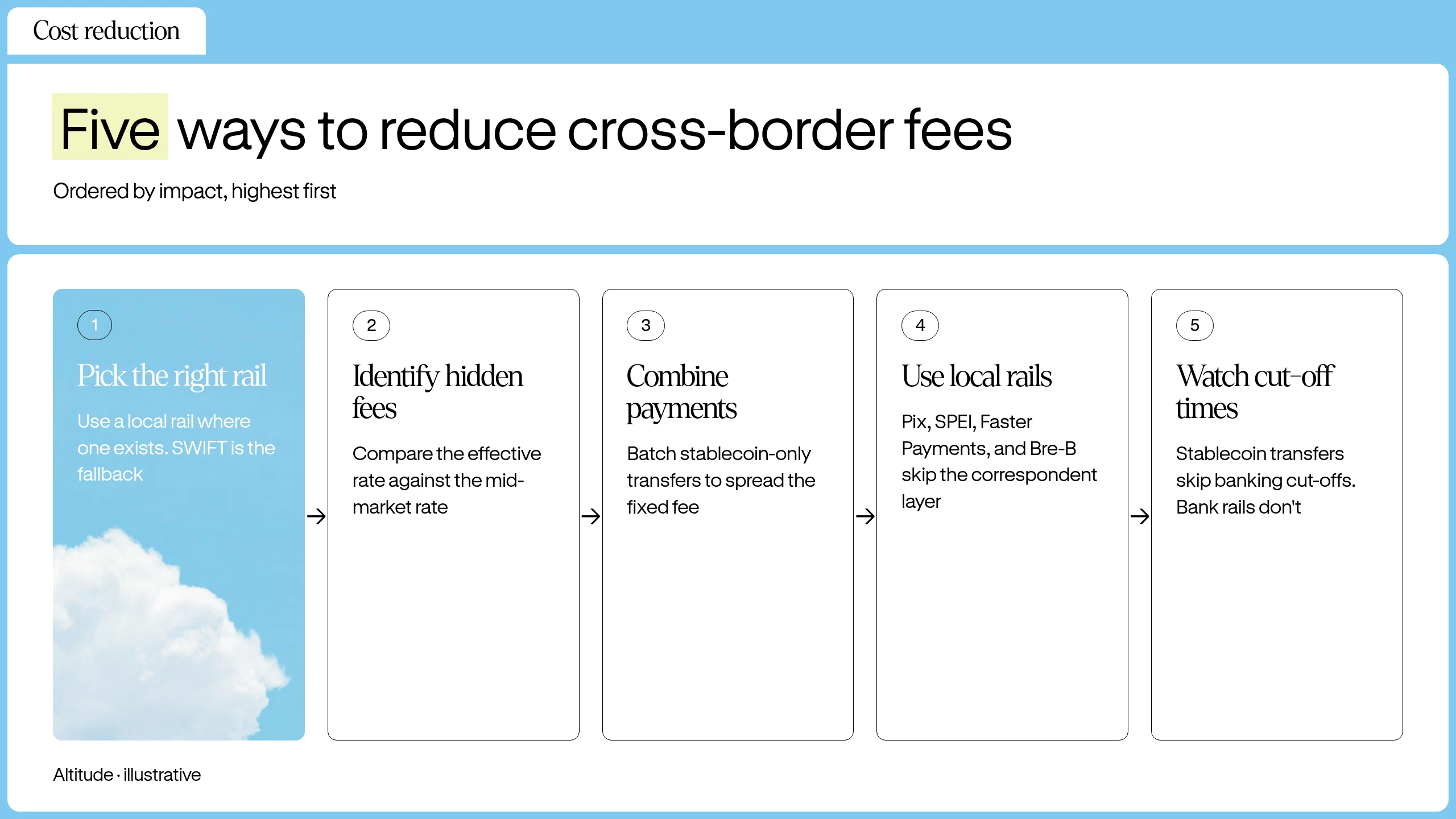
Most cross-border payment budgets leak in two places: the exchange rate markup, which is typically the largest single cost, and the rail choice, which determines how much of the remaining fee stack you can control. Reduce cross-border fees by following this four-step framework, ordered by impact:
- Pick the right payment rail: If the corridor has a local rail, use it instead of SWIFT. If the recipient accepts stablecoins, stablecoin transfers carry no Altitude platform fee. SWIFT is the fallback when no local rail exists, since a SWIFT wire stacks a send fee, an FX markup, a receiving fee, and intermediary deductions per hop.
- Use local payment rails: Local rails avoid the correspondent banking layer entirely. Altitude supports SEPA payments and US domestic payments, and sends USDC-funded payouts by Pix (Brazil), SPEI (Mexico), Faster Payments (UK), and Bre-B or local bank transfer (Colombia) from one account. These payouts are funded from a USDC balance and do not create a local-currency balance.
- Identify hidden fees: Ask your bank for the full fee schedule, including intermediary and receiving bank charges. Compare the effective rate against the mid-market rate from a source like XE or Reuters to calculate the FX spread. Multiply the percentage difference by your transaction amount to quantify the hidden cost. Use the OUR convention for SWIFT to cover known fees upfront, though some intermediary banks can still deduct charges.
- Combine payments for cost efficiency: Batching multiple payments into one transfer reduces the per-payment fixed fee. Altitude's batch payments are stablecoin-only, with a $100 minimum per transfer and a default limit of 10 recipients (up to 100 on request). Bank-rail batches are not available yet, so batching applies only where every recipient accepts stablecoins. That limit is why it ranks last.
Cut-off times affect when a payment lands, not what it costs, so they sit outside the four steps. Batch rails like ACH and wires have cutoffs, while instant rails such as FedNow, RTP, Faster Payments, Pix, and SEPA Instant run 24/7. Same-day ACH posts the same business day when submitted before cut-off. The Federal Reserve's FedACH processing schedule sets three same-day submission deadlines, at 10:30 a.m., 2:45 p.m., and 4:45 p.m. ET, with settlement at 1:00, 5:00, and 6:00 p.m. ET.
Banks set their own cutoffs, which come earlier than the Fed deadlines but often reach the afternoon, so confirm the current window with your originating depository financial institution (ODFI). The Federal Reserve does not process ACH on weekends or federal holidays. Stablecoin transfers do not observe banking cut-off times, as covered in the stablecoin section above, but this weekend capability applies to stablecoin transfers, not every bank payout.
Pinpointing markup risks in international transfers
This section gives you a repeatable audit process you can use to build a cost-reduction case for your chief financial officer.
Hidden currency conversion costs
Calculate the FX spread by comparing the rate you received against the mid-market rate at the time of the transfer. The difference, expressed as a percentage, is the markup. For cross-border payments, you fix either "You send" or "Recipient receives," and the platform shows the effective rate and both amounts before approval, refreshing every 30 seconds.
Fixed international transfer fees
The fixed fees to look for are the sending bank's transfer fee, the intermediary bank's lifting fee, and the receiving bank's deposit fee. Altitude's help center lists which rails carry no platform fee and the outbound SWIFT fee.
Quantifying correspondent fee deductions
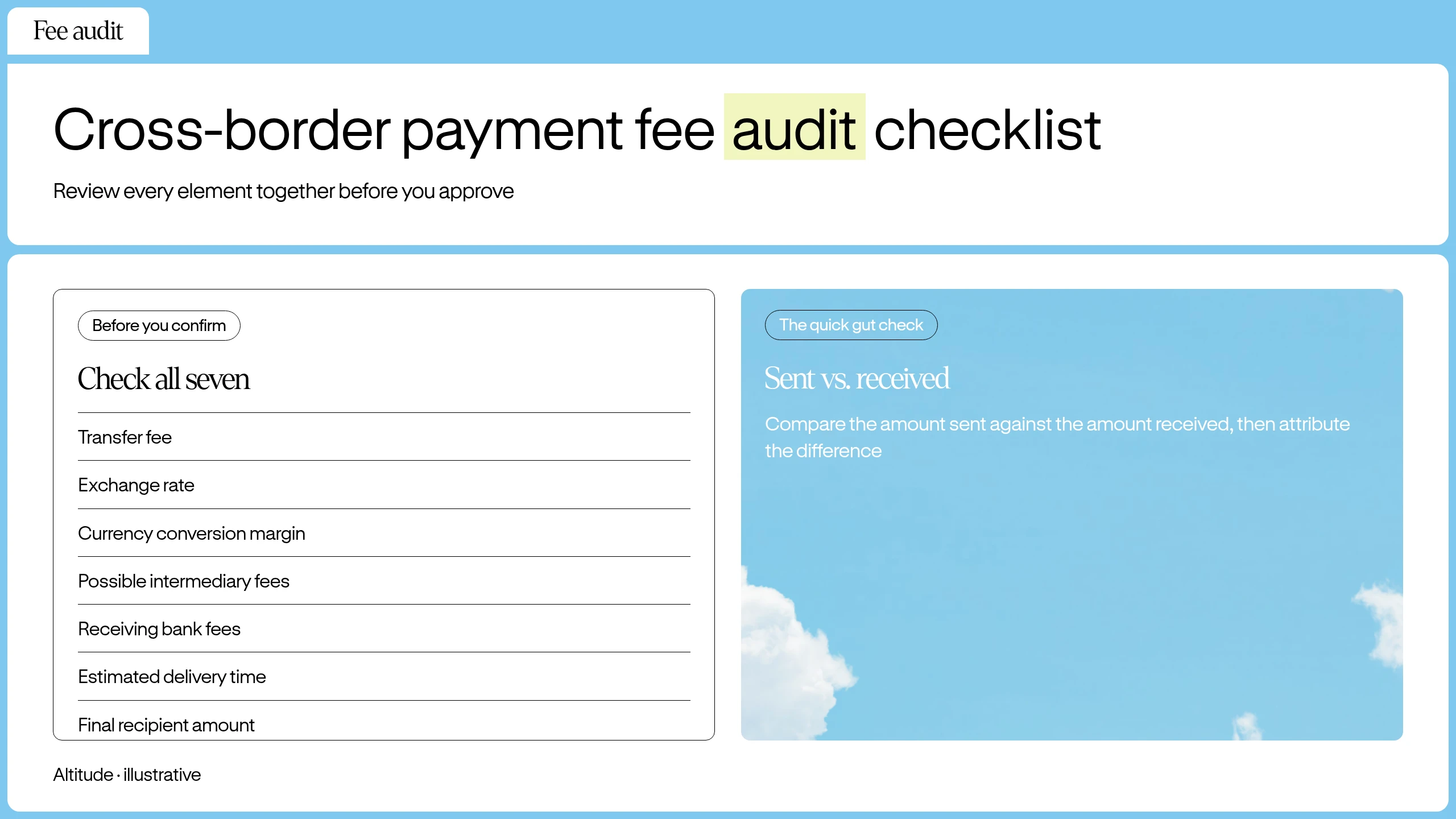
Correspondent fees are the hardest to predict because they are deducted by banks you have no relationship with. One practical way to measure the true cost is to compare the amount sent against the amount the recipient received, then attribute the difference. Before confirming any international transfer, review every element together: the transfer fee, exchange rate, currency conversion margin, possible intermediary fees, receiving bank fees, estimated delivery time, and final recipient amount. If the gap between sent and received exceeds the fixed fee plus your estimated FX spread, the remainder is likely intermediary and receiving bank deductions.
Comparing workflow costs: manual vs. integrated
The operational cost of cross-border payments includes the time spent executing them. Finance managers at distributed businesses typically log into multiple bank portals, re-enter beneficiary details for each payment, and reconcile transactions manually in spreadsheets at month-end. Altitude consolidates payment execution, approval routing, and accounting sync in one account, though manual exception handling still applies.
| Step | Manual workflow | Altitude workflow |
|---|---|---|
| Payment initiation | Typically log into multiple bank portals | One login for all rails |
| Beneficiary setup | Typically re-enter recipient details for each payment or portal | Save beneficiaries once, reuse across payments |
| Approval routing | Typically managed outside the payment system, such as by email or messaging tools | Configurable approval thresholds and role-based permissions built into the account |
| Reconciliation | Typically download statements from each portal and match transactions manually in spreadsheets at month-end | Sync to QuickBooks Online and Xero with user confirmation before posting |
| Exception handling | Typically manual investigation and correction outside the payment system | Manual investigation and correction. Altitude consolidates transaction data in one account |
The fee audit and the workflow comparison lead to the same step: see every fee layer before a payment is approved, and keep the approval and accounting trail in one place
Consolidating payments in one account also raises the question of who controls the balance. On Altitude, balances are held in fully reserved stablecoins that your business controls. Stablecoin issuers can freeze addresses under legal orders and regulated partners can suspend services independently, while your business sets the approval rules applied to every payment.
Review the fee schedule and supported payment routes before your next contractor payment run. Book a demo to see how Altitude handles cross-border payments with fees shown before you approve.
FAQs
What is the difference between FX spread and transfer fees?
The FX spread is the difference between the mid-market rate and the rate you receive, expressed as a percentage. Transfer fees are fixed charges like the $35 SWIFT outbound fee. Both reduce the amount that arrives.
Why do some payments have hidden intermediary fees?
When the sending and receiving banks do not have a direct relationship, intermediary banks process the payment and deduct charges. These deductions are unpredictable and reduce the received amount. The SWIFT OUR convention covers known fees, but some intermediary banks can still deduct charges.
Can I avoid foreign transaction fees on business payments?
Partly. You can avoid the card issuer's foreign transaction fee by using a card that doesn't charge one, and you can avoid dynamic currency conversion (DCC) by paying in the local currency at checkout. The card network's cross-border assessment is billed to the merchant's acquirer, so you can't control it.
How do I calculate the true cost of a cross-border payment?
Add the fixed transfer fee, the FX spread (the difference between the rate you received and the mid-market rate), and any intermediary or receiving bank deductions. Compare the amount sent against the amount received to attribute the difference.
Key terms glossary
FX spread: The difference between the mid-market exchange rate and the rate a bank or provider gives you. It is the hidden cost in most cross-border payments.
Intermediary bank: A bank that processes a payment when the sending and receiving banks do not have a direct relationship. Intermediary banks deduct charges that reduce the received amount.
Correspondent banking: The network of relationships banks use to process cross-border payments. Each intermediary bank in the chain can add fees and delays.
Payment rail: The specific network or system a payment travels on, such as SWIFT, SEPA, ACH, Faster Payments, Pix, SPEI, or stablecoin transfers. Each rail has its own fee structure and settlement time.
Settlement time: The time it takes for a payment to become available to the recipient.
ACH: Automated Clearing House, the US electronic network banks use for batch transfers between accounts.
Bre-B: Colombia's instant payment system, operated by Banco de la República, the central bank.
EURC: A euro-denominated stablecoin issued by Circle, backed one to one by euro reserves. On Altitude it can fund SEPA payouts.
Faster Payments: The UK's real-time payment network. Transfers typically settle in seconds.
Pix: Brazil's instant payment system, run by the Central Bank of Brazil. Payments settle in seconds, including on weekends.
SEPA: Single Euro Payments Area, the scheme for euro-denominated bank transfers across participating European countries.
Solana: A blockchain network used for stablecoin transfers.
SPEI: Sistema de Pagos Electrónicos Interbancarios, Mexico's interbank payment system, operated by Banco de México.
SWIFT: Society for Worldwide Interbank Financial Telecommunication, a messaging network banks use to instruct cross-border payments. The banks in the chain settle the payment, so timing and intermediary deductions vary by corridor.
USDC: USD Coin, a US dollar-denominated stablecoin issued by Circle. Altitude's local-currency payouts are funded from a USDC balance.
Altitude is a financial technology platform, not a bank or digital asset custodian.