
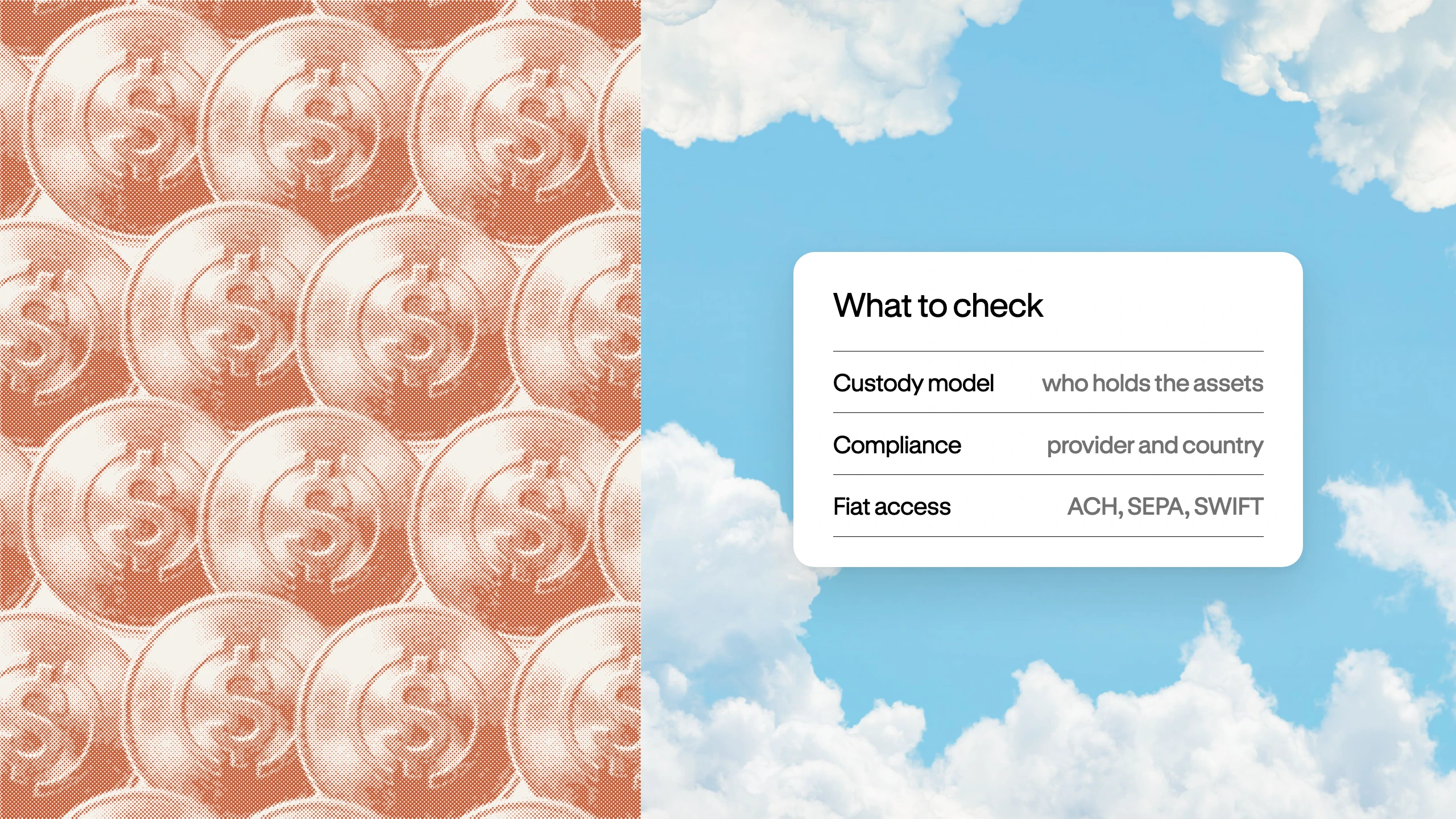
TL;DR: A crypto business account is an account held by a registered company to store, send, receive, or trade digital assets such as Bitcoin, Ethereum, and stablecoins. Features vary by provider: some connect to fiat payment systems such as ACH, SEPA, or SWIFT, while others focus on trading or storage. Choosing one comes down to three checks: custody model, compliance requirements, and fiat access. Then check which payment methods, cards, accounting integrations, and approval controls each provider offers. Eligibility varies by provider and country.
A crypto business account is held by a registered company instead of an individual, and lets the business store, send, receive, or trade digital assets. Typical assets include Bitcoin, Ethereum, and dollar-pegged stablecoins such as USDT and USDC. Businesses use these accounts for different jobs: some mainly trade, some mainly store assets, and some pay suppliers and keep financial records. This article covers how these accounts work, what to check before opening one, and how Altitude, a global business account, compares to exchange products like Crypto.com and Coinbase.
Core features of crypto business accounts
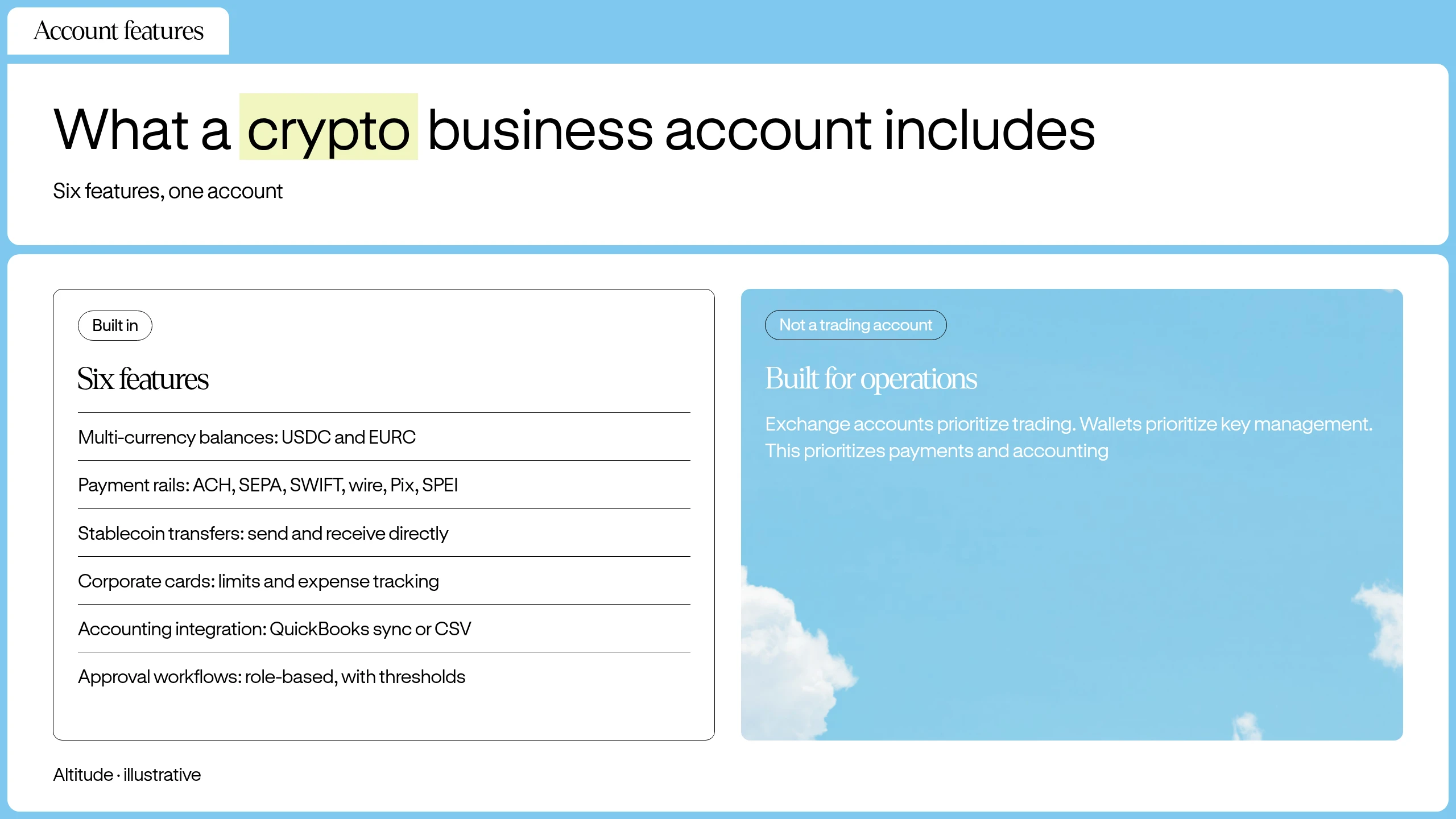
A crypto business account holds digital assets, and some providers also connect it to fiat payment systems. Depending on the provider, you can hold stablecoins or other supported crypto, receive crypto payments from customers, and send payments through bank transfers, local payment systems, or stablecoin transfers, depending on what the recipient accepts.
They include the following feature areas. The specific features in each area differ by provider:
- Supported assets: Each provider supports its own list of digital assets, such as Bitcoin, Ethereum, and stablecoins. Check the list before you deposit.
- Custody model: The provider holds the funds (custodial), or your business holds the private keys (self-custodial).
- Crypto transfers: Accounts send and receive supported assets on the blockchain networks the provider supports. Transfers are irreversible once settled, so send a small test payment first.
- Fiat access: Providers differ on whether they connect to fiat payment systems such as ACH, SEPA, SWIFT, wire transfers, and local payment systems. Each payment method has its own fees and settlement window.
- Cards: Card availability, card type, and fees depend on the provider and the region.
- Accounting and records: Providers differ in how they export transaction history, for example as CSV files, and in which accounting systems they integrate with, such as QuickBooks Online and Xero.
- Team access and approvals: Providers differ in the user roles they offer and in whether payments above a set amount require approval from a second team member.
Exchange accounts focus on trading and asset conversion. Wallets focus on key management. Business accounts differ in how many payment, card, and accounting features they add on top of custody.
Choosing the right business account type
Four account types appear most often for crypto businesses: exchange business accounts, crypto-friendly bank accounts, crypto payment service accounts, and business crypto wallets or treasury tools. Each serves a different operational need, and some providers combine features from more than one type.
- Exchange business accounts, such as those from Crypto.com and Coinbase, let you buy, sell, and convert cryptocurrencies. The exchange holds your funds in a custodial account. Fiat withdrawal options exist but typically route through ACH, SEPA, or wire transfers, and each rail carries its own fees and settlement window. Coinbase publishes wire withdrawal details through Fedwire in its help center, so confirm current fees and timing for each withdrawal method there before you rely on it. Some exchanges now offer business tools (Coinbase Business includes invoicing, payouts, and accounting integrations in the US and Singapore), but they are built around trading accounts rather than multi-rail fiat operations.
- Crypto-friendly bank accounts are traditional bank accounts opened by businesses that earn or hold crypto. The bank holds fiat deposits in your company's name and connects to ACH, SEPA, SWIFT, and card networks. The account does not hold digital assets, so you convert crypto to fiat on an exchange or another provider before funds arrive. Banks differ on whether they accept crypto-related businesses, so check each bank's policy before you apply. Traditional banks offer deposit insurance up to jurisdictional limits.
- Crypto payment service accounts, also called crypto payment processing accounts, let a business accept crypto payments from customers. Providers differ on which assets they accept, whether they settle to the business in fiat or crypto, and what fees they charge. These accounts are built around receiving customer payments, so check whether a provider also supports outbound vendor payments, cards, and accounting exports.
- Business crypto wallets and treasury tools, such as MetaMask, Ledger hardware wallets, and multisig wallets, give you full control of private keys. You sign every transaction. No intermediary can freeze the wallet itself, but the issuer of a token such as USDC can still block an address at the token level. Wallets do not connect to ACH, SEPA, or card networks. You cannot issue corporate cards, sync to accounting software like QuickBooks and Xero, or send a SEPA payment from a wallet. If your vendor invoices in euros and only accepts bank transfers, a wallet does not help.
Some crypto business accounts sit between these types. You hold stablecoins in an account your business controls, and the provider may also connect the account to fiat payment systems, sometimes through licensed partners. Altitude follows this model and holds your balances in stablecoins controlled by your business and not lent out. Altitude's licensed partners provide the banking services: ACH, SEPA, SWIFT, local payment systems, and card issuance.
Choosing a custody model for your business funds
Custody determines who controls your funds and what happens if the provider stops operating.
- Custodial storage means the provider holds your funds. Coinbase, Crypto.com, and most exchanges use this model. If the exchange freezes your account or becomes insolvent, your access depends on their terms and legal jurisdiction.
- Self-custodial storage means you hold the keys. MetaMask, Ledger, and multisig wallets follow this model. You control the funds directly, but you also bear full responsibility for key security and recovery.
Custodial accounts and provider responsibility
In a custodial account, the provider holds the private keys and your business holds a claim on the balance. The provider stores the keys, runs key recovery, and applies its own security and compliance controls.
The trade-off is that your access depends on the provider. Custodial providers can freeze or restrict an account under their terms of service, and withdrawals follow their processing times and limits. If the provider becomes insolvent, your recovery depends on its terms, its insurance, and the legal process in its jurisdiction. Lost login credentials can usually be reset through the provider, which a lost private key cannot.
Self-custody and key responsibility
Self-custody means your business holds the private keys, and whoever holds the keys controls the funds. If the provider holds them, the provider controls the funds. If your business holds them, you control the funds but bear full responsibility for key security and recovery.
The trade-off is that self-custodial models require stronger internal key management. Losing keys with no recovery path means funds nobody can recover, including the provider. Holding the keys also does not stop a stablecoin issuer from blocking a token address under legal orders.
Businesses choose self-custody for four reasons:
- Provider independence: No exchange or platform can freeze the wallet itself or hold up a withdrawal under its own terms of service.
- Counterparty exposure: Funds are not part of a provider's balance sheet, so a provider insolvency does not put them in an insolvency process.
- Direct control of approvals: The business decides who signs and under what rules, for example by requiring several signers on a multisig wallet.
- Verifiable holdings: Anyone with the wallet address can check balances and transactions on the blockchain, without relying on a provider's statement.
Self-custody suits businesses with staff who can manage keys, backups, and signing procedures. Custodial accounts suit businesses that would rather have the provider carry that responsibility and accept its terms in exchange.
Signs your business needs crypto rails
Crypto business accounts solve operating problems, not investment strategies. Watch for these patterns:
- Revenue arrives in stablecoins or other crypto, but your vendors and contractors invoice in fiat currencies and expect payment via bank transfer or local payment methods.
- Banking hours block time-sensitive payments: a Friday invoice payable to a bank that doesn't support SEPA Instant, or to a country outside the SEPA area, can wait until Monday unless the vendor can receive a stablecoin transfer.
- You pay contractors across multiple countries and face compounding FX costs and failed cross-border wires. For example, when a wire to a Brazilian contractor fails, your team has to trace the payment, resend it, and correct the entry in your accounting records.
- Your current provider flags your business as high-risk because of where you are incorporated or how you earn revenue. Foreign-incorporated businesses and crypto-adjacent companies face account closures with limited explanation.
Crypto business account comparison
Revolut and Coinbase both offer business accounts with crypto support, but they start from different places. Revolut Business is a fintech business account, while Coinbase is built around trading and asset conversion. This section compares what each provider delivers for a business that needs to pay contractors, issue cards, and close books.
Key features for Revolut Business users
Revolut's business offering is Revolut Business, a separate product from its personal accounts with its own onboarding. It is a fintech business account for holding and moving fiat currencies, with cards and accounting integrations. Crypto availability for business accounts differs by region, so confirm the supported assets, features, and card terms that apply to your business with Revolut before you rely on them. Fees depend on the plan and payment type.
Revolut uses a custodial model. Revolut holds your balances and any crypto in its own system, and you withdraw or pay out from there. The account works well if your primary activity is fiat payments and spending and you occasionally need crypto access, but confirm the crypto features available to your business before you plan around them.
What to expect from Coinbase business
Coinbase offers a business account with crypto custody, trading, and fiat on/off ramps. Its dedicated product, Coinbase Business, is available in the US and Singapore and includes invoicing, payouts, and accounting integrations. Fiat withdrawal methods include ACH, SEPA, and Faster Payments, and each rail settles on its own schedule. Coinbase publishes timing per withdrawal method in its help center, including a Fedwire withdrawal article for wires, so check the stated window for the exact method and region before you plan a payment run.
Coinbase provides institutional-grade custody. Crypto custody insurance is typically narrow in scope, often covering specific loss scenarios rather than all assets. Custody appeals to businesses that prioritize security and regulatory clarity over operational payment workflows. Coinbase also offers an API for programmatic access.
How Altitude fits into this comparison
Altitude is a global business account for businesses that earn or hold stablecoins (dollar-pegged digital currencies like USDC), and still need to pay fiat invoices. Balances are held in fully reserved stablecoins, backed one to one by the issuer's reserves, controlled by your business and not lent out by Altitude.
The later sections and the comparison table use these features as the reference point:
- Account access: Eligible businesses open accounts from 200+ countries with no US entity required. Product availability varies by country, and account, payment-destination, card, and rewards eligibility are separate scopes.
- Balances: USD and EUR accounts hold USDC and EURC on Solana. GBP, MXN, BRL, and COP balances aren't available, so payments in those currencies route through local payment systems funded from your USDC balance.
- Payment methods: ACH, same-day ACH, US domestic wire, and EURC-funded SEPA carry no Altitude fee. Outbound SWIFT costs $35 per transfer. Faster Payments, SPEI, and Pix payouts are priced as an FX rate 0.4%-0.6% above mid-market (as of October 2026). Sending, intermediary, and recipient banks may still charge.
- Stablecoin transfers: USDC and EURC transfers settle around the clock with no Altitude fee. They are irreversible once settled, so send a small test payment first.
- Cards and approvals: Virtual Visa cards carry a 1% FX fee on non-USD purchases. Role-based permissions (Propose, Approve, Submit, Read Only) and approval thresholds control who can release a payment.
- Accounting: Transactions sync to QuickBooks Online and Xero, and you confirm every posting before it applies.
Self-custodial wallets for business funds
Exchange accounts are one end of the custody spectrum. At the other end are self-custodial wallets, such as MetaMask, Ledger hardware wallets, and multisig wallets, where your business holds the private keys. No exchange holds your funds or can freeze the wallet itself, although the issuer of a token such as USDC can still block an address at the token level.
Multisig wallets require several signers to approve a transaction, which suits teams with more than one approver. The trade-off is that your business carries key security and recovery, as described in "Self-custody and key responsibility" above. Wallets also do not connect to ACH, SEPA, or card networks, so paying a vendor in fiat means moving funds to an exchange or another provider first.
Bridging fiat and crypto operations
The gap between exchange accounts and operational business accounts becomes clear when you map a real workflow: paying a contractor in Brazil who invoices in BRL and expects payment via Pix.
With an exchange account:
- Convert your stablecoins to USD inside the exchange.
- Withdraw USD to your business bank account via ACH (one to three business days).
- Log into your bank or a separate FX provider.
- Convert USD to BRL at their FX rate.
- Send BRL via SWIFT or a local payment partner (one to five business days, plus bank wire fees and any intermediary charges).
- Manually reconcile the payment in accounting software like QuickBooks and Xero.
With a crypto business account like Altitude:
- From your USDC balance, initiate a Pix payment to the contractor's registered Pix key.
- Altitude shows the effective rate and both amounts before you approve.
- The payment routes through licensed partners and settles via Pix.
- The transaction syncs to accounting software like QuickBooks Online and Xero (see "Linking crypto flows to QuickBooks and Xero" below for how).
The difference is whether the account handles the operational work after you hold it.
Fintechs with crypto support
Some fintech business platforms are not positioned as crypto companies but have added a crypto product. Slash and Flex each have one, and each sits apart from the rest of the company's offering.
- Slash Global USD: A business account for non-US entities. Its balance is denominated in USDSL, which Slash calls its native stablecoin (provided with Bridge, on Base). USDC and USDT work only as deposit and withdrawal rails. Slash's Global USD help article cites 100+ countries, while other Slash pages cite 130+, so check the supported countries list.
- Flex Global Dollar Account: Flex's own crypto product, separate from the rest of Flex's offering. It supports USDC and USDT, lists ACH, SWIFT, SEPA, and Pix rails.
Key differences in fees and capabilities
Here is how the providers compare on the features that matter for business operations. Slash and Flex are described in "Fintechs with crypto support" above. Both compete for the same foreign-incorporated businesses Altitude serves:
| Provider | Entity access | Stablecoin position | Fiat rails | Accounting sync | Card |
|---|---|---|---|---|---|
| Altitude | 200+ countries, no US entity required. Product availability varies by country | USDC and EURC in your business-controlled account | ACH, SEPA, SWIFT, wire, SPEI, Pix | QuickBooks Online and Xero | Visa Signature Corporate charge card. 1% FX fee on non-USD purchases |
| Crypto.com | Varies by jurisdiction | Custodial holdings | ACH, SEPA, wire | Connects via API or CSV data imports. No native, built-in accounting sync available | Consumer cards available. Business card availability depends on your account |
| Coinbase | Varies by jurisdiction. Coinbase Business is available in the US and Singapore | Custodial holdings | ACH, SEPA, Faster Payments, wire | Integrations such as CoinTracker and Crypto Tax Calculator | No corporate card available |
| Slash Global USD | 100+ countries per Slash's Global USD help article. Other Slash pages cite 130+, so check the supported countries list | USDSL, Slash's native stablecoin (provided with Bridge, on Base). USDC and USDT are deposit and withdrawal rails | ACH, wire, SWIFT, stablecoin | QuickBooks Online, Xero, Sage Intacct | Card available |
| Flex Global Dollar Account | 170+ countries per Flex's Global Dollar page | USDC and USDT | ACH, SWIFT, SEPA, Pix | Integrations such as QuickBooks Online and Xero | Unavailable |
Altitude and Slash both serve businesses without requiring US incorporation. Altitude adds EUR operations, a choice between USDC and EURC balances, and delivered accounting sync with QuickBooks Online and Xero. Crypto.com and Coinbase provide deep liquidity and trading features. Altitude provides payment workflows, approval controls, and accounting integration. The right choice depends on whether your primary activity is trading or operating.
How crypto business accounts receive, convert, and pay out funds
How to safely receive stablecoin and bank payments
Receiving stablecoin payments safely comes down to three checks: the token, the network, and the address. Confirm that the sender uses the exact token and network your account supports, copy the deposit address from the account itself, and send a small test payment first, because stablecoin transfers are irreversible once settled. Under standard blockchain practice, a token sent to an address that doesn't support it may be permanently and irrecoverably lost, so treat token and network selection as a hard safety rule.
For inbound bank payments, the beneficiary name on the sending instruction should match the legal entity name on your account, as standard banking practice. A mismatch can result in the receiving rail rejecting and returning the funds. At Altitude, ACH and US domestic wire transfers credit as USDC to your USD account, and SEPA transfers credit as EURC to your EUR account.
Managing stablecoin to fiat conversions
Converting stablecoins to fiat for vendor payments involves a conversion step and a payment step. Fees and timing depend on how the provider structures both.
Providers handle the conversion in one of two ways. Some execute it inside their platform and show you a rate. Others route through an external liquidity provider and pass through the executed rate. Because the rate is set at execution, the final amount can differ slightly from the quote you first saw. That difference is called slippage, and between two stablecoins pegged to the dollar and the euro it is usually small. Check whether the provider shows the exact fee before you send. Altitude, for example, converts USDC to EURC, or EURC to USDC, through its built-in FX engine at live exchange rates around the clock. It adds no fee to the conversion and shows the exact fee before you send, though the executed rate and any slippage still apply.
After conversion, the fiat payment routes through a payment rail, and each rail has its own fee and settlement window. SWIFT wires carry a fee-allocation code that sets who pays the transfer charges: OUR (the sender pays), SHA (costs are shared), or BEN (the recipient pays). Even under OUR, some intermediary banks can still deduct charges, so full-value receipt is not guaranteed.
Before you approve a cross-border payment, check whether the provider fixes the amount you send or the amount the recipient receives, and whether the quote refreshes while you review it.
Paying vendors in crypto or fiat
The rail you choose depends on what the vendor accepts and how fast they need settlement.
- Stablecoin transfers settle around the clock, typically in seconds on Solana and within minutes on most other networks. Transfer minimums apply, and stablecoin payments avoid the rail-specific fees that apply to certain other payment types. This works when the vendor holds a stablecoin wallet and can receive the stablecoin you send directly.
- Local payment systems are domestic instant payment networks that settle in minutes, far faster than a cross-border wire. Pix (Brazil), SPEI (Mexico), and Faster Payments (UK) usually route through the provider's licensed partners and settle in local currency. Providers that fund these payouts from a stablecoin balance typically don't create a local-currency balance in your account. Check that the quote shows the effective rate and both amounts before you approve, and confirm current terms before initiating.
- Standard SEPA Credit Transfers settle by the next business day, while SEPA Instant settles in seconds, 24/7, and euro-area banks must now offer it under Regulation (EU) 2024/886. EURC-funded SEPA carries no Altitude fee, you need the recipient's IBAN. For most SEPA payments within the eurozone, the BIC is no longer required, because the corresponding code is derived automatically from the IBAN.
Most SWIFT payments are credited within a day, but some corridors and compliance holds can stretch to several business days. The outbound fee is covered in "Managing stablecoin to fiat conversions" above. SWIFT supports multiple currencies including USD, EUR, GBP, MXN, BRL, and COP. If the destination account is in a different currency from the amount sent, the recipient's bank may apply its own conversion rate and fees.
Multi-currency treasury management
Treasury management across currencies means holding balances in more than one currency and deciding when to convert between them. Providers differ on which currencies they hold. Many stablecoin business accounts hold USD and EUR balances as USDC and EURC, and some add other currencies.
Many providers let you create sub-accounts by team, region, or function, each with its own deposit details, and move funds between them inside the product. Converting between two stablecoins, such as USDC and EURC, usually runs through a built-in FX engine or an external liquidity provider, so confirm the rate and fee shown before you convert.
If a provider doesn't hold a balance in a currency, payments in that currency typically route through local payment systems funded from a balance in another currency. The conversion happens at payment execution, not before. Altitude works this way for GBP, MXN, BRL, and COP payments, which it funds from your USDC balance.
Vetting criteria for your crypto business account
Before opening a crypto business account, verify custody, compliance, fiat access, fees, and geographic eligibility. This section provides a checklist.
Evaluating crypto custody and security
Ask these questions:
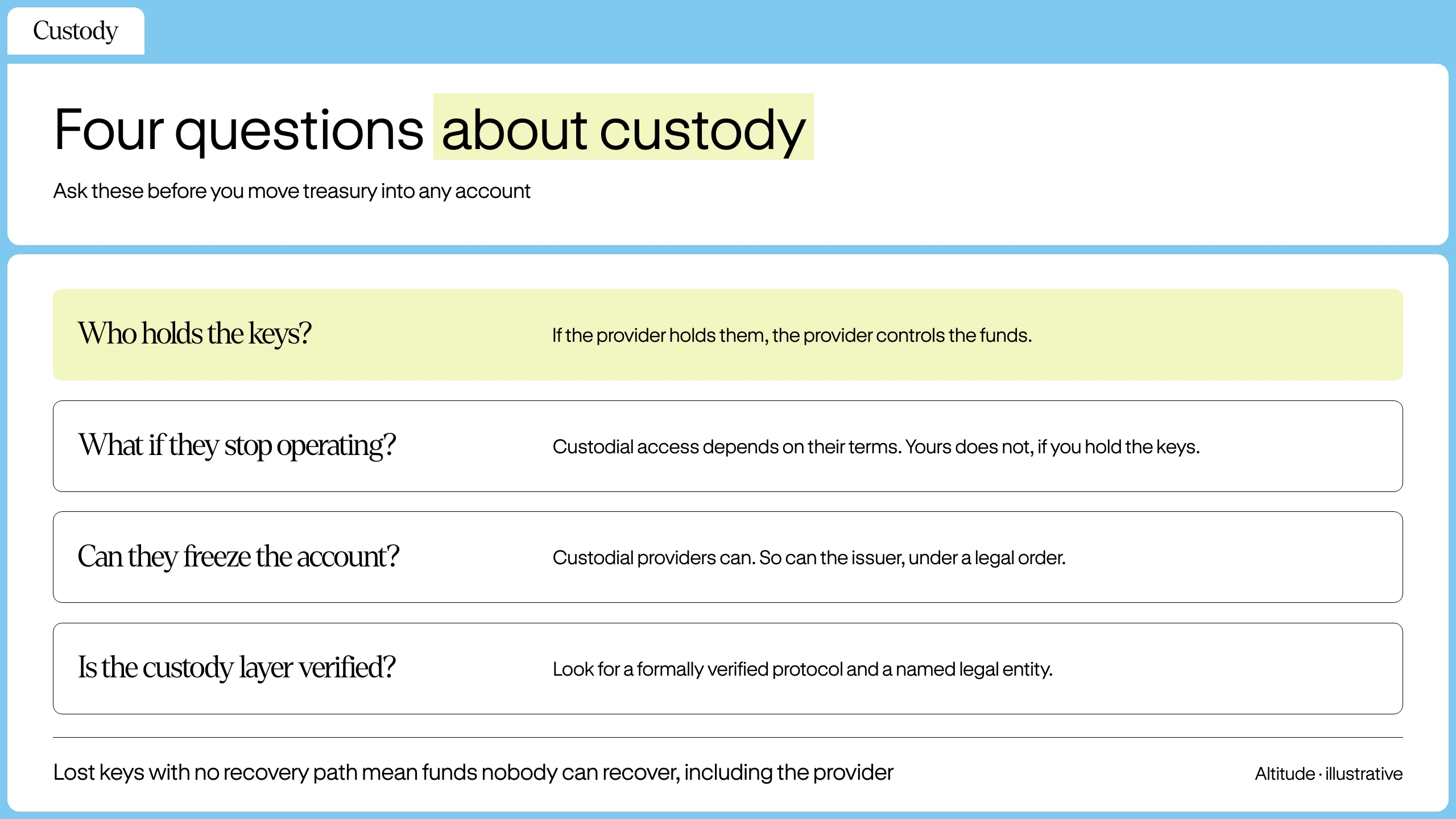
- Who holds the keys? The answer decides who controls the funds and who carries the responsibility for key security. The "Self-custody and key responsibility" section above covers what holding the keys means.
- What happens if the provider stops operating? With custodial accounts, access depends on the provider's terms and legal process. With self-custodial accounts, funds remain accessible if you hold the keys.
- Can the provider freeze your account? Custodial providers can freeze accounts under their terms of service. The stablecoin issuer can freeze USDC addresses under legal orders.
- Is the custody layer audited or verified? Ask which software holds balances and enforces approval rules, who built it, and whether an independent party has reviewed or formally verified it. Request the audit or verification report rather than a summary.
Reserves and SOC reports for custodians
Ask any custodian for evidence you can read, not a summary. A SOC 2 Type I report assesses the design of controls at a point in time, while a Type II report tests how those controls operated over a period, so check which one the provider holds and who issued it. For proof of reserves, check what the attestation covers: assets alone say little unless liabilities and the date of the snapshot are also shown. For stablecoins, look for the issuer's published reserve reports.
Due diligence on provider licensing
Crypto business accounts operate under different regulatory structures depending on jurisdiction. Verify:
- Does the provider hold licenses directly, or work through partners? Some providers hold no banking, payment institution, or e-money license themselves, so the regulated banking services come from licensed partners. Ask which entity holds which license and in which jurisdictions.
- Are balances insured? Balances held as stablecoins are not bank deposits or securities accounts, so they typically do not qualify for FDIC or SIPC coverage. FDIC coverage applies to deposits at insured banks, and SIPC covers securities held at member brokers. This applies to most crypto business accounts and exchange accounts. Traditional banks offer deposit insurance up to jurisdictional limits.
- How does business verification work? Business verification often runs in two stages: an initial submission and a follow-up. Verification is a review, not a commitment. Providers typically require UBO disclosure for 25%+ owners, so check which documents and ownership thresholds apply to your business.
MiCA and EU authorization
If your business pays EU suppliers or serves EU customers, check how the provider is authorized in the EU. The Markets in Crypto-Assets Regulation (MiCA, Regulation (EU) 2023/1114) sets authorization rules for crypto-asset service providers. Ask whether the provider holds that authorization itself or works through a partner that does, and confirm current terms for your jurisdiction before you rely on the answer.
Sanctions screening and the Travel Rule
Ask how the provider screens customers and payments against sanctions lists such as the US Treasury's OFAC list, and how it meets Travel Rule requirements, which call for sender and recipient information to accompany certain transfers. Screening can hold or block a payment, so ask what happens to a held payment and who contacts you.
Moving money between crypto and fiat
Test the deposit and withdrawal flows before committing treasury operations:
- Deposit methods: Can you deposit via ACH, SEPA, wire, and stablecoin transfers? What are the minimums and processing times?
- Withdrawal methods: Can you send ACH, SEPA, SWIFT, local payment systems, and stablecoin transfers? What are the fees and settlement windows?
- Conversion transparency: Do you see the exchange rate and both amounts before you approve? Does the rate refresh or lock at initiation?
- Name matching: For inbound fiat payments, does the beneficiary name need to match the account name exactly?
Supported cryptocurrencies and stablecoins
Most crypto business accounts support a limited set of stablecoins. Altitude supports USDC and EURC only, and other tokens cannot be deposited or held in the operating account. The exception is the Holdings feature, a separate balance for assets kept rather than spent. Holdings supports SOL and cbBTC (a Coinbase-issued token backed one to one by bitcoin) on Solana inside the account. Assets in Holdings sit outside the USDC and EURC operating balances and do not fund payments.
Check if your country is supported
Geographic eligibility covers several distinct scopes. Check each scope that your business depends on before you plan around an account:
- Business-incorporation eligibility: Does the provider accept companies incorporated in your country, and does it require a US or other local entity?
- Account eligibility: Can your business open each account type you need, such as a USD or EUR account?
- Payment-destination access: Can you send payments to the countries where your vendors and contractors are, and over which payment methods?
- Cardholder eligibility and card merchant-spending access: Can your team members receive a card where they live, and can the card be used at merchants in the countries where you spend?
- Rewards eligibility: Does the provider offer rewards to businesses in your country, and under what conditions?
Altitude, for example, opens accounts for eligible businesses from 200+ countries with no US entity required, and product availability varies by country. Account, payment-destination, card, and rewards eligibility are separate determinations, so a country that qualifies for an account may not qualify for every other feature.
Comparing total fees for crypto transfers
Headline rates hide the real cost. Compare all-in costs per corridor, including conversion fees, account movement fees, and subscription costs.
True cost of swapping crypto for fiat
Converting stablecoins to fiat for vendor payments involves at least two cost layers: the conversion spread and the payment fee. Some providers charge a conversion fee or hide the cost in the spread between buy and sell rates. At Altitude, USDC to EURC conversion runs through the built-in FX engine at live exchange rates, and the exact fee is shown before you send. This does not guarantee zero spread or slippage.
After conversion, the fiat payment incurs a fee depending on the rail. ACH, same-day ACH, US domestic wire, and EURC-funded SEPA carry no fee from Altitude. Outbound SWIFT costs $35 per transfer and uses the OUR convention (see "Managing stablecoin to fiat conversions" above).
Example cost for a $10,000 payment:
| Provider | Conversion fee | Payment fee | Total cost |
|---|---|---|---|
| Altitude (USDC to ACH) | No Altitude fee (spread or slippage may apply) | $0 | No Altitude fee (third-party charges may apply) |
| Coinbase (USDC to USD to wire) | No spread on standard conversions (Coinbase applies tiered conversion fees at high volumes, confirm current rates directly) | $25 wire withdrawal fee | $25 wire fee, plus tiered conversion fees at high volumes |
| Traditional SWIFT wire | N/A (already fiat) | Bank wire fees plus any intermediary charges | Varies by bank and corridor |
Watch for these hidden account fees
Fees that do not appear on the pricing page but show up in operations:
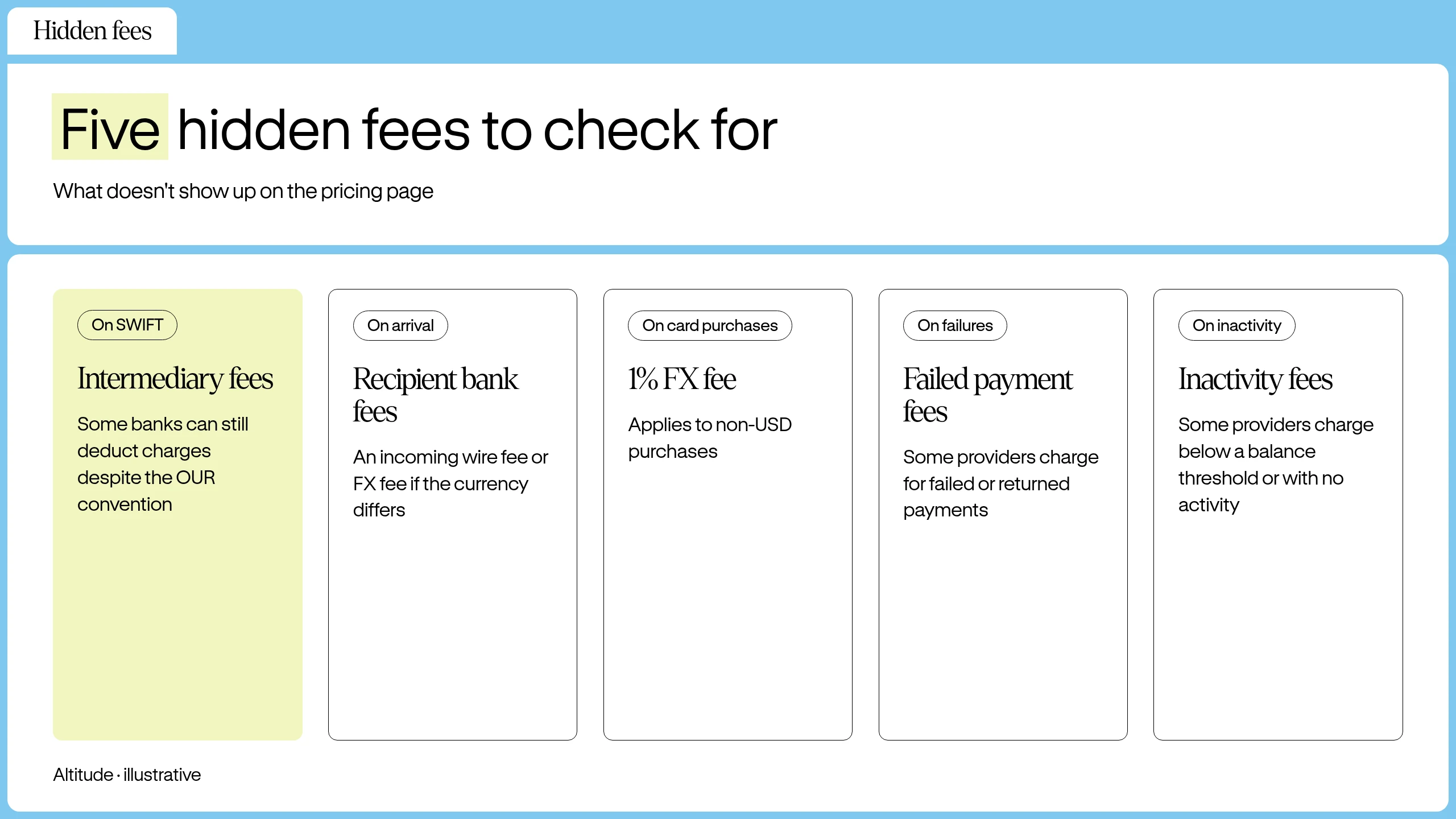
- Intermediary bank fees on SWIFT: Some intermediary banks can still deduct charges despite the OUR convention ($35, see fees above), so full-value receipt is not guaranteed.
- Recipient bank fees: The recipient's bank may charge an incoming wire fee or FX conversion fee if the destination account is in a different currency.
- FX fee on non-USD card purchases: A 1% FX fee applies to card purchases in currencies other than USD.
- Failed payment fees: Some providers charge for failed or returned payments. Altitude's documentation does not list failed payment fees as of October 2026.
- Inactivity fees: Some providers charge monthly fees if the account balance falls below a threshold or if no transactions occur within a period. Altitude doesn't have a minimum balance requirement.
Essential tools for managing crypto funds
Payments are one workflow. Closing the books, controlling approvals, and producing audit-ready records are the workflows that determine whether a crypto business account actually reduces operational burden.
Linking crypto flows to QuickBooks and Xero
Reconciliation chaos happens when revenue and expenses live in separate systems. An invoice is issued, a payment arrives three days late in a different account structure, and matching the two requires manual work.
Altitude syncs with QuickBooks Online and Xero. You confirm every posting before it applies, and it does not auto-post. Accounting sync covers deposits, payments, transfers, card activity, and rewards.
Setting user roles for secure payments
Approval bottlenecks happen when the person who needs to approve a payment is asleep and the founder ends up manually approving edge cases at hours that are not their working hours.
Role-based permissions and configurable approval thresholds control who can release a payment. Typical roles separate the people who propose a payment from those who approve, submit, or only view it. Look for approval rules that apply by payment amount, currency, or recipient, and that run automatically on every payment instead of depending on a manual check.
Also check how sign-in and approvals are secured. A passkey is a sign-in credential stored on a member's device under the WebAuthn/FIDO2 standard, and it replaces a password and resists phishing. Ask whether a payment executes only when the approval rules your team sets are met, and whether one compromised credential or one provider outage can lock the account or expose funds. Altitude, for example, uses Propose, Approve, Submit, and Read Only roles and gives every member a passkey.
How Altitude handles contractor and supplier payments across borders
If your business earns revenue in crypto but needs to pay contractors, suppliers, and operational expenses in fiat, Altitude bridges that gap. Check your country's eligibility, then hold USDC and EURC in a business-controlled account. Pay by ACH, SEPA, SWIFT, local payment systems, or stablecoin transfer. Issue virtual Visa cards with cashback. Sync transactions to QuickBooks Online and Xero. Run approvals without hiring a finance team.
Book a demo to see how Altitude handles your specific payment corridors and workflows.
FAQs
Can I use a crypto business account for payroll?
Crypto business accounts can send payments to contractors and employees, but they do not run payroll or handle employment, tax, or payroll compliance. Many providers offer batch payments that send stablecoins to multiple recipients in one payment run, which suits recurring contractor payouts. Check the recipient limit per batch and whether batch submission is available on bank rails, because fiat payments often go out one at a time. Payroll tax filing and employment classification stay outside the account. Altitude, for example, offers stablecoin-only batch payments (default limit 10 recipients, up to 100 on request) and no bank-rail batch submission today.
What happens if the provider loses my crypto?
With custodial accounts, loss depends on the provider's insurance and legal obligations. With self-custodial accounts, your business holds the keys, so access continues directly through the underlying blockchain account if the provider stops operating. Lost keys mean funds nobody can recover, and a stablecoin issuer can still block an address under legal orders. Altitude, for example, holds balances in fully reserved stablecoins, backed one to one, controlled by your business and not lent out.
Are stablecoin business accounts regulated differently?
Stablecoin issuers will face regulation under the GENIUS Act (signed July 2025, effective January 18, 2027). Once effective, it will require permitted issuers to hold one-to-one reserves with custodians under the Act's segregation rules and to publish monthly reserve reports. Issuers above $50 billion that are not already SEC reporting companies will also need annual audits. The platforms that provide business accounts operate under different structures. Some hold no banking, payment institution, or e-money license themselves, and licensed partners provide the banking services under their own regulatory frameworks. Ask which entity holds which license and in which jurisdictions.
Can I hold both crypto and fiat in one account?
It depends on the provider. Some accounts hold fiat balances directly. Others hold USD and EUR balances as stablecoins such as USDC and EURC. In that model, fiat deposits by ACH, wire, or SEPA credit as stablecoins, and fiat payments by ACH, SEPA, SWIFT, or local payment systems are funded from the stablecoin balance, so you do not hold fiat balances directly. Check which model a provider uses before planning deposits and payment runs. Altitude, for example, holds USD and EUR balances as USDC and EURC on Solana.
Key terms glossary
Stablecoin: A cryptocurrency designed to maintain a stable value by pegging to a reserve asset like the US dollar or euro. USDC and EURC are fully reserved stablecoins backed one to one by cash and short-duration assets held by the stablecoin issuer.
Custody: The control and safekeeping of digital assets. Custodial accounts mean the provider holds your funds. Self-custodial accounts mean you hold the private keys.
Fiat on-ramp: A service that converts traditional currency (USD, EUR) into cryptocurrency or stablecoins. Altitude accepts ACH, wire, and SEPA deposits, which credit as stablecoins to your account.
Hot wallet: A wallet connected to the internet that enables immediate transactions.
Cold wallet: A wallet that stores keys offline for enhanced security.
Multisig or smart account: An account that fits neither the hot wallet nor the cold wallet category on its own. Its keys can sit on hot or cold devices, but a transaction executes only when a defined set of approval rules is met, so no single key can move funds alone.
KYB (Know Your Business): The verification process a business completes to open an account. KYB requires corporate documentation, identification of directors and beneficial owners (typically those holding 25% or more), and proof of operating address.
Altitude is a financial technology platform, not a bank or digital asset custodian.