
TL;DR: Entity management software maintains the legal record of each entity (filings, deadlines, ownership, governance documents). Multi-entity banking executes and records money movement across those entities (payment instructions, settlement confirmations, transaction matching data). If you pay across currencies from several entities, you need both. There's no fixed threshold for adding multi-entity banking. Teams typically add it when payment volume, corridor complexity, and reconciliation lag across entities outgrow their current setup, and entity count alone doesn't settle the question.
Treasury operators at multi-entity companies often run two systems that don't talk to each other: one that tracks legal obligations and one that moves cash. Auditors can ask for artifacts from both. On the governance side, that means evidence of good standing, signing authorities, and current governance records. On the payment side, it means segregation of duties enforced through system logic, plus time-stamped audit trails of approvals. When teams confuse the two or miss one entirely, reconciliation gaps can reach an external auditor and become audit findings.
How entity management software supports compliance
Entity management software answers the question "are we compliant?" It maintains the legal record of each entity in your corporate structure: formation documents, ownership details, filing deadlines, and governance artifacts. Platforms in this category typically centralize entity and people records, equity and debt structures, structure charts, document repositories, and appointment tracking into a single system of record. For treasury, that record shows which entities exist, who is authorized to act for them, and whether they are in good standing.
The operational value is consolidation. Instead of tracking filing deadlines in a spreadsheet and storing board minutes in a shared drive, entity management software applies automated workflows, reminders, and compliance calendars to reduce the risk of a missed filing or an expired foreign qualification. That puts the legal record in one place, so treasury can check an entity's standing without chasing the legal team.
Core entity record maintenance tasks
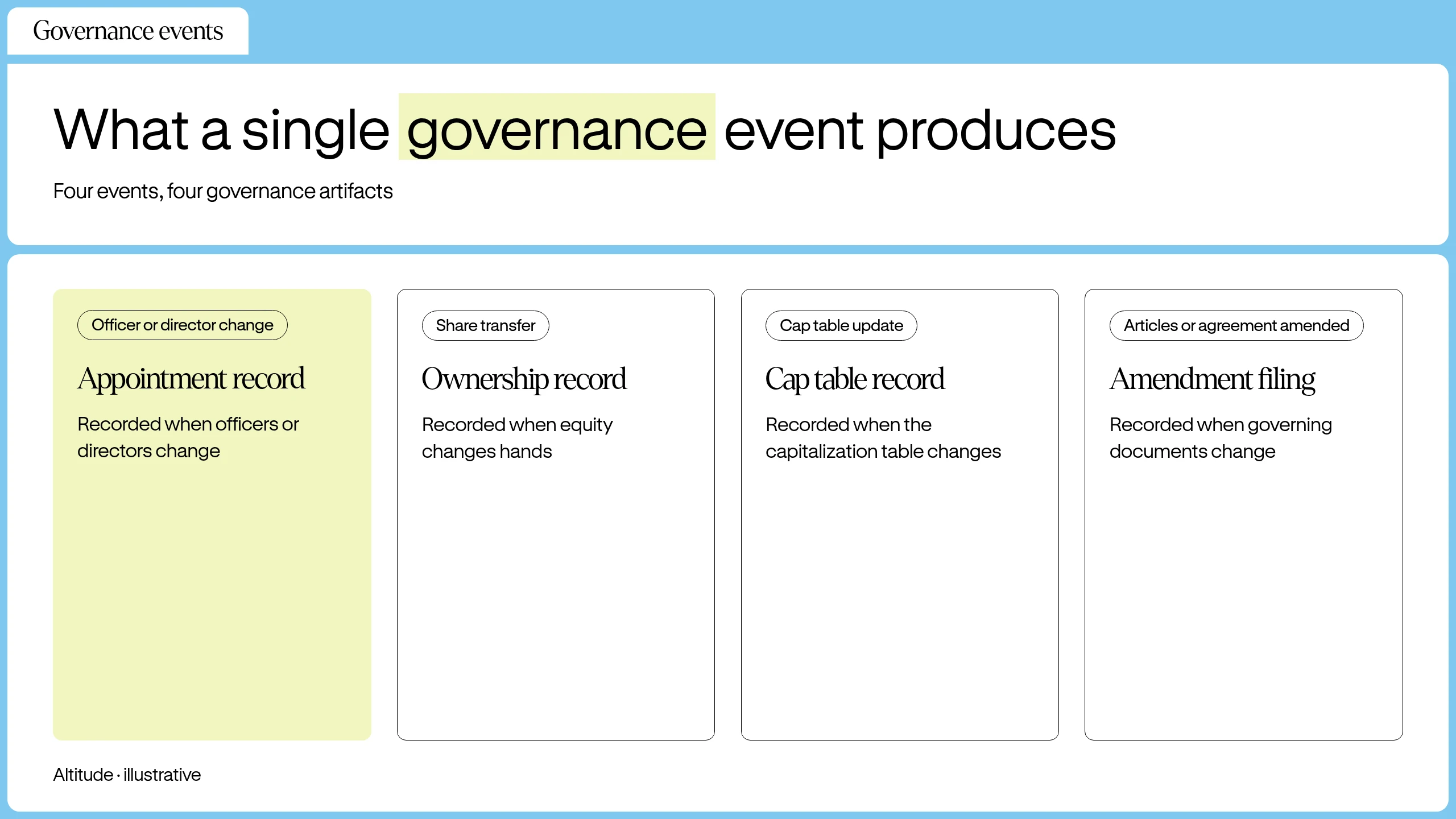
The daily work inside entity management software centers on keeping the corporate record current. That includes updating officer and director appointments, recording share transfers, maintaining capitalization tables, and logging amendments to articles of incorporation or operating agreements. Each change produces a governance artifact that an auditor or diligence team can request months or years later.
Cloud-based platforms add automated compliance tracking, board management workflows, and secure document storage with role-based access.
Tracking legal entity obligations
Entity management software tracks each obligation as a record per entity: the jurisdiction, the filing type (such as an annual report or franchise tax filing), the due date, the person responsible, and the filing confirmation once it's submitted. The requirements themselves come from the registry or regulator in each jurisdiction where an entity is formed or operates. Examples include Companies House for UK entities, including its register of people with significant control (PSC), and each US state's filing office for US entities.
On the US federal side, FinCEN's beneficial ownership information (BOI) reporting page notes that a final rule effective 14 August 2026 exempts U.S. companies and U.S. persons from BOI reporting under the Corporate Transparency Act. Only certain foreign entities registered to do business in a U.S. state still have narrower reporting duties, so check FinCEN's announcement before treating BOI as a current filing. For entities elsewhere, each jurisdiction runs its own company registry and, often, a separate beneficial ownership register. Germany, for example, has the Handelsregister (commercial register) and the Transparenzregister (transparency register). "PSC" is the UK term, while "ultimate beneficial owner" (UBO) is the term most other regimes use. The register name, what it records, who can access it, and how often entries must be updated differ by country, so confirm each entity's requirements directly with the local registry or regulator and record the result per entity.
Organizing subsidiary compliance data
For companies with subsidiaries across multiple jurisdictions, entity management software centralizes compliance data that treasury would otherwise have to request from email threads, local counsel folders, and disconnected spreadsheets.
An entity compliance audit checks that the corporate record is internally consistent. Reviewers compare formation documents, amendments, and ownership records against each other, confirm that current officers and directors are listed correctly, and look for entity names that differ from one jurisdiction to the next. For UK entities, the reference point is the register held by Companies House.
Defining multi-entity banking for treasury operations
Multi-entity banking answers the question "can we pay, convert, and reconcile today?" It handles the operational cash layer: moving money between entities, executing cross-border payments, converting currencies, and producing the payment-level records that reconcile to your accounting ledger. Where entity management software tracks which entities exist, who can act for them, and which filings are due, multi-entity banking records what you actually paid, when it settled, and at what rate.
Multi-entity banking coordinates cash, liquidity, and payments across an organization that operates through multiple legal entities. Each entity has its own accounts and often its own banking relationships. The operational challenge is that many treasury teams manage this through a bank portal per entity, a payment provider per corridor, and a spreadsheet to stitch it together.
Managing treasury across legal entities
A multi-entity banking setup aggregates balances and transactions from every account and legal entity into a consolidated view. In more capable configurations, it also lets treasury teams initiate payments across all connected accounts from a central hub. The goal is real-time visibility into liquidity, exposure, and payment activity across every entity and currency.
Handling cross-currency disbursements
Cross-currency disbursements are where multi-entity banking earns its cost. For example, a treasury operator paying a contractor in Brazil, a supplier in Germany, and a vendor in the UK from three separate entities needs settlement windows, fee transparency, and corridor-specific rails.
Verifying each entity (KYB)
Each legal entity opens its own accounts, so each one typically goes through its own know-your-business (KYB) verification with the bank or provider. A provider usually asks for formation documents, ownership details, and the people authorized to act for the entity, and requirements vary by provider and jurisdiction. Those inputs come from the entity register, so keeping it current shortens verification. A new subsidiary can't pay anyone until its own review is complete.
Moving money between entities
Intercompany transfers are a banking capability in their own right, not only a side effect of M&A. They include funding a subsidiary's operating account, settling intercompany invoices, and repaying intercompany loans. Each transfer needs a payment record, an approval, and a matching entry in both entities' books. Intercompany sales are real revenue and expense in each entity's own statutory books, and they're eliminated only in the consolidated financial statements, so the payment record has to tie to the correct entity on each side.
Cash pooling and notional pooling
Groups with several entities sometimes pool balances to manage liquidity. In physical cash pooling, balances from participating accounts are swept into a central header account, usually on a schedule. In notional pooling, balances stay in each entity's account and are offset on paper to calculate the group's net position, without moving funds. Availability, structure, and rules vary by bank and jurisdiction, so confirm what a provider supports and what your tax and legal advisers allow. Physical sweeps create intercompany balances between the header entity and each participant, and those balances need matching entries in each entity's books.
Why fragmented cash balances slow month-end
Accounting records live separately in an enterprise resource planning (ERP) system, and the bank portals and payment providers don't connect to it natively. Month-end then requires manually threading balances, payments, and ledger entries across silos, which is where reconciliation lag starts. Where a banking platform offers an accounting sync, it connects to specific ledgers, such as QuickBooks Online and Xero, so confirm that each entity's ledger is supported before relying on it.
Key differences between entity management and multi-entity banking
The two categories produce different records and serve different owners. An auditor reviewing entity governance asks for governance artifacts, and an auditor reviewing treasury controls asks for payment records.
| Dimension | Entity management software | Multi-entity banking |
|---|---|---|
| Primary function | Governance, compliance, ownership records | Payment execution, cash management, reconciliation |
| Core records produced | Constitutional documents (articles of incorporation in the US, articles of association in the UK and elsewhere), bylaws, board minutes, and jurisdiction filings (such as US state filings or UK Companies House filings) | Payment instructions, approval records, settlement confirmations |
| Audit artifact | Entity register, ownership records, filing confirmations | Audit trail, transaction log, ledger reconciliation |
| Typical owner | Legal, corporate secretary | Treasury, finance operations |
| Failure mode | Missed filing, lapsed qualification, stale ownership record | Payment failure, reconciliation miss, settlement delay |
Ensuring audit readiness across your tech stack
Audit readiness across a multi-entity structure needs two sets of records created as events occur: governance artifacts in the entity management platform, and payment artifacts (approval chain, settlement confirmation, reconciliation entry) in the banking platform. Auditors look for records made at the time, not records assembled the week before the audit.
When to adopt dedicated entity compliance tools
Entity management software becomes necessary when manual tracking breaks down: filing deadlines multiply across jurisdictions, M&A diligence surfaces gaps in ownership records, or a regulatory review requests documentation that lives in three different email inboxes. The threshold varies by company and doesn't depend on a fixed entity count.
Tracking regulatory reporting dates
When regulatory compliance requirements increase and corporate structures grow more complex, spreadsheets stop working. Reporting dates vary by jurisdiction and entity type, and annual report deadlines and franchise tax filings each follow their own calendar. A spreadsheet can list those dates, but it doesn't send reminders or assign owners. Entity management software applies compliance calendars and automated reminders so the legal team sees upcoming deadlines for every entity in one view.
Centralizing entity governance records
Scattered entity data can slow M&A diligence. For example, if a buyer's legal team requests governance records for a dozen entities across several jurisdictions and the answer involves searching multiple email accounts and shared drives, the team spends diligence time locating records instead of answering questions. Centralizing governance records before the request arrives is the operational case for entity management software.
Tracking M&A and restructuring events
Acquisitions and restructurings put pressure on entity records, because due diligence includes verifying entity compliance and corporate structure. Entity management software can typically track the structural changes (new entities, dissolved entities, ownership transfers, board composition changes) that restructuring events produce, though exact capabilities vary by platform, so confirm them with your vendor. Such events can also create payment flows, such as intercompany settlements, vendor payments from the acquiring entity, and contractor payments during transition.
Operational triggers for multi-entity banking
There's no fixed threshold for adding multi-entity banking. Teams typically add it when payment volume, corridor complexity, and reconciliation lag across entities outgrow a single-account setup or a collection of disconnected bank portals.
Scaling multi-entity payment flows
Multi-entity payment flows are usually organized in one of five ways. Each entity can keep its own bank logins, a single business account can hold sub-accounts for several entities, or a separate treasury platform can sit on top of existing bank accounts. Larger groups may also use a hub-and-spoke structure, where one central entity's accounts make payments on behalf of the others, or an in-house bank, where a central treasury entity manages intercompany funding, settlement, and lending for the group. Separate logins keep each entity isolated but multiply the work as payment volume and corridors grow.
A shared account or treasury layer reduces that work, and the trade-off is how much entity-level separation, reporting, and approval control it provides. Hub-and-spoke and in-house bank structures concentrate payment execution and intercompany balances in one entity, so each entity's own books need accurate intercompany records of what the central entity paid or settled for it.
Altitude, a global business account, is one example of the workspace-per-entity model. It runs each entity as a separate workspace with its own accounts, cards, and records, and your team reaches every workspace with one login. Role-based permissions (Propose, Approve, Submit, Read Only) and the approval rules your team sets control who can move money in each workspace. Supported stablecoin transfers between your own entities carry no Altitude fee, and each workspace's accounting syncs to QuickBooks Online and Xero.
Cross-currency payments add a rail choice for each corridor, and the rail each entity uses determines when a payment arrives and when the matching record reaches the ledger.
Reducing multi-day reconciliation lag
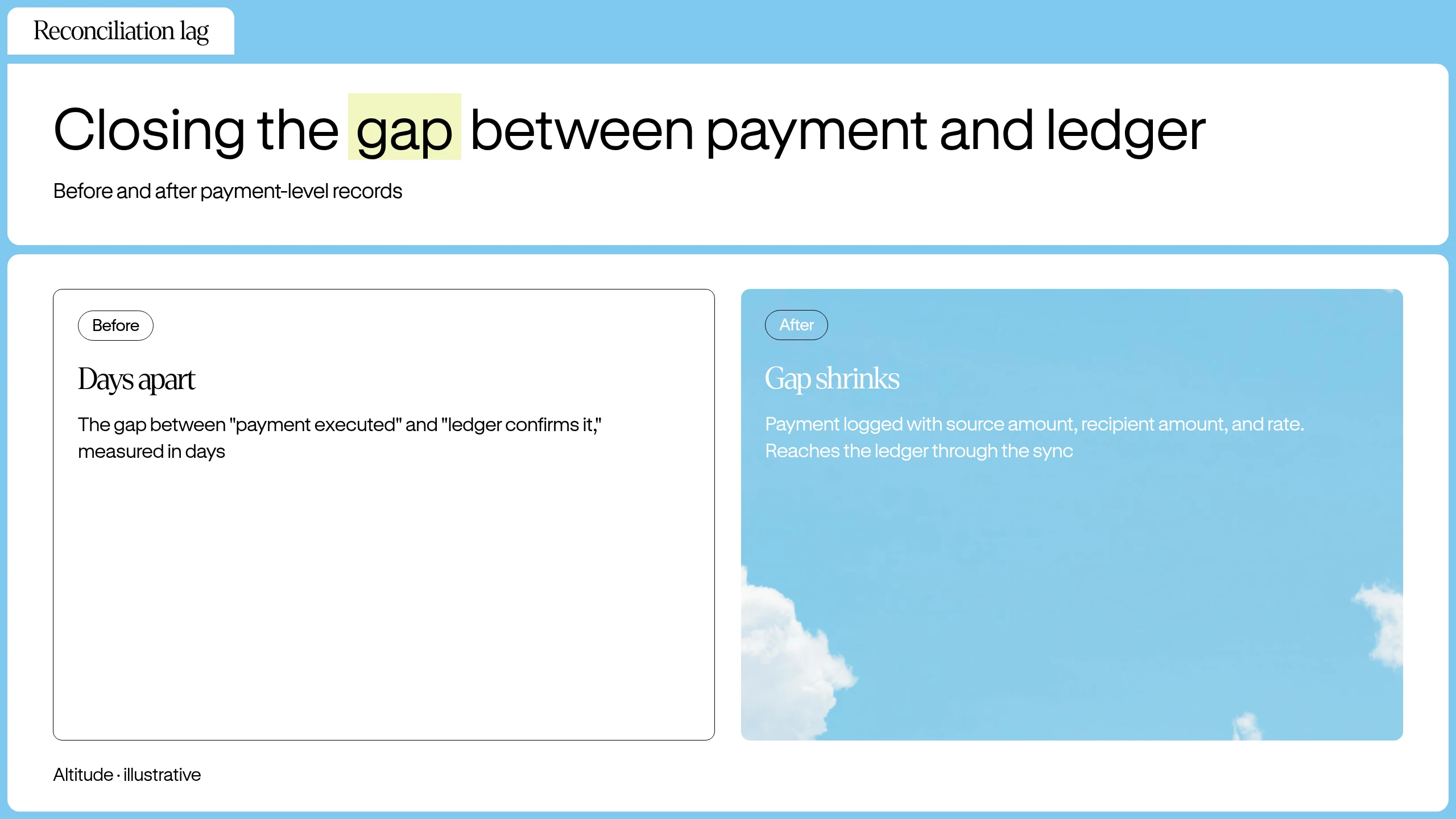
Companies managing multiple bank accounts across subsidiaries or countries can benefit from treasury platforms that consolidate cash visibility and reduce manual reconciliation. J.P. Morgan's treasury guidance identifies complex reconciliation, forecasting, and limited real-time visibility as challenges in decentralized banking structures. Reconciliation lag is a measurable symptom: the number of days between payment execution and ledger confirmation.
Integrating entity and banking workflows
In practice, legal entity governance and operational treasury typically run in separate systems. The integration point is the audit trail: governance records prove the entity had the authority to act, and payment records prove the action was executed correctly. One check belongs at that integration point: compare the authorized signatories and approvers set up in the banking platform against the officers and signing authorities in the entity register. An officer change recorded on the legal side needs a matching permission change on the payment side, and a departed officer who still holds approval rights is a gap an auditor can find.
| Trigger | Entity management software | Multi-entity banking |
|---|---|---|
| Entity count exceeds manual tracking | Yes: the legal record outgrows spreadsheets | No: entity count alone doesn't require banking |
| Payment volume scales across entities | No: it doesn't execute payments | Yes: volume outgrows single-account setups |
| Reconciliation lag exceeds close window | No: it doesn't reconcile cash | Yes: payment-level records shorten the lag |
| M&A or restructuring events | Yes: it tracks new entities, dissolved entities, and ownership transfers | Yes, for payment flows such as intercompany settlements. Confirm support with your vendor |
See how Altitude handles multi-entity payment flows and approval controls. Book a demo to walk through your specific entity structure and payment corridors.
FAQs
Can entity management software handle payments?
No. Entity management software tracks legal records, governance documents, and compliance deadlines for each entity. It doesn't execute payments, hold operating balances, or reconcile cash balances, so teams that need those functions use a banking or treasury platform alongside it.
Do I need both entity management software and multi-entity banking?
If your company operates through multiple legal entities and makes cross-border payments, yes. Neither substitutes for the other. Entity management software keeps the legal record, and multi-entity banking executes and records money movement.
Can multi-entity banking replace entity management software?
No, multi-entity banking handles the payments side only, whichever provider you use. Filing deadlines, ownership records, and governance artifacts stay in entity management software.
What happens if an approver is unavailable outside business hours?
Weekend and overnight payments need an approver who is available. Before relying on out-of-hours payments, test who can approve a payment and who covers each entity, and each Altitude workspace, when approvers are offline.
Key terms glossary
Entity management software: A platform that maintains the legal record of each corporate entity, including formation documents, ownership structures, filing deadlines, and governance artifacts. It doesn't execute payments.
Multi-entity banking: A treasury setup that executes and records payments across multiple legal entities, each with its own accounts, producing payment-level records that reconcile to the accounting ledger.
Ledger reconciliation: The process of matching transaction records across systems to confirm that every payment, deposit, and transfer is accounted for in the accounting ledger.
Settlement window: The time between payment initiation and final settlement, which varies by rail.
Approval threshold: A configurable limit above which a payment requires additional sign-off before execution.
Altitude is a financial technology platform, not a bank or digital asset custodian.