
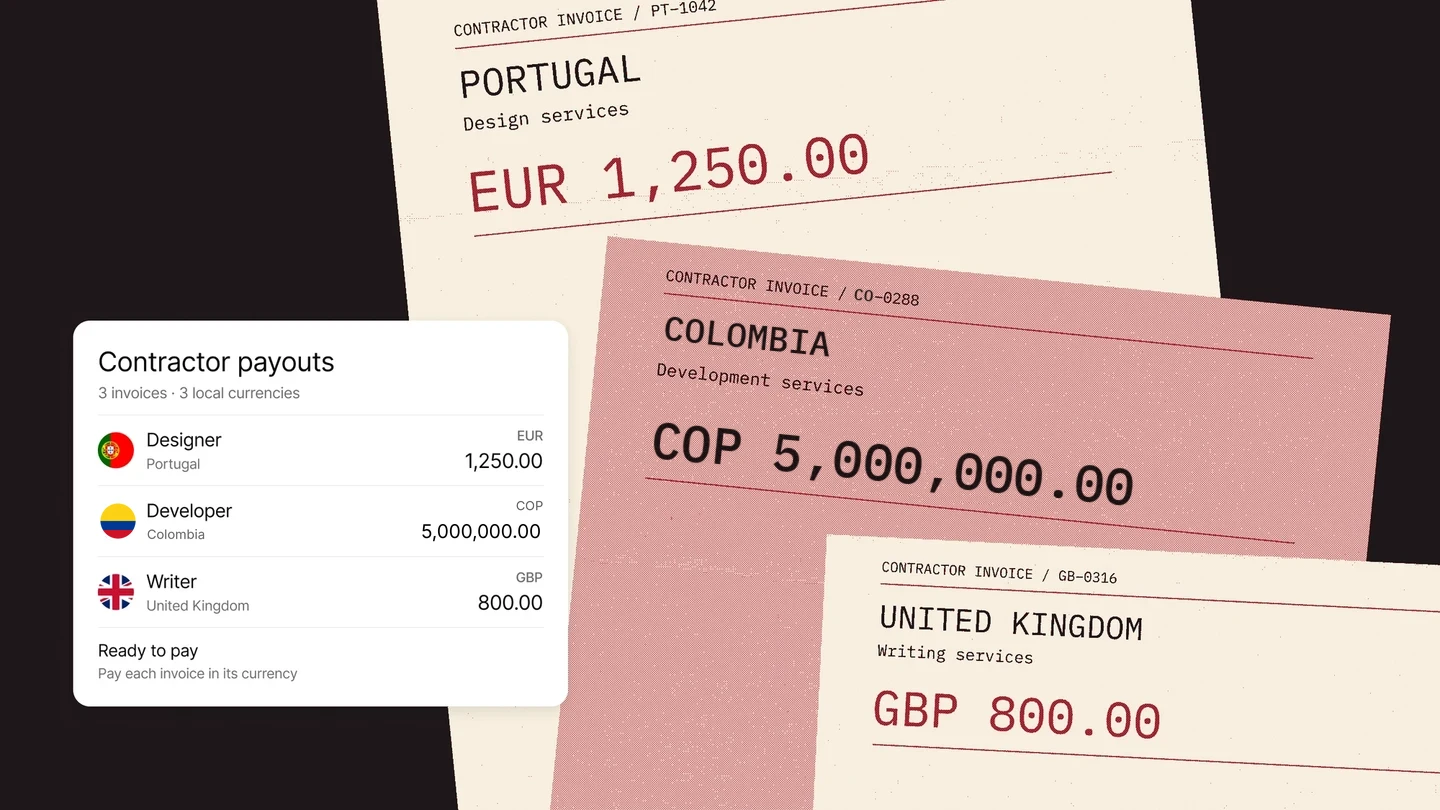
TL;DR: Paying international contractors requires matching the payment rail to the corridor, urgency, and compliance needs of each transfer. SWIFT gpi payments are often credited within a day, though some corridors take up to 5 business days, while EURC-funded SEPA typically clears in 1 business day, and stablecoin transfers settle in minutes, including on weekends. If you're a US business, collect W-8BEN or W-8BEN-E forms before the first payment, because without them you may have to treat a foreign contractor as a US person subject to 24% backup withholding. Outside the US, check your own country's withholding and reporting rules for payments to foreign contractors. Use accounting sync to QuickBooks Online or Xero to close books without manual stitching across bank portals, and set role-based approval thresholds so payments above your risk limit require secondary sign-off.
If you pay contractors in Brazil, Germany, and the UK, what is functionally one workflow can end up spread across multiple separate platforms. Each rail carries its own settlement window, fee structure, and compliance footprint. For example, a contractor invoice that arrives Friday afternoon in a different time zone can miss a bank's cut-off and wait until Monday to be processed, or settle the same day on a stablecoin rail if the recipient accepts USDC.
This guide compares payment methods on cost, speed, and documentation requirements. You will learn how to classify contractors correctly, which tax forms to collect before the first transfer, and how to choose rails by corridor rather than defaulting to the most expensive option.
Challenges in scaling multi-currency contractor pay
Managing contractor classification risks
Classification tests differ by country, and the tax liability for a misclassified worker usually lands on the business that pays them. Check the test in the contractor's country as well as your own before the first payment.
United States
The IRS groups its common-law factors into three categories: behavioral control, financial control, and the type of relationship. If you control how the work is done, provide equipment, or require set hours, the worker likely qualifies as an employee regardless of what the contract says, and the reduced employer rates under IRC section 3509 are unavailable for intentional disregard, according to IRS Publication 4341. The US Department of Labor applies a separate economic reality test under the Fair Labor Standards Act, so check the DOL's classification guidance for the current status.
United Kingdom
Under IR35, the off-payroll working rules apply when a worker supplies services through their own company and would be an employee if you engaged them directly. For medium and large private-sector clients, the client decides the worker's status and must issue a status determination statement with its reasons. For small clients, the worker's own company decides. Status turns on factors such as control, the right to send a substitute, and mutuality of obligation, and a client that gets the determination wrong can owe the unpaid tax and National Insurance.
Germany
Germany's Scheinselbständigkeit (false self-employment) rules look at whether the contractor follows your instructions and is integrated into your organization's workflows. Either party can ask the Deutsche Rentenversicherung for a status determination (Statusfeststellungsverfahren), and a reclassification can lead to back payment of social security contributions. Other EU member states apply their own tests, so confirm the local rules for each contractor's country.
Misclassification triggers back taxes, penalties, and interest in every jurisdiction, and tax authorities and labor regulators can examine classification decisions separately. Getting this wrong means owing employer taxes you never budgeted for.
Employer of record versus direct contracting
Direct contracting fits a person who runs an independent business, sets their own hours, and takes other clients. An employer of record (EOR) becomes the legal employer in the worker's country and runs local payroll, which fits workers who look like employees under local classification tests. An agent-of-record arrangement is a separate model in which a third party handles the contracting relationship.
US tax obligations for contractors
Whether you withhold US tax on a contractor payment depends on where the work is performed and which documents you hold. A foreign contractor working entirely outside the US generally isn't subject to US withholding when you have the correct W-8 form on file. The "Essential tax forms for international payees" section below explains which form to collect and what happens without it.
Permanent establishment risk
A contractor can create a permanent establishment (PE) for your business in their country if they habitually conclude contracts on your behalf or work from a fixed place you control. Whether that happens depends on local law and the applicable tax treaty. A contractor who delivers defined work is lower risk than one who negotiates and signs deals for you, so ask a local tax adviser to review any contractor who acts as a sales agent or works full time under your direction.
Managing FX markups and conversion fees
When you send a cross-border wire through a traditional bank, you rarely see the FX cost as a line item. Instead, the bank that converts the funds applies an exchange rate worse than the interbank mid-market rate, and that gap is where the real cost sits. The sending bank usually does the conversion, unless you send USD, in which case the recipient's bank typically converts it on arrival.
Beyond the stated transfer fee, an embedded FX markup applies to the converted amount. The markup is a percentage of the payment, so its dollar cost scales with the amount: each 1% of markup on a $10,000 contractor payment equals $100, on top of any fixed fees. This turns a quoted "$35 wire fee" into a higher real cost. For a corridor benchmark, the World Bank's Remittance Prices Worldwide database publishes total transfer costs, including the exchange rate margin, by sending and receiving country. It tracks consumer remittances rather than B2B payments, so treat it as a reference point and calculate your own cost by comparing the rate your bank quotes against the mid-market rate on the day you send.
How payment rails impact settlement windows
Banking hours constrain traditional rails. Most SWIFT gpi payments are credited within a day, but delays of several business days still occur on some corridors, especially where intermediary or beneficiary banks hold payments for compliance checks. Standard SEPA Credit Transfers settle by the next business day and only run on banking days. SEPA Instant Credit Transfers settle within seconds at any time. Under Regulation (EU) 2024/886, euro-area payment providers have had to offer sending instant euro transfers since 9 October 2025.
ACH reaches only US bank accounts, so its cut-offs matter for US contractors rather than international ones. Same-day ACH has three submission deadlines (10:30 a.m., 2:45 p.m., and 4:45 p.m. ET), with same-day settlement for files submitted on time on business days. A payment initiated at 5:01 p.m. ET on a Friday waits until Monday for processing.
How to execute cross-border contractor payouts
Managing SWIFT payment compliance
SWIFT works best when you need to send large, infrequent international payments to corridors where local rails do not reach. You need the recipient's SWIFT/BIC code, IBAN or account number, and the bank's physical address. You also choose a charge instruction for each payment. SHA, where the sender and recipient share the fees, is the common default. Under OUR, the sender covers the known fees under the OUR convention, though some intermediary banks can still deduct charges.
SWIFT payments route through correspondent banks, and each intermediary can add delays and fees. On a $5,000 contractor payment, the sender pays an outbound wire fee, and the recipient may lose further amounts to intermediary lifting fees plus the FX markup. Sending, intermediary, and recipient banks can all charge independently.
Traditional banks with established correspondent networks can sometimes negotiate lower intermediary fees on high-volume SWIFT corridors, an advantage for very large, infrequent payments. Before approving any transfer, ask your provider to show the effective exchange rate, the amount you send, and the amount the recipient receives, so the contractor knows what to expect.
Local rail coverage by corridor
Local rails bypass correspondent banking and settle faster at lower cost. EURC-funded SEPA Credit Transfers cover euro payments across Europe. Faster Payments in the UK typically settle in seconds, with two hours as the maximum. Pay.UK publishes the £1 million system limit, and individual banks may set lower limits.
In Latin America, SPEI handles Mexican peso transfers in seconds, and Banco de México publishes SPEI operating information. Pix processes Brazilian real transfers instantly, 24/7, including weekends. Banco Central do Brasil describes the instant settlement capability.
When you centralize these rails in one account, you eliminate the workflow of logging into separate bank portals for each corridor. You select the destination country, enter the recipient details once, and the platform routes via the appropriate local rail without requiring you to know which CLABE format Mexico uses or whether the UK transfer needs a sort code.
Managing contractor pay via stablecoins
Stablecoin transfers operate outside banking hours and settle in minutes. On Solana, transaction costs on the network typically run under a cent.
This rail works when the contractor accepts USDC or EURC. It does not work if they need local currency in a traditional bank account immediately. Stablecoins eliminate the Friday afternoon problem: you send a payment Saturday morning, it settles Saturday morning, not Monday evening. Learn more about cross-border payment options including stablecoin and traditional rails.
Managing international wire payments
US domestic wires typically settle within one business day. For international wires, verify whether the recipient's account is USD-denominated or requires conversion. If the destination account holds another currency, the recipient's bank sets the conversion rate and fees.
Always confirm the exact amount the contractor should receive. Wire transfers do not guarantee full-value receipt when correspondent banks deduct lifting fees. Fixed fees and transfer minimums make wires impractical for small, frequent contractor payments.
Reducing FX costs in foreign accounts
Hold balances in the currencies you pay frequently. If you pay EUR contractors monthly, maintain a EURC balance rather than converting from USD each time. When you convert between USDC and EURC, the executed rate and any slippage apply.
For example, Altitude, a global business account that pays contractors by local payment system, international transfer, or stablecoin, lets you fix either the "You send" or "Recipient receives" amount before executing. Altitude calculates the other side and shows the effective rate and both amounts, refreshing every 30 seconds. This transparency prevents the surprise of a contractor receiving €850 when you intended to send €900.
Payment schedules and invoice terms
Set the payment terms in the contract: the invoice currency, the number of days after approval you pay, and the rail you use. Name the currency so the contractor or your business, not the bank, decides who carries the FX risk. Match the due date to the rail's settlement window, as described in the settlement windows section above: a SWIFT payment needs to leave earlier than a stablecoin transfer that settles in minutes.
Evaluating payment rails for contractor payouts
Settlement speed by payment rail
| Rail | Settlement Time |
|---|---|
| SWIFT | Up to 5 business days |
| EURC-funded SEPA | Typically 1 business day |
| Stablecoin (Solana) | Within minutes |
| ACH (US bank accounts only) | 1 to 2 business days |
| Same-day ACH (US bank accounts only) | Same business day |
Evaluating FX markups and service fees
Calculate the total cost as a percentage of the payment amount to compare rails fairly. A typical $35 bank wire fee on a $500 payment equals 7% before adding FX markup, and each 1% of markup adds another $5. The same $500 payment via stablecoin transfer on Solana carries network fees that typically run under $0.01, plus whatever your provider charges. If the contractor needs local currency, add their off-ramp or exchange fees and the conversion spread, because a SWIFT payment that includes conversion is not a like-for-like comparison without them.
For payments that must settle in local currency via a traditional bank, compare the platform's stated fee against the FX spread. Specialized platforms often charge significantly less than the markup embedded in bank wires.
Mapping global payment corridors
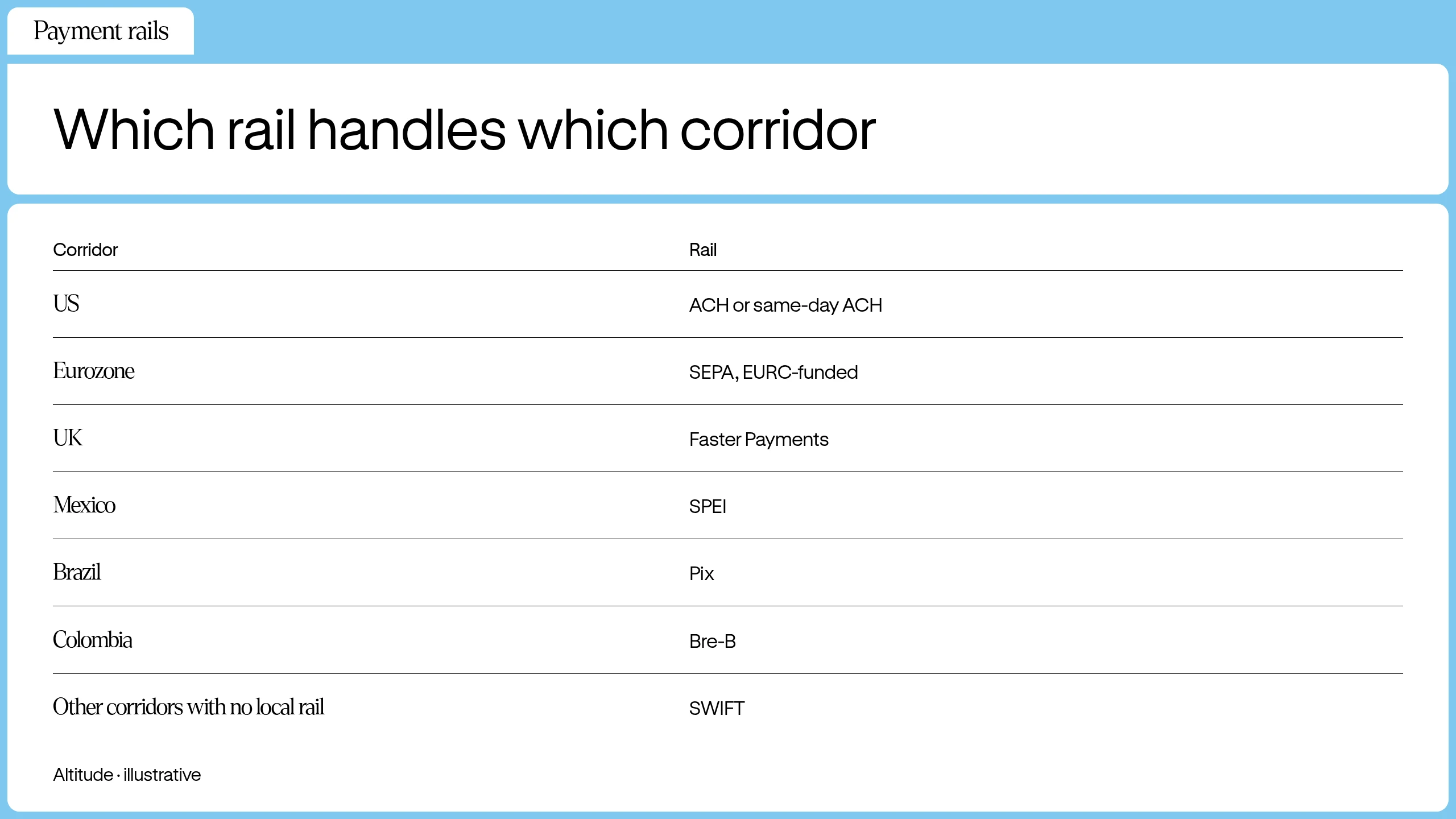
Match the rail to the destination country and currency:
- Europe: SEPA is the standard rail for Euro payments
- UK: Faster Payments handle GBP
- Mexico: SPEI handles MXN
- Brazil: Pix handles BRL
- Colombia: Bre-B handles COP
- Thailand: PromptPay handles THB, where your provider can route to it
- India: UPI handles INR, where your provider can route to it
Each rail requires specific identifiers. SPEI needs an 18-digit CLABE with valid check digits. Pix requires a registered Pix key: email, phone number, random EVP key, or CPF/CNPJ. Bre-B uses a Bre-B key, which is separate from a standard bank transfer. Altitude Help Center details these requirements.
PromptPay and UPI are domestic systems, so confirm that your provider can send to them before you plan around them. PromptPay accounts are linked to identifiers such as a mobile number or national ID, and UPI payments go to a UPI ID or bank account details, so ask the contractor which one they use. For countries in Asia and Africa where your provider has no local route, use SWIFT, or a stablecoin transfer if the contractor accepts USDC, and compare the full fee stack first.
Match urgency to rail capability. If the contractor needs funds within hours and accepts stablecoins, use that rail regardless of geography. If they need local currency in a bank account and you have three business days, use the local rail (SEPA, Pix, SPEI) for that corridor. Reserve SWIFT for corridors where no local rail exists, and weigh the full fee stack before sending. Layered fees from the sending, intermediary, and recipient banks hit smaller transfers hardest, so compare the total against the payment amount before choosing this rail.
Solving multi-currency reconciliation gaps
Manual reconciliation across bank portals consumes hours at month-end. You match a GBP Faster Payments receipt to a EUR invoice to a QBO or Xero entry, often across different dates due to settlement delays. Each unmatched transaction requires investigation.
Centralized accounts with accounting sync reduce this burden. A one-way sync to QuickBooks Online or Xero, with your confirmation required before anything posts, eliminates the CSV export, format manipulation, and manual journal entries that typically accompany multi-rail contractor pay.
Compliance requirements for international contractor payments
Essential tax forms for international payees (US payers)
Collect Form W-9 from US contractors and W-8BEN or W-8BEN-E from foreign contractors before the first payment. The W-8BEN is the IRS form a foreign individual gives a payer to establish foreign status and, if applicable, claim a reduced rate under a tax treaty, while the W-8BEN-E applies to foreign entities. Without the right form, you may have to treat the contractor as a US person subject to 24% backup withholding. The IRS instructions for Form W-8BEN explain who completes it, and IRS Publication 515 details the withholding requirements for nonresident contractors and foreign entities.
A W-8BEN generally expires at the end of the third calendar year after the year you sign it, unless circumstances change, so collect a new one before then. Retention is a separate question: keep forms for as long as your records policy and the IRS statute of limitations require. You do not submit them to the IRS, but you must produce them during an audit.
Essential audit logs for cross-border payments
Maintain records showing who initiated each payment, who approved it, when, and for what business purpose. Role-based permissions create this audit trail automatically without requiring you to log actions in a separate system. Configurable approval thresholds ensure that payments above your set limit require secondary review, so you can prove to your CFO or an auditor that no single person could move large amounts without oversight.
Document the business purpose for each payment by matching contractor invoices to payment confirmations by amount and transaction reference. This supports the independent contractor classification decision and tax treatment if questioned during a tax authority review.
US withholding tax on payments to foreign contractors
The standard withholding rate for foreign persons on US-source income is 30% unless a tax treaty reduces or eliminates it. Treaty rates vary by country, so check the treaty that applies, as IRS Publication 515 explains. The UK-US treaty shows why the details matter: the treaty eliminated the separate article covering independent personal services, so that income now falls under business profits (Article 7) and is taxable in the US only when attributable to a US permanent establishment, as the IRS Technical Explanation of the US-UK Income Tax Convention details. You generally do not withhold US tax on payments to a UK contractor performing services entirely outside the US.
Tax rules for non-US payers
The W-8 forms, 1099 reporting, and US withholding rates above apply only to US payers. Many EU businesses that buy services from a contractor in another country account for VAT under the reverse charge, rather than paying it to the supplier, and many countries also withhold tax on certain payments to foreign providers, depending on local law and any tax treaty. Check your own country's rules, and ask a local tax adviser which forms, VAT treatment, and reports apply to each contractor.
A non-US example shows the difference. A German business that hires a freelance designer established in Portugal generally doesn't pay Portuguese VAT on the invoice. Under Article 196 of the EU VAT Directive (2006/112/EC), the customer that receives business services from a supplier established in another member state is the one liable for the VAT, so the German payer accounts for it through the reverse charge in its own VAT return. That is a VAT rule and says nothing about income tax withholding, which depends on German law and any treaty with the contractor's country, so confirm both with a local tax adviser before the first payment.
Withholding works the same way in reverse for a payer outside the US. A UK business that pays a contractor based in another country should check whether UK rules require it to withhold tax on that payment, and whether a tax treaty between the UK and the contractor's country changes the result. The answer depends on what the payment is for, because fees for services and payments for rights to use the contractor's work product can be treated differently. Ask a local tax adviser to confirm the treatment and the reporting duties before the first payment, and keep the contractor's residence documentation on file.
E-invoicing mandates across jurisdictions
E-invoicing rules are set country by country, so check them wherever you have a local entity or pay a contractor who invoices under local rules. In the EU, member states are implementing mandatory e-invoicing with varying timelines. Germany's mandate phases in by company size: all businesses have had to be able to receive structured e-invoices for domestic B2B transactions since January 2025, and the duty to issue them starts in January 2027 or January 2028, depending on prior-year turnover. The mandate covers only invoices between businesses established in Germany, so contractors invoicing a foreign client can usually keep issuing standard invoices that meet German VAT content rules. Italy has required e-invoicing since 2019.
Latin America has its own formats. Brazilian invoices (Nota Fiscal) must include specific tax identifiers, and failure to provide compliant invoices can result in tax authorities rejecting the expense deduction. In Mexico, the mandatory e-invoice is the CFDI (Comprobante Fiscal Digital por Internet), a digital invoice that a certified provider validates and registers with the tax authority, SAT. Confirm with a local tax adviser whether each contractor in Brazil or Mexico must issue a Nota Fiscal or CFDI for your payments, and check the rules in any other country where you have an entity.
Contractor agreements and IP assignment
Put the scope, deliverables, fee, invoice currency, and payment terms in a written agreement. Also state who owns the work product. In many jurisdictions the contractor keeps the rights to what they create unless the contract assigns them, and some countries add rules on assignment or moral rights.
Sanctions screening and Form 1042-S
Screen each payee against the sanctions lists that apply to your business before the first payment, and again when the payee's details change. US payers check the lists published by OFAC. UK businesses check the UK's consolidated list of financial sanctions targets, which the Office of Financial Sanctions Implementation (OFSI) publishes. EU businesses check the EU sanctions measures, which the EU Sanctions Map collects.
The UN Security Council also publishes a consolidated list of sanctioned individuals and entities. Which lists apply depends on where your business is established and which banks and providers handle the payment, so confirm the set with your compliance adviser. For US payers, Form 1042-S reports US-source income paid to foreign persons, including any tax you withhold, as the IRS instructions for Form 1042-S explain. Pay for services performed entirely outside the US is generally foreign-source.
Contractor payment checklist
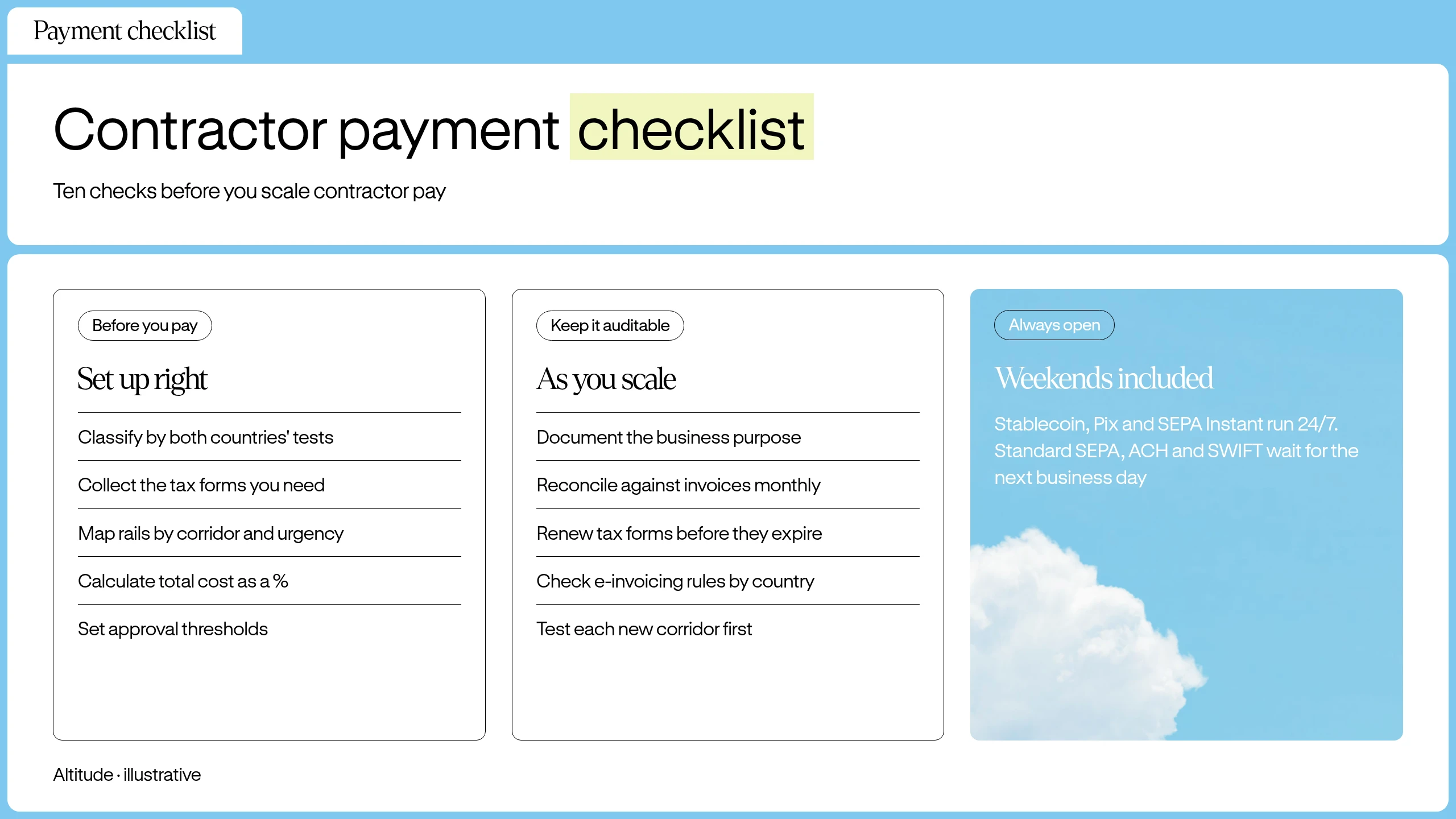
Use this checklist to audit your international contractor payment workflow:
- Classify each worker correctly using the test in your country and the contractor's country (for example, the IRS behavioral, financial, and relationship tests in the US, IR35 in the UK, or Scheinselbständigkeit in Germany) before the first payment.
- Collect the tax forms your country requires from each contractor before processing any transfer (Form W-9 from US contractors and Form W-8BEN or W-8BEN-E from foreign contractors, for US payers).
- Map your payment corridors by destination country, volume, and urgency to identify which rails (SEPA, SWIFT, stablecoins, local rails) serve each need.
- Calculate the total cost per payment including fixed fees and FX markups as a percentage of the transfer amount.
- Set role-based approval thresholds so payments above your risk limit (e.g., $5,000) require secondary sign-off.
- Document the business purpose for each payment by matching contractor invoices to payment confirmations by amount and transaction reference.
- Reconcile payments to invoices at month-end using transaction IDs and amounts, accounting for settlement delays across different rails.
- Renew tax forms before they expire (for US payers, each W-8BEN expires at the end of the third calendar year after signing), and store them for as long as your records policy and your tax authority's rules require, in a system that lets you produce them during a tax authority audit.
- Check e-invoicing rules in each country where you have a local entity (for example Germany and Italy), and confirm contractors in Brazil issue a compliant Nota Fiscal and contractors in Mexico issue a CFDI where required.
- Test one payment per new corridor before running a full batch to confirm the recipient's details and rail identifiers are correct.
How Skyrise consolidated contractor and treasury payments in one account
Skyrise, a global creative agency with team members across Portugal, Thailand, and the US, needed to pay some people in USDC and others in euros directly to local bank accounts. Managing both flows alongside treasury and card spend meant juggling separate tools and reconciling across them at month-end.
By centralizing on Altitude, Skyrise eliminated the multi-portal workflow. The team now processes both USDC and EUR-to-bank-account payments from one account, with treasury and card spend in the same place.
Book a demo to see how Altitude handles multi-rail contractor payouts from one account.
FAQs
What is the cheapest way to pay international contractors?
The cheapest option depends on the corridor, the payment size, and what the contractor can receive. Stablecoin transfers (USDC or EURC) usually carry the lowest sending cost and settle in minutes, but they only work if the contractor accepts them, and they are irreversible once settled, so test with a small payment first. For bank transfers, local rails such as SEPA, Faster Payments, SPEI, and Pix generally cost less than SWIFT, which can add sending, intermediary, and recipient bank fees plus an FX markup. ACH only reaches US bank accounts, so it applies to US contractors, not international ones. Compare the total cost as a percentage of the payment, using your bank's published fee schedule and the gap between its quoted rate and the mid-market rate, before choosing.
How long do international contractor payments take to settle?
Settlement ranges from minutes (stablecoins on Solana) to five business days (SWIFT). SEPA settles by the next business day, or in seconds with SEPA Instant. ACH takes 1 to 2 business days, same-day ACH settles the same business day, and Faster Payments typically settle in seconds.
What tax forms do I need for international contractors?
If you're a US business, collect Form W-9 from US contractors and Form W-8BEN (individuals) or W-8BEN-E (entities) from foreign contractors. You do not issue Form 1099-NEC to foreign contractors for services performed entirely outside the US, but you must keep the W-8 forms on file. Without them, you may have to treat the contractor as a US person subject to 24% backup withholding and 1099 reporting. If you pay from outside the US, the W-8 and 1099 forms don't apply to you, so check which forms, VAT treatment, and reports your own country requires for payments to foreign contractors, and confirm them with a local tax adviser.
Can I pay international contractors on weekends?
Yes, via stablecoin transfers, which operate 24/7 including weekends and holidays. Standard SEPA, ACH, and SWIFT transfers don’t process on weekends or banking holidays, though SEPA Instant and Pix run 24/7. A payment initiated Friday evening via standard SEPA, ACH, or SWIFT typically settles Monday or Tuesday.
How do I reconcile multi-currency contractor payments?
Use a platform that syncs to QuickBooks Online or Xero with user confirmation before posting. Match payment confirmations to contractor invoices by amount and date, accounting for settlement delays, and use transaction reference numbers to trace each transfer back to the original invoice.
Key terms glossary
SWIFT: The Society for Worldwide Interbank Financial Telecommunication network facilitates international wire transfers between banks.
Local payment rails: Domestic payment systems like SEPA (Europe), Faster Payments (UK), SPEI (Mexico), and Pix (Brazil) that settle transactions within their respective countries or regions faster and cheaper than international wires.
Correspondent banking: The network of intermediary banks that facilitate international transfers when the sending and receiving banks lack direct relationships. Each correspondent bank can add delays and deduct fees.
FX markup: The difference between the mid-market exchange rate and the rate offered to customers. Banks typically embed this markup in the exchange rate rather than charging an explicit fee. The World Bank's Remittance Prices Worldwide database tracks these costs for consumer remittances, not B2B payments, so compare your own bank's quoted rate against the mid-market rate on the day you send.
Settlement time: The duration between payment initiation and final availability of funds to the recipient. This ranges from minutes for stablecoin transfers to several business days for bank transfers on some corridors.
Stablecoin transfers: Networks that transfer digital dollars (USDC, EURC) pegged to fiat currencies. These operate outside traditional banking hours.
Altitude is a financial technology platform, not a bank or digital asset custodian.