
Intercompany accounting: entries, eliminations, reconciliation and payments between entities
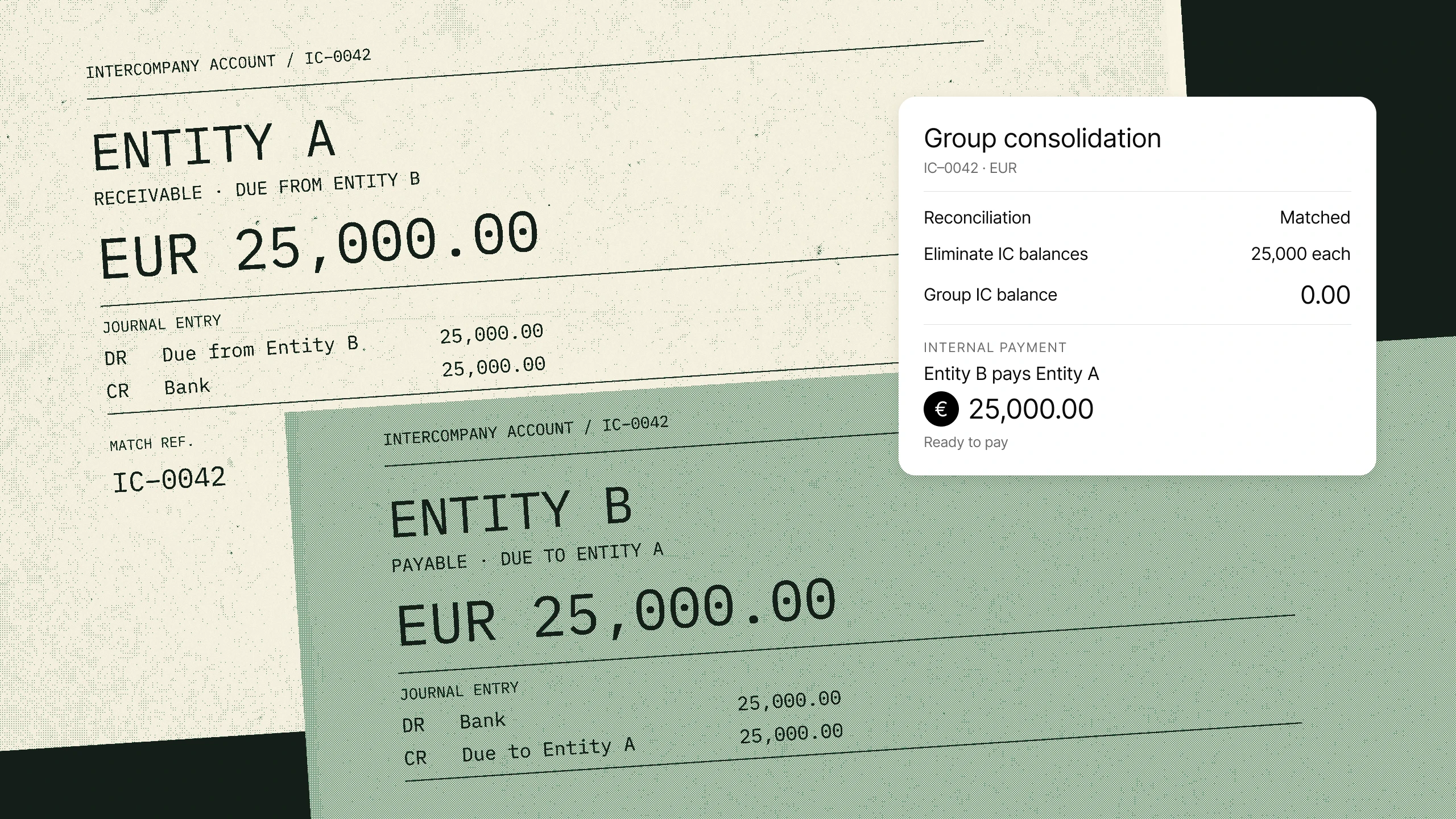
TL;DR: A single unmatched intercompany balance can hold up a consolidated close, so the work is to reconcile by entity pair monthly and eliminate only after both sides match. Intercompany accounting requires reciprocal due-to/due-from entries that mirror each other, elimination entries that remove intercompany activity from consolidated statements, and reconciliation workflows that prove both are correct. Every entry should reference its source document, and FX gains and losses follow IAS 21 or ASC 830. The settlement rail is the main payment decision: ACH, SWIFT and standard SEPA transfers follow banking cut-off times, while SEPA Instant and stablecoin transfers aren't limited to banking hours, and stablecoin transfers are irreversible once settled. For stablecoin settlement, a transaction hash alone is not enough for audit acceptance, so pair it with the approval record and the mapped ERP entry.
This article covers how to document entries, match balances, run eliminations, standardize audit evidence, and handle FX. It also covers how to move money between entities with controls that hold up in an audit.
The mechanics of intercompany ledger flow
Intercompany accounting starts with a single transaction between two legal entities within the same corporate group. The mechanics depend on the transaction type, how each entity records it in their ledger, and whether the balances match at month-end.
The core control principle is that one entity's due-to balance mirrors the other entity's due-from balance. If Entity A records a $100,000 payable to Entity B, Entity B must record a $100,000 receivable from Entity A, so the internal debt nets to zero when consolidated statements eliminate intercompany activity. The consolidation team should not post eliminations until both sides agree, because eliminating against balances that don't match creates a plug that misstates consolidated assets, liabilities, revenue, or equity. Every unmatched invoice, missed accrual, or currency difference therefore becomes a chain of emails between entity controllers.
Key intercompany transaction archetypes
Intercompany transactions follow several common types, each creating distinct due-to/due-from entries and elimination treatments.
The table covers common intercompany transaction types between affiliates.
| Archetype | Due-to/due-from entry created | Elimination treatment |
|---|---|---|
| Intercompany sale | Seller records revenue and due-from. Buyer records expense and due-to | Revenue, expense, receivable and payable eliminated |
| Intercompany loan | Lender records loan receivable. Borrower records loan payable | Loan balance and associated interest eliminated |
| Cost allocation | Provider records expense recovery. Recipient records allocated expense | Recovery income and allocated expense eliminated |
| Management fee | Parent records fee income. Subsidiary records fee expense | Fee income and expense eliminated |
| IP licensing | Licensor records royalty income. Licensee records royalty expense | Royalty income and expense eliminated |
Ensuring data integrity in reconciliation
Reconciliation starts with balance-level comparison by entity pair, then moves to transaction-level matching. Comparing aggregate balances first shows which entity pairs have differences and sets the priority for line-by-line investigation. If Entity A's ledger shows a $50,000 due-from Entity B, the reconciliation must identify the specific invoices, loans, or allocations that created that balance and confirm Entity B recorded the same transactions. Data integrity requires reciprocal entry posting to both entities' ledgers simultaneously, transaction ID tracking that links due-to and due-from records across entities, and monthly matching to catch discrepancies before the consolidated close.
Documenting ledger entries between subsidiaries
Documentation should begin when the intercompany transaction occurs. Every due-to/due-from entry must reference the underlying commercial document: an invoice, loan agreement, or cost allocation memo.
Managing intercompany due-to/from balances
Due-to and due-from balances accumulate over time as intercompany activity occurs. Managing these balances requires a clear settlement policy covering how often intercompany positions are settled and how FX differences are handled when entities operate in different currencies. A written settlement policy typically defines:
- Settlement frequency: how often each entity pair settles open balances (for example monthly or quarterly) and who triggers the settlement.
- Settlement method: which payment rail the entities use and which payment reference is recorded against the settlement entry.
- Currency and FX rate: the settlement currency, plus the rate source and date used to record the transaction and the settlement, so FX differences are calculated the same way for every entity pair.
- Netting: whether balances between entity pairs are netted before settlement or settled gross.
- Aging and escalation: the age at which unsettled balances are flagged, reviewed, and escalated to the entity controllers.
- Approval and documentation: who approves each settlement, with the source document referenced per the documentation policy.
Automating intercompany ledger entries
Manual intercompany entries introduce error surface at every step. Automating entries requires a shared chart of accounts across entities, standardized transaction codes, and workflow rules that post reciprocal entries simultaneously. When Entity A records a management fee to Entity B, the accounting system should automatically post the reciprocal entry in Entity B's ledger, which reduces the risk of one entity recording the transaction and the other missing it.
Designing intercompany ledger codes
Intercompany ledger codes separate intercompany activity from third-party transactions. A common design uses a dedicated account range with sub-codes by counterparty entity:
- Due-from accounts by entity
- Due-to accounts by entity
This structure makes intercompany balances easy to identify, extract for reconciliation, and eliminate in consolidation. It also prevents intercompany balances from being buried in general receivables or payables.
Aligning charts of accounts, calendars, and currencies across entities
Intercompany matching breaks down when entities record the same transaction on different bases. Three alignments prevent many of the mismatches covered later in this article:
- Chart of accounts: map each entity's local accounts to a shared group chart, so every due-to and due-from account has one group-level equivalent per counterparty.
- Calendars: entities can keep different local close calendars, provided each one closes against a shared group cutoff date and balances are extracted after the group's intercompany posting deadline. Confirm each entity applies the same cutoff rule. If an entity's reporting date differs from the group's, document how intercompany transactions between the two dates are handled and confirm the treatment with your auditor.
- Currencies: record each balance in the currency of the underlying agreement alongside the entity's functional currency, and set one group rate source and rate date for remeasuring intercompany balances.
Recording intercompany sales and expenses
Intercompany sales follow the same accounting logic as third-party transactions, with one difference: both entities record transactions inside the same consolidated group. When Entity A sells services to Entity B for $75,000, Entity A records $75,000 revenue and $75,000 due-from Entity B, while Entity B records $75,000 expense and $75,000 due-to Entity A.
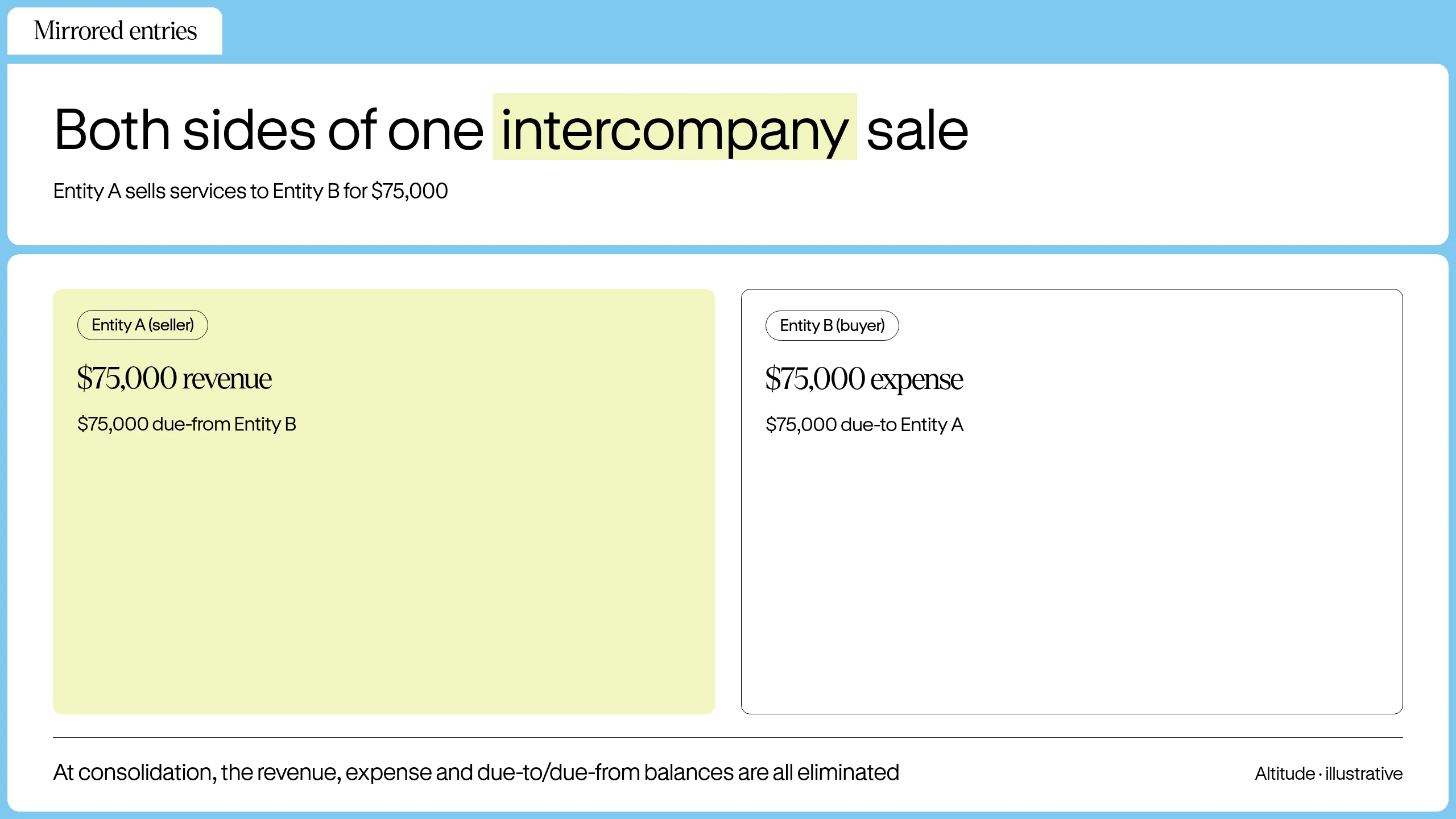
At month-end, the consolidation eliminates the $75,000 revenue and $75,000 expense, along with the due-to/due-from balances. Both US GAAP and IFRS require this elimination of intra-group balances, transactions, income, and expenses. The section "Defining intercompany elimination criteria" below covers the governing standards in detail.
Matching intercompany balances for audit
Reconciliation creates the audit trail. It proves that intercompany balances are real, documented, and matched.
Matching intercompany ledger balances
Ledger matching compares intercompany balances across entities and flags discrepancies, and unmatched items require admin review. The process runs in three steps:
- Pull due-to and due-from balances from each entity's ledger.
- Match reciprocal entries by unique transaction identifier.
- Flag unmatched or mismatched entries for investigation.
For stablecoin transfers between entities, matching adds one requirement: each transfer generates a transfer reference (the transaction hash) that both entities should record in their ledgers as part of the intercompany settlement entry.
Resolving intercompany balance mismatches
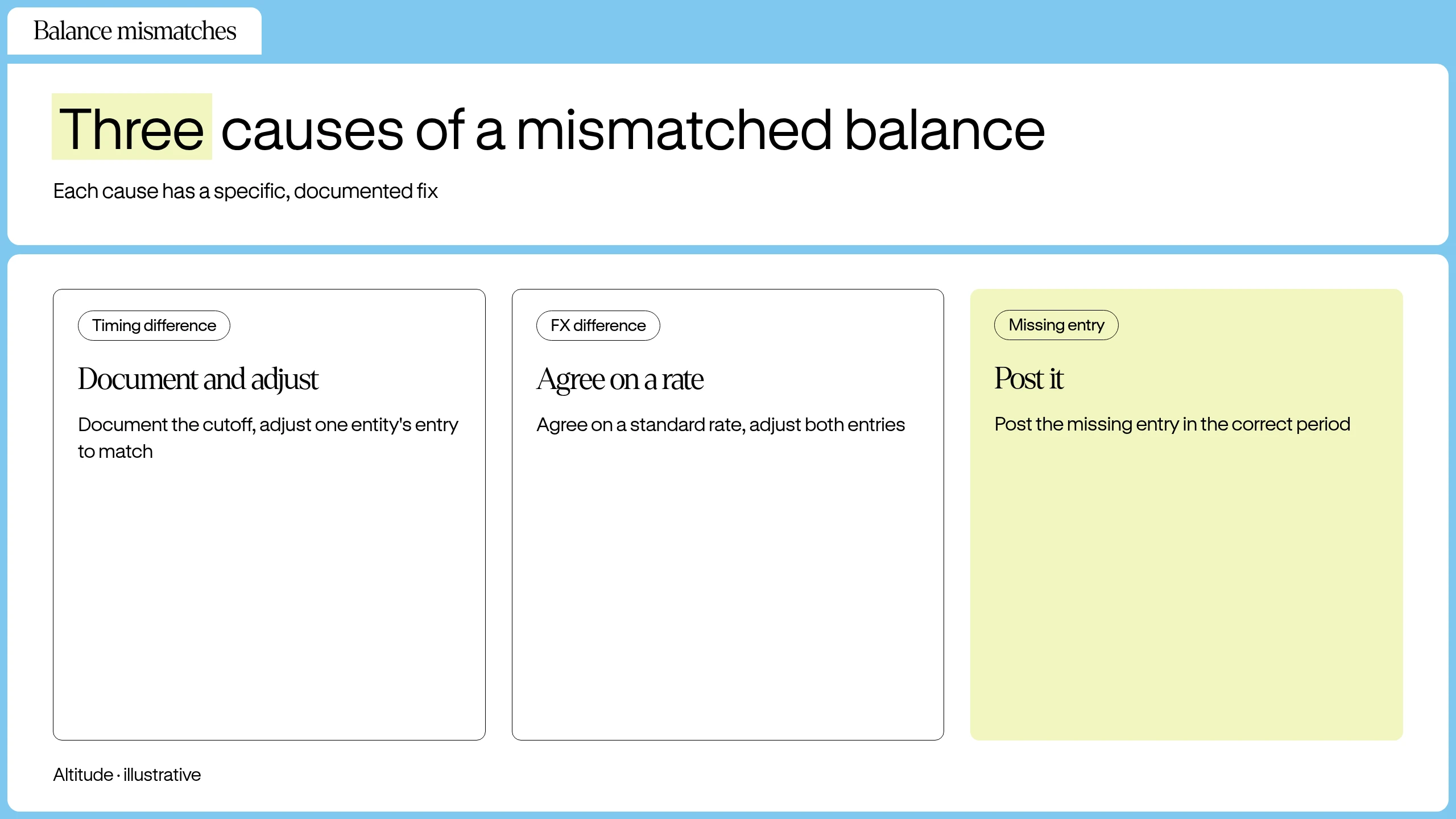
An unbalanced intercompany position means Entity A's due-to balance does not match Entity B's due-from balance. Mismatches have several possible causes. Three are covered here, each with a fix:
- Timing differences arise when one entity records a transaction in March and the other in April. Resolution: document the cutoff and adjust one entity's entry to match.
- FX differences arise when entities in different currencies record the same transaction at different exchange rates. Resolution: agree on a standard rate and adjust both entries.
- Missing entries arise when one entity records the transaction and the other does not. Resolution: post the missing entry in the correct period.
Document every resolution. The auditor will ask why the adjustment was made and who approved it.
Standardizing audit support evidence
Standardizing evidence means every intercompany reconciliation follows the same workflow: transaction-level detail for each balance, an explanation for every variance, and approval sign-off. Detailed reconciliation workpapers for each entity relationship, documented disposition of all identified discrepancies, and a complete set of supporting invoices and transfer agreements provide the audit trail external reviewers expect.
Managing FX gains and losses
When intercompany transactions cross currencies, FX gains and losses arise from exchange rate movements between the transaction date and the settlement date. IAS 21 and ASC 830 govern the treatment, and under both, these gains and losses go through net income by default. Each standard has narrow exceptions, worded differently. The one that matters most for intercompany balances is the long-term investment exception.
- US GAAP: ASC 830-20-35-3(b) moves gains and losses on intra-entity transactions "of a long-term-investment nature" (settlement not planned or anticipated in the foreseeable future) to other comprehensive income.
- IFRS: IAS 21 moves exchange differences on monetary items that form part of the net investment in a foreign operation to other comprehensive income in the consolidated statements. Settlement must be neither planned nor likely in the foreseeable future. Because "long-term investment nature" is US GAAP phrasing, IFRS reporters should test each balance against the IAS 21 wording.
Intercompany eliminations for consolidated reporting
Intercompany eliminations remove intercompany activity from consolidated financial statements. If Entity A sells services to Entity B, the consolidated group did not generate external revenue from that transaction.
Defining intercompany elimination criteria
Eliminations remove all transactions between consolidated entities and leave only transactions with external third parties. The elimination entries remove intercompany revenue and expense, intercompany receivables and payables, intercompany loans and associated interest, and unrealized profit on intercompany transfers of assets.
Eliminations are consolidation entries only. Controllers record them in a separate consolidation ledger, so each entity's standalone financial statements and statutory books still show intercompany sales as real revenue and expense. The elimination happens only in the consolidated financial statements (ASC 810-10-45-1 under US GAAP, and IFRS 10 paragraph B86 under IFRS).
Documenting intercompany eliminations
Every elimination entry must reference the underlying intercompany transaction it eliminates. The documentation includes:
- The intercompany transaction being eliminated, with a reference to its source document
- The elimination journal entry with debit and credit accounts
- Preparation and approval records for the elimination
Automating eliminations with consolidation rules
Consolidation rules post recurring elimination entries from tagged intercompany data, so controllers don't rebuild them by hand each month. A rule typically matches due-to and due-from accounts by counterparty pair, posts the elimination to the consolidation ledger only, and runs only when both sides agree within a set tolerance. Items outside the tolerance go to the entity controllers as exceptions. Eliminations such as unrealized profit on asset transfers usually still need manual review. Keep each rule's logic, approver, and change history with the elimination documentation.
Accounting cutoffs for intercompany data
Cutoff discipline ensures both entities record intercompany transactions in the same period. For example, if Entity A ships goods to Entity B on March 30 and Entity B receives them on April 2, both entities must agree on the transaction date. There is no single standard approach: the date depends on the contract terms and the group's accounting policy, and both entities must apply the same rule. Document the rule in the group policy, and document any remaining timing differences as reconciling items in the monthly reconciliation.
Documenting internal entity payment controls
Moving money between entities requires the same controls as paying an external vendor: documented approval, auditable payment records, and reconciliation to the ledger. Intercompany pricing is also subject to arm's-length rules under transfer pricing law. In the US, 26 U.S.C. §482 lets the IRS reallocate income between related parties to prevent evasion of taxes or to clearly reflect income. Arm's-length pricing applies to every intercompany sale, service fee, and cost allocation.
Outside the US, many jurisdictions base their rules on the OECD Transfer Pricing Guidelines, the international reference for applying the arm's-length principle to transactions between related entities. The requirements vary by jurisdiction, so confirm them with a tax advisor.
Core controls for inter-entity payments
Whatever the payment rail, an intercompany transfer needs the same control set, written into the group's payment policy:
- Approval workflow: each transfer is approved against a documented threshold before it is sent, with approvers named by role for each entity.
- Segregation of duties: the person who proposes or initiates a transfer is not the person who approves it, and neither of them posts the settlement entry in the ledger.
- Audit trail: each transfer keeps its approval record, the rail's payment reference (a bank reference or a stablecoin transaction hash), and the source document per the documentation policy.
- Ledger reconciliation: the settlement entry is posted in both entities' ledgers and matched to the payment record at month-end.
Document who can propose, approve, and release payments for each entity, and review that list whenever roles change. The sections below cover how these controls apply to different rails, FX, and reconciliation, with one platform shown as an example.
Operationalizing intercompany transfers
An intercompany transfer moves funds between two legal entities. The mechanics depend on the payment rail.
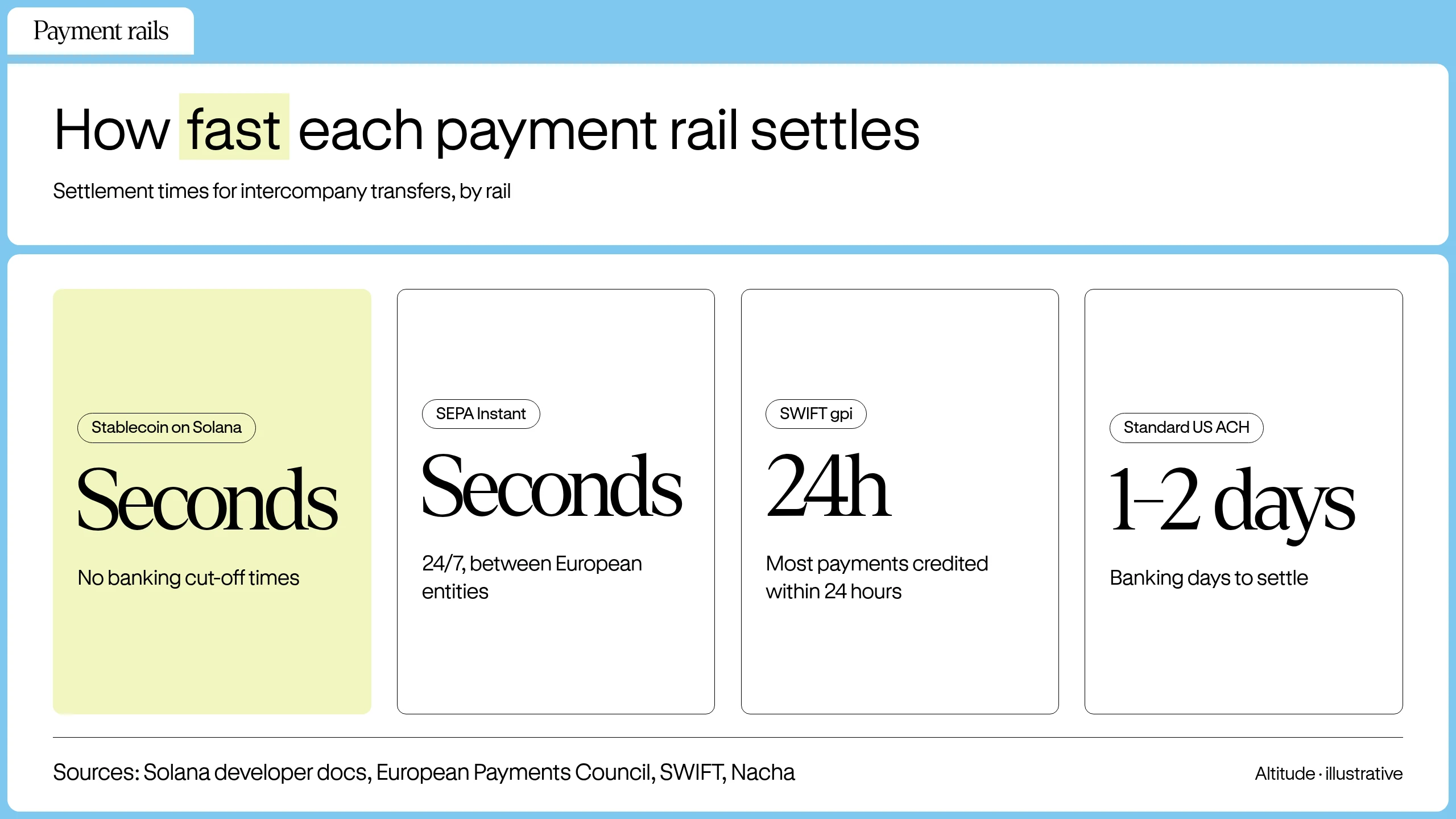
- The rail sets how fast an intercompany transfer lands. Solana's developer documentation describes transactions that confirm within seconds, and because the network doesn't observe banking cut-off times, stablecoin transfers can settle on a Saturday. Nacha puts standard US ACH at 1 to 2 banking days, and US same-day ACH arrives the same business day. SWIFT reports that most gpi payments are credited within 24 hours, though some corridors take several business days.
- In the US, same-day ACH runs within submission windows set by the ACH network, and the last network submission window is 4:45 PM ET, which is the originating bank's deadline.
- Between European entities, SEPA Instant settles in seconds, 24/7, and European banks have been required to offer sending it since 9 October 2025 under Instant Payments Regulation (EU) 2024/886. Standard SEPA Credit Transfers settle by the next business day, which is the fallback when the receiving bank can't take an instant payment. Between UK entities, Faster Payments moves GBP transfers on a separate local rail, so confirm the settlement window with your bank before you set a cut-off in the payment policy.
- Stablecoin transfers are irreversible once settled, so a wrong address or amount can't be recalled. Send a small test payment first, confirm the receiving entity has it and has recorded the transaction hash, then send the full amount.
Accounting for FX in entity transfers
When an intercompany transfer crosses currencies, the FX rate applied to the transfer can create a realized FX gain or loss in the entity that carries the intercompany balance in a currency other than its functional currency. Platforms differ in how they fix the rate. For example, Altitude, a global business account, calculates the exchange rate at the time of the transfer, shows the effective rate and both amounts, and refreshes the quote every 30 seconds. The payment records the agreed source amount, recipient amount, and rate, and executes as a fixed-output transfer.
An illustration: if Entity A (USD functional currency) sends $100,000 to Entity B (EUR functional currency) at a rate of 1.10, Entity A records a $100,000 outflow (representing dollar value) and Entity B records a €90,909 inflow (representing euro value). An FX gain or loss arises only in an entity whose recorded intercompany balance was denominated in a currency other than its functional currency, and it equals the difference between the recorded balance and the settled amount.
Example: how Altitude workspaces and transfers work
Each legal entity runs in its own Altitude workspace, with separate accounts, cards, and records. Transfers between workspaces can settle as stablecoin transfers on Solana, which settle on the Solana network without banking-hours dependency. Approval rules your team sets are applied automatically, every time, and the role-based permissions and approval thresholds in those rules determine who can propose and approve each transfer. Altitude preserves the approval records for audit.
Altitude syncs transactions from USD and EUR accounts to QuickBooks Online and Xero. Finance teams match each stablecoin transfer reference to its ERP entry manually, and correct synced entries in QuickBooks or Xero.
Reconciling stablecoin transfers to the ledger
Altitude exports transactions one workspace at a time, and controllers handle consolidated group reporting manually or in a separate consolidation tool. For controllers reconciling Altitude transfers between entities to the ledger, the workflow runs in three steps:
- Altitude's accounting and reporting tools export transactions to CSV or PDF for the current month, last month, current quarter, last quarter, year to date, or a custom range, across all accounts or a single sub-account. Run the export separately for each workspace.
- Manually match each stablecoin transfer's reference to the corresponding intercompany settlement entry in the ERP, so the ERP entry carries the same transaction hash.
- Confirm monthly that the exported transaction history matches the intercompany settlement entries recorded in each entity's ledger.
Beneficiary name mismatches on inbound SEPA and SWIFT payments
When the beneficiary name on an inbound SEPA or SWIFT payment doesn't match the account holder, the receiving rail rejects the payment and returns the funds. The due-to/due-from entries on the two ledgers then no longer match. To resolve it, correct the beneficiary name to match the legal entity name on the receiving account and resend the payment. Then update the intercompany settlement entry so both entities' ledgers reflect the same outcome.
Other failure scenarios, such as unavailable approvers and delayed stablecoin transfers, should each have a documented escalation path in the group's payment policy.
Month-end close checklist
- Export transaction history for each entity's account or workspace (CSV or PDF)
- Manually match stablecoin transfer references to ERP ledger entries
- Reconcile due-to/due-from balances across entities
- Document FX treatment for cross-currency intercompany transfers
- Verify approval records for all intercompany transfers
- Archive reconciliation workpapers with supporting documentation
- Confirm accounting syncs (for example, Altitude's QuickBooks Online and Xero syncs) are complete.
Resolving control gaps in ledger reconciliation
Control gaps surface when intercompany balances do not match, eliminations are incomplete, or transaction records are missing.
Resolving unrecorded elimination entries
Unrecorded eliminations cause consolidated financial statements to overstate revenue, expenses, assets, or liabilities. Prevention requires a complete listing of all intercompany transactions before consolidation begins. If an elimination is missed, correct it in the consolidation ledger. Whether the correction needs a prior-period adjustment or disclosure depends on materiality.
Resolving mismatched transaction records
Mismatched records occur when the underlying documentation does not align with the ledger entries. If Entity A records a $75,000 intercompany sale but the invoice shows $70,000, resolution requires reviewing the source document and correcting the ledger entry to match. If the source document is incorrect, issue a corrected invoice and adjust both entities' ledgers.
See how Altitude handles multi-workspace payments, approvals, and records. Book a demo.
FAQs
How often should intercompany accounts be reconciled?
Reconcile intercompany accounts monthly, before the consolidated close. Monthly reconciliation catches timing differences, FX mismatches, and missing entries while the transaction detail is still fresh, which reduces the risk of a year-end audit finding. Groups with high transaction volume may reconcile more often, depending on their close calendar.
What happens if intercompany balances don't match?
The consolidated close is delayed until the discrepancy is resolved, because eliminating against mismatched balances creates a plug that misstates consolidated results. Entity controllers trace the cause, such as a timing difference, FX difference, or missing entry, then post the correcting entry and document it with approval and the source document.
Do intercompany eliminations affect individual entity financials?
No. Eliminations are consolidation entries only, so each entity's standalone statements still show its own intercompany revenue, expenses, receivables, and payables. Only the group's consolidated statements drop them, because the group would otherwise report revenue it never earned from external parties.
How do you handle intercompany transactions in different currencies?
Record the transaction at the transaction-date exchange rate, remeasure open balances at each reporting date, and recognize the final gain or loss at settlement. Under IAS 21 and ASC 830, these gains and losses go through net income by default. A narrow exception sends long-term investment balances to other comprehensive income.
Can auditors accept stablecoin transfer records as intercompany support evidence?
Auditors may consider distributed ledger data as evidence if relevant and reliable, as a PCAOB staff spotlight on crypto assets notes, though it does not address stablecoins specifically and is a staff publication, not a rule. A transaction hash alone is not enough, since it doesn’t show who approved the transfer. Pair it with the approval record and mapped ERP entry.
Key terms glossary
Due-to account: A liability account recording an amount one entity owes to another entity within the same corporate group. It mirrors the counterparty's due-from account.
Due-from account: An asset account recording an amount one entity is owed by another entity within the same corporate group. It mirrors the counterparty's due-to account.
Elimination entry: A journal entry recorded in the consolidation ledger that removes intercompany transactions and balances from consolidated financial statements.
Consolidated financial statements: Financial statements that present the combined financial position, results of operations, and cash flows of a parent company and its subsidiaries as a single economic entity.
Intercompany reconciliation: The process of matching and verifying reciprocal due-to and due-from balances between entities, identifying discrepancies, and resolving differences before the consolidated close.
Altitude is a financial technology platform, not a bank or digital asset custodian.