
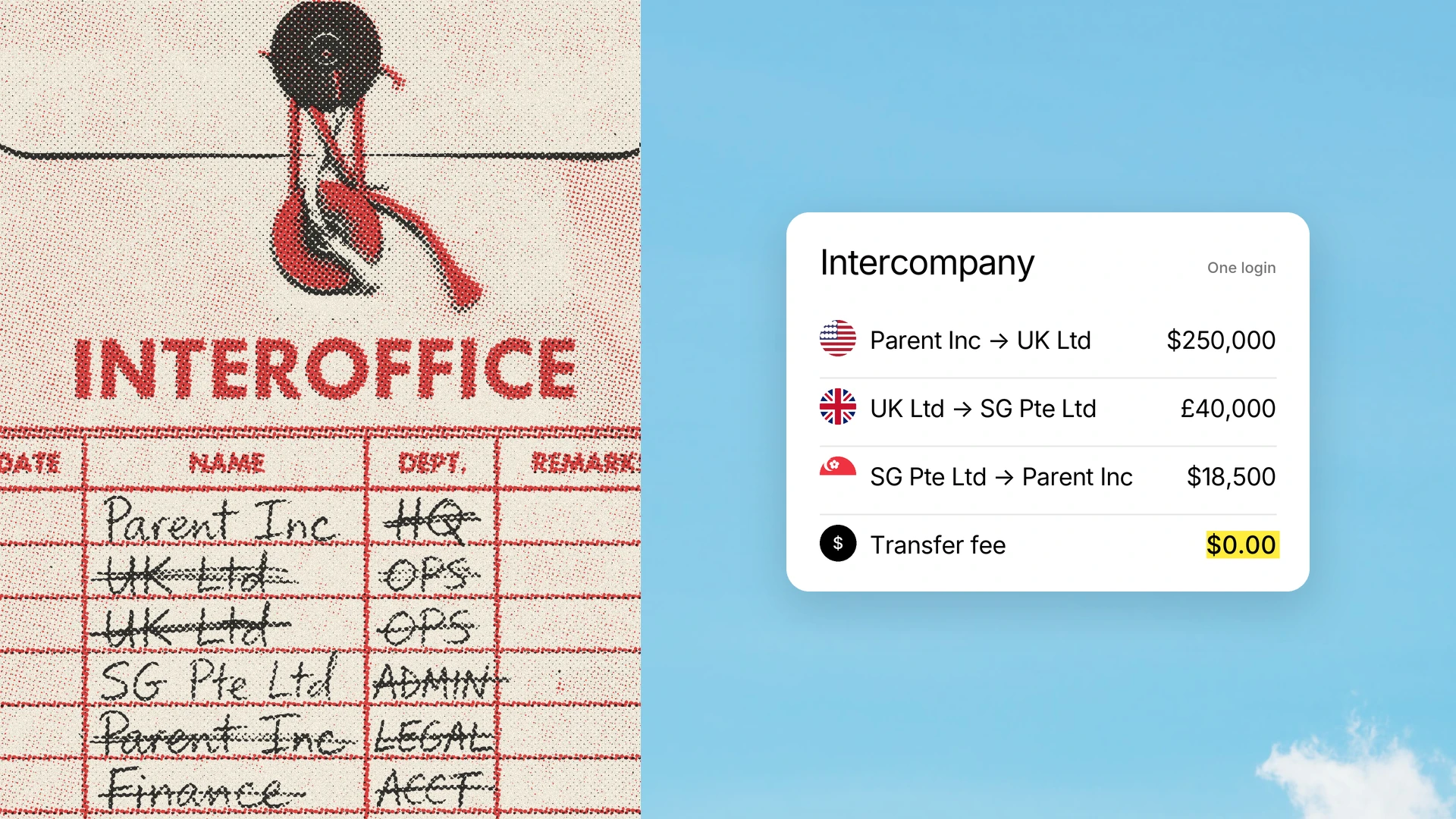
TL;DR: Intercompany transactions are transfers of value between entities under common control. Each entity books them as normal revenue or expense, but they are eliminated in full when the group consolidates. Every intercompany transfer needs three artifacts: a documented commercial rationale, a settlement record, and a reconciliation entry. Settlement rails matter: standard SEPA credit transfers (European bank transfers) settle within one business day, while SEPA Instant settles in seconds, 24/7, and has been mandatory for euro payment providers to offer since 9 October 2025. SWIFT (cross-border bank messaging) credits most payments within 30 minutes but complex transfers can take up to five business days, and stablecoin transfers settle outside banking hours. The control is a repeatable workflow: document the rationale, execute on a rail that matches your cash needs, record the transfer in both ledgers, and reconcile at period end.
Intercompany transactions are a fact of life for any business running multiple entities. This guide explains what counts as an intercompany transaction, how to document it for compliance, how to reconcile balances across entities, and how to execute the actual transfer on rails that match your cash needs and your audit requirements.
Defining intercompany transactions for treasury
An intercompany transaction is a transfer of value between two or more entities that are part of the same corporate group and under common control. Intercompany transactions require elimination during consolidation since consolidated statements exist to prevent double-counting of value transferred inside the group. Intracompany transactions, which happen within a single legal entity, require no elimination.
The distinction matters because it defines your reconciliation surface. Under both U.S. accounting rules (GAAP) and international standards (IFRS 10), parent companies must present financial statements as if the group were a single economic entity. Each entity still records intercompany sales and charges as revenue or expense in its own statutory books and tax returns. Consolidation then purges any internal profit or duplication from the group statements.
The four categories of intercompany transfers
Intercompany transfers typically fall into four categories: cost recovery, loans, service charges, and asset transfers. Each category carries its own documentation requirements and tax implications, and the scenario sections later in this guide cover each one in detail. The common thread is that every transfer must have a documented commercial rationale and must reconcile to the same amount on both sides of the transaction.
Managing intercompany payment workflows
The operational workflow for intercompany payments starts with the business case. First, document why the transfer is happening and which entities are involved. Second, execute the payment using a rail that matches your cash forecast and settlement needs. Third, record the transaction in both entities' ledgers. Fourth, reconcile the balances at period end.
The workflow breaks down when one entity records the transaction and the other misses it, when the two entities use different exchange rates, or when documentation is missing. According to Cadel, a reconciliation software vendor, these gaps are common reasons intercompany balances fail to tie at consolidation. The reconciliation section below covers the root causes and how to correct them.
| Failure scenario | What happens | Resolution path | Documentation impact |
|---|---|---|---|
| Cross-border payment fails | Beneficiary bank rejects due to compliance hold or incorrect details. Funds return to sender, which can take several business days depending on the rail: SEPA returns are generally faster, while SWIFT returns can take significantly longer. | Contact beneficiary bank for rejection reason. Correct details and re-submit. Notify counterparty entity of delay. | Log rejection reason, correction, and new submission date in intercompany ledger notes. |
| Beneficiary name mismatch | Payment held or returned. Where the account number is valid, the payment may enter a suspense account pending manual review, where the details can't be reconciled, funds are returned. Resolution time varies by bank and rail. | Verify registered entity name with counterparty. Resubmit with exact legal name. | Document the mismatch, the verified name source, and resubmission in payment record. |
| Network halt | Stablecoin transfer pending until network resumes. No funds lost, but settlement delayed. | Monitor network status. Transaction finalizes when network resumes. | Record delay cause and actual settlement time in reconciliation notes. |
| Approval signer unavailable | Payment can't execute until the required approver acts. | Configure backup approvers with same threshold. Route urgent payments to available signer per approval policy. | Log approval delay, backup signer used, and rationale in audit trail. |
The business case for intercompany transfers
Subsidiary transfers aren't optional for multi-entity businesses. They happen because shared resources cost money, because entities operate in different currencies, because tax obligations differ by jurisdiction, and because cash needs to move where it is needed.
Handling multi-currency transfers
Multi-entity groups often operate in different functional currencies. One entity may run in dollars, another in pounds, and a third in euros. When one entity transfers cash to another, the transaction may involve a currency conversion.
Defining intercompany tax obligations
Intercompany transactions create tax obligations in each jurisdiction where the entities operate, even though consolidation eliminates them. Tax authorities generally require you to price transactions between related parties as if they were between independent parties. This is called the arm's length principle, and it applies to transactions between entities in the same group, including between domestic affiliates, as well as to cross-border transactions. It also covers interest on intercompany loans, and cross-border payments may trigger withholding tax.
Transfer pricing documentation rules differ by jurisdiction, so check the requirements of each entity's tax authority. In the U.S., for example, Internal Revenue Code Section 482 governs the pricing of intercompany transactions. To avoid 20% to 40% penalties, U.S. groups should have documentation in place by the filing date. Under the Section 6662 regulations, that documentation should cover the transaction, the pricing method used, and how it was benchmarked, and the group must hand it to the IRS within 30 days of a request.
Documenting intercompany flows for compliance
Intercompany documentation isn't optional. Auditors examine it, tax authorities require it, and consolidation depends on it. The documentation trail must show what was transferred, why it was transferred, how it was priced, and how it was settled.
Mapping intercompany transaction records
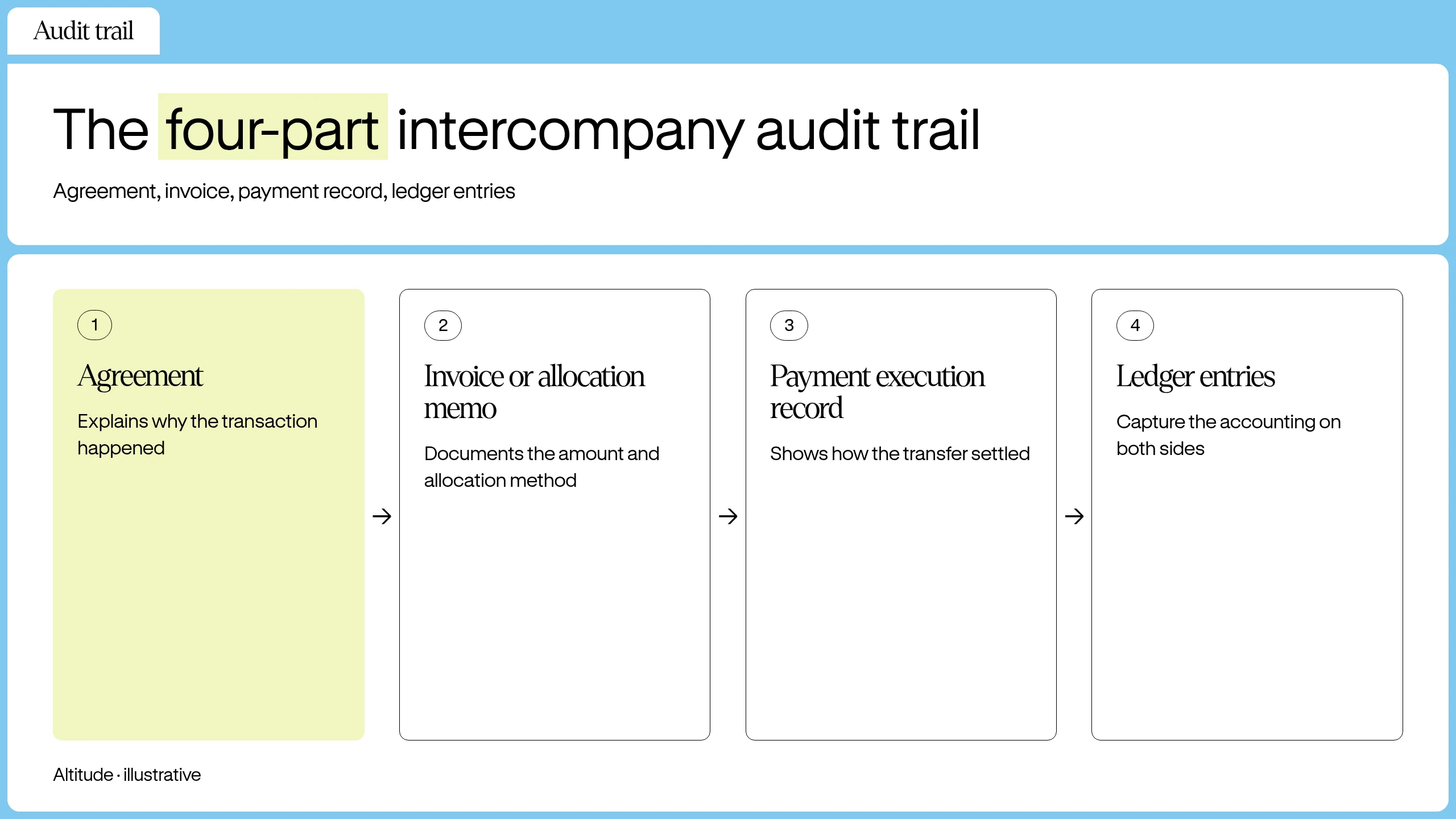
Every intercompany transaction creates records in both entities. The records include the agreement or commercial rationale, the invoice or allocation memo, the payment execution record, and the ledger entries. If an agreement, invoice, or supporting schedule is missing, auditors have less evidence to test and the group has a harder time showing the transaction was real and priced correctly.
The records must tie together. The agreement explains why the transaction happened, while the invoice or memo documents the amount and allocation method. From there, the payment record shows how it settled, and the ledger entries capture the accounting on both sides. Any gap in this chain creates audit exposure.
Writing intercompany agreements
An intercompany agreement is the written contract between two entities that sets the terms of a recurring transaction. It should name the parties, describe the goods, services, or funds covered, state the pricing method and rate, and set the currency, payment terms, and settlement timing. It should also state the term and how either entity can end it. Both entities sign it before the first invoice, and each entity reviews it again when pricing or scope changes.
Managing intercompany balances
Intercompany balances are the receivables and payables that entities owe each other. At period end, these balances must reconcile to zero at the consolidated level, with any timing differences documented and aged. For intercompany accounts, require symmetry: Entity A's intercompany receivable should equal Entity B's payable (in the same currency, or after translating both at the same FX rate), so the pair nets to zero on consolidation.
Mandatory evidence for compliance
The OECD Transfer Pricing Guidelines provide the international framework for arm's length pricing analysis.
For each material intercompany transaction, the evidence includes the intercompany agreement, the pricing methodology, the benchmarking analysis, and the reconciliation between the transfer pricing study and the booked amounts. Penalty regimes vary by jurisdiction. In the U.S., without qualifying documentation, a substantial valuation misstatement carries a 20% penalty and a gross valuation misstatement carries a 40% penalty on the underpayment under IRC 6662(e) and (h).
Transfer pricing documentation isn't only for large multinationals. Smaller multi-entity businesses face the same audit expectations, with fewer resources.
Choosing a transfer pricing method
The OECD guidelines describe several methods for testing a related-party price. Three come up most often for multi-entity businesses:
- Comparable uncontrolled price (CUP): compares the price charged between related entities with the price charged in a comparable transaction between independent parties. It suits goods, loans, and licenses where reliable comparables exist.
- Cost plus: adds an arm's length markup to the supplier's costs. It suits routine services and contract manufacturing.
- Transactional net margin method (TNMM): compares the net profit margin of one entity, measured against costs, sales, or assets, with the margins of comparable independent companies. The closest US equivalent is the comparable profits method under Treas. Reg. 1.482-5.
Document why you selected the method, which comparables you used, and how the result ties to the booked amounts.
Common intercompany transaction scenarios
Each category creates a two-sided ledger entry and an audit trail. The table below maps the required documentation and tax considerations for each scenario.
| Transaction type | Example | Required documentation | Tax consideration |
|---|---|---|---|
| Cost recovery | A parent pays a shared vendor invoice and allocates the cost to each subsidiary based on a documented methodology | Allocation memo, vendor invoice, transfer pricing study | Arm's length allocation methodology |
| Loan | $500K loan at 5% interest | Loan agreement, amortization schedule, reconciliation | Arm's length interest rate, withholding tax if cross-border |
| Service charge | A management fee billed between entities on a documented schedule | Service agreement, invoice, transfer pricing memo | Arm's length pricing, deductible expense |
| Asset transfer | Inventory sold between entities | Asset transfer agreement, valuation, ledger entries | Transfer pricing, unrealized profit deferral |
Document intercompany cost recovery
Cost recovery happens when one entity pays an expense on behalf of another and charges it back. A parent company pays a software vendor for licenses used by all subsidiaries. The parent allocates the cost based on usage, headcount, or another documented methodology.
The allocation creates a receivable for the parent and an expense for each subsidiary. The allocation memo explains the methodology and ties to the vendor invoice. The settlement happens through an intercompany payment. Consolidation eliminates the internal revenue and expense.
Managing intercompany loan balances
Intercompany loans move capital between entities. A parent lends $500,000 to a subsidiary at 5% annual interest. The parent records a note receivable and accrues interest income quarterly. The subsidiary records a note payable and interest expense on the same schedule.
Reconciliation verifies that the principal balances match and that the interest calculations align. If rates aren't synced, accrual conventions differ, or one entity is on a different close calendar, the balances won't tie. The loan agreement, amortization schedule, and monthly reconciliation form the audit trail.
Document intercompany service charges
Service charges cover shared services like management fees, intellectual property (IP) royalties (fees one entity charges another for using group-owned patents, software, or brands), and centralized functions. Each charge creates a journal entry on both sides. Consolidation eliminates both entries. The amounts should tie to the transfer pricing memo, and the memo should tie to the transfer pricing study.
The service agreement documents what services the entity provides, how it prices them, and how it calculates the charge. The invoice or allocation memo shows the amount. The settlement record shows the payment. The ledger entries record the revenue and expense.
Recording intercompany asset transfers
Asset transfers move inventory, equipment, or intangible assets between entities. Say Entity A sells inventory that cost it $6,000 to Entity B for $10,000. In its own books, Entity A records a $10,000 receivable, $10,000 of revenue, and $6,000 of cost of goods sold (COGS). Entity B records $10,000 of inventory and a $10,000 payable.
Both entities keep these entries in their statutory books. Elimination happens only in the consolidated financial statements. If Entity B still holds all the goods at period end, the consolidation entry debits revenue $10,000, credits COGS $6,000, and credits inventory $4,000 to remove the unrealized profit. A second entry debits the $10,000 intercompany payable and credits the $10,000 intercompany receivable. Once Entity B sells the goods to an outside customer, the $4,000 profit is realized and no longer deferred. The asset transfer agreement, valuation methodology, and ledger entries form the documentation trail.
Sample elimination entries for loans and service charges
Loans and service charges follow the same pattern as the asset transfer. Take the $500,000 loan at 5% from the table above, with a full year of interest, which is $25,000. Each entity books its side in its own ledger. In the consolidated statements, one entry debits the note payable $500,000 and credits the note receivable $500,000. A second entry debits interest income $25,000 and credits interest expense $25,000.
For a $12,000 management fee, the consolidation entry debits management fee revenue $12,000 and credits management fee expense $12,000. No unrealized profit remains to defer, because no asset stays on the group's books.
Solving common intercompany reconciliation gaps
Intercompany reconciliation fails when balances don't match, when one side is missing, or when documentation is incomplete. Process controls are required to solve this problem.
Key controls for intercompany accuracy
Assign a reviewer in each entity for intercompany reconciliations, not one reviewer covering both sides. When one subsidiary's accountant confirms a balance the counterparty never agreed to, you have prepared twice and reviewed zero times.
The second control is account-level risk tiering, which is an internal policy choice rather than a mandated standard. Intercompany accounts carry two-sided and cross-currency risk, so a sensible policy is to reconcile them monthly at minimum, with enhanced review and tighter aging expectations than lower-risk accounts. The third control is a single group exchange rate policy, applied through system-driven conversions, so both entities translate the same transaction at the same foreign exchange (FX) rate.
Correcting intercompany balance mismatches
Balance mismatches typically trace to four root causes: timing differences, currency conversion variances, missing counterparties, and posting errors. The investigation checks for missing journals, incorrect entity coding, duplicate postings, wrong values, tax treatment issues, or unsupported allocations.
Timing differences happen when one entity invoices on day 30 and the other receives the invoice and posts on day 2 of the next period. Currency variances happen when one entity posts in local currency and the other in group currency using different rates. Missing counterparties happen when one side records a transaction and the other misses it completely.
The correction workflow documents the root cause, posts the correcting entry, and updates the process to prevent recurrence. Manual processes stretch the month-end close, creating bottlenecks that delay decisions.
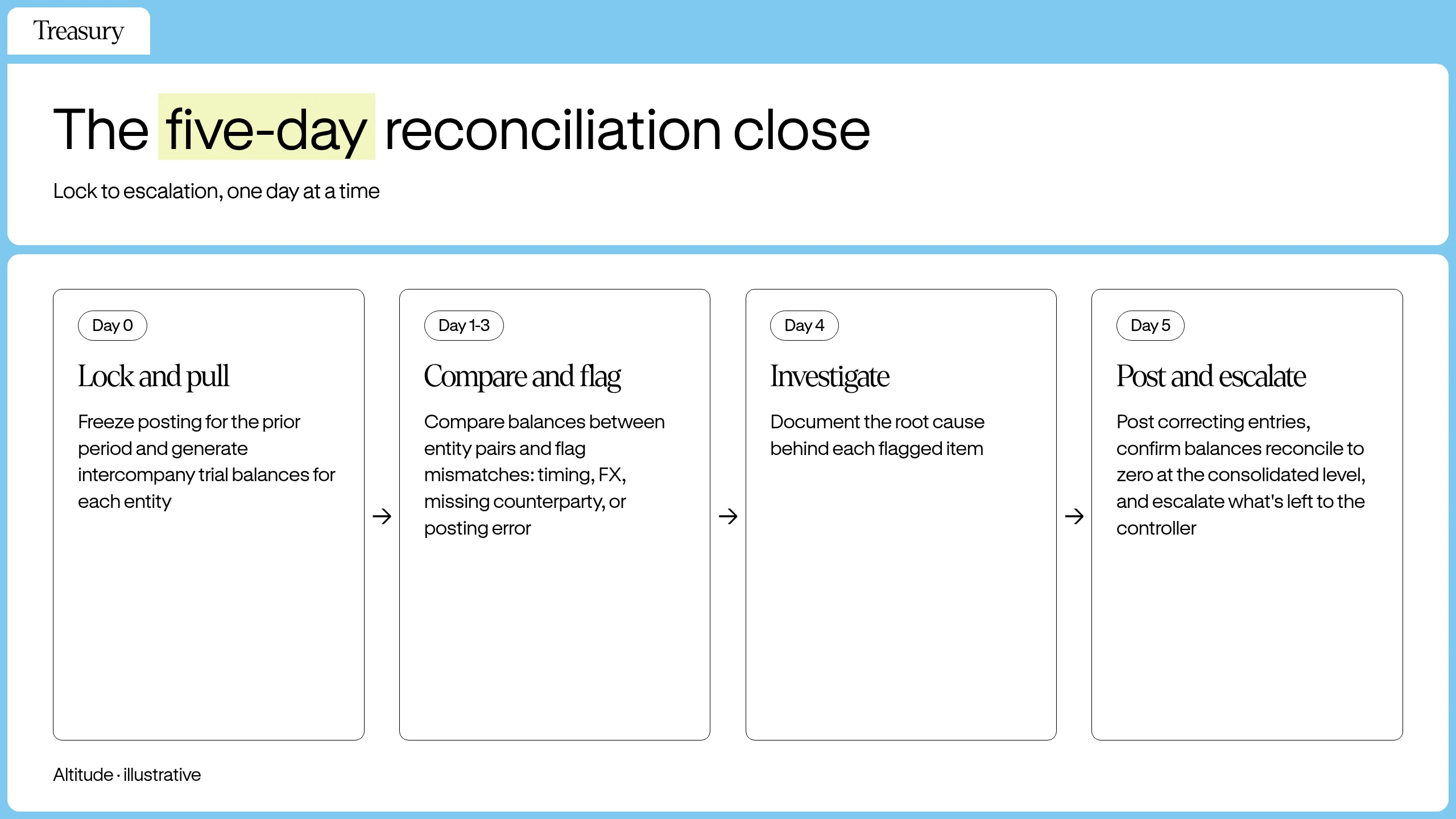
Treasury reconciliation checklist:
- Day 0: Lock transactional posting for the prior period. Generate intercompany account trial balances for each entity.
- Day 1-3: Compare balances between entity pairs. Flag mismatches for timing, FX, missing counterparty, or posting error.
- Day 4: Investigate flagged items. Document root cause (missing journal, wrong entity code, duplicate posting, incorrect value, or unsupported allocation).
- Day 5: Post correcting entries in both entities. Confirm balances reconcile to zero at consolidated level. Escalate unresolved variances to controller with root-cause write-up and corrective action plan.
- Ongoing: Update process documentation to prevent recurrence. Review approval workflows and FX policies quarterly.
Executing internal fund transfers
Executing an internal transfer is the operational step where documentation meets payment rails. The rail you choose affects settlement timing, fees, and the audit trail.
Selecting payment rails for transfers
The rail selection depends on the entities' locations, the currency, the amount, and the timing requirements. Standard SEPA credit transfers between European entities settle within one business day, while SEPA Instant settles in seconds, 24/7. Euro-area banks have been required to offer sending SEPA Instant since 9 October 2025 under Regulation (EU) 2024/886. SWIFT gpi data shows most SWIFT payments are credited within 30 minutes and almost all within 24 hours, although complex cross-border payments can take up to five business days. According to Nacha, Automated Clearing House (ACH) credits within the U.S. settle in one to two banking days. Same-day ACH settles within the same business day when you submit before the network's cutoff times, and it isn't available for every transaction type. On Altitude, a global business account, stablecoin transfers are also available on Solana and settle outside banking hours. They can't be reversed once settled, so test with a small payment first.
By one estimate from payments vendor Corpay, ACH, which is a U.S. domestic rail, costs $0.20 to $1.50 per payment at most banks. SWIFT's all-in cost varies: intermediary banks along the route can deduct fees, and the FX spread depends on the provider, the currency pair, and the transfer size, so confirm the quoted spread before you send.
When you send a stablecoin, the network validates the transaction and moves the asset in a single step, so the transfer of the token is the transfer of value. There is no batch window, no chain of intermediary banks passing the payment along, and no end-of-day netting through a clearing house.
| Rail | Settlement window | Audit trail generation | Failure mode visibility |
|---|---|---|---|
| SEPA | Standard credit transfers within 1 business day, SEPA Instant in seconds, 24/7 | Bank payment records (varies by bank) | Rejected payments return with reason codes |
| SWIFT | Most payments credited within 30 minutes and almost all within 24 hours per Swift gpi data, up to 5 business days for complex transfers | Payment message records (varies by bank) | Delays are hard to trace, and intermediary banks can deduct fees |
| ACH | 1-2 banking days for credits per Nacha, with same-day options | Bank statement and ACH trace number (the payment's tracking reference) | Returns possible within 2 business days for business-to-business transfers. The 60-day window applies to unauthorized consumer debits, including a corporate SEC-code debit posted to a consumer account (return code R05), per Nacha's return rules |
| Stablecoin | Typically seconds to reach finalized status (the network's strongest confirmation level) on Solana, about 13 minutes on Ethereum | Transaction hash (the transfer's confirmation ID), searchable on a public blockchain explorer website | The network doesn't reverse finalized transfers, but issuers such as Circle can freeze stablecoin addresses under legal orders |
Solana's RPC documentation describes three commitment levels: processed, confirmed and finalized, with finalized as the strongest. Transactions typically reach finalized status within seconds. Ethereum finalizes in about 13 minutes.
Netting intercompany settlements
Netting lets entities offset what they owe each other so only the net amount moves. Say Entity A owes Entity B $30,000 and Entity B owes Entity A $20,000 for the same period. A single $10,000 payment from Entity A to Entity B settles both balances, which cuts the number of payments, rail fees, and FX conversions. With more than two entities, multilateral netting applies the same logic across the whole group.
Each entity still records the gross receivables and payables in its own ledger, and the netting statement becomes part of the documentation trail. Both sides must agree on the netted amounts and currencies before you pay, and some jurisdictions restrict netting, so confirm local rules with your advisers first.
Handling FX in intercompany transfers
FX in intercompany transfers creates two challenges: the conversion rate and the accounting treatment. You must document the conversion rate and apply it consistently across both entities. The accounting treatment depends on the functional currency of each entity and whether the transaction creates a foreign currency exposure.
When a parent that reports in dollars sends euros to a subsidiary that reports in euros, the parent records a reduction in its dollar balance and an increase in its euro-denominated intercompany receivable. The subsidiary records an increase in its euro balance and an increase in its intercompany payable. The exchange rate on the transaction date determines the amounts recorded.
Remeasurement at period end is the step that catches many teams out. Intercompany receivables and payables are monetary balances, so the entity that holds a balance in a currency other than its functional currency remeasures it at the closing rate. Under IAS 21 (paragraphs 28 and 45) and ASC 830-20, the resulting FX gain or loss doesn't eliminate on consolidation. It stays in consolidated profit or loss, even though the receivable and payable themselves eliminate.
For example, parent with a dollar functional currency lends its euro-functional subsidiary €100,000 when EUR/USD is 1.08, so it records a $108,000 receivable. At period end, EUR/USD is 1.10, so the parent remeasures the receivable to $110,000 and books a $2,000 FX gain. The subsidiary's functional currency is the euro, so its €100,000 payable doesn't change and it books no FX difference. On consolidation, the $110,000 receivable and the translated payable eliminate, but the $2,000 gain remains in consolidated profit or loss. The exception is a balance that is in substance part of the net investment in the subsidiary, where settlement is neither planned nor likely. In that case, IAS 21 paragraph 32 and ASC 830-20 send the difference to other comprehensive income instead. Document which treatment applies to each balance, and confirm it with your auditor.
For stablecoin transfers, USDC and EURC are designed to track the dollar and euro 1:1. US GAAP doesn't yet treat stablecoins as cash, and an August 2026 FASB proposal on cash equivalents would let only certain stablecoins qualify, so check with your auditor how to classify them on the balance sheet.
Reconciling stablecoin intercompany transfers
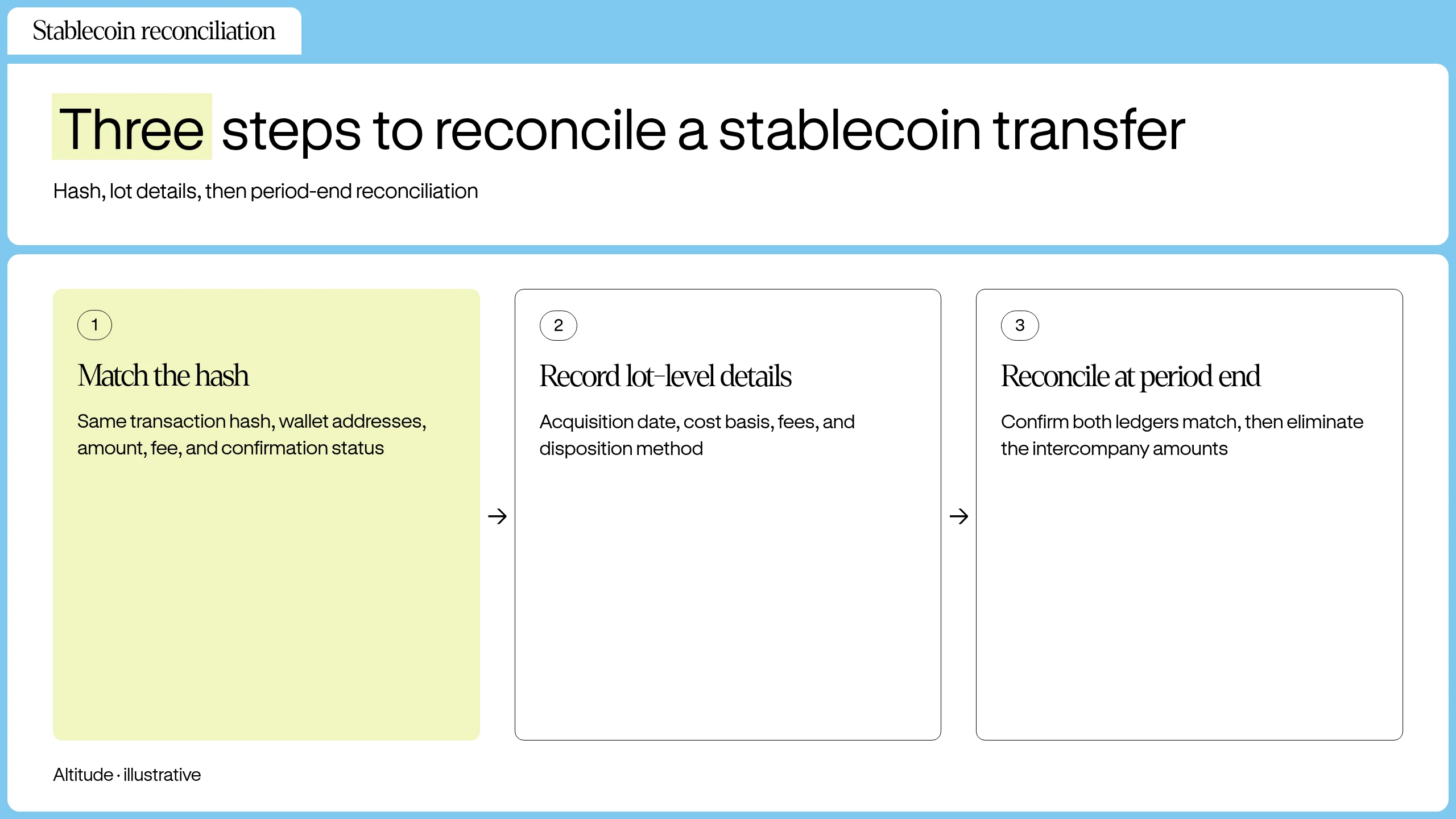
Stablecoin intercompany transfers require three reconciliation steps to satisfy audit and fair value measurement requirements.
- Match the transaction hash to both entities' ledgers. The sending entity records a reduction in its stablecoin balance and an increase in its intercompany receivable. The receiving entity records an increase in its stablecoin balance and an increase in its intercompany payable. As best practice, both entities should reference the same transaction hash in their ledger notes, alongside wallet addresses, stablecoin amount, network fee, and confirmation status, to support reconciliation and audit readiness.
- Record lot-level details for each crypto asset transaction. Track the acquisition date, cost basis, fees, and disposition method for each lot. When one entity transfers USDC to another, both entities record the lot acquisition details on the transfer date to support cost basis calculations and tax reporting.
- Reconcile the recorded amounts at period end. Compare the booked amounts in both entities' ledgers and confirm they reference the same transaction hash, stablecoin amount, and transfer date. Reconcile any variance and eliminate the intercompany amounts during consolidation.
Structuring intercompany payment approvals
Approval workflows for intercompany payments must satisfy internal controls and produce an audit trail. Role-based permissions define who can propose, approve, submit, and view transactions. Approval thresholds determine when a payment requires multiple approvers.
Your approval rules, which your team sets, are applied automatically, every time. The approval record shows who proposed the payment, who approved it, when it was approved, and when it was executed. This record forms part of the documentation trail for the intercompany transaction. Altitude is one option for approving and sending payments between your entities with these controls, but it doesn't support consolidated reporting, group treasury, or intercompany settlement, so balances, netting, and eliminations stay in your ERP or accounting system. Each entity in your group runs as its own Altitude workspace, so a payment between two entities follows the same role-based permissions and approval thresholds.
Separate workspaces under one login suit the payment step of an intercompany transfer because each entity's workspace matches the two-sided entries a transfer creates in the sending and receiving entities' books, and your team doesn't need a separate login for each entity. Check what Altitude supports across your entities before you plan group treasury or intercompany settlement around it. See how Altitude handles payments between your entities. Book a demo.
FAQs
Do intercompany transactions need to be at arm's length?
Yes. Tax authorities generally require you to price intercompany transactions as if they were between independent parties. The OECD guidelines set the international standard. In the US, Section 482 and its regulations apply the arm's length principle, including between domestic affiliates, and the principle applies to cross-border transactions as well.
How do intercompany transactions affect consolidated financial statements?
You must eliminate intercompany transactions in full during consolidation. Consolidation frameworks generally treat the group as a single economic entity. You remove internal revenue, expense, assets, and liabilities to avoid overstating financial results.
What happens if intercompany balances don't reconcile?
Unreconciled intercompany balances prevent the books from closing and create audit findings. Variances that persist across close cycles typically escalate to the controller with a root-cause write-up and corrective action plan.
Are intercompany transactions taxable?
Consolidation eliminates intercompany transactions, but they still create tax obligations. Transfer pricing rules require arm's length pricing. Cross-border payments may trigger withholding tax. Interest on intercompany loans is taxable income for the lender and a deductible expense for the borrower, subject to arm's length rates.
How should intercompany transactions be documented for audit?
Every intercompany transaction needs three artifacts: a documented agreement or commercial rationale, a settlement record, and a reconciliation entry. Your transfer pricing documentation must include the organizational structure, the pricing method you selected, the comparables you used, and preparation before you file the tax return.
What's the difference between combined and consolidated financial statements?
Consolidated statements present a parent and the subsidiaries it controls as one economic entity. Combined statements aggregate entities under common control that don't have a parent-subsidiary chain, such as sister companies owned by the same person. Both eliminate intercompany balances and transactions between the entities they cover.
How do non-controlling interests affect intercompany eliminations?
A non-controlling interest (NCI) is the share of a subsidiary the parent doesn't own. Consolidation still eliminates intercompany balances and transactions in full. The NCI changes how unrealized profit is allocated: profit on a downstream sale from the parent is charged to the parent, while profit on an upstream sale from the subsidiary is shared with the NCI. Confirm the allocation with your auditor.
What do related-party disclosure rules require?
IAS 24 under IFRS and ASC 850 under US GAAP both require disclosure of the nature of the relationship, a description of the transactions, the amounts for each period, and the amounts due to or from related parties. Transactions eliminated in consolidated statements aren't disclosed in those statements. They can still require disclosure in the separate statements of each entity.
How do you set up an intercompany matrix in your ERP?
An intercompany matrix lists every entity pair, the transaction types between them, the currency, and the accounts each side posts to. In the ERP, give each counterparty its own intercompany receivable and payable accounts, require entity coding on every posting, and apply one exchange rate table to both sides. Then run elimination entries from a dedicated elimination entity or rule set.
Key terms glossary
Intercompany transaction: A transfer of value between two or more legal entities under common control. You must eliminate these transactions during consolidation.
Intracompany transaction: A transaction within a single legal entity. Doesn't require consolidation elimination.
Arm's length principle: The requirement that you price transactions between related parties as if they were between independent parties. Defined in the OECD Transfer Pricing Guidelines and IRS Section 482.
Consolidation elimination: The accounting process that removes intercompany balances, income, expenses, and unrealized profits from consolidated financial statements. Consolidation presents the group as a single economic entity.
Transfer pricing: The pricing of intercompany transactions. Tax regulations require you to follow the arm's length principle and document it contemporaneously.
Lot-level records: Detailed tracking of each crypto asset transaction, including acquisition date, cost basis, fees, and disposition method. Tax reporting relies on these records to calculate realized gains and losses on disposals.
Settlement window: The time between payment initiation and final settlement. Varies by rail: standard SEPA credit transfers take one business day and SEPA Instant takes seconds, SWIFT credits most payments within 30 minutes but complex transfers can take up to five business days, ACH credits take one to two banking days, and stablecoin transfers settle in seconds to minutes.
Approval threshold: The configured limit above which a payment requires multiple approvers. Part of role-based permissions that create the audit trail for internal transfers.
Altitude is a financial technology platform, not a bank or digital asset custodian.