





 Startups
 Creative agencies
 Onchain teams
 European businesses
 AI
 Software

TL;DR: An international business account lets a company hold, send, and receive funds across borders from one account with multi-currency holding and cross-border payment rail access. You need one when you're paying contractors in multiple countries from separate platforms, reconciling revenue in different currencies manually, or your entity is incorporated outside the US or EU and getting rejected by neobanks. Altitude opens accounts for eligible businesses from 200+ countries with no US entity required, sends payments by ACH, SEPA, SWIFT, Pix, SPEI, Faster Payments, and stablecoin transfers, and syncs one way to QuickBooks Online and Xero. You confirm every posting before it applies, and not all transaction and object types sync. Product availability varies by country.
Paying vendors from different countries, through a different platform for each currency, is a workaround rather than a finance strategy. You log into one platform for a transfer, another to check if a payment went through, and at month-end you're matching invoices to payments manually. Transfers also don't always move when you need them to. Miss a bank's cut-off time on a Friday and that payment isn't going out until Monday. A domestic business account just isn't built for this, and at some point the workarounds stop being worth it.
An international business account consolidates multi-currency operations into one account with cross-border payment rails, account-level controls, and accounting connectivity. Unlike a domestic account designed for local transactions, or a personal multi-currency wallet that mixes business and personal funds, an international business account is built for companies that pay and get paid across borders as a core operating pattern.
This guide defines the category by what it does operationally, gives you a friction-based checklist to decide if you need one, and shows what to verify before choosing a provider.
International business account vs. personal multi-currency wallet
Personal accounts are protected by Regulation E, which limits your liability for unauthorized transactions if reported quickly, while certain commercial funds transfers, particularly wires, can be governed by UCC Article 4A, under which liability depends on whether the agreed security procedure was commercially reasonable (see Cornell LII UCC Article 4A, §§ 4A-202, 4A-204). A personal multi-currency wallet is designed for individual use, not for a company that needs approval workflows, role-based permissions, and an audit trail.
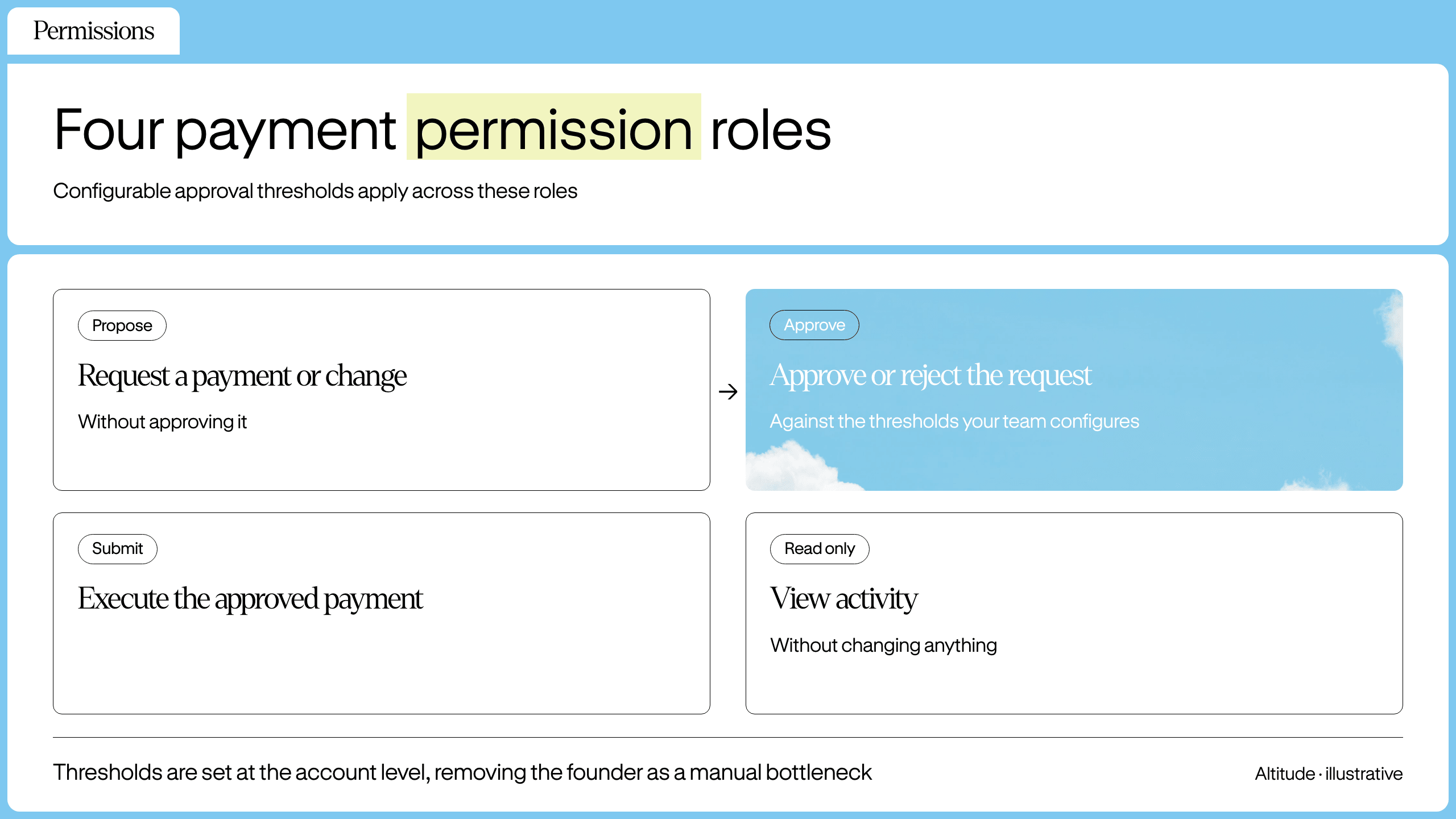
Altitude supports role-based permissions and configurable approval thresholds at the account level. Your balance moves only when your approval rules are met, and payments follow the approval workflow your team configures. This is the operational alternative to routing every payment through a single founder or hiring a dedicated finance team.
When to open a global account for your startup
A global business account is a single operating account that lets a company hold, send, and receive funds across borders without maintaining a separate banking relationship in every market. You need one when the friction of managing cross-border payments, reconciling multi-currency transactions, or accessing accounts from your jurisdiction becomes a measurable cost in time, fees, or operational risk.
Manage cross-border vendor payments
If you're paying contractors in multiple countries and each payment requires logging into a different platform and manually tracking settlement, you're doing work the account should handle. Altitude consolidates payments by Pix, SPEI, SEPA, Faster Payments, and stablecoin transfers into one account with transparent fees shown before approval.
Collect revenue in multiple currencies
If you're invoicing customers in USD, EUR, or GBP and each payment arrives in a different account, matching invoices to settlements requires manual work and month-end close is a scramble. Altitude provides dedicated US routing numbers and SEPA IBANs so you receive payments as if you had local accounts.
Eliminate time zone payment delays
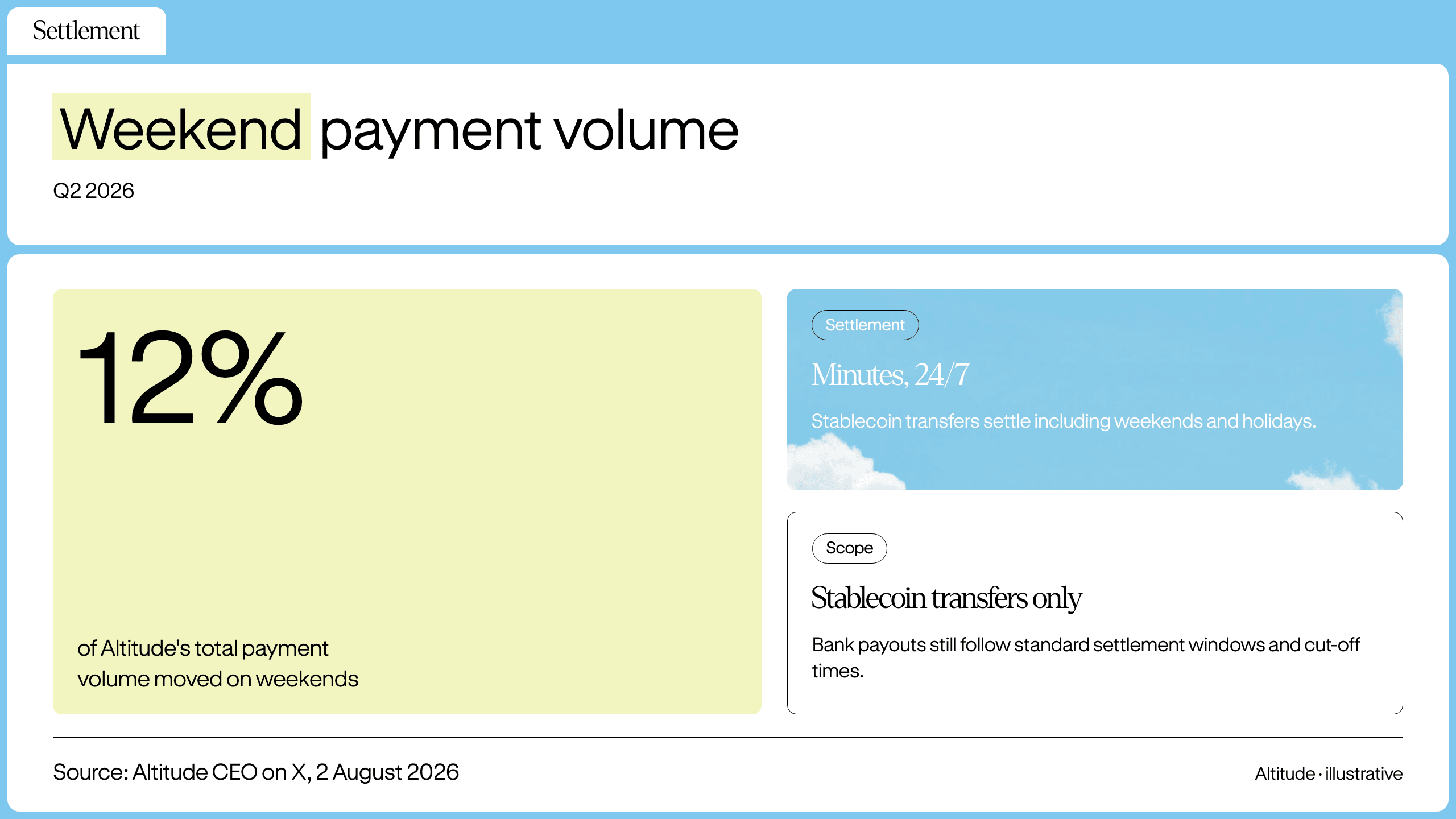
If banking cut-off times hit Friday afternoon and the person who needs to approve a payment is asleep, you're manually approving edge cases at off hours. Stablecoin transfers settle 24/7 including weekends and holidays. In Q2 2026, 12% of our payment volume moved on weekends (CEO @SimkinStepan, X, 2 August 2026), which applies to stablecoin transfers only.
One platform for every global currency
If you're comparing total cost per corridor and surprises erode trust, you need transparent fees shown before approval. Altitude supports payments to 200+ countries. Local payouts are available in EUR, GBP, MXN, BRL, and COP, though local payouts need workspace enablement and route approval. Product availability varies by country, check the fee table below for per-rail costs.
Your entity is incorporated outside the US or EU
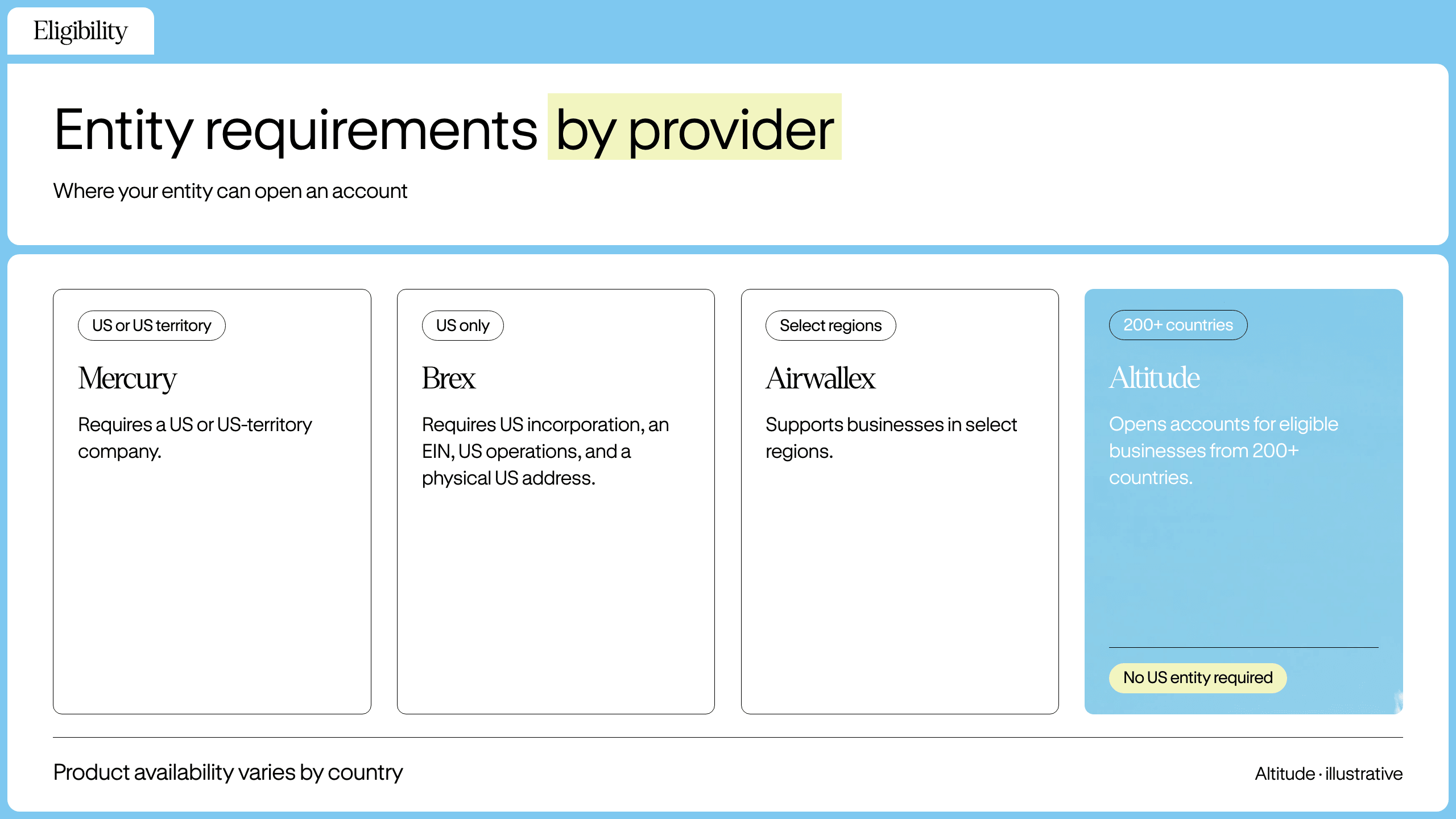
If you've been rejected by a bank or neobank because your business is foreign-incorporated, you need an account that opens with the entity you already have. Mercury requires a US or US-territory company and Brex requires US incorporation, an EIN, US operations, and a physical US address, while Airwallex supports businesses in select regions. Confirm product and market availability for your incorporation country. Altitude opens accounts for eligible businesses from 200+ countries (product availability varies by country) with no US entity required, and the supported-countries page shows account details, SWIFT, card, and rewards availability by country.
What to look for in an international business account
Choosing a provider means checking eligibility, all-in fees per corridor, approval controls, and accounting sync before anything else. Evaluate perks and rewards only after confirming the operational fundamentals are met. The right account handles what your incumbent can't: cross-border settlement, weekend payments, and stablecoin revenue, and many teams open a new account alongside their existing one to test it on live flows before migrating workflows.
Fintech providers and traditional banks differ most on entity access, settlement speed, and fee transparency, covered above and below. The decision usually comes down to whether the provider will open an account for your entity, and whether its fees are published or negotiated case by case.
Run five checks before signing a provider:
- Entity eligibility: some providers limit access based on where your business is incorporated. Confirm your incorporation country is supported before applying. Altitude opens accounts from 200+ countries, product availability varies by country.
- All-in fee per corridor: cross-border payments can involve intermediary bank deductions and FX markups beyond the headline rate. Check the rail fee, the minimum, and whether the provider uses OUR or SHA convention for SWIFT.
- Accounting sync: manual reconciliation at month-end adds overhead that grows with transaction volume. Verify your accounting software is supported. Altitude syncs one-way to QuickBooks Online and Xero.
- Support and account stability: cross-border businesses carry the highest compliance-hold risk of any segment, and the real test of a provider is what happens during a hold, not how fast you can open an account. Check whether the provider publishes a typical review timeline and whether a human is reachable if your account is flagged. Altitude's help center describes most reviews as completed within two business days, with follow-up documents requested by email when needed.
- Approval controls: bottlenecking every payment through one person breaks as the team grows. Confirm role-based permissions and configurable thresholds are available at your plan level, and verify whether they require an upgrade to access.
Fees for paying contractors and suppliers
The rails and fees below apply to payments you send, such as contractor and supplier payouts. When you send a cross-border payment, Altitude shows you the exchange rate and both amounts before you approve it, so you can confirm the cost before the transfer executes. This applies to outbound payments only, and it does not describe how a client's payment to you is converted.
| Outbound rail | Timing | Altitude's charge | Minimum |
|---|---|---|---|
| ACH | 1–3 business days | $0 | None |
| Same-day ACH | Same business day | $0 | None |
| US domestic wire | Same business day | $0 | None |
| SEPA (EURC-funded) | 1 business day | $0 | None |
| SWIFT outbound | 1–5 business days | $35 SWIFT transfer fee (OUR charges) | $100 |
| Stablecoin (USDC, EURC) | Minutes, 24/7 | $0 | None |
Sending, intermediary, and recipient banks may still charge. Card purchases in non-USD currencies carry a 1% FX fee. On payments you send by SWIFT, the OUR convention means you cover the known fees, though some intermediary banks can still deduct charges, so full-value receipt isn't guaranteed. Altitude adds no fee to USDC to EURC conversion, though this does not guarantee zero spread or slippage. This table covers outgoing payments only.
When you pay a contractor, each rail requires the recipient's registered identifier: SPEI needs an 18-digit CLABE, Pix needs a registered Pix key, Faster Payments needs a sort code and account number, SEPA needs an IBAN and BIC, and Bre-B needs a registered Bre-B key. When a client pays you, they need your dedicated US routing details or your SEPA IBAN.
Payment approval and user permissions
Altitude supports role-based permissions (Propose, Approve, Submit, Read Only) and configurable approval thresholds at the account level. As your team grows, you need payment approvals to happen without the founder as a manual bottleneck, with configurable rules applied through your approval workflow across time zones.
Sync with your accounting software
Altitude syncs with QuickBooks Online (QBO) and Xero, one way from Altitude to QBO and Xero, and you confirm every posting before it applies, though not all transaction types and object types sync. EUR postings to QBO require a QBO plan with multi-currency support on Essentials, Plus, and Advanced. Simple Start doesn't include it. For Xero, confirm the multi-currency requirements of your Xero plan separately.
If you're incorporated outside the US or EU, paying teams across time zones, or reconciling payments in multiple currencies, Altitude can show you how contractor and supplier payments work across borders in one account. Book a demo.
FAQs
Can I open an international business account without a US entity?
Yes. We open accounts for eligible businesses from 200+ countries (product availability varies by country) with no US entity required, and every business goes through verification. Mercury requires a US or US-territory company, and Brex requires US incorporation, EIN, US operations, and a physical address.
How long does it take to set up an international business account?
Most reviews are described as completed within two business days, though Altitude requests follow-up documents by email when needed. Traditional banks typically take one to two weeks, and sometimes longer for complex entities.
What happens to my money if the provider stops operating?
Balances are held in fully reserved stablecoins, backed one to one by the issuer's reserves, controlled by your business and not lent out by Altitude, with licensed partners providing the banking services.
Do international business accounts work on weekends?
Stablecoin transfers settle in minutes, 24/7, with no banking-hours dependency and no weekend gap. In Q2 2026, 12% of Altitude's payment volume was processed on weekends. Bank payouts still follow standard settlement windows and cut-off times, so the weekend advantage applies to stablecoin transfers specifically.
Key terms glossary
ACH: Automated Clearing House, a US payment network for bank transfers. Altitude carries no fee for outbound ACH transfers, with settlement in 1–3 business days.
Named IBAN: An account number issued in the holder's own name, making payments clearly attributable and reconciliation clean, versus pooled IBANs shared across multiple clients.
SEPA: Single Euro Payments Area, a payment network for EUR transfers. Altitude carries no fee for outbound EURC-funded SEPA, with settlement typically within 1 business day.
SWIFT: Society for Worldwide Interbank Financial Telecommunication, a messaging network for international wire transfers. Altitude charges $35 for outbound SWIFT with a $100 minimum, and settlement takes up to 5 business days.
Stablecoin transfer: A payment using USDC or EURC on Solana or other networks. Altitude carries no fee for supported outbound stablecoin transfers, with settlement in minutes, 24/7.
Altitude is a financial technology platform, not a bank or digital asset custodian.