
TL;DR: Most international payment failures come down to one thing: the wrong bank identifier for the payment rail. SEPA needs an IBAN (BIC optional within the EEA since 1 February 2016 under Regulation 260/2012). ACH needs a routing number and account number. International wires need a SWIFT/BIC and often an IBAN plus intermediary bank details. A pre-flight checklist, covering IBAN validity, BIC/SWIFT presence, intermediary details, and beneficiary name, catches the errors that cause rejections, returns and payee warnings before your customer does.
An international invoice has to carry the bank identifiers that the payment rail requires. SEPA needs an IBAN, ACH needs a routing number and account number, and an international wire needs a SWIFT/BIC. A missing identifier, the wrong one for the rail, or an invoice currency the rail can't carry can delay the payment or get it returned to the payer.
International invoices fail for predictable reasons: a missing BIC, a routing number where a SWIFT code belongs, or an invoice currency that doesn't match the payment rail. This article gives you the exact fields to include for SEPA, ACH, international wire, and stablecoin payments, plus a pre-flight checklist that catches errors before your customer does.
Avoid payment delays with precise invoice data
International invoicing requires more than just an IBAN. SEPA payments run on the IBAN, and whether you also need a BIC depends on where the payment goes, as explained in the SEPA section below. Payments outside SEPA go by SWIFT and need whatever account identifier the destination country uses. An ACH payment requires a routing number that looks nothing like a SWIFT code. If you send the wrong identifier, the payment bounces, and your customer has to resend the transfer.
The cost of a failed payment extends beyond the delay. It includes the reconciliation work on both sides, the follow-up emails, and the trust erosion when a customer has to chase their own bank to recall a transfer. A single wrong digit fails the ISO 13616 IBAN check, so the payer's bank should block it before sending. A valid but wrong IBAN is what sends money astray.
Clean invoice records matter beyond the immediate payment. At month-end close, your finance team needs invoices that reconcile cleanly against bank statements. An invoice with the correct bank identifiers, a clear payment reference, and a settlement date creates an audit trail that holds up when you're reviewing aged receivables or preparing for an external audit.
Key components of an international invoice
Every international invoice needs the same core components. The bank identifier block changes per rail, but the structure of the invoice stays the same.
Start with your business name and address, the customer's name and address, and the invoice number. The invoice number is your reconciliation anchor. It should be unique, sequential, and referenced in the payment memo so you can match the incoming transfer to the invoice. Use your exact legal account name: in the EU, a mismatch triggers a Verification of Payee warning that can make the payer hesitate or pay the wrong account, and some banks may hold the payment for review. For US wires, UCC 4A-207 lets the beneficiary bank rely on the account number, so the account number has to be right as well.
Include the invoice date and the payment due date. According to Allianz Trade, Net 30 is the most widely used net term in B2B trade, and Net 15 is common for smaller orders or newer customers. Use unambiguous date formats: "October 14, 2026" not "10/14/26" or "14/10/26."
Each line item should include a description, quantity, unit price, and total. Subtotal the line items, add any taxes or fees, and show the total amount due. State the currency clearly next to the total. The invoice currency should match the payment rail where possible: a USD invoice is typically paid by ACH or wire, and a EUR invoice is typically paid by SEPA.
Payment terms should include the due date, the payment method, and the payment reference. The payment reference is the invoice number. Tell the customer to include the invoice number in the payment memo or remittance advice, so the incoming payment can be matched to the right invoice when it arrives.
VAT and tax fields for cross-border invoices
The payment rail decides the bank identifiers, but tax rules decide a separate set of invoice fields. This section uses EU VAT as the worked example because the VAT Directive 2006/112/EC sets a single list of mandatory invoice particulars that applies across all 27 member states, which makes it the most widely reusable checklist for cross-border B2B invoices. Member states apply the directive through national law, so confirm the exact requirements for your jurisdiction and your customer's with a tax adviser.
- Supplier VAT or tax ID: Your VAT identification number, or the local tax ID where VAT doesn't apply.
- Customer VAT number: Required where the customer is liable for the VAT under the reverse charge.
- Reverse-charge wording: The directive calls for a mention that the reverse charge applies. Some member states also expect the wording in the local language.
- Tax rate and amount: The VAT rate applied and the VAT amount, or the reason the supply is exempt or outside scope.
Outside the EU, invoice tax rules are set country by country, and the required fields differ. The UK, Australia, Canada, Singapore and other countries with a VAT or GST each publish their own tax invoice requirements, so the EU list above won't transfer one for one. The US has no federal VAT, and sales tax rules are set state by state, so a US supplier's invoice usually carries its tax ID and any state-level tax only where one applies.
Before you invoice, check the tax authority guidance for the country where you're registered and the country where your customer is based. If the invoice covers physical goods, customs paperwork usually asks for additional commercial invoice fields such as HS codes and Incoterms, so check the destination country's customs requirements before shipping. Some countries also mandate structured e-invoicing for B2B transactions, so check whether your customer's country requires a specific format before you issue a PDF.
SEPA payment fields: IBAN and BIC explained
SEPA (Single Euro Payments Area) covers 41 countries and territories, comprising 27 EU member states plus 14 non-EU members. According to the EPC SCT Rulebook 2025, the transfer amount of a standard SEPA Credit Transfer must reach the beneficiary's bank within one banking business day. SEPA Instant credits within 10 seconds, around the clock. Since 9 October 2025, euro-area payment providers have had to offer sending instant payments at no more than the price of a standard transfer, under the Instant Payments Regulation and the European Commission's implementation Q&A. To receive a SEPA payment, give your customer your IBAN. The BIC rules are covered in the BIC section below.
The IBAN identifies your specific account, and the BIC identifies your bank.
Decoding IBAN for SEPA payments
IBANs run up to 34 characters and follow the ISO 13616 standard. The first two characters are the country code. The next two are check digits that validate the IBAN. The remaining characters are the Basic Bank Account Number, which includes the bank identifier and the account number.
For example, a German IBAN looks like this: DE89370400440532013000. The "DE" is the country code for Germany. The "89" are the check digits. The rest identifies the bank and the account. Each country has a fixed IBAN length. Germany is always 22 characters. France is always 27. If the IBAN you are given doesn't match the expected length for that country, it is wrong.
The IBAN includes check digits at positions three and four that catch most typing errors, including transpositions.
How BIC codes work for payments
BICs (also called SWIFT codes) follow ISO 9362 and are 8 characters plus an optional 3-character branch code. The first four characters are the institution code. The next two are the country code. The next two are the location code. The optional last three are the branch code.
For example, DEUTDEFF is the BIC for Deutsche Bank in Frankfurt. "DEUT" is the institution code. "DE" is the country code for Germany. "FF" is the location code for Frankfurt. If the BIC is 11 characters, the last three identify a specific branch.
Since 1 February 2016, the BIC is optional for SEPA payments within the EEA, and the remitter only has to provide the IBAN, under Regulation (EU) 260/2012. For SEPA payments involving a non-EEA SEPA country such as Switzerland or the UK, include the BIC as well as the IBAN. The European Payments Council's SEPA scope lists the countries covered. Some banks still request the BIC for all SEPA payments, so include it on your invoice even if it is optional.
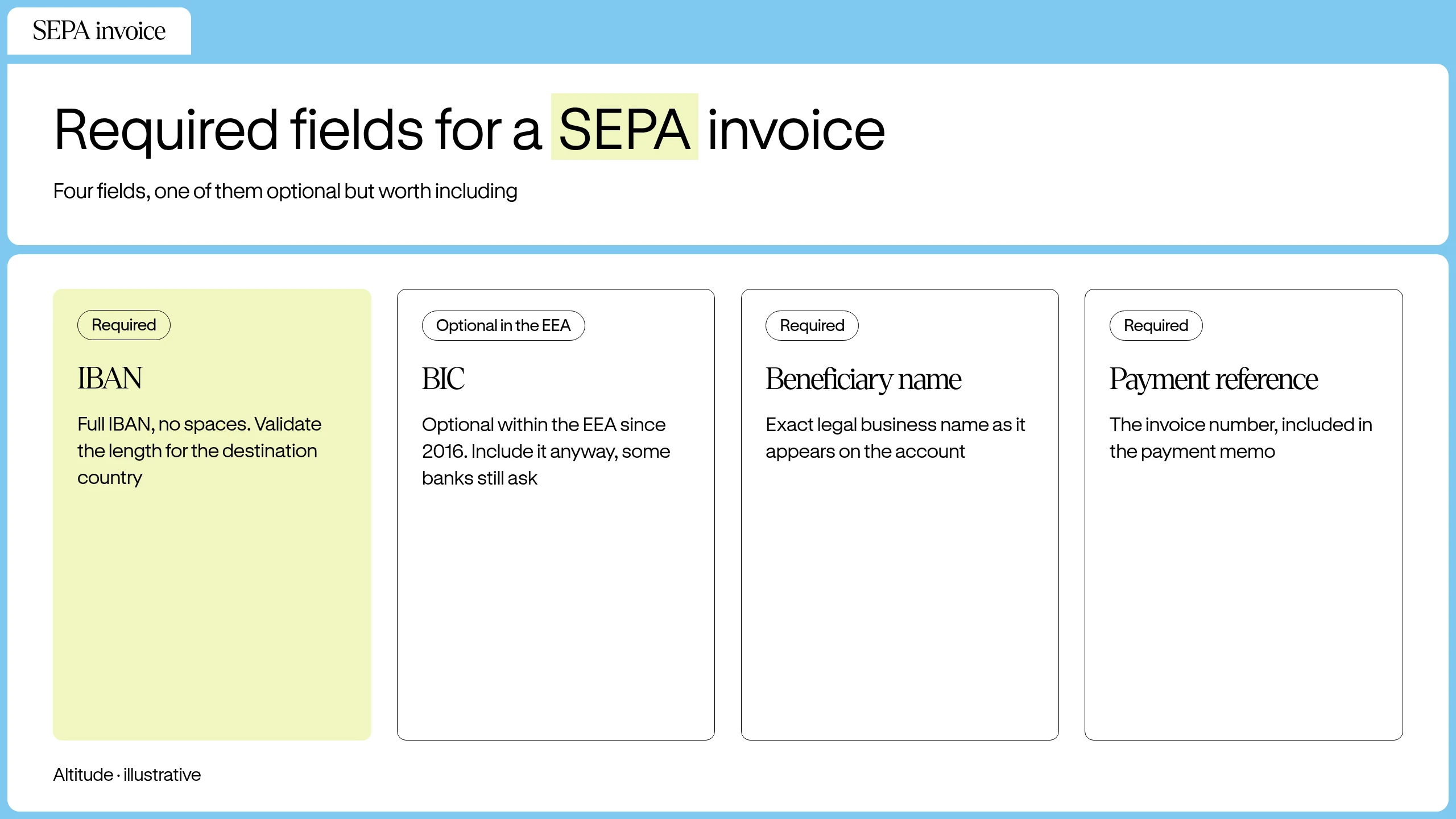
Essential SEPA invoice fields
- IBAN: Your full IBAN, with no spaces. Validate the length against the expected character count for your country before sending.
- BIC: Your bank's BIC. Include it on every SEPA invoice, because it is needed outside the EEA and some banks still request it inside.
- Beneficiary name: Your business legal name exactly as it appears on the account. A mismatch triggers a Verification of Payee warning that can make the payer hesitate or pay the wrong account, and some banks may hold the payment for review.
- Payment reference: The invoice number. Ask the customer to include it in the payment memo so you can match the incoming transfer to the invoice. SEPA carries up to 140 characters of remittance information, so put the invoice number first.
Essential ACH details for US customers
ACH (Automated Clearing House) is the US domestic payment network for bank-to-bank transfers. According to Nacha (2023), roughly 80% of ACH volume settles in one banking day or less, and ACH credits settle within two banking days at most. To receive an ACH payment, you need to provide your customer with two numbers: your routing number and your account number.
The routing number identifies your bank and is always nine digits. The account number identifies your specific account and varies in length by bank. Both are required for ACH payments.
Why routing numbers matter for payments
The routing number (also called the ABA routing number, after the American Bankers Association) is a nine-digit code that identifies the financial institution where your account is held. The American Bankers Association introduced routing numbers in 1910 to process checks. Today, they also route ACH and wire payments, and LexisNexis Risk Solutions is the official registrar, according to ABA documentation.
Each bank has one or more routing numbers, depending on the state and the account type. Some large banks use different routing numbers for different states or account types. The routing number on your invoice must match the routing number for your specific account.
Account number and type
Your account number identifies your specific bank account. Its length depends on the bank. You can find it on a check (the digits after the routing number), on a bank statement, or in your online banking portal.
For ACH payments, include the account type (checking or savings). The sender's bank asks for it when setting up the ACH payment.
If you are using Altitude, a global business account, your USD account comes with a dedicated US routing number and account number. You can find both in your account details, and you can receive ACH payments from any US bank using those details.
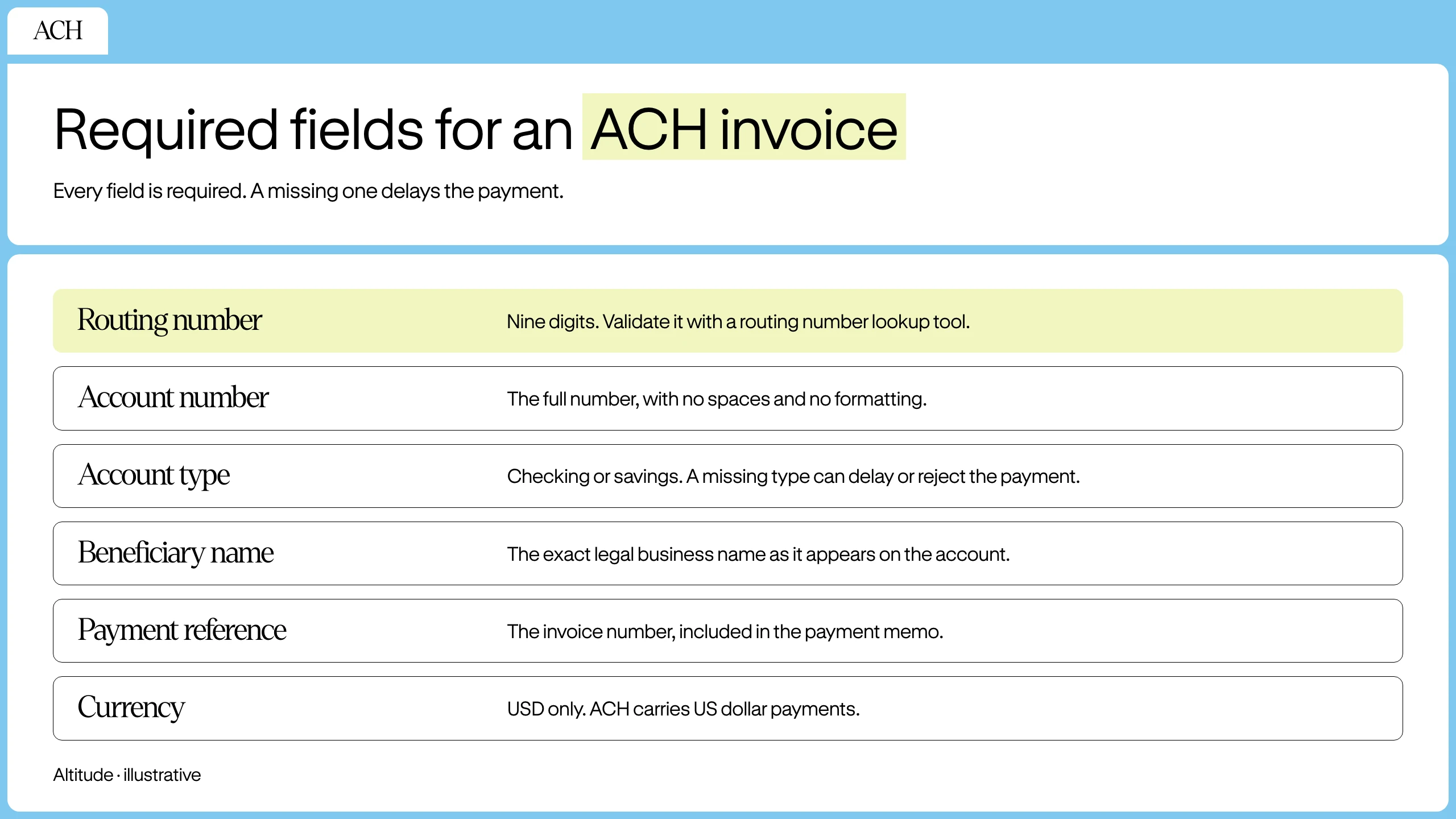
Required ACH details for your invoice
Here is what to include on an ACH invoice:
- Routing number: Your nine-digit routing number. Validate it with a routing number lookup tool before you send the invoice.
- Account number: Your full account number, with no spaces or formatting.
- Account type: Checking or savings.
- Beneficiary name: Your business legal name exactly as it appears on the account.
- Payment reference: The invoice number, so the customer can include it in the payment memo.
- Currency: USD. ACH only handles US dollar payments.
Same-day ACH is available for payments initiated before the cutoff time, and those payments settle on the same business day.
Essential fields for international wire payments
International wire transfers use the SWIFT network to move money between banks in different countries. According to the Federal Reserve Financial Services, domestic wires usually arrive the same day. International SWIFT wires often arrive within a day via Swift gpi, but can take several days depending on intermediaries and compliance checks. To receive an international wire, you need to provide your customer with a SWIFT/BIC code and, in many cases, an IBAN and intermediary bank details.
Wire transfers are more complex than SEPA or ACH because they often pass through multiple banks. Your customer's bank sends the wire to an intermediary bank, which forwards it to your bank. Each bank in the chain needs to be identified with a SWIFT/BIC code.
SWIFT/BIC requirements for wires
SWIFT (Society for Worldwide Interbank Financial Telecommunication) is the global messaging network that banks use to send wire transfer instructions. A SWIFT/BIC code identifies a bank or other institution in the SWIFT network and follows the same format as the BIC described in the How BIC codes work for payments section above.
For international wires, the SWIFT/BIC is required. The customer's bank uses the SWIFT/BIC to route the wire to your bank. If the SWIFT/BIC is wrong or missing, the wire will be rejected or delayed.
The SWIFT/BIC identifies your bank, not your specific account. You also need to provide your account number or IBAN so your bank knows which account to credit. For wires to Europe, the IBAN is required. For wires to the US, the account number and routing number are required.
How correspondent banks affect wires
An intermediary bank (also called a correspondent bank) is a third bank that facilitates the wire transfer between the sending bank and the receiving bank. The Federal Reserve defines an intermediary bank under UCC Article 4A as "a receiving bank other than the originator's bank or the beneficiary's bank."
If your bank uses an intermediary bank to receive wires, you need to provide the intermediary bank's SWIFT/BIC on your invoice. The customer's bank sends the wire to the intermediary bank, which forwards it to your bank. You can find the intermediary bank details from your bank or payment provider.
When a payment is made in a currency that is different from the local currency, intermediary banks are often used. For example, if a customer in the UK sends a USD wire to a US account, the wire may pass through an intermediary bank in New York before it reaches the final destination.
Structuring your international invoice
Here is what to include on an international wire invoice:
- SWIFT/BIC: Your bank's SWIFT/BIC code. Required for all international wires.
- IBAN or account number: Your IBAN if your account is in a country that uses IBANs, or your account number if your account is in the US.
- Routing number: If your account is in the US, include the routing number in addition to the SWIFT/BIC.
- Intermediary bank SWIFT/BIC: If your bank uses an intermediary bank, include the intermediary bank's SWIFT/BIC.
- Beneficiary name: Your business legal name exactly as it appears on the account.
- Beneficiary address: Your business address.
- Payment reference: The invoice number, so the customer can include it in the payment memo.
- Currency: The currency you want to receive.
Wire transfer fees are higher than SEPA or ACH fees, and sending, receiving, and intermediary banks can each deduct a charge (see the cost comparison section below for typical bank fee ranges). SWIFT defines three fee conventions that decide who pays these charges: OUR (the sender pays all fees), SHA (sender and recipient share the costs), and BEN (the recipient pays). Under OUR, the sender covers the known fees, although some intermediary banks can still deduct charges.
Beneficiary addresses, name checks and purpose codes
Banks are moving payment messages to ISO 20022, which stores addresses in structured fields (street, building number, postal code, town, country) instead of free-text lines. Swift deferred its November 2026 cutover for unstructured addresses and has said it will announce new timing by December 2026, so confirm the current date with your bank. Write the beneficiary address on your invoice in that structure, with each element on its own line, so the customer can copy it into the payment instruction without reformatting.
Name checks give a second reason to match the legal entity name exactly. Euro-area payment providers have been required to offer Verification of Payee since 9 October 2025 under Regulation (EU) 2024/886, and a name that doesn't match triggers a warning to the payer before the transfer goes out. In the UK, Confirmation of Payee runs a comparable check on payments to UK accounts.
Some destination countries also ask for a purpose code or a documented payment reason on incoming international wires. Ask the customer's bank whether the destination country requires one, and put the invoice number and a one-line description of the goods or services in the payment reference.
Crypto invoicing: fields for stablecoin payments
A customer who wants to pay an invoice in crypto needs the same precision as a bank payment, but the identifiers are different. A bank identifier tells the payer's bank where to send funds. A crypto invoice has to name the asset, the network and the receiving address, because a transfer sent on the wrong network can't be pulled back.
Altitude's Crypto Invoice Generator builds these fields from preset templates, covering stablecoins and EVM tokens. Match the asset and network to what your receiving account actually accepts: an Altitude account credits USDC and EURC only, and any other token sent to an Altitude deposit address is lost permanently.
Here is what to include on an invoice that accepts crypto:
- Amount due: The total in the invoice currency, so the books stay in the currency you agreed with the customer.
- Asset: The specific token you accept, such as USDC or EURC. Accept only the tokens your receiving account supports.
- Network: The blockchain the transfer must use. The same token can exist on several networks, and a token sent on an unsupported network can be lost.
- Receiving address: The full address, copied exactly from your account details, not retyped.
- Token amount and rate date: If you quote a token amount, state the exchange rate and the date it was fixed.
- Payment reference: The invoice number, in a memo or note field where the network or sender supports one, so you can match the incoming transfer to the invoice.
Stablecoin transfers are irreversible once settled, so a wrong address or network means lost funds, where a bank payment can sometimes be recalled. Ask the customer to send a small test payment first and confirm it arrived before sending the full amount.
Cost comparison and settlement timing
Different customers prefer different payment methods. A US customer will default to ACH or wire. A European customer will default to SEPA. Your invoice should make it easy for the customer to pay using their preferred method.
The all-in cost of a payment isn't just the headline fee. It includes the sending fee, the receiving fee, any intermediary bank fees, and the FX markup if the payment involves currency conversion. NerdWallet's survey of nearly 35 US banks and credit unions puts the median fee at $45 for an outgoing international wire and $15 for an incoming one. Some banks charge nothing to receive a wire, so check your bank's own fee schedule. Intermediary banks may also deduct their own fees from the transfer amount.
| Rail | Settlement time | Bank fees (typical) |
|---|---|---|
| SEPA (EUR) | Standard: next business day. SEPA Instant: within 10 seconds, 24/7 | Varies by bank |
| ACH | Same day to 2 business days | Varies by bank |
| SWIFT wire | Often within a day via Swift gpi; can take several days with intermediaries or compliance checks | Sending, receiving, and intermediary banks may each deduct a fee |
For domestic US payments, FedNow and RTP settle instantly, 24/7. In the UK, Faster Payments does the same for sterling.
If you need the money by a specific date, work backward from the settlement time. Banking cut-off times also matter. For standard SEPA, ACH and wires, a payment initiated after the cut-off time settles the next business day.
Prevent common international invoicing errors
Invoice errors are preventable. A pre-flight checklist catches most of them before you send the invoice.
Fixing incorrect IBAN format errors
The check digits explained in the Decoding IBAN for SEPA payments section above catch most typing errors, so a failed check usually points to a mistyped or pasted IBAN.
A frequent cause of an "invalid IBAN" result is a paste artifact rather than a wrong digit. When you copy an IBAN from a PDF or website, invisible characters or spaces can slip in. Delete every space and make every letter uppercase before validating.
Before you send an invoice, validate the IBAN with an IBAN checker. The checker will confirm the length, the country code, and the check digits. If the IBAN is invalid, the checker will tell you.
Routing numbers vs SWIFT codes
A routing number is a nine-digit code used for domestic US payments. A SWIFT/BIC code is an 8 or 11-character code used for international payments. They aren't interchangeable.
If your customer is sending an ACH payment, they need your routing number and account number. If your customer is sending a wire transfer, they need your SWIFT/BIC and account number (or IBAN if your account is in Europe). Providing a routing number when a SWIFT/BIC is required, or the reverse, is a frequent cause of failed payments.
Preventing payment delays from missing info
A missing BIC on a cross-border SEPA invoice outside the EEA, a missing SWIFT/BIC on a wire transfer invoice, or a missing intermediary bank SWIFT/BIC will each delay the payment.
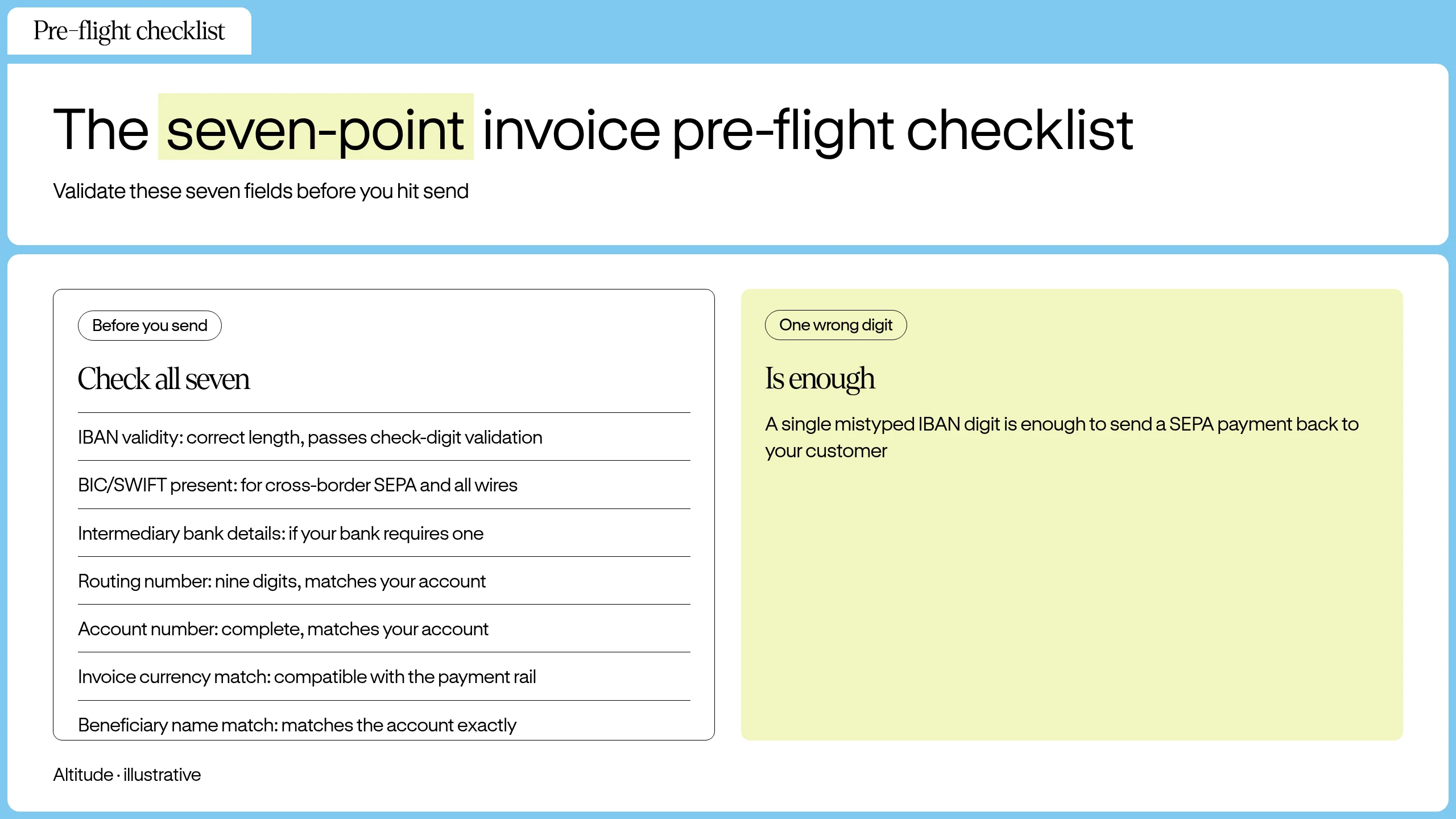
The pre-flight checklist catches these errors:
- IBAN validity: Confirm the IBAN matches the expected length for the destination country and passes a check-digit validator before sending.
- BIC/SWIFT present: Confirm the BIC is included for cross-border SEPA payments outside the EEA, and that the SWIFT/BIC is included for all international wire invoices.
- Intermediary bank details: Confirm the intermediary bank SWIFT/BIC is included if your bank requires one to receive wires.
- Routing number: Confirm the routing number is nine digits and matches your account.
- Account number: Confirm the account number is complete and matches your account.
- Invoice currency match: Confirm the invoice currency is compatible with the payment rail. USD is typically paid by ACH or wire, EUR is typically paid by SEPA, and the agreed currency applies for wire transfers.
- Beneficiary name match: Confirm the beneficiary name on the invoice matches the legal entity name on the account exactly.
Aligning invoice and payment currencies
The invoice currency should match the payment rail. A USD invoice is typically paid by ACH or wire, and a EUR invoice is typically paid by SEPA. When the invoice currency doesn't match the customer's local currency, a wire transfer is one option rather than the only one. Wires may be the better choice when you must deliver US dollars rather than the local currency to an overseas beneficiary, while an international ACH can only deliver the payment in local currency, according to US Bank. Paying in the vendor's local currency often settles faster and makes reconciliation easier, according to JPMorgan.
If the invoice currency doesn't match the payment rail, the payment may be rejected or delayed, and the customer's bank may convert the currency, which may carry a fee. SEPA payments are denominated in euros only, so if you invoice in USD but the customer attempts to pay using SEPA, the customer would need to convert USD to EUR before initiating the SEPA payment.
Retyping bank identifiers by hand is where a wrong routing number, IBAN or BIC usually enters an invoice. Altitude's invoicing covers USD and EUR, and the customer pays into your USD or EUR account. Copy the details from your account page rather than retyping them.
A clean invoice, with the right IBAN, routing number, SWIFT/BIC, and beneficiary name, removes the most common preventable causes of a failed payment. That means less reconciliation work and fewer follow-up emails on both sides.
To see how Altitude gives your business dedicated US routing numbers and SEPA IBANs from one account, book a demo.
FAQs
Do I need to include every payment method on one invoice?
No. Include only the payment method that matches the invoice currency and your customer's location. If you invoice in USD, include ACH and wire details. If you invoice in EUR, include SEPA details.
Can I use the same invoice template for SEPA and wire payments?
The core invoice fields are the same (invoice number, date, line items, total), but the bank identifier block changes per rail. SEPA requires an IBAN, plus a BIC for payments outside the EEA. Wire requires SWIFT/BIC and often IBAN plus intermediary bank details.
What happens if I put the wrong bank details on an invoice?
A wrong account identifier usually fails or returns to the payer, while a name mismatch typically triggers a payee-verification warning rather than an automatic rejection. Under the EU Instant Payments Regulation, Verification of Payee returns match, close match or no match, and the payer decides whether to proceed.
Do I need a local bank account to receive SEPA or ACH payments?
No. A global business account with dedicated US routing numbers and SEPA IBANs covers both rails from one place. Altitude provides eligible businesses with US routing numbers and SEPA IBANs from one account, with no US entity required.
How do I find my IBAN or routing number?
Your IBAN and routing number are in your account details. For Altitude, log into your account and go to the USD or EUR account details page. The routing number and account number are listed for USD accounts. The IBAN and BIC are listed for EUR accounts.
Key terms glossary
IBAN: International Bank Account Number. A standardized account number up to 34 characters long, used in Europe and other countries to identify a specific bank account.
BIC / SWIFT code: Bank Identifier Code (also called SWIFT code), defined in ISO 9362. An 8-character code with an optional 3-character branch code that identifies a bank or other business party in the SWIFT network.
Routing number: A nine-digit code used in the United States to identify a financial institution for ACH and wire transfers.
ACH: Automated Clearing House. The US domestic payment network for bank-to-bank transfers. Most ACH payments settle within one business day, same-day ACH settles the same day, and ACH credits settle within two business days at most.
SEPA: Single Euro Payments Area. A payment integration initiative that simplifies EUR bank transfers across 41 countries and territories, comprising 27 EU member states plus 14 non-EU members. Standard SEPA Credit Transfers settle by the next business day, and SEPA Instant credits within 10 seconds, around the clock.
Intermediary bank: A third bank that facilitates an international wire transfer between the sending bank and the receiving bank when they don't have a direct relationship.
Altitude is a financial technology platform, not a bank or digital asset custodian.