





 Startups
 Creative agencies
 Onchain teams
 European businesses
 AI
 Software
TL;DR: The payment methods you list on an invoice determine how fast you get paid, what it costs, and whether international clients can pay you at all. Choose by client location and urgency. If the client is in the US and the invoice is routine, list ACH, which carries no Altitude fee and is already set up in their accounting software. If the invoice is large or the client needs same-day proof of payment, list a wire. If the client is in Europe, or in the UK and paying in EUR, list SEPA, which is faster and cheaper than SWIFT. If the client is elsewhere, list SWIFT as the bank-transfer option, since most corporate accounts payable teams pay by bank transfer. Add USDC on Solana if the client already holds stablecoins or the invoice falls on a weekend. USDC settles instantly and carries no Altitude fee, though a client who has to buy USDC may pay an exchange or on-ramp fee. Most SWIFT payments between banks that use Swift GPI arrive within a day, but some routes take several business days and intermediary banks may deduct fees that vary by bank.
Most founders spend more time choosing invoicing software than choosing which payment methods to list on the invoice. The second decision has a bigger impact on cash flow. A US client paying by standard ACH takes up to three business days to settle, or the same business day if their bank offers same-day ACH. A client in Germany paying by SWIFT may see the money arrive within a day between Swift GPI banks, or wait several business days on other routes. The payment method on your invoice is a cash-flow decision you make before you ever see the money.
This article compares the main invoice payment methods: ACH, wire, SWIFT, SEPA, USDC, cards, and checks. It shows what each one costs and how long it takes, and gives you a checklist for choosing which to offer.
How payment methods impact your cash flow
Payment methods aren't a technical detail. They determine when money hits your account, what fees get deducted along the way, and whether a client in another country can pay you without calling their bank.
Why payment speed and reliability matter
Late payments tie up cash that founders have already earmarked for payroll, rent, and suppliers. When a client says they paid, the settlement window of the method they used determines when you can actually spend that money. A wire settles the same day. A standard ACH transfer can take three business days, while same-day ACH settles the same business day when the client's bank offers it and submits the file in time.
Hidden fee traps in payment methods
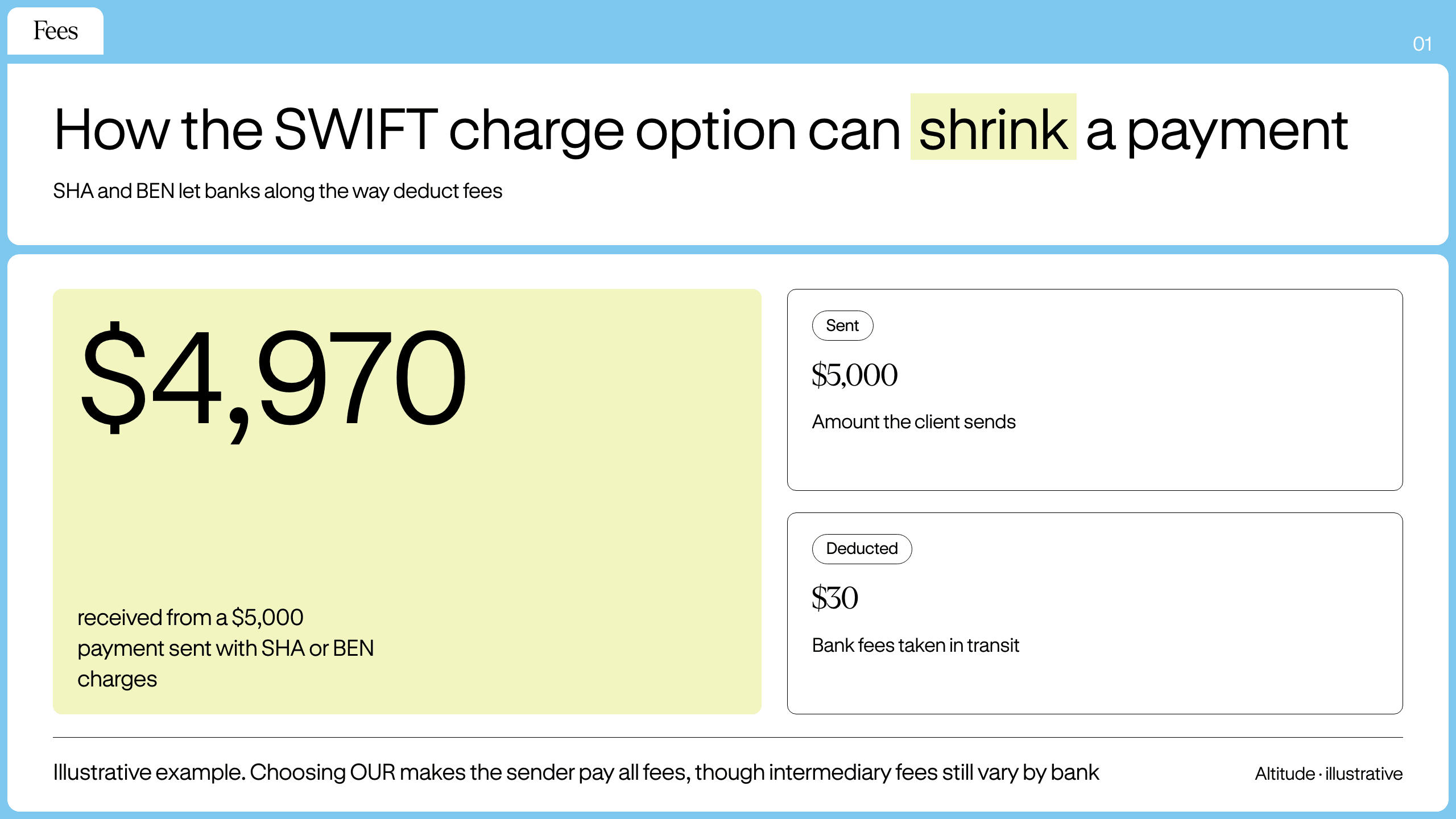
The fee you see on your invoice platform isn't the total cost. When the sender's bank and your bank have no direct relationship, a SWIFT payment passes through a correspondent bank, a third-party institution that moves the money between them and may deduct a fee for the service. The payer chooses the SWIFT charge option: OUR means the sender pays all fees, while SHA (shared) and BEN (beneficiary pays) allow banks along the way to deduct fees, per Swift.
If your client sends with the SHA or BEN charge option, banks along the way can deduct fees, so in one illustrative case a $5,000 payment arrives as $4,970. Ask clients to choose OUR, and add “all bank charges for the payer’s account” to the invoice. Even with OUR, intermediary fees vary by bank and some intermediary banks can still deduct charges.
Simplifying cross-border revenue collection
If your clients are in different countries, the payment method you offer determines whether they can pay you without friction. A client in Brazil has no direct access to ACH through their local bank, because ACH is US-domestic infrastructure and Brazil runs its own domestic clearing system. A client in the UK can still pay by SEPA, because the UK remains a member of the scheme. Offering the wrong method means the payment either fails or arrives through a costly workaround.
Automating invoice payments via ACH
ACH is the default for US-to-US payments because it's familiar, cheap, and integrated into every US bank account.
How ACH payments clear for clients
ACH transfers move in batches, not in real time. When your client initiates an ACH payment, their bank groups it with other ACH transfers and sends the batch to the Federal Reserve's clearing system, per the FedACH processing schedule. A standard ACH credit settles one or two business days after your client's bank sends it, and since September 18, 2026, Nacha requires the receiving bank to make the funds available by 9:00 a.m. local time on the settlement date. Allow up to three business days end to end.
How long ACH transfers take
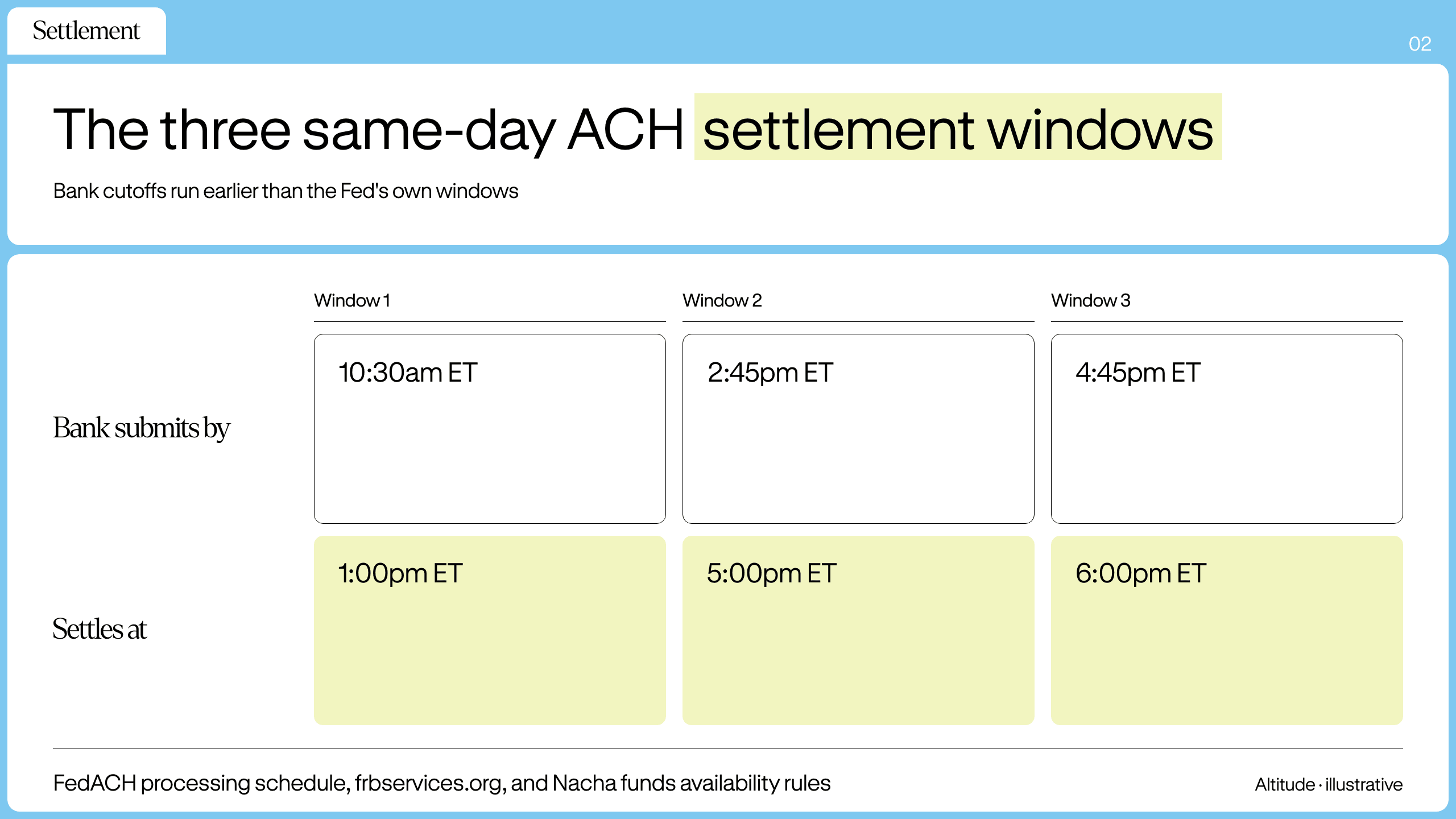
Standard ACH takes one to three business days. Same-day ACH settles the same business day when the client's bank sends the payment to the Fed in time. Banks can submit same-day ACH files to the Fed by 10:30 a.m., 2:45 p.m. or 4:45 p.m. ET, settling at 1:00 p.m., 5:00 p.m. or 6:00 p.m. ET, per the FedACH processing schedule. The client's bank sets an earlier cutoff, and not every bank offers same-day ACH. Settlement isn't the same as funds availability: Nacha requires receiving banks to make funds available by 1:30 p.m. local time for the first window and 5:00 p.m. local time for the second, while third-window credits only need to post by the end of the bank's processing day. Altitude charges no fee for ACH or same-day ACH.
ACH payment costs and limits
ACH is the cheapest invoice payment method. Altitude charges $0 for ACH and same-day ACH. The client's bank may charge them a small fee, but most US business accounts include free ACH. Same-day ACH has a $1 million per-payment limit under rules from Nacha, the organization that governs the US ACH network, as of October 2026, with an approved increase to $10 million per payment taking effect in 2027.
Why clients prefer paying via ACH
US clients default to ACH because it's already set up in their accounting software, their bank doesn't charge them for it, and they don't need to learn a new payment method. If your client is US-based and not in a rush, ACH is the path of least resistance.
Wire transfers for invoice payment
Wires are the fastest traditional option for large same-day payments and the most widely available option for large international payments, because nearly every bank worldwide offers them. Fedwire runs only on business days, with a 6:45 p.m. ET cutoff for customer transfers. Instant payment networks, like RTP and FedNow, settle in seconds, around the clock, up to $10 million per payment, if both banks participate. Both run 24/7/365 with final settlement, and FedNow raised its limit from $1 million on November 12, 2025.
Wires aren't the only choice, though. Multi-currency accounts, fintech platforms, and stablecoin transfers also move large cross-border payments, and USDC settles in minutes rather than within the same day. The fees and cutoff times still make wires a poor default for routine invoices.
When to use domestic or global wires
Use a domestic wire when the payment is large enough that the client wants same-day settlement and is willing to pay for it. Use an international wire (SWIFT) when the client is outside the US and Europe, or in the UK and paying in GBP, and pays by bank transfer rather than stablecoin. Wires aren't the right choice for small, recurring invoices because the fees compound.
Reliability of wire invoice payments
The core strength of a wire is settlement finality. Fedwire moves individual payments in real time with immediate, final settlement, and once a wire is sent, it can't be reversed. This makes wires the preferred method for large invoices where payment certainty matters more than cost.
Evaluating wire transfer payment fees
Altitude charges $0 for US domestic wires. SWIFT outbound carries a fee of $35. The sender covers the known fees under the OUR convention, the SWIFT fee arrangement in which the sender pays all transfer charges upfront so the payment should arrive in full. Intermediary banks can still deduct fees that vary by bank, so full-value receipt isn't guaranteed. If the destination account is in another currency, the recipient's bank sets the conversion rate and fees.
Best use cases for wire payments
Wires work best for one-time, high-value invoices where the client needs proof of payment and same-day settlement. They also work for international clients who pay by bank transfer and aren't in a SEPA country. For small or recurring invoices, the fee compounds and ACH or USDC becomes more cost-effective.
Direct transfer options for invoice payments
Local payment methods like SEPA handle regional payments faster and cheaper than international wires.
Handling local invoice transfers
If your client is in Europe, SEPA is faster and cheaper than SWIFT. If your client is in the UK and pays in EUR, they can also use SEPA, because the UK remains a SEPA participant for euro payments. For GBP or other non-EUR payments, their bank may support Faster Payments for domestic UK transfers, but for paying you as an international recipient, they will typically send a SWIFT wire. The key is matching the payment method and currency to the client's local banking system so they pay you the way they pay their local suppliers.
When to use SEPA for your invoices
Use SEPA for any client in a SEPA country paying in EUR. SEPA Credit Transfers settle within one business day, and Altitude charges no fee for EURC-funded SEPA. SEPA Instant Credit Transfer credits the payee in under 10 seconds, 24/7. Under the Instant Payments Regulation (EU) 2024/886, European payment providers had to be able to receive instant euro payments from January 9, 2025 and send them from October 9, 2025, so EU banks that offer euro transfers must also offer instant ones. Banks outside the EU, including UK banks, may not offer it yet, and the scheme no longer sets a maximum amount per payment.
ACH vs wire for invoice processing
Standard ACH is free but takes one to three business days. Same-day ACH settles the same business day at no Altitude fee when the client's bank offers it and submits the file in time, up to $1 million per payment. Wire is fast and costs money. For routine invoices with US clients who aren't in a rush, standard ACH is the right default. For urgent invoices, ask whether the client's bank offers same-day ACH. For large invoices where the client needs proof of payment today, or the amount exceeds the same-day ACH limit, wire is worth the fee.
Settling invoices with USDC stablecoins
USDC is a dollar stablecoin issued by Circle, redeemable 1:1 for US dollars and backed by cash and short-term Treasury reserves. It isn't a bank deposit. Paying with it moves a dollar-denominated token on a network that settles in minutes, works on weekends, and carries no Altitude platform fee.
Paying invoices with USDC stablecoins
A client pays your invoice by sending USDC to your Altitude deposit address. The payment arrives in your account as USDC, which you can hold, convert to EURC, or send out by ACH, wire, or SEPA. The client needs a wallet or an account that supports USDC transfers, but they don’t need to understand crypto. They’re sending a dollar-denominated stablecoin that Circle redeems 1:1 for US dollars, not a bank deposit. For a detailed breakdown of how to structure invoices that accept USDC, Altitude’s help center explains how to receive invoice payments.
USDC payment arrival times
USDC moves across several separate networks, each with its own confirmation speed. On Solana, transactions confirm instantly, and Altitude credits Solana deposits directly once the transaction confirms. On other networks such as Ethereum, Base, Avalanche, and Tempo, settlement typically takes about 15 minutes. Altitude credits USDC sent on Ethereum, Base, Avalanche, and Tempo as USDC on Solana.
Fees for USDC invoice payments
Altitude charges $0 for stablecoin transfers, with the network fee included. Solana network fees are typically very low but vary with network conditions. The minimum is 1 USDC or 1 EURC. The client may also pay an exchange or on-ramp fee if they need to buy USDC first, and that fee varies by provider.
| Fee Type | Cost |
|---|---|
| Altitude platform fee | $0 |
| Network fee (Solana) | Typically very low, varies with network conditions |
| Exchange or on-ramp fee (if the client needs to buy USDC) | Varies by provider |
The client may incur an on-ramp fee to acquire USDC if they don't already hold it. Once USDC arrives in your Altitude account, you can hold it, convert it to EURC, or send it out by bank transfer with no conversion required.
When to request USDC for invoices
Request USDC when the client already holds stablecoins and the client is international, the invoice is time-sensitive, or the payment falls on a weekend. In Q2 2026, 12% of Altitude's payment volume was processed on weekends, according to an X post by Altitude CEO @SimkinStepan dated 2 August 2026, which shows that stablecoin transfers work when bank transfers can't settle. USDC is also the right choice when you want to avoid SWIFT intermediary fees or when the client's country has limited banking infrastructure, provided the client can hold and send stablecoins.
USDC works best when the client already has access to stablecoins or is willing to acquire them. For clients without that infrastructure, ACH, SEPA, or wire remain the path of least resistance.
Card payments on invoices
Some clients want to pay with a corporate card to earn rewards or extend their cash cycle. Card acceptance costs the merchant about 2.9% + 30¢ per transaction on standard Stripe US pricing, so collecting a $5,000 invoice by card on Stripe costs about $145.30. PayPal invoicing charges 2.99% to 3.49% plus a fixed fee per transaction. That is more than ACH, which carries no Altitude fee, and more than a domestic wire. Altitude invoicing doesn't list card payments as a supported option, so accepting cards means using a separate payment processor.
You can pass the cost to the client with a surcharge, but card networks restrict it. Under Visa's US surcharging rules:
- Surcharges are allowed on credit cards only, never on debit or prepaid cards.
- The surcharge is capped at the lower of the merchant discount rate (the fee the merchant pays to accept the card) or 3%.
- The merchant must notify its acquirer 30 days in advance and disclose the surcharge to the client.
- Per Visa (February 2024), Connecticut, Maine, Massachusetts, Oklahoma, and Puerto Rico prohibit surcharging. Colorado, Minnesota, New Jersey, and New York have additional requirements.
Cards work best for small, one-off invoices where the client values the convenience and you accept the fee. For large or recurring invoices, a 2.9% cost adds up quickly, and ACH or USDC is more cost-effective. Confirm current surcharging rules with your acquirer before adding a surcharge to any invoice.
Checks for invoice payments
Checks still show up with clients who run paper-based accounts payable. The client mails the check, you deposit it, and your bank clears it. Mailing time and your bank's funds availability policy decide when you can spend the money, and the check can be lost in the mail or bounce after you deposit it. Each check also needs to be matched to its invoice by hand.
Altitude invoicing accepts ACH, wire, EURC-funded SEPA, and USDC, and doesn't list checks as a payment option. If a client pays by check, ask whether they can switch to ACH, which most US business accounts support without a fee. Offer checks only when the client can't pay any other way.
Choosing your supported invoice payment methods
The right mix of payment methods depends on where your clients are, how fast you need the money, and what fees you're willing to absorb.
Settlement times for ACH and wires
| Payment Method | Settlement Time | Altitude Fee |
|---|---|---|
| ACH | 1–3 business days | $0 |
| Same-day ACH | Same business day | $0 |
| US domestic wire | Same business day | $0 |
| EURC-funded SEPA | 1 business day | $0 |
| SWIFT | Most Swift GPI payments arrive within a day; some routes take several business days | $35 ($100 minimum per transfer) |
| USDC (Solana) | Instantly | $0 |
Who can pay by each method depends on the client's bank and location:
| Payment method | Who can pay this way |
|---|---|
| ACH | Any US bank account |
| Wire (domestic) | Any US bank that offers Fedwire transfers |
| Wire (SWIFT) | Any bank with SWIFT access, per Swift |
| SEPA | Any bank in a SEPA country, paying in EUR, per the European Payments Council |
| USDC (Altitude) | Any client who holds USDC and can send it |
Reversibility also differs by method. Under Nacha's rules on warranty claims, an ACH debit to a business account can be returned as unauthorized within 2 banking days, and an ACH debit to a consumer account within 60 days. Fedwire payments are final once credited, per the Federal Reserve's Fedwire funds service guidance, so a sent wire can't be recalled by the sender.
Total expense per payment method
The cheapest method isn't always the one with the lowest platform fee. Standard ACH is free but takes one to three business days, and same-day ACH is also free when the client's bank offers it. SWIFT costs $35 on Altitude, with a $100 minimum per transfer, plus intermediary fees that vary by bank and that the client or you absorb. USDC costs nothing on Altitude, but the client may pay an exchange or on-ramp fee to acquire USDC. The total cost is the sum of what you pay, what the client pays, and what gets lost to intermediaries.
Handling international invoice payments
For international clients, the payment method determines whether the payment arrives at all. A client in a country with capital controls or weak banking infrastructure may not be able to send a wire. A client in Europe should use SEPA. A client outside the US and EU should use SWIFT, or USDC if the client already holds stablecoins. Altitude opens accounts for eligible businesses from 200+ countries with no US entity required, though product availability varies by country.
Payment options for Altitude invoices
Altitude invoicing accepts ACH, wire, EURC-funded SEPA, and USDC. You invoice in USD or EUR and set the payment terms on each invoice: On Receipt means payment is due as soon as the client receives the invoice, Net 15 means the client has 15 days to pay, Net 21 is the default and gives the client 21 days, Net 30 means the client has 30 days to pay, and you can also set a specific due date. You can track invoice status and due dates while payment is outstanding. Deposit matching is manual today, with automatic matching coming soon. One matched deposit marks the whole invoice as paid. Partial payments aren't tracked and card payments on invoices aren't currently listed as a supported option.
How to offer flexible invoice payment options
The goal is to give clients the method that works for them without creating reconciliation chaos on your end.
Align payment methods with client needs
Match payment methods to client segments, such as client location, payment time and average invoice amount. US clients on routine invoices should see ACH unless the payment is large or urgent. European clients on any amount should see SEPA, or USDC if they already hold stablecoins. International clients outside these regions should see SWIFT, or USDC if they already hold stablecoins.
Choose payment options by jurisdiction
Match the payment method to the client's local banking system. US clients get ACH and wire. European clients, and UK clients paying in EUR, get EURC-funded SEPA. UK clients paying in GBP and other international clients outside Europe get SWIFT, or USDC if the client already holds stablecoins. Altitude supports local payouts in EUR, GBP, MXN, BRL, and COP, but these are for outgoing payments.
How Altitude syncs to QuickBooks and Xero
Every payment method that arrives in a separate account creates a reconciliation task. If a client pays by ACH to one account, another pays by wire to a different account, and a third pays by USDC to a wallet, you're matching three payment sources to three invoices in three systems. Altitude syncs transactions to QuickBooks Online and Xero, and you confirm every posting before it applies. Card transactions sync once mapped. Receipt-to-transaction matching is a separate card feature.
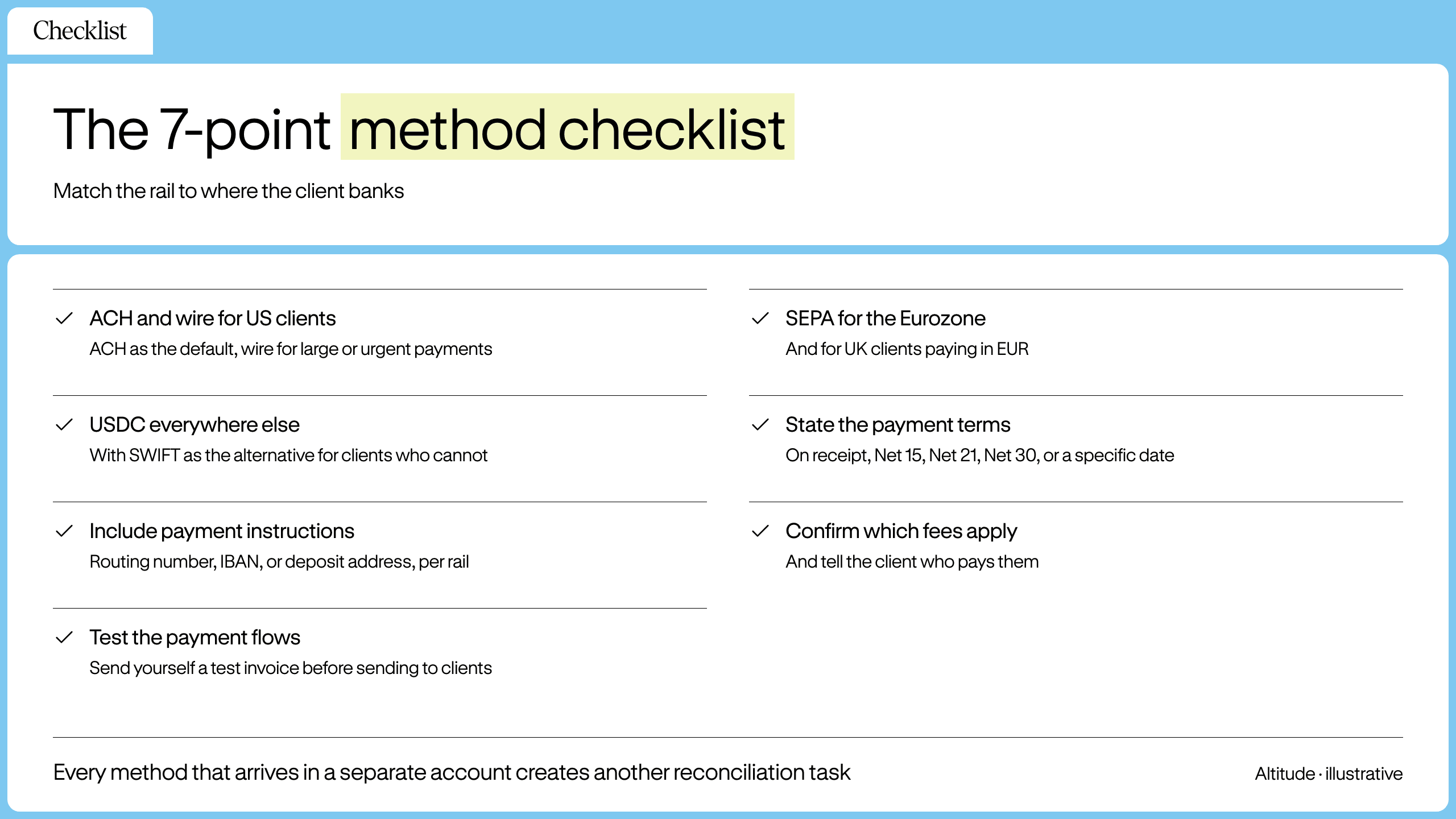
Here is the checklist for choosing invoice payment methods:
- List ACH and wire for US clients. ACH is the default. Wire is for large or urgent payments.
- List SEPA for European clients and for UK clients paying in EUR. EURC-funded SEPA settles in one business day with no Altitude fee.
- List SWIFT for international clients outside the US and Europe, and for UK clients paying in GBP, since most corporate accounts payable teams pay by bank transfer. Add USDC if the client already holds stablecoins. It settles in minutes, works on weekends, and avoids intermediary fees.
- State the payment terms clearly. On Receipt, Net 15, Net 21 (default), Net 30, or a specific date.
- Include payment instructions. Routing number for ACH, IBAN for SEPA, deposit address for USDC.
- Confirm which fees apply. Tell the client if they will pay a wire fee or an exchange or on-ramp fee.
- Test critical payment flows. Send yourself a test invoice and confirm at least ACH and wire instructions work before sending to clients.
See how Altitude handles invoice payments across borders. Book a demo.
FAQs
What is the fastest way to pay an invoice?
USDC on Solana settles instantly, and the network runs continuously without banking hours. Same-day ACH settles the same business day when the client's bank submits the file to the Fed by 4:45 p.m. ET (settling at 6:00 p.m. ET), though the client's bank sets an earlier cutoff and not every bank offers it. Domestic wires settle the same day during banking hours.
What is the cheapest invoice payment method?
ACH is the cheapest for US clients because Altitude charges $0 and most US banks don't charge the sender. For international clients, USDC has the lowest total cost when the client already holds it: Altitude charges no fee for stablecoin transfers, there are no SWIFT intermediary fees, and Solana network fees are typically very low. A client who has to buy USDC may pay an exchange or on-ramp fee, so compare the total cost to the payer and to you. SWIFT costs $35 on Altitude, with a $100 minimum per transfer, plus intermediary fees that vary by bank.
Can clients pay invoices internationally with ACH?
Technically, yes. ACH is a US-based system, but it supports International ACH Transactions (IAT), which send payments in a defined set of currencies and countries. Confirm current coverage with your bank. In practice, though, most international clients pay by SWIFT, SEPA, or USDC. Most SWIFT payments between banks that use Swift GPI arrive within a day, but some routes take several business days and intermediary banks may deduct fees. SEPA works for European clients and for UK clients paying in EUR. USDC settles instantly on fast networks like Solana, though timing varies by network.
How do I accept USDC payments on invoices?
Altitude invoicing accepts USDC alongside ACH and wire. You invoice in USD or EUR, and the client pays by sending USDC to your Altitude deposit address. The payment arrives as USDC, which you can hold, convert, or send out by bank transfer. Card payments on invoices aren't available.
Which invoice payment method is best for cross-border clients?
Most cross-border clients pay by bank transfer. SEPA works for European clients and UK clients paying in EUR, and SWIFT works for other currencies and regions. Most SWIFT payments between banks that use Swift GPI arrive within a day, but some routes take several business days and intermediary banks may deduct fees. USDC is a strong option if the client already holds stablecoins. It settles instantly on Solana and works on weekends, since the network runs continuously outside banking hours. Altitude charges no platform fee for stablecoin transfers, though network fees may still apply and a client who has to buy USDC may pay an exchange or on-ramp fee.
Key terms glossary
ACH: Automated Clearing House, a US payment network that moves money between bank accounts in batches. Settlement takes 1–3 business days, or the same day for same-day ACH.
Wire transfer: An electronic transfer between banks that settles the same day for domestic payments. Domestic wires settle in real time via Fedwire. International wires use the SWIFT network. Most SWIFT payments between banks that use Swift GPI arrive within a day, but some routes take several business days and intermediary banks may deduct fees.
Fedwire: The Federal Reserve's real-time settlement system for US dollar wire payments between banks. Settlement is immediate and final, so a sent wire can't be reversed.
SWIFT: Society for Worldwide Interbank Financial Telecommunication, the messaging network banks use to instruct international wire payments. A SWIFT transfer can pass through one or more correspondent banks, each of which may deduct an intermediary fee.
USDC: USD Coin, a dollar stablecoin, redeemable 1:1 for US dollars and backed by cash and short-term Treasury reserves. It isn't a bank deposit. Balances are held in fully reserved stablecoins, backed one to one by the issuer's reserves.
EURC: Euro Coin, a stablecoin pegged 1:1 to the euro. On Altitude, EURC can be held as an account balance or used to fund SEPA transfers.
SEPA: Single Euro Payments Area, the schemes banks in 41 European countries and territories use to send euro transfers on the same rules (SEPA Credit Transfer and SEPA Instant). SEPA Credit Transfers settle within one business day. SEPA Instant Credit Transfers settle in under 10 seconds.
IBAN: International Bank Account Number, a standardized format for identifying bank accounts in cross-border payments. SEPA transfers are sent to the recipient's IBAN.
Settlement time: The time between when a payment is initiated and when the funds are available in the recipient's account. ACH takes 1–3 business days. Domestic wires settle the same business day. Most SWIFT payments between banks that use Swift GPI arrive within a day, but some routes take several business days. USDC on Solana settles instantly.
Altitude is a financial technology platform, not a bank or digital asset custodian.