
Mid-market rate vs the rate you actually pay: the all-in cost of an international payment
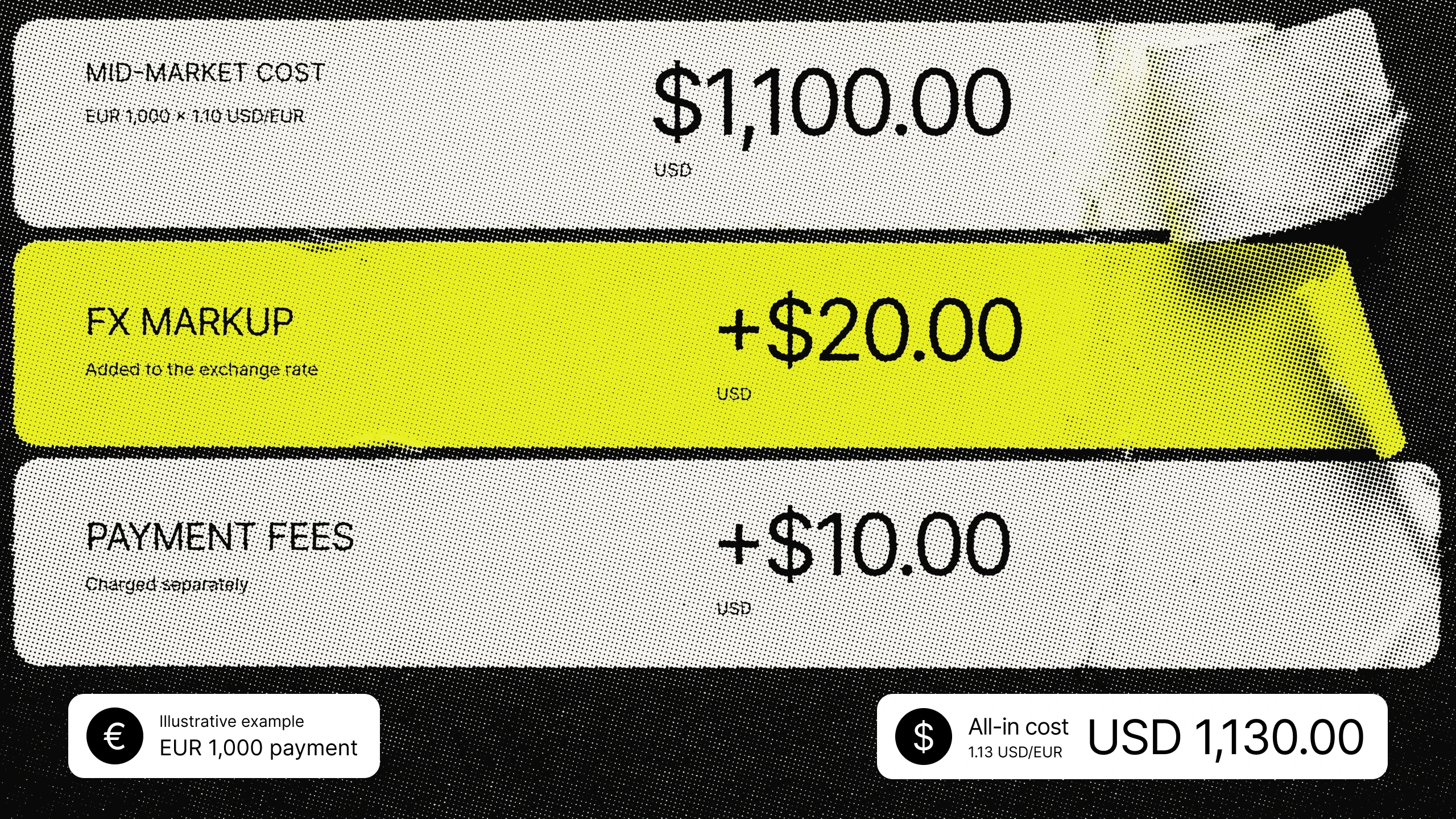
TL;DR: The mid-market rate is a benchmark that providers use as a baseline before adding their markup. The rate you actually pay includes an FX markup plus fixed fees from your provider and intermediary banks. To calculate your all-in cost, compare the mid-market rate at execution time against the settlement rate on your bank statement, add every fixed fee, and express the total as a percentage of payment volume. For example, a 1% spread on a $50,000 payment costs $500, and fees vary by payment rail.
Your bank statement shows the amount that arrived, but it doesn't show the mid-market rate at the moment the payment was executed, or the spread your provider kept.
For finance managers, that gap matters. A hidden FX cost discovered in a month-end review creates a credibility problem with your CFO. This article gives you a repeatable audit method to expose the gap between the mid-market rate and the rate you actually pay, quantify it as a percentage of payment volume, and use that number to either negotiate better terms or move volume to a provider with a transparent fee structure.
How the mid-market rate sets your FX baseline
The mid-market rate, often referred to as the interbank rate, is the midpoint between the buying (bid) and selling (ask) prices of two currencies on the foreign exchange market. Calculate it this way: (bid + ask) ÷ 2. This gives you a neutral baseline for a currency pair at a given moment: the rate at which banks trade with one another, without adding any margin or markup.
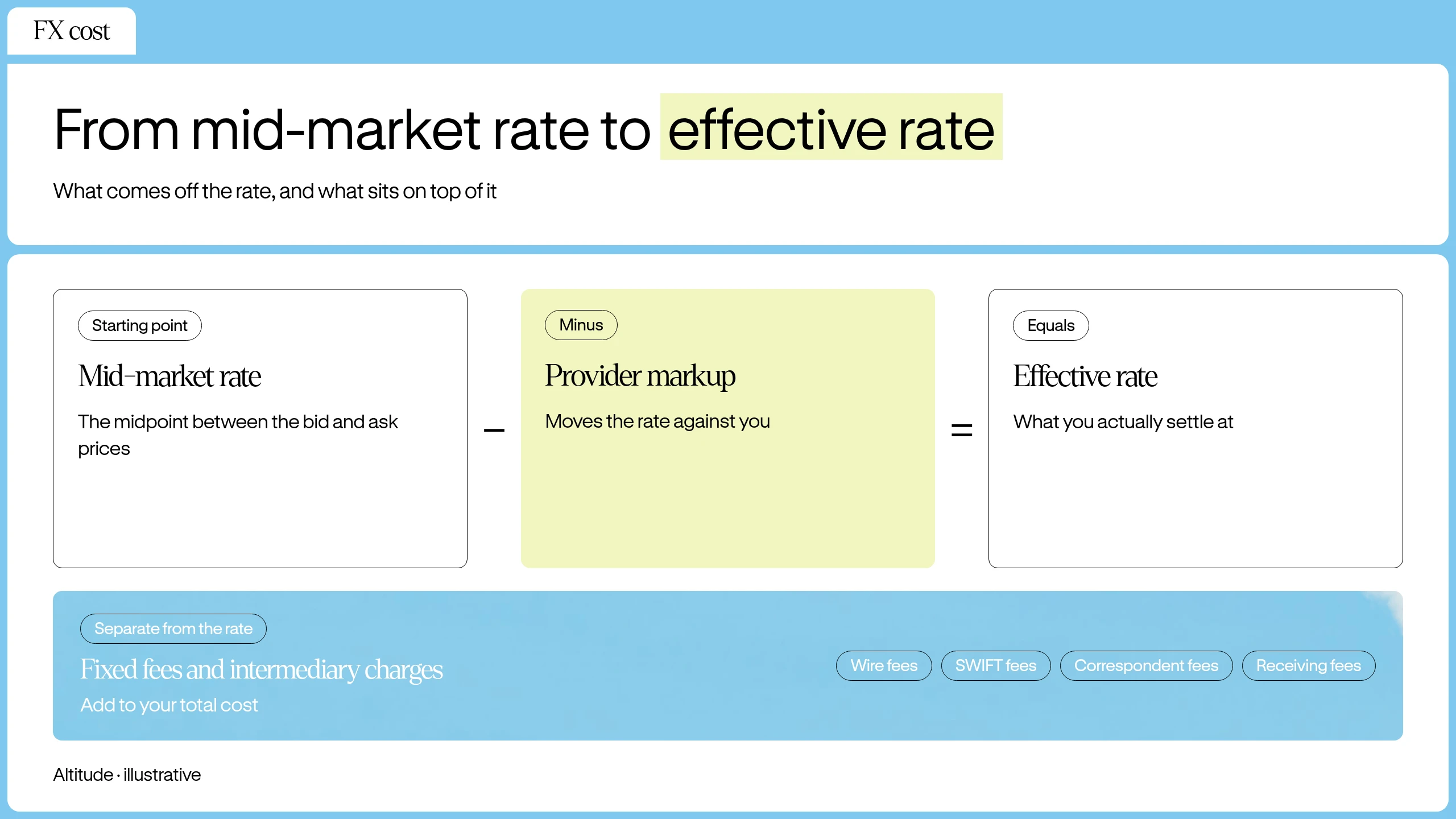
Most businesses cannot access the mid-market rate directly. Instead, they receive an effective rate: the rate you actually settle at. The effective rate is the mid-market rate adjusted by the provider's markup, which moves the rate against you. Fixed fees and intermediary charges sit on top of that as separate costs, not as part of the rate, and that difference is where the audit starts.
What influences mid-market pricing
Supply and demand in the interbank market determine the mid-market rate, and several macroeconomic factors move both. Central bank policy also shapes the rate through its effect on interest rates and money supply, which the ECB's transmission mechanism explains: policy rate changes feed into asset prices, including the exchange rate, and into inflation expectations.
Interest rates set by central banks directly affect currency values. When a country raises its interest rates, it typically increases the return on investments in that currency, attracting foreign capital and strengthening the currency. Inflation differentials matter through purchasing power parity: when the same goods are cheaper in one country, demand for that country's currency rises and pressures the exchange rate to adjust, absent trade frictions. The Federal Reserve's FAQ explains the same interest-rate-to-inflation link from the US central bank's side.
Market liquidity and volatility also move the mid-market rate. Currency pairs with higher trading volume, such as EUR/USD or GBP/USD, typically have tighter bid-ask spreads and more stable mid-market rates. Less liquid pairs can have wider spreads and more volatile mid-market rates, especially outside of overlapping trading sessions. A Bank of Canada analysis of business payments from 2021 to 2023 supports this with more recent data, though it covers quoted prices for Canadian outbound payments, not payments actually made.
What influences your final FX rate
Provider markup, fixed fees, intermediary bank charges, and the time between invoice and conversion are factors beyond the mid-market rate that influence what you actually pay.
- The provider markup is the spread added on top of the mid-market rate. This is where most of the hidden cost lives.
- Fixed fees include wire fees, SWIFT fees, and receiving fees.
- Correspondent banks deduct intermediary charges from the transfer amount.
- Conversion timing affects the rate you pay because the mid-market rate can move between the invoice and the moment you book the conversion. Once the conversion is booked, the rate is locked.
Deconstructing the true cost of cross-border payments
The full cost of an international payment includes several components: FX markup, sender fee, correspondent fee, receiving fee, and rate movement between invoice and conversion. The FX markup is often the largest component, though that depends on payment size and rail. A Bank of Canada analysis of business payments from 2021 to 2023 looked at quoted prices for Canadian outbound payments, not payments actually made. In those quotes, FX margins made up over 75% of what banks charged, and the total margin was around 2% to 3.5% of transaction value. The markup is also usually embedded in the rate rather than shown as a line item.
| Cost component | Who sets it | How to find it |
|---|---|---|
| FX markup | Your provider, embedded in the rate | Compare effective rate to mid-market rate at execution time |
| Sender fee | Your sending bank or provider | Bank fee schedule |
| Correspondent fee | Each intermediary bank, charged per hop | Compare the amount sent with the amount received |
| Receiving fee | The recipient's bank | Bank fee schedule |
| Invoice-to-conversion rate movement | The market, before you book the conversion | Compare the mid-market rate at invoice date with the mid-market rate at the conversion timestamp |
How FX markups impact your total cost
Providers express FX markups as a percentage of the payment amount, but they translate to dollars: a 1% markup on a $50,000 payment costs $500, and a 3% markup costs $1,500. As an illustrative estimate, not a measured figure, a business sending $50,000 monthly ($600,000 annually) to international suppliers or contractors would pay $12,000 to $24,000 annually in markup at a 2% to 4% rate. Your actual figure depends on your provider's markup, which you can calculate from your own statements.
| Payment amount | 0.5% markup | 1% markup | 2% markup | 3% markup |
|---|---|---|---|---|
| $10,000 | $50 | $100 | $200 | $300 |
| $50,000 | $250 | $500 | $1,000 | $1,500 |
| $100,000 | $500 | $1,000 | $2,000 | $3,000 |
SWIFT outbound fees and charge instructions
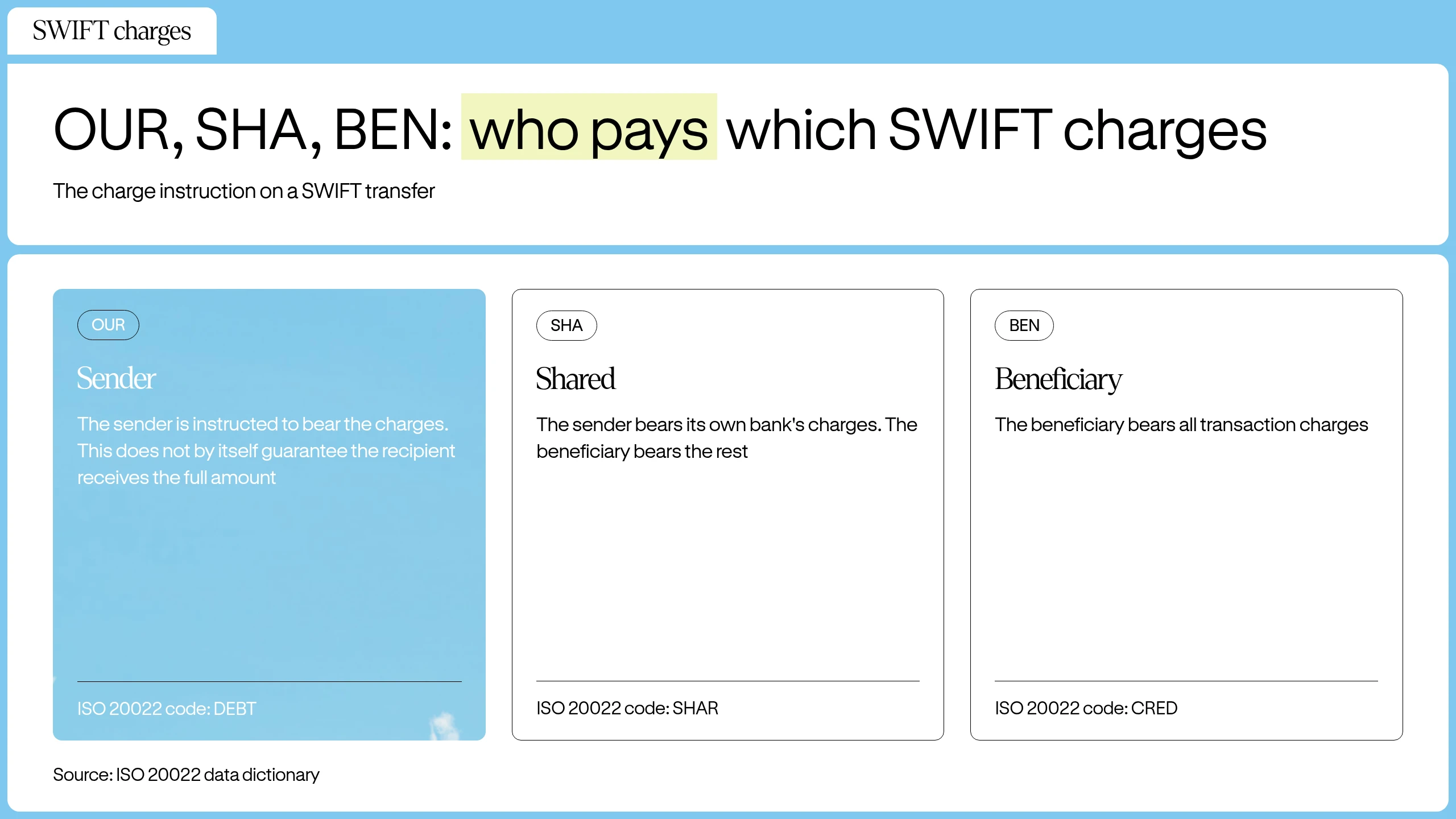
SWIFT transfers carry one of three charge instructions: OUR, SHA, or BEN. The instruction decides whether the sender or the beneficiary bears the sending bank, intermediary bank, and receiving bank charges. ISO 20022 defines the charge bearer codes behind them: OUR maps to DEBT, SHA to SHAR, and BEN to CRED.
Under OUR, the sender is instructed to bear the charges, but this does not by itself guarantee the recipient receives the full amount. Under SHA, the sender bears its own bank's charges and the beneficiary bears the rest. SHA is legally required when both banks are in the EEA, under Article 62(2) of the EU's Payment Services Directive (PSD2). Under BEN, the beneficiary bears all transaction charges.
Navigating correspondent bank charges
Correspondent banks are intermediary banks that facilitate transfers between banks without a direct relationship, and each one can take a handling charge from the payment as it passes through. Banks do not always show those deductions before the payment leaves, and they are the usual reason a beneficiary reports receiving less than the figure you sent. Swift gpi tracking shows the route a payment took and the deductions taken along it, where the banks involved support gpi. To identify these deductions, compare the amount you sent with the amount your recipient reports receiving: the difference, minus any stated sender and receiving fees, is the correspondent charge. The same method works for SWIFT transfers under any charge instruction: the OUR convention covers known fees but not all intermediary deductions, and under SHA or BEN each correspondent bank can deduct its own charges.
Managing inbound settlement costs
Receiving banks may charge an inbound wire fee, and if the destination account is in a different currency, the recipient's bank sets the conversion rate and fees, which add to your total cost. Take the receiving fee from the recipient bank's fee schedule, then subtract it, along with the stated sender fee, using the method in the correspondent bank charges section above.
How timing between invoice and conversion affects payment costs
Once a conversion is booked, the rate is locked, so time in transit doesn't change your FX cost. The rate risk sits between the invoice and the conversion: if you convert three business days after receiving an invoice and the mid-market rate moves 0.5% against you, that movement adds 0.5% to your all-in cost. Weekend and cut-off delays only matter if they push back the moment you book the conversion.
Quantifying the actual cost of international payments
Calculating the all-in cost of an international payment requires a manual reconciliation process:
- Track daily mid-market exchange rates at execution time
- Account for wire and intermediary fees
- Sum your total FX costs and express them as a percentage
Step 1: track daily mid-market exchange rates
Use Altitude's currency converter to capture the mid-market rate at execution time, and the ECB euro foreign exchange reference rates for end-of-day checks. ECB reference rates are a once-daily snapshot, published around 16:00 CET, so they can't show the rate at the moment of execution. Record the timestamp, not just the date, because the mid-market rate can move significantly within a single day.
Step 2: account for wire and intermediary fees
List every fixed fee: sender fee, correspondent fee, receiving fee. Pull these from bank statements and fee schedules. If you are using SWIFT, note the charge instruction (OUR, SHA, or BEN) and whether any intermediary deductions were applied.
Step 3: sum your total FX costs and express them as a percentage
The formula for total cost is: settlement amount × FX spread + Fixed fees, where FX spread = (Mid-market rate - Effective rate) ÷ Mid-market rate. The spread is a percentage, so multiplying it by the settlement amount returns the cost in dollars. The effective rate equals the mid-market rate × (1 - markup percentage), and both rates must be quoted in the same direction, such as EUR per 1 USD. The table below applies the formula to a $50,000 payment.
| Component | Value |
|---|---|
| Settlement amount | $50,000 |
| Mid-market rate | 0.9200 EUR per USD |
| Effective rate | 0.8970 EUR per USD |
| FX spread | (0.9200 - 0.8970) ÷ 0.9200 = 2.5% |
| FX markup cost | $50,000 × 2.5% = $1,250 |
| Sender fee | $30 (illustrative) |
| Correspondent fee | $25 |
| Receiving fee | $15 |
| Total cost | $1,320 ($1,250 + $30 + $25 + $15) |
| Cost as % of payment | 2.64% |
To normalize the result, divide the total cost by the settlement amount and multiply by 100. In the worked example, $1,320 ÷ $50,000 × 100 = 2.64% of payment volume, of which the FX spread accounts for 2.5%.
The table below applies the same formula at three quoted rates on a $50,000 payment.
| Mid-market rate (EUR per USD) | Quoted rate (EUR per USD) | Spread percentage | Dollar cost on $50,000 |
|---|---|---|---|
| 0.9200 | 0.9108 | 1.0% | $500 |
| 0.9200 | 0.9062 | 1.5% | $750 |
| 0.9200 | 0.8970 | 2.5% | $1,250 |
How to audit quoted rates versus mid-market
Auditing quoted rates requires comparing the quoted rate against the mid-market rate at the same timestamp. This is a manual process requiring bank statements and a neutral rate source.
Request the effective rate and both amounts before approving a payment, then compare them against the mid-market rate at the same moment and flag any quote that does not show the effective rate.
Identifying hidden FX spread fees
Look for "rate differences" or "conversion fees" on bank statements, and check whether the provider shows the mid-market rate as a reference. Some providers bundle the markup into the rate without a line item, and some banks don't publish a standard markup. Bank of America sets its exchange rate at its discretion, builds the markup into that rate, and doesn't publish one markup percentage for every route, amount or customer.
Quantifying your total FX spread exposure
Aggregate the per-payment calculations into a monthly or quarterly view. Express total FX cost as a percentage of gross payment volume.
Calculating monthly FX cost as % of volume
The formula is: Total monthly FX cost ÷ Total monthly payment volume × 100
| Payment | Corridor | Amount | FX cost | % of volume |
|---|---|---|---|---|
| Supplier payment 1 | USD to EUR | $10,000 | $150 | 1.5% |
| Contractor payment 1 | USD to GBP | $5,000 | $75 | 1.5% |
| Supplier payment 2 | USD to BRL | $25,000 | $500 | 2.0% |
| Contractor payment 2 | USD to MXN | $8,000 | $120 | 1.5% |
| Total | - | $48,000 | $845 | 1.76% |
How to present your FX cost findings to your CFO
Present your findings to your CFO as a one-page summary with three components:
- A cost comparison table showing your current provider's all-in cost against the alternatives you are evaluating
- The total FX cost as a percentage of payment volume, with the top three payment corridors by cost
- A recommendation with dollar savings, expressed as both an annual figure and a percentage of payment volume
State the annual savings in dollars. If your current provider charges 2.5% all-in (illustrative) and a hypothetical provider charges 0.5% on the same corridors, the saving on $50,000 monthly volume is $12,000 annually.
How Altitude prices SWIFT, SEPA, and local rail payments
Altitude, a global business account, charges $35 per outbound SWIFT transfer with a $100 minimum per transfer. Transfers are configured under the OUR convention, meaning the sender is instructed to bear the charges, though some intermediary banks can still deduct charges and the recipient may not receive the full amount.
EURC-funded SEPA carries no Altitude fee, while SEPA from a USD account is priced at 0.4% above mid-market. Settlement timing comes from the SEPA scheme: SEPA Instant makes funds available in less than ten seconds, at any time, and for standard SEPA Credit Transfers, funds take up to one business day to be available on the payee's account, according to the European Payments Council. Local rails are priced as a markup on the mid-market rate: Faster Payments (GBP), SPEI (MXN), and Pix (BRL) are documented at 0.4% above mid-market, and Bre-B (COP) at 0.6% above mid-market, per the Altitude help center, as of October 2026. On a $50,000 payment, that is $200 and $300 respectively.
Local payouts in GBP, MXN, BRL, and COP are funded with USDC from a USD account, and they need workspace enablement and approval of each route. They cost 0.4% above mid-market, or 0.6% for COP, built into the rate shown with no separate transfer fee and no volume tiers. Local payouts do not create a local-currency balance. The recipient receives exactly the amount quoted, as per the Faster Payments, SPEI, Pix, and Bre-B guides.
Reducing costs with stablecoin transfers
Stablecoin transfers settle typically within seconds on Solana, or up to 15 minutes on other networks. Note that stablecoin transfers are irreversible once settled, so test with a small payment first. Stablecoin transfers also settle on weekends and outside banking hours.
Stablecoin transfers avoid correspondent bank charges entirely, but the recipient must accept stablecoins or convert them, which may introduce a separate conversion cost. Because they settle outside banking hours, they address cut-off risk for urgent transfers that cannot wait for a Monday settlement window.
See how Altitude handles contractor and supplier payments across borders. Book a demo.
FAQs
How much do banks typically mark up the mid-market rate?
Disclosure varies by bank and region. Many banks don't publish one markup that applies to every business transfer, and the figure varies by currency pair and transaction size. To find your own, compare the effective rate on your statement with the mid-market rate at the same timestamp, then express the difference as a percentage of the payment amount.
Can I negotiate FX rates with my bank?
Contact your bank's treasury or corporate banking team to ask about volume-based pricing. Bring your last three months of effective rates measured against mid-market, so the conversation starts from your actual spread.
What's a reasonable all-in cost for international payments?
A reasonable all-in cost depends on corridor, rail and payment size, so measure yours: add the FX spread and every fixed fee, then divide by the payment amount. For a benchmark, Bank of Canada analysis of Canadian business payments from 2021 to 2023 found banks quoted a total margin of around 2% to 3.5% of transaction value on outbound payments. These are quoted prices, not payments actually made, so your realized cost may differ. The paper also found payment companies quoted 1.3 to 2.1 percentage points less than banks, and it notes the G20 target of 1% by the end of 2027. Compare your own corridors against that range and that target.
How do I track FX costs across multiple corridors?
Use a spreadsheet to record the payment amount, mid-market rate at execution time, effective rate, fixed fees, and total cost for each payment. Calculate the FX spread percentage for each payment and aggregate by corridor to identify your most expensive routes.
Key terms glossary
Mid-market rate: the midpoint between the buying (bid) and selling (ask) prices of two currencies on the foreign exchange market, calculated as (bid + ask) ÷ 2. It is the closest thing to a true market price for a currency pair.
FX spread: the difference between the mid-market rate and the effective rate you actually pay, expressed as a percentage of the mid-market rate.
Exchange rate markup: the percentage added on top of the mid-market rate by a payment provider, typically embedded in the rate rather than shown as a line item.
Correspondent bank: an intermediary bank that facilitates transfers between banks without a direct relationship, typically charging a handling fee deducted from the transfer amount.
Effective exchange rate: the rate you actually settle at: the mid-market rate adjusted by the provider's markup, which moves the rate against you. Fixed fees and intermediary charges sit on top of that as separate costs, not as part of the rate.
Altitude is a financial technology platform, not a bank or digital asset custodian.