

TL;DR: Multi-entity accounting keeps each legal entity's books isolated, traceable, and audit-ready while documenting the intercompany flows that connect them. Manual processes break down as entity count grows: a single intercompany mismatch can turn a clean close into days of reconciliation work. Each entity keeps its own ledger, and the group consolidates those ledgers with intercompany balances eliminated.
Every group close raises two questions: what did each entity earn and owe on its own books, and what does the group look like once dealings between its entities are removed? Multi-entity accounting answers both. This article covers when a group needs it, how ownership percentage changes the accounting treatment, how intercompany balances get eliminated, and what an audit-ready workflow looks like.
When you need multi-entity accounting
A business needs multi-entity accounting when two or more legal entities share ownership and transact with each other. Any one trigger below usually means each entity needs its own ledger. Meeting the control test also means the group must consolidate, with intercompany balances eliminated.
- Two or more legal entities sit under common ownership, each with its own bank accounts, tax obligations, and books.
- A parent company controls a subsidiary, usually by owning more than 50% of the voting rights, though control can also come from other arrangements. When a group reports under IFRS 10 or US GAAP (ASC 810), the parent combines its subsidiaries into one set of consolidated statements. This applies to private groups as well as listed ones whenever lenders, investors or local rules require financial statements.
- Entities run regular intercompany sales, loans, management fees, or cost allocations that must be recorded in both ledgers and eliminated on consolidation.
- Lenders, investors, or the board ask for group-level numbers.
- Entities operate in different currencies or tax jurisdictions, including VAT regimes.
- A parent owns enough of a subsidiary to qualify for group tax filing under local rules. In the US, a parent that owns 80% or more of a US subsidiary can file a consolidated federal tax return. Other countries set their own thresholds, so confirm eligibility with a tax adviser in each jurisdiction.
- Your finance team spends several days building spreadsheet roll-ups to close each month, and the group numbers arrive after lenders, investors, or the board need them.
The need is sharpest when entities sit in different countries, for example a US parent with a subsidiary in Germany and another in Brazil. Each subsidiary keeps local bank accounts, records in its own currency, and follows its own tax rules, including VAT where it applies. Statutory reporting requirements also vary by country, so confirm them with a local adviser.
Cross-border intercompany charges add two further tasks: translating each subsidiary's figures into the group's presentation currency and documenting related-party prices. A shared spreadsheet can't keep that straight for long, and a separate ledger per entity gives each country's books a clean starting point.
Combined and consolidated statements are not the same thing. Consolidated statements present a parent and the subsidiaries it controls as one economic entity, after intercompany items are eliminated. Combined statements add together entities that share common ownership but have no parent, such as sister companies owned by the same person. Which one applies depends on the ownership structure, so confirm it with your accountant.
Ownership thresholds and accounting treatment
Ownership percentage usually determines how one entity's results appear in another's books. The thresholds below are rules of thumb, and the actual treatment depends on the facts and the standard you report under.
- Above 50% of voting rights: The investor usually controls the investee and fully consolidates it under IFRS 10 or ASC 810.
- About 20% to 50%: The investor usually has significant influence but not control, so it applies the equity method under IAS 28 or ASC 323. The investor records its share of the investee's profit or loss on one line instead of combining line items.
- Below 20%: The investment is usually carried at fair value under IFRS 9 or ASC 321, with no consolidation.
Control can exist below 50% through contractual rights, board control, or variable interest entity (VIE) arrangements, so a percentage alone doesn't settle the question.
Non-controlling interest
When a parent controls a subsidiary but owns less than 100% of it, the outside owners' share is reported as non-controlling interest (NCI). Consolidation still includes 100% of the subsidiary's assets, liabilities, income, and expenses, then attributes part of equity and net income to NCI.
For example, a parent owns 80% of a subsidiary that earns $100,000. Consolidated net income includes the full $100,000, with $80,000 attributable to the parent and $20,000 attributable to NCI.
How multi-entity accounting simplifies reporting
Multi-entity accounting treats each legal entity as a separate ledger with its own chart of accounts, approval rules, and audit trail. The goal is clean, isolated ledgers that remain defensible under audit, while every intercompany transaction is recorded on both sides and can be traced and reconciled.
Key components of entity management
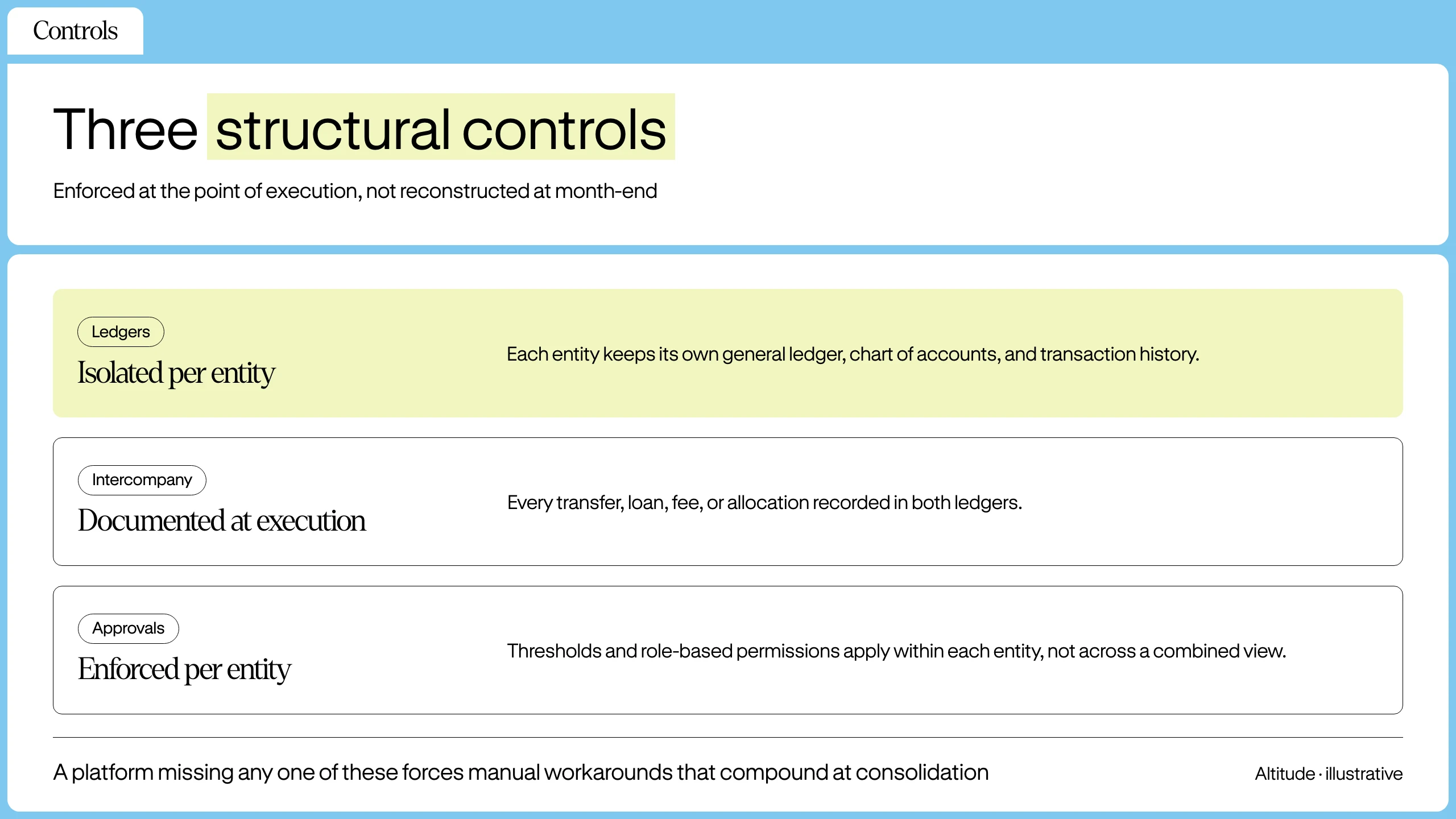
Multi-entity accounting requires three structural elements:
- Isolated ledgers per entity: Each legal entity maintains its own general ledger, its own chart of accounts, and its own transaction history. Nothing posts across entity boundaries without documentation.
- Documented intercompany transactions: Every transfer, loan, management fee, or cost allocation between entities must be recorded in both ledgers at the point of execution, not reconstructed at month-end.
- Approval rules per entity: Payment thresholds, role-based permissions, and audit trails apply within each entity.
A centralized chart of accounts helps keep intercompany balances traceable by matching every "due-to" in Entity A to a corresponding "due-from" in Entity B.
Multi-entity vs. single-entity workflows
Single-entity accounting assumes one ledger, one set of books, and one audit trail. Multi-entity accounting assumes none of those things.
| Single-entity | Multi-entity |
|---|---|
| One chart of accounts | Standardized chart of accounts per entity |
| One approval workflow | Approval rules per entity, enforced at execution |
| One month-end close | Staged close: entity first, then intercompany reconciliation, then consolidation |
| One audit trail | Audit trail per entity, plus documented intercompany flows |
Multi-entity closes need staged reviews: entity close first, then intercompany reconciliation, then consolidation. A checklist that does not account for entity sequencing will create rework at the consolidation stage every month.
Structural patterns for global finance
Global finance teams manage multiple legal entities across tax jurisdictions, currencies, and regulatory regimes. The process is further complicated when only some of the entities are wholly owned, or when the entities use different general ledger systems, record in multiple currencies, and face different tax rules such as VAT. These structural differences compound reconciliation complexity.
Foreign-currency translation
Each entity records transactions in its functional currency, which is the currency it mainly earns and spends in day to day operations. When a subsidiary's functional currency differs from the group's presentation currency, the group translates that subsidiary's statements before consolidating them, following IAS 21 or ASC 830. Assets and liabilities are translated at the closing rate, and income and expenses at the transaction-date rate or a period average. The resulting translation differences go to other comprehensive income, not profit or loss.
A foreign-currency transaction inside one entity, such as a EUR invoice in a USD ledger, is remeasured instead, and the gain or loss goes to profit or loss. Hyperinflationary economies follow separate rules. Translation also feeds intercompany mismatches: if two entities record the same transaction at different rates, the balances won't eliminate cleanly until the rate difference is resolved.
Signs you have outgrown manual consolidation
Manual consolidation usually fails at the close before it fails on paper, and each additional entity adds another ledger to cross-reference and another set of timing differences to resolve. These are the signs it has run its course:
- Intercompany balances don't eliminate cleanly, and the same mismatches (timing, FX rate, missing entry) come back every close.
- Reconciling items roll forward unresolved from one month into the next.
- Group numbers depend on one person who knows which spreadsheet tabs and links to update.
- One entity that closes late holds up consolidation for the whole group.
- Adding an entity means building more manual cross-references, not opening one more set of books to close.
Roll-ups that take days at each close, listed under "When you need multi-entity accounting," are the clearest sign. Two or more of the signs above at once means the close needs staged reviews and entity-level ledgers.
Transfer pricing across tax borders
Transfer pricing is the price one entity charges a related entity for goods, services, loans, or intellectual property, and it is a common area of tax scrutiny. For US federal income tax, related-party prices must meet the arm's length standard under 26 CFR 1.482-1. Other countries apply their own transfer pricing rules, so confirm them with a local tax adviser.
The arm's length standard asks whether unrelated parties would have agreed the same price in comparable circumstances. For charges such as management fees, finance teams typically record the pricing basis, for example a cost-plus markup or a comparable market rate, alongside the invoice, so the same figure appears in both ledgers and supports the tax position.
Approval workflows across entities
Internal controls should include structured approval workflows and audit trails that track transactions across entities. Set approval policies for each entity and department: who can propose a payment, who can approve it, and the amount above which a second approver is required. Keep the preparer and approver of a payment separate, and record the approver and the date against every payment so the trail survives an audit.
Tax filing rules for multi-entity groups
For US federal income tax, each entity has its own tax obligations, but not always a separate return. A single-member LLC is usually disregarded for US federal income tax, and a US affiliated group with 80% of the vote and value can file one consolidated federal return under IRC 1504 using Form 851. Where an entity is taxed as its own taxpayer, missing documentation, inconsistent pricing, or reconciliation gaps expose the structure to penalties and audit risk. Other countries set their own entity tax and group filing rules, so confirm them with a local tax adviser.
Establishing audit-ready multi-entity workflows
Audit-ready workflows apply the controls described under "Key components of entity management" at the point of execution. The test is whether an auditor can verify each entity's ledger, intercompany records, and approval trail without month-end reconstruction.
Isolating ledgers for each entity
This workflow depends on keeping each entity's ledger isolated while giving operators a single login. The practical test is whether one set of credentials opens a separate workspace per entity, each with its own accounts, approval rules, and records, so the team can move between entities without merging the books.
Post eliminations in the consolidation layer or group journal process so the entity ledgers stay unchanged and only the group figures carry the adjustment. That separation lets an auditor review each entity's books on their own.
Tracking intercompany payments
Intercompany transactions are where multi-entity accounting breaks. Elimination entries, transfer pricing, and settlement timing must be documented at the point of execution, not reconstructed at month-end.
Consolidated statements zero out internal fund transfers, sales, loans, management fees, inventory movements, and other related-party dealings among group companies to reflect only external transactions and prevent double counting that would overstate revenue, assets, and liabilities.
Closing books for multiple legal entities
Locking the accounting period only after every key reconciliation is completed and signed off stops reconciling items from rolling forward unresolved. An item left open in one month tends to cause errors in the next. Checkflow's month-end close checklist describes this control.
Managing multi-entity elimination flows
Elimination entries strip the effect of dealings inside the group out of consolidated results, so only transactions with outside parties remain. Classify each internal item first: a receivable or payable balance, a sale between group companies, a charge, a loan, a dividend, or profit not yet realized on inventory still held within the group. Then decide whether the full amount can be eliminated in the current period.
Worked example: A US parent bills its UK subsidiary $10,000 for shared services, and the subsidiary hasn't paid by period end. Each entity records its own side, and the elimination is posted only in the consolidation layer.
| Where posted | Account | Debit | Credit |
|---|---|---|---|
| US parent ledger | Intercompany receivable from UK subsidiary | $10,000 | - |
| US parent ledger | Intercompany service revenue | - | $10,000 |
| UK subsidiary ledger | Shared services expense | $10,000 | - |
| UK subsidiary ledger | Intercompany payable to US parent | - | $10,000 |
| Consolidation layer | Intercompany service revenue | $10,000 | - |
| Consolidation layer | Shared services expense | - | $10,000 |
| Consolidation layer | Intercompany payable to US parent | $10,000 | - |
| Consolidation layer | Intercompany receivable from UK subsidiary | - | $10,000 |
After the elimination, consolidated revenue, expenses, receivables, and payables carry none of the internal charge. If the UK subsidiary had paid the invoice before period end, each ledger would settle the receivable and payable, and only the revenue and expense lines would still need eliminating.
The case finance teams struggle with is a currency difference. Suppose the UK subsidiary books the $10,000 charge in GBP at the rate on the day it approves the invoice, while the US parent booked the receivable at the rate on the invoice date. If the two rates differ, the subsidiary's payable, once translated into USD, no longer equals the parent's $10,000 receivable.
The elimination leaves a residual balance until the team traces the gap to the rate difference and records it. Under IAS 21 or ASC 830, that difference is a foreign-currency effect. A payable the subsidiary owes in USD but records in GBP is remeasured, with the gain or loss in profit or loss, and the subsidiary's translated statements add a translation difference in other comprehensive income. See "Foreign-currency translation" above for how each is treated.
Intercompany settlement workflow
Before producing consolidated financials, reconcile each intercompany balance and eliminate it. Compare what entity B owes entity A with what entity A shows as receivable from entity B. Trace any gap to a timing difference, an FX rate difference, or a missing entry, and clear it before the period locks.
Cutoff differences between periods cause many intercompany mismatches. Entity A invoices Entity B for a management fee on March 30 and books the revenue in Q1. Entity B approves the invoice on April 3 and books the expense in Q2. Each entry follows its own entity's cutoff, yet at the Q1 elimination, A's receivable has no matching payable on B's ledger. Account mismatches occur when entities use different general ledger accounts for the same transaction.
Reconciliation finds the gaps, and settlement clears the balance. An intercompany settlement is the payment that clears a receivable in one entity and the matching payable in another. Each entity records the cash movement in its own ledger, ideally on the same date and at the same amount, so both balances go to zero. Bank fees and FX differences on the payment can leave a residual, so finance teams document both sides at the point of execution and pair them before the period locks. Settling a balance doesn't remove the need for elimination entries, which are still posted in the consolidation layer for any revenue and expense between the entities.
Centralizing audit-ready reporting
Centralizing audit-ready reporting starts at the entity level. Every transaction, approval, and supporting record must be traceable from execution to ledger entry within each entity, so an auditor can review each entity on its own books without manual reconstruction. The group also consolidates: a parent that controls subsidiaries must present consolidated statements with intercompany balances eliminated (IFRS 10, ASC 810-10-45-1), as PwC's guidance on intercompany transactions describes.
Hidden costs of manual multi-entity accounting
Manual reconciliation across systems that do not integrate is the primary hidden cost. When intercompany transactions, bank statements, and ERP entries live in separate platforms with incompatible export formats, the labor of reconciling them compounds every month. As entity count grows, timing differences multiply, ledger cross-references stack up, and the close window shrinks.
Data errors in manual entity reporting
Inconsistent intercompany handling and incomplete documentation tend to show up as mismatches during the close. The team then spends time tracing balances and correcting entries. With dozens or hundreds of entities, small gaps multiply quickly. Citrin Cooperman's intercompany accounting guidance describes these close-process failures.
Bottlenecks in month-end reporting
Context-switching between payment platforms, bank portals, and ERPs adds time to every close cycle. Each system has its own data format, so reconciliation is manual by default, and one entity that finishes late holds up intercompany reconciliation and consolidation for the whole group.
Audit trail gaps across entities
Ad hoc payments that bypass the approval chain are a control failure. Every payment execution must be documented. Approval workflows must produce records that satisfy internal audit and external review.
Payment rail fees for entity transfers
Moving money between entities usually carries a cost, and the cost depends on the rail. Domestic rails such as ACH and wire often charge a flat fee or none. International SWIFT transfers can pick up charges from the sending, intermediary, and recipient banks, and currency conversion adds an FX margin. Each entity should record any fee in its own ledger, because a transfer that arrives short of the amount sent leaves a residual intercompany balance. Finance teams avoid that gap by agreeing in advance which entity bears the fees.
How Altitude supports multiple entities
Everything above applies whichever bank accounts and accounting tools your entities use. This section covers one product. Altitude, a global business account, doesn't keep your general ledger or consolidate your entities. It gives each entity its own workspace behind a single login, and each entity's books stay in your accounting or consolidation tool, where the group also consolidates.
Benefits of running multiple entities on Altitude
Beyond the accounting sync, a company with several entities gets three practical benefits from the account itself:
- Payment rails for each entity: every workspace can use ACH, same-day ACH, US domestic wire, SEPA, SWIFT, and stablecoin transfers, so each entity pays suppliers and contractors on the rail that fits its corridor. Rail availability varies by country, and every business goes through verification.
- Free intercompany transfers: transfers between your Altitude accounts carry no Altitude fee and settle instantly, so funding one entity from another doesn't wait on a banking cutoff.
- One login, separate cards and access: Altitude is available in 200+ countries, with product availability varying by country, so entities in different countries can sit behind one login. One email address opens up to five workspaces, and each workspace has its own accounts, cards, approval rules, and role-based permissions (Propose, Approve, Submit, Read Only). A finance lead can move between entities without sharing credentials across them.
Accounting syncs to QuickBooks Online and Xero
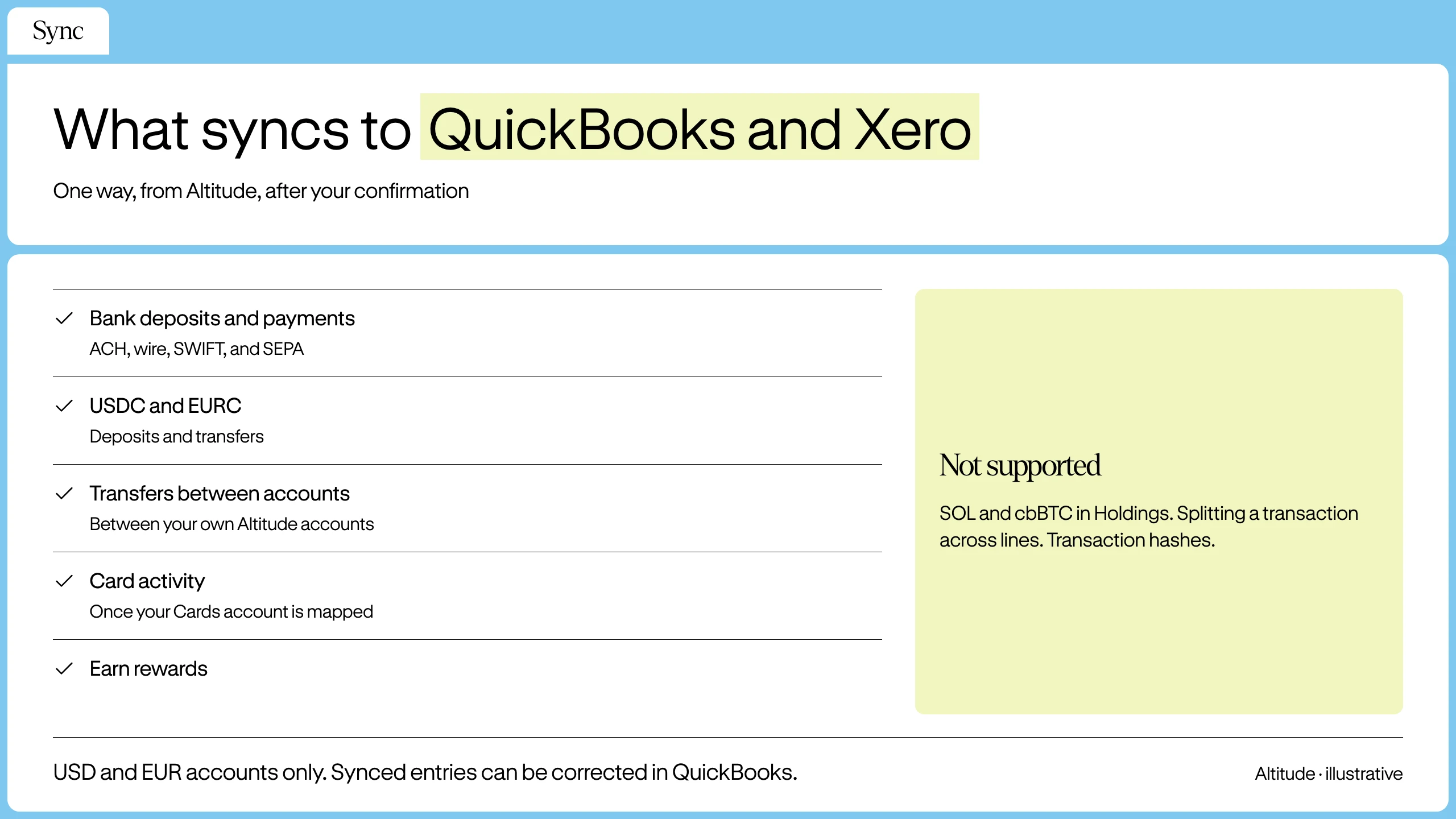
Accounting syncs to QuickBooks Online and Xero and syncs:
- Bank deposits and payments: ACH, wire, SWIFT and SEPA
- USDC and EURC deposits and transfers
- Transfers between your Altitude accounts
- Card activity, once your Cards account is mapped
Granular user permissions by entity
Permissions are set per workspace, so each entity has its own role-based permissions (Propose, Approve, Submit, Read Only) and configurable thresholds. Those are the operational alternative to routing every payment through a single founder or hiring a dedicated finance team.
Payment rail fees on Altitude
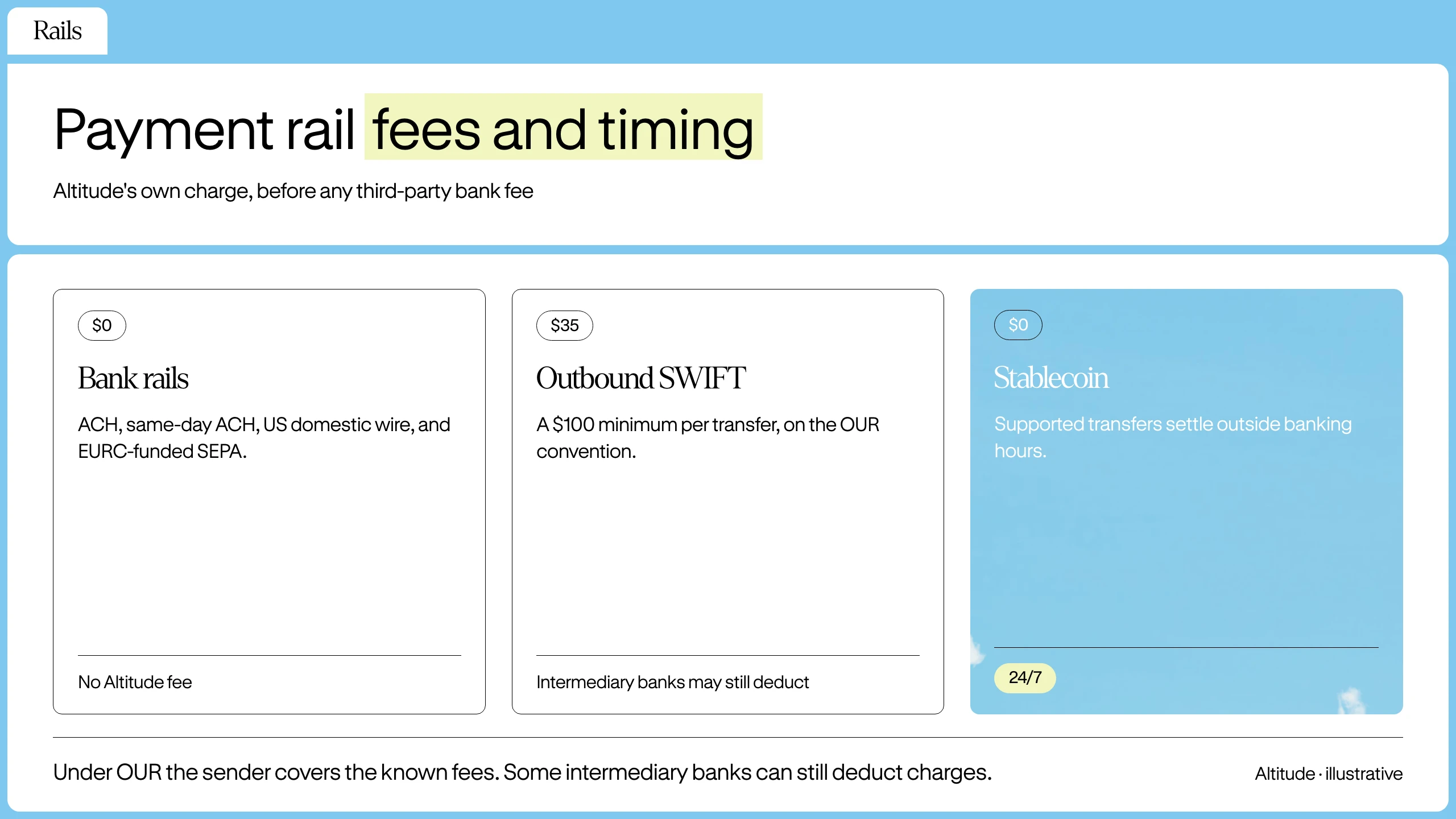
ACH, same-day ACH, US domestic wire, SEPA and supported stablecoin transfers carry no Altitude fee, so transfers between entities on those rails add no Altitude cost. Outbound SWIFT costs $35. Under the OUR convention, the sender covers the known fees, though some intermediary banks can still deduct charges. Stablecoin transfers settle outside banking hours, and Altitude's payments documentation shows settlement windows by rail.
Consolidation checklist
Use this checklist to maintain audit-ready multi-entity accounting:
- Each legal entity has its own isolated ledger, chart of accounts, and approval rules
- Every intercompany transaction is documented in both ledgers at the point of execution
- Intercompany balances are reconciled and eliminated before period lock
- Elimination entries are posted in the consolidation layer, not in entity ledgers
- Approval workflows produce records that satisfy internal audit and external review
- Accounting syncs to QuickBooks Online and Xero
Before vs. after reconciliation flow
| Manual reconciliation | Software-enabled reconciliation |
|---|---|
| Multiple platform logins | Single login, individual workspaces per entity |
| Manual matching of bank statements, payment records, and ERP entries across disconnected systems | Accounting sync to QuickBooks Online and Xero |
| Ad hoc payments bypass approval chain | Approval rules your team sets, applied automatically, every time |
| Reconciliation artifacts preserved manually | Audit trail per entity, plus documented intercompany flows |
See how individual workspaces, per-entity rails and cards, approval rules, and one-way accounting sync support audit-ready multi-entity workflows. Book a demo.
FAQs
Do I need separate accounts for each entity?
Yes. Each legal entity needs a self-contained set of accounts for external reporting, which typically means maintaining its own ledger, chart of accounts, and approval rules. Separate bank accounts also keep each entity's cash, tax obligations, and audit trail distinct, so transactions between entities can be recorded on both sides and eliminated on consolidation.
How do intercompany transactions affect consolidation?
Intercompany transactions must be documented in both ledgers at the point of execution, then eliminated in the consolidation layer. See "Managing multi-entity elimination flows" for how elimination entries are classified and posted, with a worked example showing that each entity's books stay unchanged.
Can I add entities as my business grows?
Yes. A new legal entity needs its own ledger, chart of accounts, and approval rules from the day it starts transacting, so the group can add entities without restating the books of existing ones. Each new entity also adds intercompany balances to document on both sides and eliminate on consolidation, and one more set of timing differences to resolve before each close.
What's the difference between multi-entity and multi-currency accounting?
Multi-entity accounting treats each legal entity as a separate ledger. Multi-currency accounting treats each currency as a separate balance. A business can have multiple entities, multiple currencies, or both.
Key terms glossary
Consolidation: the presentation of a parent and the subsidiaries it controls as one economic entity, after intercompany items are eliminated. Entities under common ownership with no parent are added together as combined statements instead. Elimination entries are part of consolidation and remove amounts that arise only from dealings between group companies.
Elimination entry: a journal entry posted in the consolidation layer that reverses amounts recorded between group companies, such as intercompany balances, income, expenses, and unrealized profit. The entity ledgers stay unchanged, and only the group figures are adjusted.
ERP (enterprise resource planning): software that manages a company's accounting, procurement, and operations in one system. Finance teams match bank and payment records against ERP entries during reconciliation.
EURC (Euro Coin): a stablecoin issued by Circle that tracks the euro one to one.
USD Coin (USDC): a stablecoin issued by Circle that tracks the US dollar one to one.
Foreign exchange (FX): the conversion of one currency into another. FX differences appear during intercompany reconciliation when two entities record the same transaction at different exchange rates.
Intercompany transaction: a transfer, loan, management fee, or cost allocation between two legal entities under common control. Every intercompany transaction must be documented in both ledgers at the point of execution.
Legal entity: a business structure recognized by law, such as a corporation, LLC, or partnership. Each legal entity has its own tax obligations, though not always a separate return: a single-member LLC is usually disregarded for US federal income tax. Each legal entity maintains its own general ledger.
Altitude is a financial technology platform, not a bank or digital asset custodian.