

TL;DR: Multi-entity consolidation combines the financial statements of a parent company and its subsidiaries into one set of statements, as if the group were a single economic entity. Unreconciled internal balances make eliminations unreliable, so define the consolidation boundary, apply the control tests (IFRS 10 or ASC 810), and match both sides of every intercompany transaction before writing an elimination entry. For groups that hold stablecoins, the transaction hash is the reference used for that match. The method (full consolidation under IFRS 10 or ASC 810, or the equity method under IAS 28 or ASC 323) depends on whether the parent controls the investee or only has significant influence. Clean entity-level records and consistent accounting policies matter more than the consolidation tool itself.
Two entities can record the same intercompany loan with different terms, and the mismatch may not surface until close. If you are the controller or group finance lead responsible for consolidating a holding company or multi-entity structure, note that consolidation problems start long before the first elimination entry. They start at the transaction level, where bank statements and ledger entries can describe the same transfer differently. For groups that hold stablecoins, the transaction hash is a third record that has to match, and an unmatched item at that level can reach the external auditor.
IFRS applies in most countries, while US companies use US GAAP (ASC). This article names the framework wherever the treatment differs.
Defining multi-entity consolidation
Multi-entity consolidation combines the financial statements of a parent and all its subsidiaries into one set of statements, as if the group were a single economic entity. ASC 810 is the standard that governs which entities are in scope for consolidation and prescribes guidance on when and how to consolidate for financial reporting.
Consolidation is a defined accounting process with specific control tests under ASC 810, the Financial Accounting Standards Board standard that governs which entities belong in consolidated financial statements. The quality of the consolidated output depends on how cleanly intercompany transactions, ownership stakes, and accounting policies are defined at the entity level before any elimination entry is written.
Under ASC 810-10-10-1, consolidated statements are presumed to be more meaningful than separate statements, and they are usually necessary for fair presentation when one entity in the group holds a controlling financial interest, directly or indirectly, in the others. Consolidation answers the question boards, lenders, and auditors ask: what does the entire group own, owe, and earn, after you remove the internal transactions that move money between entities but create no value for the group as a whole?
Consolidation accounting applies two main methods depending on control and ownership level:
- Full consolidation
- Equity method
Proportional consolidation isn't a main method under either framework. IFRS 11 removed it for joint ventures, which use the equity method instead. Under US GAAP, it's allowed only in narrow cases, such as certain unincorporated ventures in the construction and extractive industries (ASC 810-10-45-14). Full consolidation under ASC 810 and the equity method under ASC 323 are therefore the two that apply to most reporting.
Defining parent and subsidiary roles
In consolidation terms, the parent is the entity that controls one or more subsidiaries. A subsidiary is an entity controlled by the parent, typically through ownership of more than 50% of the voting interests, the level at which the voting interest model generally presumes control.
Legal entity structure and consolidation structure aren't always the same. A holding company may own 100% of a subsidiary's equity but lack substantive control if contractual arrangements or regulatory restrictions prevent it from directing operations.
Criteria for multi-entity consolidation
Under US GAAP, ASC 810 applies two models to determine control: the Voting Interest Model (control through majority voting rights) and the Variable Interest Entity model (control through power and economics when voting rights don't determine control, under ASC 810-10-15-14). Below 50% of voting rights, US GAAP consolidation arises through the VIE model or through contractual arrangements.
Under IFRS, IFRS 10 uses a single control model. An investor controls an investee only if it has power over the investee, exposure or rights to variable returns from its involvement, and the ability to use its power to affect those returns (IFRS 10.7). A holder with less than 50% of the votes can still control when other holdings are widely dispersed (de facto control, IFRS 10.B41-B42), and substantive potential voting rights count in the assessment.
The table below summarizes when each consolidation method applies under ASC 810 and ASC 323, the equity method standard.
| Method | Ownership threshold | Control requirement | Reporting treatment |
|---|---|---|---|
| Full consolidation | More than 50% of voting interests | Control through voting rights or VIE primary beneficiary status | Combine subsidiary's balance sheet, income statement, and cash flows line by line |
| Equity method | 20% to 50% of voting interests (typical) | Significant influence but not control | Record investment at cost, adjust for share of investee earnings as a single line item |
If the investing entity has enough control to consolidate under ASC 810, ASC 323 wouldn't apply. The table simplifies: specific structures may require professional judgment, particularly when variable interests or contractual arrangements affect the control assessment.
Standardizing data for consolidated statements
Standardization is the prerequisite for consolidation. Entities with different charts of accounts, fiscal calendars, or currency policies must first be aligned to common policies, and only then can their records be mapped and combined. For example, if Entity A records revenue on an accrual basis and Entity B uses cash basis, the consolidation requires restating one to match the other before aggregation can occur. Fragmented ERP records and inconsistent transaction descriptions create the data mismatches that make consolidation slow and error-prone.
Mapping charts of accounts to consolidation account groups
Each entity usually runs its own chart of accounts, so the same economic item can sit under different account numbers and names. A group chart of accounts fixes this with consolidation account groups: reporting lines such as trade receivables, revenue from goods or intercompany receivables. Every entity account is mapped to one of these groups before any balances are combined.
Use this sequence to build the mapping:
- Export each entity's chart of accounts and trial balance for the period.
- Define the account groups so they match the line items of the consolidated balance sheet and income statement, with separate groups for intercompany receivables, payables, revenue and expense.
- Map each entity account to exactly one group. Several entity accounts can feed the same group, but one account can't feed two.
- Check that the mapped balances for each entity add up to that entity's trial balance, and review any unmapped account that carries a balance.
- Keep the mapping table under version control and review it whenever an entity adds or renames an account.
Handling intercompany accounts and policy differences
Keep intercompany accounts in their own groups instead of folding them into trade balances. That lets the preparer pair each intercompany balance with its counterpart and write the elimination entry against the matching group. Mapping aligns account names only, and differences in accounting policy, such as accrual versus cash basis, must be resolved before the entity's balances are included in the mapped totals.
Establishing the consolidation boundary
The consolidation boundary defines which entities are included and which are excluded. The control test asks whether the parent holds substantive decision-making power over the entity, since protective rights alone don't confer control.
The boundary can shift over time as ownership stakes change, new entities are acquired, or control arrangements are amended. A joint venture accounted for under the equity method may require full consolidation if one partner gains unilateral control. Reassess the boundary at each reporting date.
Ownership stakes and control tests
Under the voting interest model, control is generally presumed above 50% of voting interests. Below that threshold, consolidation can arise under the VIE model when the investor is the entity's primary beneficiary.
Under the VIE model, the analysis centers on power and economics. The primary beneficiary has both the power to direct activities that most significantly affect the VIE's economic performance and the obligation to absorb losses or the right to receive benefits that could be significant to the VIE.
When to use equity method accounting
The equity method applies when the parent has significant influence over the investee but doesn't control it. Significant influence generally equates to ownership of 20% or more of a corporation's voting rights (ASC 323-10-15-8), though the threshold can be lower for partnerships.
The equity method applies to associates, where the investor has significant influence but not control, and to joint ventures, where two or more parties share control and decisions need unanimous consent (IAS 28 under IFRS, ASC 323 under US GAAP). If both partners possess substantive participating rights requiring mutual consent for significant decisions, neither consolidates and both use the equity method. Under IFRS 11, a joint arrangement can also be a joint operation, where the investor recognizes its own share of the assets, liabilities, revenue, and expenses instead of using the equity method.
Consolidating entities in other currencies
Each entity first books its foreign-currency transactions at the transaction-date rate and restates open monetary balances at the closing rate, with the difference recognized in that entity's own profit or loss. This happens in the entity's books, before any consolidation step.
To consolidate a foreign subsidiary whose functional currency differs from the group's presentation currency, translate its statements into the presentation currency. Assets and liabilities are translated at the closing rate, and income and expenses at transaction-date or average rates. The resulting difference goes to other comprehensive income as the cumulative translation adjustment, which moves to profit or loss when the subsidiary is sold. This is the treatment under IAS 21 for IFRS and ASC 830-30 for US GAAP.
US GAAP also has remeasurement (the temporal method) for entities whose books aren't kept in their functional currency or that operate in highly inflationary economies. IFRS handles hyperinflation separately under IAS 29.
Intercompany eliminations in financial consolidation
Intercompany eliminations remove transactions between entities within the consolidation boundary to avoid double-counting. Each legal entity records intercompany transactions in its own accounting records, but those transactions don't change the group's position with outside parties.
Without eliminations, consolidated totals are overstated on both the income statement and the balance sheet.
Defining elimination entry mechanics
For each intercompany transaction, the consolidation preparer writes a corresponding elimination entry in the consolidation worksheet, and the individual entity ledgers stay untouched. The group's financials then reflect only what it earns from and owes to external third parties.
For example, if ParentCo's balance sheet includes $100,000 Intercompany Receivable from SubCo and SubCo carries $100,000 Intercompany Payable to ParentCo, combining those lines without elimination would overstate both assets and liabilities. The elimination entry debits the intercompany payable and credits the receivable, reducing both to zero in consolidation. Intercompany sales follow the same logic. The table below shows both sides of the elimination for a $100,000 sale from ParentCo to SubCo, assuming SubCo resells all of the goods to an outside customer in the same period.
| Line item | Before elimination | Elimination entry | After elimination |
|---|---|---|---|
| ParentCo intercompany sales revenue | $100,000 | Debit $100,000 | $0 |
| SubCo intercompany purchases (cost of sales) | $100,000 | Credit $100,000 | $0 |
Intercompany transfers in stablecoins are eliminated like any other. Match them on the transaction hash (see our intercompany transactions guide).
Mapping internal transaction flows
Mapping all intercompany transaction types starts with documentation, and consolidation software can only work from what the team has documented. Common flows include loans, sales of goods or services, management fees, dividends, interest payments, and cost allocations. Unmapped flows are a common source of missed eliminations.
Inconsistent descriptions turn mapping into detective work. For example, ParentCo records a $50,000 loan to SubCo on March 15 as "Intercompany Loan #3." SubCo records $48,000 from ParentCo on March 16 as "Capital Contribution." The $2,000 difference and the mismatched descriptions make the match non-obvious. Consistent transaction descriptions and a shared chart of accounts reduce the manual matching burden.
Calculating internal profit margins
Intercompany sales often include a profit margin, and that margin must be eliminated from ending inventory if the receiving entity hasn't resold the goods by period-end. Unrealized profit represents the portion of the intercompany sale price the seller recorded as profit but the group hasn't yet realized through an external sale.
For example, Subsidiary A sells $200,000 of goods to Subsidiary B at a 30% gross profit margin. At period-end, Subsidiary B holds $60,000 of these goods in inventory. The unrealized profit calculation is $60,000 times 30% = $18,000, and that amount must be eliminated from consolidated inventory and group profit. Once Subsidiary B resells the inventory externally, the profit becomes realized and no further elimination is needed.
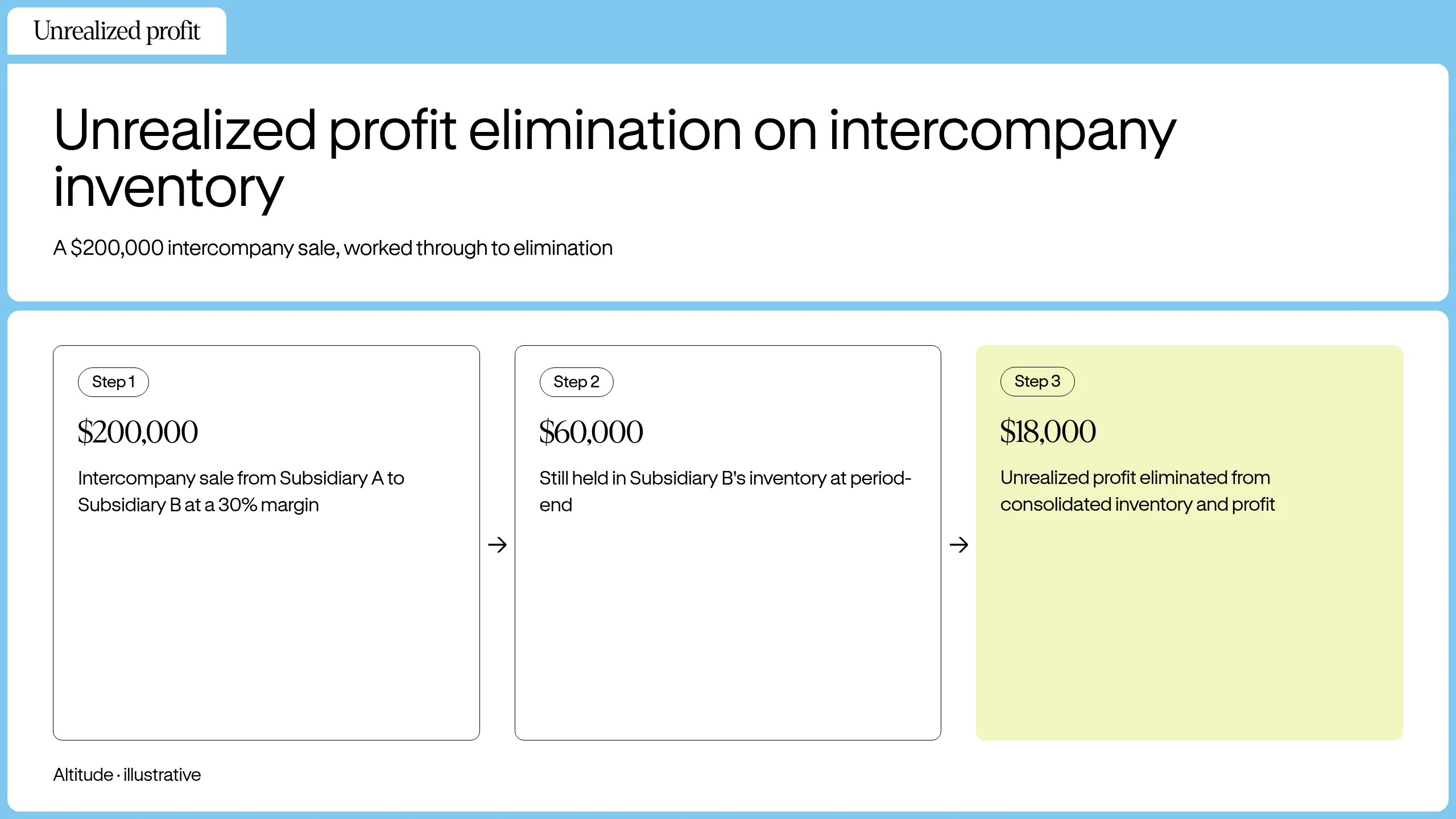
This calculation requires lot-level or transaction-level cost data. If the receiving entity can't identify which inventory items came from intercompany purchases versus external suppliers, the unrealized profit figure becomes an estimate rather than a precise adjustment. The full profit is always eliminated. When the seller is a partly owned subsidiary, groups often share the elimination with NCI in proportion to ownership, which is a policy choice under US GAAP. When the parent is the seller, the parent absorbs all of it. In the example above, Subsidiary A is the seller, so the $18,000 comes out in full, and any NCI share depends on whether Subsidiary A is partly owned.
Calculating and presenting non-controlling interest
Non-controlling interest (NCI) is the part of a consolidated subsidiary's equity and earnings that the parent doesn't own. When the parent holds less than 100% of a subsidiary it controls, full consolidation still brings in 100% of the subsidiary's assets, liabilities, revenues, and expenses, and the NCI holders' share is then carved out separately. The share calculation applies the NCI holders' ownership percentage to the subsidiary's net assets for the balance sheet and to the subsidiary's net income for the income statement.
The table below uses a simplified, hypothetical case: ParentCo owns 80% of SubCo, SubCo has $500,000 of net assets and $100,000 of net income for the period, and there are no acquisition-date fair value adjustments or unrealized intercompany profits.
| Item | SubCo total | NCI share (20%) | ParentCo share (80%) |
|---|---|---|---|
| Net assets | $500,000 | $100,000 | $400,000 |
| Net income | $100,000 | $20,000 | $80,000 |
In practice, NCI starts at its acquisition-date measurement and is then adjusted each period for its share of earnings, its share of other comprehensive income, dividends paid to NCI holders, and any unrealized profit elimination on upstream sales, so the simple percentage is a starting point rather than the final figure. The starting measurement differs by framework: IFRS 3.19 lets the acquirer measure NCI at fair value or at its proportionate share of the acquiree's identifiable net assets, chosen deal by deal, while US GAAP requires fair value (ASC 805-20-30-1).
On the balance sheet, NCI appears as a separate component within consolidated equity, apart from the parent's shareholders' equity. On the income statement, consolidated net income is shown in full, and the portion attributable to NCI is disclosed separately from the portion attributable to the parent. Groups with multiple classes of equity, or with ownership percentages that change during the period, need extra care, because the measurement and attribution can differ from the simple percentage split.
Preventing manual reconciliation gaps
Run position reconciliation on intercompany accounts monthly instead of waiting for year-end. A year-end-only cycle surfaces mismatches under time pressure, with limited ability to trace transactions back to source documents. Monthly reconciliation catches discrepancies while transaction details are still accessible and the people who recorded the entries can explain them.
Monthly close checklist for intercompany positions
- Export each entity's transaction history for the period and confirm the cut-off date is the same across entities.
- Pair each intercompany record with its counterpart in the other entity, and list any unpaired item as an open difference.
- Resolve differences in amount, date, or description before writing any elimination entry.
- Record intercompany transactions in a currency other than the entity's functional currency at the transaction-date rate. At period end, remeasure only open monetary balances, such as intercompany loans, receivables and payables, at the period-end rate. Keep non-monetary items at the rate from the date they arose. Check that your written accounting policy covers intercompany accounts specifically, and confirm the treatment with your auditor.
- Confirm which transaction types synced to the ledger and which were excluded, then post the excluded items manually.
- Save the exports, approval records, and matching evidence so the process is auditable end to end.
Mapping the data flow for entity consolidation
Consolidation moves through seven steps, from the boundary decision to the final consolidated statements:
- Set the boundary: Identify which entities the parent controls, using the voting interest and VIE tests.
- Close and align: Each entity closes its books for the same period and exports a trial balance, with intercompany accounts shown separately. Align accounting policies, reporting periods, and the chart of accounts to the group chart.
- Translate foreign subsidiaries: Translate each foreign subsidiary's statements into the group's reporting currency under the rates your written policy sets, typically average rates for the income statement and closing rates for the balance sheet.
- Add up line by line: Combine 100% of each entity's assets, liabilities, revenues, and expenses in the consolidation worksheet.
- Eliminate the investment against equity: Eliminate the parent's investment in each subsidiary against its share of the subsidiary's equity, and recognize goodwill on acquisition (IFRS 10.B86 with IFRS 3 under IFRS, and ASC 805 and ASC 810 under US GAAP).
- Eliminate intercompany items: List every intercompany flow (loans, sales, management fees, dividends, interest, cost allocations), pair the record on each side, resolve differences in amount, date, or description, then eliminate the balances, transactions, dividends, and unrealized profit on intercompany inventory.
- Attribute to NCI: Attribute profit, other comprehensive income, and equity to non-controlling interests, then produce the consolidated balance sheet, income statement, cash flow statement, and equity statement.
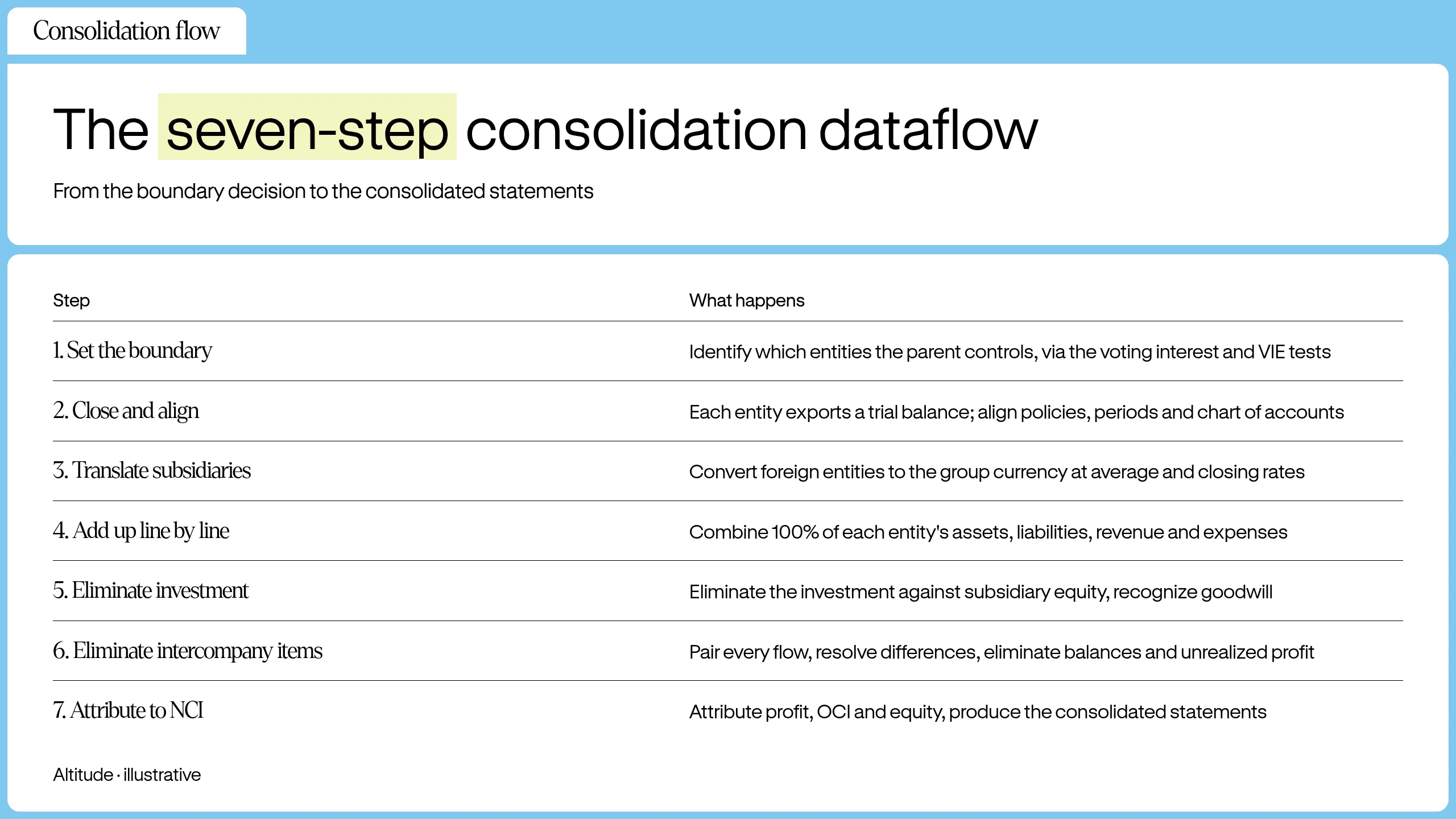
The pairing and elimination work in step 6 is where flows break. If two entities record the same transaction with different amounts, dates, or descriptions, resolve the mismatch before any elimination entry is written. A missing accrual or an unreconciled account at the entity level flows through to the consolidated statements as an unexplained variance.
Technology stack for unified financial reporting
The technology question is secondary to data discipline. The best consolidation tool can't fix bad entity-level records. Tool selection depends on entity count, transaction volume, intercompany complexity, and reporting frequency.
ERP modules for financial consolidation
ERP systems offer consolidation modules that automate eliminations within a single vendor's platform. Groups often acquire businesses on different platforms. You might have three entities on one ERP, two on Xero, and a recent acquisition still running legacy software, and the ERP module may have no native answer for that mixed environment.
Manual spreadsheet consolidation risks
Spreadsheet-based consolidation is common for groups with two or three entities but breaks down as entity count grows, because manual data entry introduces errors such as incorrect formulas and broken links that propagate through consolidated statements. Version control fails when multiple finance team members collaborate on the same spreadsheet, and teams struggle to identify the most current version, which leads to errors in final reports. Spreadsheets also leave a weak audit trail. Unless the team adds its own change log, a workbook doesn't record who changed a formula or an elimination entry, or why, so an auditor can't trace a consolidated figure back to its source.
Top risks for holding company financial reporting
Holding companies face specific risks because they often run multiple entities with different systems, currencies, and fiscal calendars. These structures create blind spots such as intercompany imbalances, currency volatility, and manual workflow dependencies. Fragmented reporting means answers to board questions on performance, cash, and margin come with caveats, because the group view is incomplete or inconsistent.
| Failure mode | Cause | Mitigation |
|---|---|---|
| Unreconciled intercompany balances | Entities record the same transaction with different amounts, dates, or descriptions | Monthly intercompany reconciliation with consistent transaction descriptions |
| Missed eliminations | Unmapped intercompany flows or incomplete transaction identification | Document all intercompany transaction types and review them during the monthly reconciliation |
| Unrealized profit not eliminated | Intercompany sales with margin still held in inventory at period-end | Track lot-level or transaction-level cost data for intercompany inventory |
| Intercompany FX remeasurement errors | Intercompany transactions in different currencies without transaction-level FX tracking | Record each transaction at its transaction-date rate, remeasure only open monetary balances at period end (non-monetary items keep the rate from the date they arose). Confirm your policy covers intercompany accounts, and use average and closing rates when translating entity statements |
| Fiscal calendar misalignment | Entities with different year-ends or closing schedules | Align fiscal calendars or use uniform closing schedule with cut-off rules |
| Fragmented ERP records | Entities on different systems with no integration | Standardize chart of accounts and use exportable transaction records |
| Approver unavailable out of hours | Single approver for an entity and a payment that is urgent on a weekend | Assign a backup approver per entity, set approval thresholds in advance, and document the escalation path |
| Spreadsheet version control failures | Multiple finance team members collaborating on the same consolidation workbook, which makes it hard to identify the most current version | Implement strict version control with a single designated owner for the consolidation workbook |
Operational process discipline for multi-entity groups
When entities run on separate platforms, group finance manually bridges data between them every month before consolidation can begin, which adds time to the close.
Align fiscal calendars where possible, or use a uniform closing schedule with documented cut-off procedures. Exporting each entity's transaction history for the monthly reconciliation keeps the cut-off evidence in one place and lets the team pair intercompany records before any elimination entry is written.
Where Altitude fits in this workflow
Altitude, a global business account, can supply the entity-level records that consolidation depends on. Each entity runs as its own workspace, so a group can export that entity's transaction history for the period and use it to pair intercompany records and document cut-off dates. The workspace structure supplies entity-level records only. Consolidated reporting and intercompany settlement sit outside Altitude, so the consolidation worksheet, eliminations and consolidated statements stay with the group's finance team or consolidation tool. To move those entity-level records into the group's books, Altitude syncs transactions to QuickBooks Online and Xero.
Tracking intercompany currency gains
Intercompany transactions in different currencies create FX gains and losses that must be tracked. A USD loan to a EUR subsidiary creates an FX gain or loss in the subsidiary's books each period as the exchange rate moves, because the loan's currency differs from the subsidiary's EUR functional currency. The parent, whose functional currency is USD, has no FX difference on the loan. The loan balance itself eliminates in consolidation because it is an internal position, but the subsidiary's FX gain or loss generally remains in consolidated profit or loss under both IFRS (IAS 21) and US GAAP (ASC 830-20-35), because the currency exposure is real for the group even though the counterparty is internal.
The exception is a loan that is neither planned nor likely to be repaid in the foreseeable future. Both frameworks treat it as part of the parent's net investment in the subsidiary: IAS 21.32 and 21.45 under IFRS, and ASC 830-20-35-3(b) under US GAAP. In the consolidated statements, the FX difference on that loan goes to other comprehensive income instead of profit or loss, and it moves to profit or loss only when the subsidiary is sold.
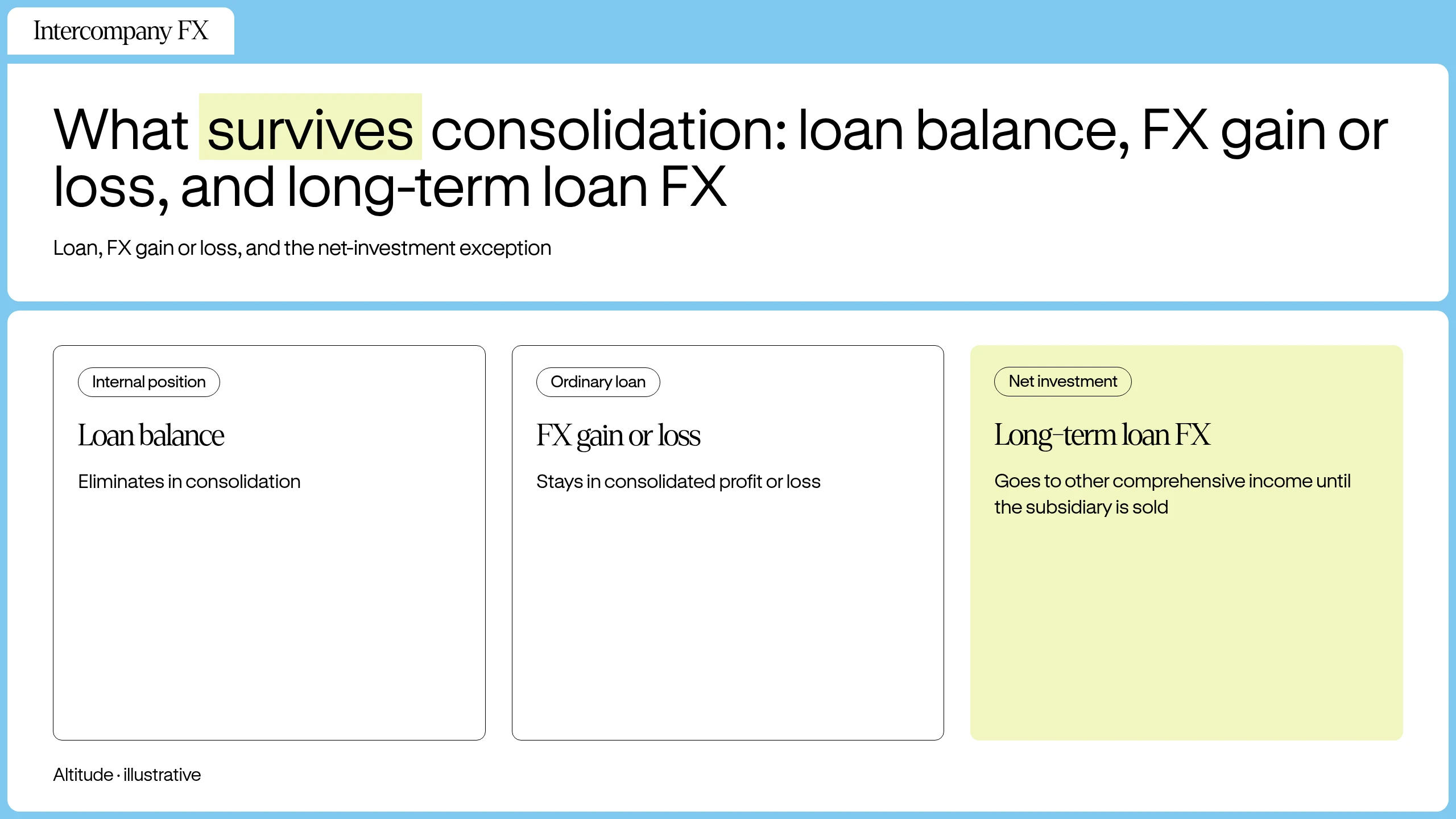
ASC 830 governs intra-entity foreign currency transactions. Under US GAAP, the net investment treatment in ASC 830-20-35-3(b) applies when settlement of the loan is neither planned nor anticipated in the foreseeable future. That condition rests on management's assertion about settlement, not on a designation, and the auditor tests whether the assertion is supported. IFRS applies the same test through IAS 21.32.
If the entity records only the period-average exchange rate rather than the rate at each transaction date, the FX calculation becomes an estimate. Altitude's payment flow shows the effective rate and both amounts. Consolidation adjustments are only as reliable as the exported fields behind them, so the export needs to carry the executed rate, the source amount, and the recipient amount for each transaction.
Maintaining audit-ready records
Every elimination entry must be supported by source documentation, and the process must be auditable end to end. Audit-ready records start at the entity level, before consolidation begins. A missed elimination with no supporting documentation is both a reporting error and a control gap.
Approval workflows and consistent transaction descriptions support the audit trail external auditors require. Altitude applies the approval thresholds and role-based permissions your team sets to every payment initiated through Altitude, automatically.
See how Altitude handles approval thresholds and transaction exports for entity-level payments. Book a demo.
FAQs
What is the difference between consolidation and combination?
Consolidated statements combine a parent and its controlled subsidiaries into one set of statements, as if the group were one economic entity. Combined statements present two or more entities under common control as a single reporting entity when no parent-subsidiary relationship exists among them. In both, intra-entity transactions are eliminated, and the entities stay legally separate (ASC 810-10-45-10).
Do I need to consolidate if I own less than 50%?
Control determines whether you consolidate, and ownership percentage is one input. Under IFRS 10, a holder with less than 50% of the votes can still control when other holdings are widely dispersed (de facto control, IFRS 10.B41-B42), and substantive potential voting rights count. Under US GAAP, a stake below 50% can still require consolidation through contractual arrangements or if the investee is a variable interest entity and you are its primary beneficiary (ASC 810). Confirm the assessment with your auditor.
How often should consolidated financial statements be prepared?
Consolidated financial statements are prepared at least annually for external reporting, and the required frequency depends on the reporting regime, such as quarterly filings for public companies. Private holding companies often prepare them monthly or quarterly for internal management and lender reporting. Monthly intercompany reconciliation keeps each cycle from starting with unresolved mismatches.
Can I consolidate entities with different fiscal year-ends?
Yes. Under US GAAP, using a subsidiary's statements with a fiscal period up to about three months different is usually acceptable if you disclose the effect of material intervening events (ASC 810-10-45-12). Under IFRS 10, paragraphs B92 and B93, the parent and its subsidiaries use the same reporting date unless that's impracticable. If it is, the subsidiary's statements can be used with adjustments for significant events, and the gap between reporting dates can't exceed three months. Document the approach.
What happens if intercompany transactions don't reconcile?
If intercompany transactions don't reconcile, the mismatch should be resolved before elimination entries are written, because eliminating against mismatched balances creates a plug that misstates consolidated results. This is usually done by tracing both entities' records back to source documents. Unreconciled balances draw auditor attention because they signal the consolidation process lacks controls over internal transaction identification.
Key terms glossary
Consolidation boundary: The set of entities included in the consolidated financial statements, determined by control, with legal ownership as one input.
Control test: The assessment of whether a parent controls another entity and must consolidate it. Under IFRS 10, an investor controls an investee when it has power over the investee, exposure or rights to variable returns, and the ability to use its power to affect those returns. Under US GAAP, ASC 810 applies either the voting interest model or the variable interest entity model.
Intercompany elimination: An entry in the consolidation worksheet that removes transactions between entities within the consolidation boundary to avoid double-counting internal balances.
Equity method: An accounting method used when the parent has significant influence but not control, typically 20% to 50% ownership (ASC 323-10-15-8 presumes significant influence at 20% or more of voting rights), where the investment is recorded at cost and adjusted for the parent's share of earnings.
Full consolidation: An accounting method that combines a subsidiary's balance sheet, income statement, and cash flows line by line into the parent's statements when the parent controls the subsidiary. Non-controlling interest is presented separately to reflect the portion of equity not owned by the parent.
Proportional consolidation: An accounting method that reports the investor's proportionate share of a joint venture's assets, liabilities, revenues, and expenses. IFRS 11 removed it for joint ventures, which use the equity method. US GAAP also applies the equity method to joint ventures, with narrow exceptions such as certain unincorporated ventures in the construction and extractive industries (ASC 810-10-45-14).
Variable interest entity (VIE): A legal entity where the equity at risk is insufficient to finance the entity's activities or the equity holders lack the power to direct significant activities, requiring consolidation by the primary beneficiary.
Unrealized profit: The profit margin on intercompany sales that hasn't yet been realized through a sale to an external customer, which must be eliminated from ending inventory in consolidation.
Altitude is a financial technology platform, not a bank or digital asset custodian.