





 Startups
 Creative agencies
 Onchain teams
 European businesses
 AI
 Software
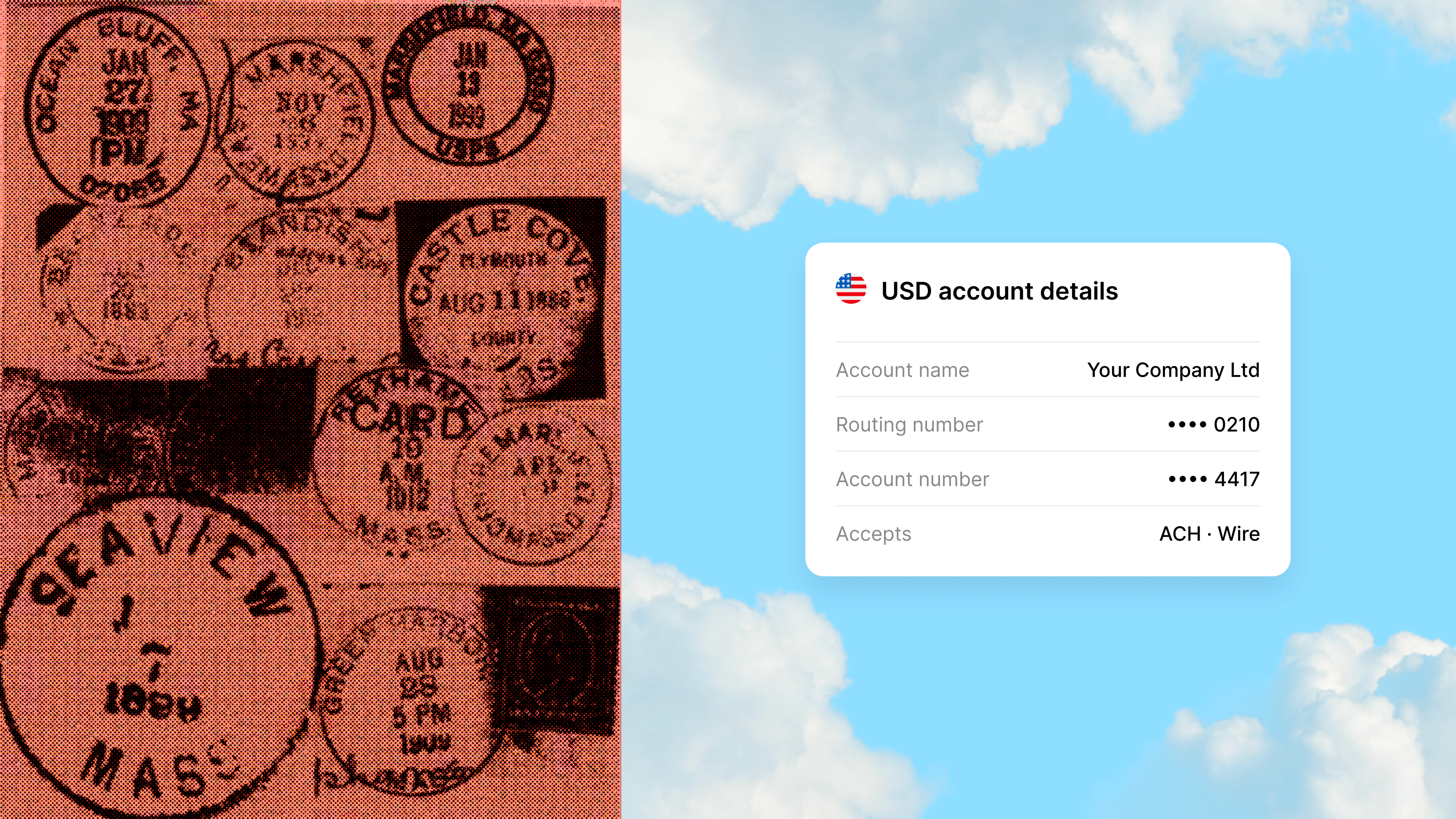
TL;DR: A non-US resident can open a USD business account. Two paths exist: form a US LLC and apply through a digital platform, or use a banking provider that accepts your existing foreign entity. Either way, you need formation documents. US entities almost always get an EIN because providers ask for the confirmation letter. For foreign entities, EIN requirements vary by provider, though a foreign entity may still need one for US tax obligations such as hiring US employees, paying employment or excise taxes, or withholding tax on income paid to a non-resident alien. Altitude opens accounts for eligible businesses from 200+ countries with no US entity required. Product availability varies by country.
A non-US founder can open a USD business account, but the route depends on where the company is incorporated. One option is to form a US LLC, which adds formation paperwork, a registered agent fee, and ongoing compliance obligations. The other is to use a provider that accepts the existing foreign entity, which skips the LLC but narrows the list of providers to choose from.
This guide covers both routes, including how to choose between them, the documents each one needs, a six-step application workflow, and a provider comparison that includes each provider's eligibility restrictions, fee structures, and key limitations, including Altitude's. It is written for founders looking for a USD business account for non-residents, whether or not they end up forming a US entity.
Why non-US founders need a USD business account
You need a USD business account because your customers pay in USD and your contractors expect ACH transfers. Without one, every transaction routes through an intermediary bank, picks up correspondent fees, and takes days longer.
A USD business account gives you domestic routing and account numbers, letting you receive ACH payments exactly as a US company would. You pay US-based vendors and contractors without SWIFT fees eating into every transfer.
Do you need a US entity?
You can open a USD business account with your existing foreign entity if you choose a banking provider that accepts it. A US entity is only necessary if your investors require one or your chosen provider doesn't accept foreign-incorporated businesses.
If you are raising from US venture capital, your investors may require a Delaware C-corp for preferred stock and familiar governance structures. If your investors do not require it, the C-corp adds double taxation and formality you may not want.
Non-US residents can legally form an LLC or C-corporation in any US state without citizenship, residency, or a visa. S-corp status isn't available to non-resident aliens.
Entity eligibility and account eligibility are separate. You can form a US LLC and still get rejected by a banking provider because of where you live or how your revenue flows, which is why the provider choice matters as much as the entity choice.
Entity requirements for non-resident founders
Before you gather documents or compare providers, decide which entity structure you will use. You have three options: your existing foreign entity, a new US LLC, or a new US C-corp. Each has different costs, timelines, and banking implications.
Opening accounts as a foreign entity
Some providers accept foreign-incorporated businesses directly. Altitude opens accounts for eligible businesses from 200+ countries, with no US entity required and product availability varying by country. This path avoids LLC formation, the registered agent requirement, and state filing fees, but it depends entirely on choosing a provider that accepts your foreign entity, as many US-focused providers require a US-registered business.
Fewer providers accept foreign entities, so you have a narrower selection. Mercury requires a US or US-territory registered company. Brex requires US incorporation, an EIN, US operations, and a physical US address. Ramp requires a US-registered business entity and a US address. Rho requires a US-incorporated entity and a US business address. If your provider of choice doesn't accept foreign entities, you either form a US entity or find a different provider.
Opening accounts without a US entity
You can open a USD business account as a non-resident without forming a US entity if you choose a provider that accepts foreign-incorporated businesses. Depending on your country of incorporation and registered address, the account may include US routing numbers, SEPA IBANs, or both.
USD account details are unavailable in 15 countries, and a principal residential or operating address in New York blocks both USD and EUR account details. Altitude's supported countries list shows which account details and payment products are available for your country.
This path removes the $50 to $500 state filing fee, the $50 to $300 annual registered agent cost, and the ongoing US compliance obligations. It also removes the wait time for state approval and EIN issuance, which can add weeks to your timeline.
LLC vs. C-corp: impact on banking
If you do form a US entity, the LLC vs. C-corp choice affects your banking options less than it affects your tax treatment and investor compatibility. Both structures may qualify for business accounts at US-focused digital platforms and traditional banks, though eligibility requirements vary by provider and can change.
The differences between LLC and C-corp are primarily in cost, tax, and fundraising. Verify current entity requirements directly with any provider before applying.
| Factor | LLC | C-corp |
|---|---|---|
| Formation cost | $50 to $500 state filing fee (varies by state) | $109+ Delaware filing fee (minimum for a stock corporation) plus registered agent |
| Tax treatment | Pass-through to members' personal returns | 21% corporate tax, then dividend tax |
| Investor compatibility | Not standard for VC (no preferred stock) | VC standard (supports preferred stock) |
| Annual compliance | Foreign-owned LLCs may have US filing obligations. Ask a US tax adviser | Full corporate return, board minutes, stock ledger |
Talking Tree's LLC vs. C-corp comparison and Caldwell Tax's foreign founder tax breakdown cover the details. For banking purposes, either structure works. For fundraising, the C-corp is the standard. For a lean operation without US investors, the LLC is simpler and cheaper.
Choosing your LLC formation state
If you decide a US LLC is the right structure, file with a state that works for non-residents. Delaware is the most common for its business-friendly courts, but Wyoming and New Mexico offer lower fees and stronger privacy.
Every LLC needs a registered agent with a US address to receive legal documents. Professional registered agent services cost $50 to $300 per year. Your operating address for account applications must be a real physical business address that is separate from your registered agent's address.
Essential paperwork for non-resident founders
The document checklist for a non-resident application verifies who you are and what your business is.
Identity and address verification
- Your passport is the primary identity document for non-resident founders and the most widely accepted form of identification across providers.
- Proof of address, such as a utility bill, bank statement, or lease agreement showing your name and current address within the last three months. Providers reject P.O. boxes, registered agent addresses, and virtual office addresses without verifiable physical presence.
- Some providers require a selfie or live face check during the application. Check your chosen provider's application process for current identity verification requirements.
Business formation documents
- The Certificate of Formation or Incorporation is the state-issued document proving your entity exists. For a US LLC, this is the Articles of Organization. For a foreign entity, this is your local equivalent.
- The CP 575 or 147C letter from the IRS confirms your Employer Identification Number. It is required only if you formed a US entity. International applicants apply by phone, fax, or mail. File your entity formation before you apply for an EIN.
- An operating agreement or ownership schedule shows who owns the business and in what percentages.
- Write a clear, specific business description that names your product, your customer, and your revenue model. For example, specifying the industry you serve, the problem you solve, and how you earn revenue. Vague or generic descriptions are more likely to prompt follow-up questions during review.
Executing your USD business account application
The application process follows six steps, from entity decision to funded account. Each step has a known failure point.
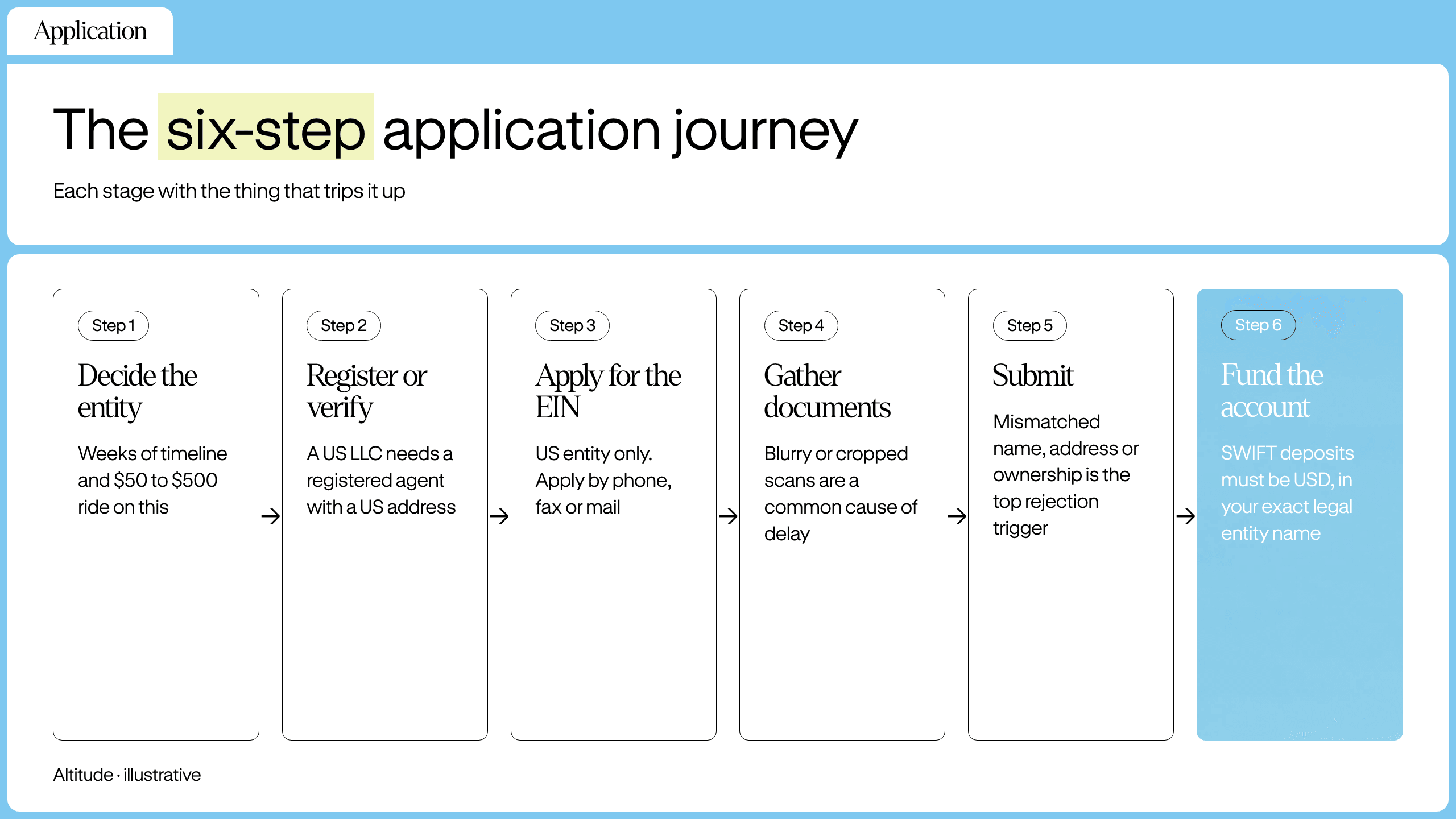
1. Decide on your US entity structure
If your provider accepts foreign entities, skip this step. If you need one, choose between an LLC (simpler, cheaper, pass-through tax) and a C-corp (investor standard, double taxation, more formality). The decision affects your timeline by weeks and your upfront cost by $50 to $500 in one-time state filing fees, plus ongoing annual costs: a registered agent fee of $50 to $300 per year, Delaware's $300 annual LLC tax (or a franchise tax calculated on shares for a C-corp, which can run into thousands of dollars), and any state-specific annual report fees.
2. Register your US entity or verify foreign entity eligibility
If forming a US entity, file with your chosen state. Delaware, Wyoming, and New Mexico are the most common for non-resident founders. No green card, SSN, or physical presence is required, but each LLC needs a registered agent with a US address.
If using your existing foreign entity, check the provider's supported countries list to confirm your country of incorporation is eligible.
3. Apply for your federal EIN
If you formed a US entity, this step always applies. The EIN is the business's IRS tax ID, and many providers ask for the confirmation letter (CP 575) during KYB. To apply, complete Form SS-4 and submit it to the IRS by phone, fax, or by mail. Founders without a US taxpayer identification number can still get an EIN.
If the business stays a foreign entity, the account application may not need an EIN at all. A foreign entity can still need one separately, for example when it has employees, pays employment or excise taxes, or withholds tax on income paid to a non-resident alien. The account provider's requirements don't change that.
4. Gather proof of business and identity
Collect the documents listed above: formation certificate, EIN confirmation, operating agreement, passport, and proof of address. Scan them at high resolution, because blurry or cropped documents are a common cause of delays.
5. Select a provider and submit your application
Apply through the provider's online portal. Altitude's verification typically takes around two business days, though this is a general indication, and verification is a review, not a guarantee of approval. Match every field in the application to your formation documents. Mismatched ownership details, different address spellings, or a business name that doesn't match the certificate of formation are the most common rejection triggers.
6. Fund your account
After submitting, respond promptly to any follow-up requests by email. Once approved, fund the account by ACH, wire, SEPA, SWIFT (once enabled), or stablecoin transfer. Incoming SWIFT deposits must arrive in USD and use your legal entity name exactly as shown in your account details. SWIFT pay-ins require a separate compliance review and approval before they are enabled. Altitude's receive funds guide explains the supported deposit methods, requirements, and processing times.
USD business account options for non-resident founders
The provider you choose determines whether the application succeeds. This section compares the main options, including eligibility restrictions and limitations for each provider.
Why major banks reject non-residents
Traditional banks reject non-residents because verifying a foreign-incorporated business costs more than verifying a Delaware LLC with a US-resident founder. Traditional US banks require in-person visits, US addresses, and often a US credit history. Many banks decide the revenue doesn't justify the compliance work. Even when a bank accepts a non-resident application, the process takes weeks, a timeline that doesn't work for founders who need an account quickly.
Digital platforms for global founders
Eligibility varies widely across digital platforms. Some accept foreign-incorporated businesses directly; others require a US entity, a US address, or both:
| Provider | Entity requirement | US address required | Key fees |
|---|---|---|---|
| Altitude | Foreign entity accepted (200+ countries. Product availability varies by country) | No | $0 account fee. ACH free. EURC-funded SEPA free if you already hold EURC; FX fees apply if converting from another currency. SWIFT and other FX fees apply |
| Mercury | US or US-territory registered entity required | No. A US or international principal place of business address is accepted | No monthly fee. $0 for USD international wires. 1% conversion fee for non-USD wires. 3% on non-USD card transactions (as checked October 2026) |
| Brex | US incorporation, EIN, and physical US address required | Yes | No Brex fee on wires. Card FX markup up to 3% |
| Wise Business | Foreign entities accepted in supported countries. Not available in all markets | No | $31 one-time setup fee. Conversion fee varies by currency |
| Airwallex | Foreign entities accepted. Business registration supported in 69 countries and territories | No | 0.5% FX fee on major currencies, 1% on others. SWIFT sending fee $15–$25 per transfer |
Provider information is based on publicly available sources as checked October 2026 and may change. Verify current requirements and fees directly with each provider before applying.
The table above shows the entity and address requirements that exclude non-US founders from Mercury and Brex, and the fee structures Wise and Airwallex publish for the corridors listed. Provider fees vary by corridor and change over time, so treat any published figure as a snapshot. Check Altitude's help articles for current fees on the routes you plan to use before drawing comparisons.
Common rejection triggers
Most rejections trace to three causes: flagged addresses, vague business descriptions, and mismatched ownership details. To avoid rejection:
- Use a real operating address, not a registered agent address or a P.O. box. Providers cross-reference your address against known registered agent databases.
- Write a specific business description. Name your product, your customer, and your revenue model in one sentence.
- Every field must match your formation documents exactly and include legal name, entity name, ownership percentages. Any mismatch triggers manual review or rejection.
Why you need a global currency account
A US business account handles USD payments. But if your business operates across currencies, you also need EUR, GBP, MXN, BRL, or COP capability. A global currency account combines both: US routing numbers for ACH and wires, SEPA IBANs for European payments, and local payment rails for Latin America and the UK.
Altitude provides US routing numbers and SEPA IBANs in the same account, with payments across ACH, SEPA, SWIFT, Faster Payments, SPEI, Pix, and stablecoin transfers. ACH and EURC-funded SEPA transfers carry no Altitude fee. Balances are held in fully reserved stablecoins, controlled by your business and not lent out by Altitude. Balances aren't FDIC or SIPC insured.
What to check before you sign up
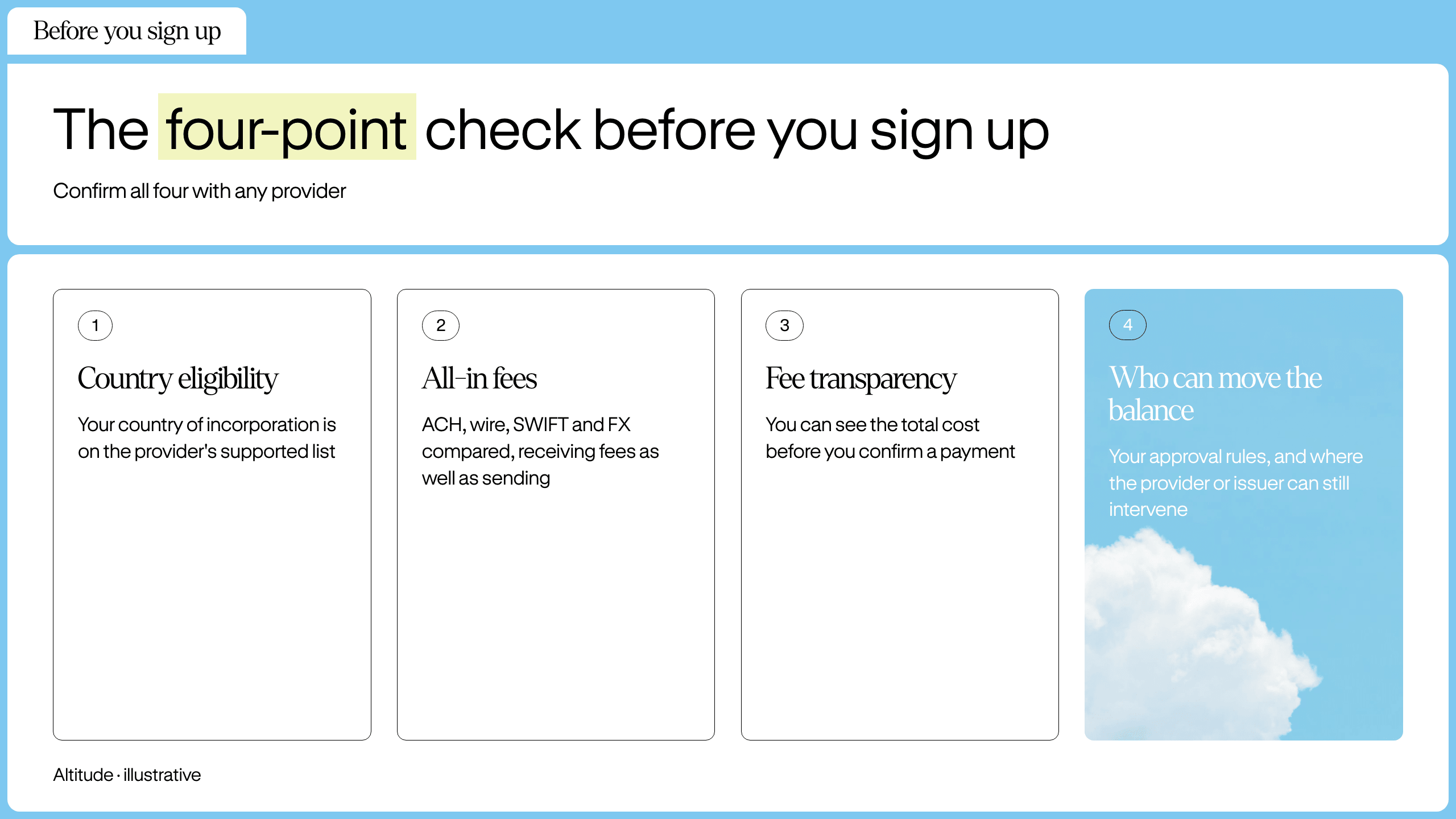
Before you apply to any provider, verify four things:
- Check whether your country of incorporation is on the supported list.
- Work out the all-in fees for the rails you use. Compare ACH, wire, SWIFT, and FX costs, and ask about receiving fees, not just sending fees.
- Confirm fee transparency before you commit. Can you see the total cost before you confirm a payment? Altitude shows the exchange rate, both amounts, and the fee before you approve a cross-border payment.
- Understand who can move your balance. With Altitude, a payment goes through only when it meets the approval rules your team sets. Altitude may still suspend a payment where the law requires or to address fraud, and stablecoin issuers and regulated partners can act independently.
Key steps to activate your new business account
Approval isn't the end of the process. You still need to fund the account, set up payment flows, and configure your compliance posture.
Funding your account
Altitude charges $0 to open an account, with no monthly platform fee. Fund the account using the method that matches your revenue. If you receive ACH payments from US customers, deposit by ACH. If you hold USDC from stablecoin revenue, deposit by stablecoin transfer.
Setting up your regular payments
Once funded, set up the payment flows your business runs every month. If you pay contractors in Brazil, Mexico, Colombia, or the UK, Altitude supports local payouts by Pix, SPEI, Bre-B, and Faster Payments with USDC funding from a USD account. Altitude shows the rate and both amounts before you approve. Check each route's help article for fees. For stablecoin batch payments, you can send to multiple recipients. Bank-rail batch payments are not available. For US-based vendors, a US domestic payment settles by ACH.
Staying compliant
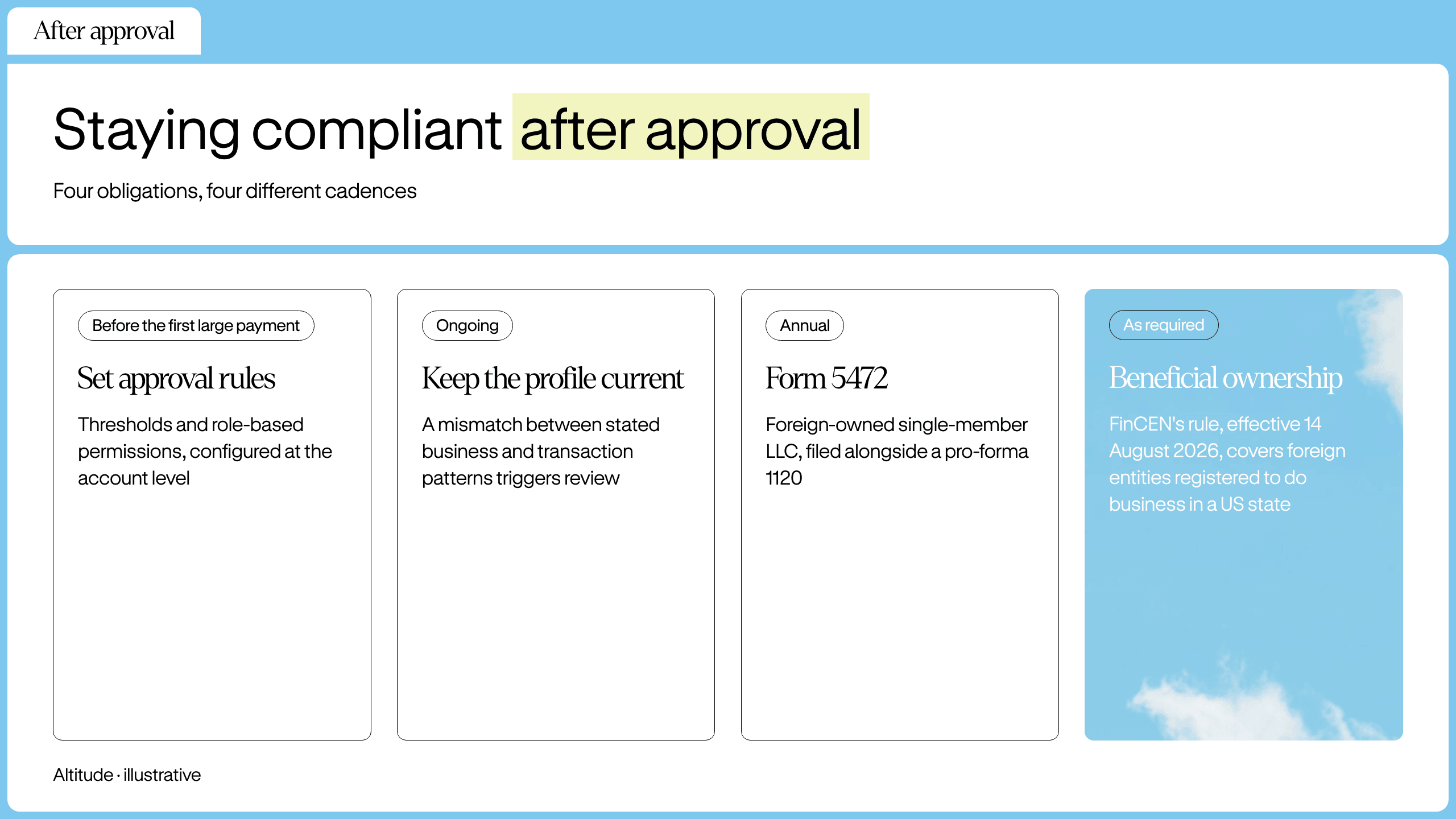
Opening the account is the start. Keeping it open requires ongoing compliance hygiene.
- If you have a foreign-owned US LLC, ask your accountant about Form 5472. A foreign-owned single-member LLC typically needs to file Form 5472 with the IRS each year to report transactions between the LLC and its foreign owner. The filing goes in alongside a pro-forma 1120. It isn't something to set up yourself, flag it with a US tax adviser before your first tax year closes.
- Check whether you need to report beneficial ownership under the Corporate Transparency Act. FinCEN's final rule (effective August 14, 2026) limits beneficial ownership reporting to foreign entities registered to do business in a US state. Check current FinCEN guidance for your situation, as the rules have changed more than once.
- Keep your profile current. If you move or change your business model, update your account profile. A mismatch between your stated business and your transaction patterns triggers compliance review.
- Set approval rules before you need them. Altitude supports role-based permissions and configurable approval thresholds at the account level. Configure these before your first large payment, not after a payment gets stuck waiting for a founder who is asleep in a different time zone.
Which path is right for you?
If your investors require a Delaware C-corp, form one. If you want the simplest, lowest-cost route to US banking, use a provider that accepts your existing foreign entity and skip the LLC entirely. If you need both US and multi-currency payments in one account, choose a provider that combines US routing numbers with SEPA IBANs and local payment rails. The entity decision and the provider decision are separate. Make both deliberately, and the account follows.
See how Altitude handles USD account access for foreign-owned businesses without requiring a US entity. Book a demo.
FAQs
Can I open a US business account without visiting the US?
Yes. Digital platforms like Altitude, Mercury, and Wise Business process applications entirely online. You submit documents, complete identity verification, and receive account details without a branch visit. Traditional banks typically require an in-person visit.
How long does it take to open a USD business account as a non-resident?
If you form a US entity first, expect several weeks: entity formation, EIN issuance, and provider verification each add time. If you use an existing foreign entity with Altitude, verification typically completes within two business days after you submit a complete application, though it is a review and not a guaranteed timeline.
What if my application gets rejected?
Ask the provider for the specific rejection reason. Most rejections come from flagged addresses, vague business descriptions, or mismatched ownership details. Fix the issue and reapply, or apply to a provider with different eligibility requirements.
Do I need a US address to open a business account?
It depends on the provider. Brex requires a physical US address. Mercury accepts a US or international principal place of business address. Altitude doesn't require a US address for eligible foreign-incorporated businesses. If you form a US LLC, your registered agent address doesn't satisfy provider requirements for an operating address.
Can I open a USD business account with my existing foreign entity?
Yes, if the provider accepts foreign entities. Altitude opens accounts for eligible businesses from 200+ countries without requiring a US entity, though product availability varies by country. Mercury and Brex require a US-registered entity.
Key terms glossary
EIN: An Employer Identification Number is a nine-digit tax ID the IRS assigns to a business entity. Non-residents apply by submitting Form SS-4 by phone, fax or mail.
LLC: A Limited Liability Company is a US business structure that combines pass-through taxation with limited personal liability. State filing fees to form one typically fall between $50 and $500 depending on the state.
C-corporation: A C-corporation is a US business structure taxed as a separate entity at 21% on profits, with shareholders taxed again on dividends. It is the standard structure for venture-backed startups because it supports preferred stock issuance.
Registered agent: A registered agent is a person or service with a physical US address designated to receive legal documents on behalf of a business entity. Every US LLC and corporation must have one in its state of formation.
KYB: Know Your Business (KYB) verifies entity legitimacy with formation documents, an EIN, and beneficial ownership disclosure for anyone owning or controlling 25% or more.
ACH: The Automated Clearing House network moves USD payments between US bank accounts. It is the standard rail for domestic vendor payments, direct deposits, and account funding.
SEPA: The Single Euro Payments Area is the euro transfer system covering the EU and several neighboring countries. SEPA transfers move between IBANs and typically settle within one business day.
SWIFT: The messaging network banks use to route international wire transfers. Transfers can pass through intermediary banks and take up to five business days.
Pix: Brazil's instant payment system, run by the Central Bank of Brazil. It settles BRL payments in seconds at any hour.
SPEI: SPEI (Sistema de Pagos Electrónicos Interbancarios) is Mexico's interbank payment system, operated by Banco de México. It settles MXN transfers between Mexican bank accounts in near real time.
Bre-B: Colombia's new real-time payment system from Banco de la República. It moves COP between participating Colombian financial institutions instantly.
Faster Payments: Faster Payments is the UK's real-time rail for GBP transfers between UK bank accounts. Payments typically settle in seconds.
Stablecoin: A stablecoin is a digital asset designed to hold a steady price by tracking a government-issued currency such as the US dollar or euro. USDC and EURC are stablecoins backed one to one by issuer reserves.
USDC: USD Coin (USDC) is a US dollar stablecoin issued by Circle and backed one to one by reserves. Businesses use it to hold and move dollar value without bank cut-off times.
FDIC and SIPC: The Federal Deposit Insurance Corporation (FDIC) insures deposits at US banks if a bank fails, and the Securities Investor Protection Corporation (SIPC) covers customers if a brokerage fails. Neither covers stablecoin balances.
FinCEN: The Financial Crimes Enforcement Network is the US Treasury bureau that administers anti-money-laundering rules, including Corporate Transparency Act reporting.
Altitude is a financial technology platform, not a bank or digital asset custodian.