





 Startups
 Creative agencies
 Onchain teams
 European businesses
 AI
 Software

TL;DR: SWIFT transfers settle in 1–5 business days and carry a $35 outbound fee at Altitude, plus intermediary deductions and FX markup. Stablecoin transfers settle in seconds to minutes on Solana with no fee. Stablecoins run 24/7, including weekends, while SWIFT follows banking hours. For recipients who need fiat delivery, Altitude also supports the full stablecoin sandwich: on-ramp from fiat to stablecoin, transfer across the network, and off-ramp back to fiat on the receiving side. The trade-off is counterparty acceptance: stablecoins only work when the recipient can accept them on the right network with the right stablecoin. Altitude's accounting sync currently covers QuickBooks Online and Xero.
A SWIFT transfer sent on Friday afternoon can sit in correspondent banking limbo until Tuesday. A stablecoin transfer sent the same afternoon settles before the sender closes their laptop. For finance managers weighing stablecoin vs SWIFT, the question is which rail moves a specific payment to a specific recipient faster and cheaper on that specific day. This article breaks down both rails on settlement time, all-in cost, and compliance, and names the conditions where each one earns its place in a B2B payment workflow.
Payment workflow: SWIFT transfers vs. stablecoins
SWIFT and stablecoin transfers move money through fundamentally different architectures. SWIFT is a messaging network that instructs banks to debit and credit accounts. Stablecoins are digital assets that transfer directly between wallets on a blockchain. The architecture determines the settlement time, the fee structure, and the compliance requirements for every payment you send.
The mechanics of SWIFT settlement
SWIFT doesn't move money. It sends payment instructions between banks. The actual settlement happens through a chain of correspondent banks, each holding nostro and vostro accounts with the next institution in line. A wire from a US bank to a Vietnamese bank typically passes through multiple correspondent banks, each adding a fee and a delay.
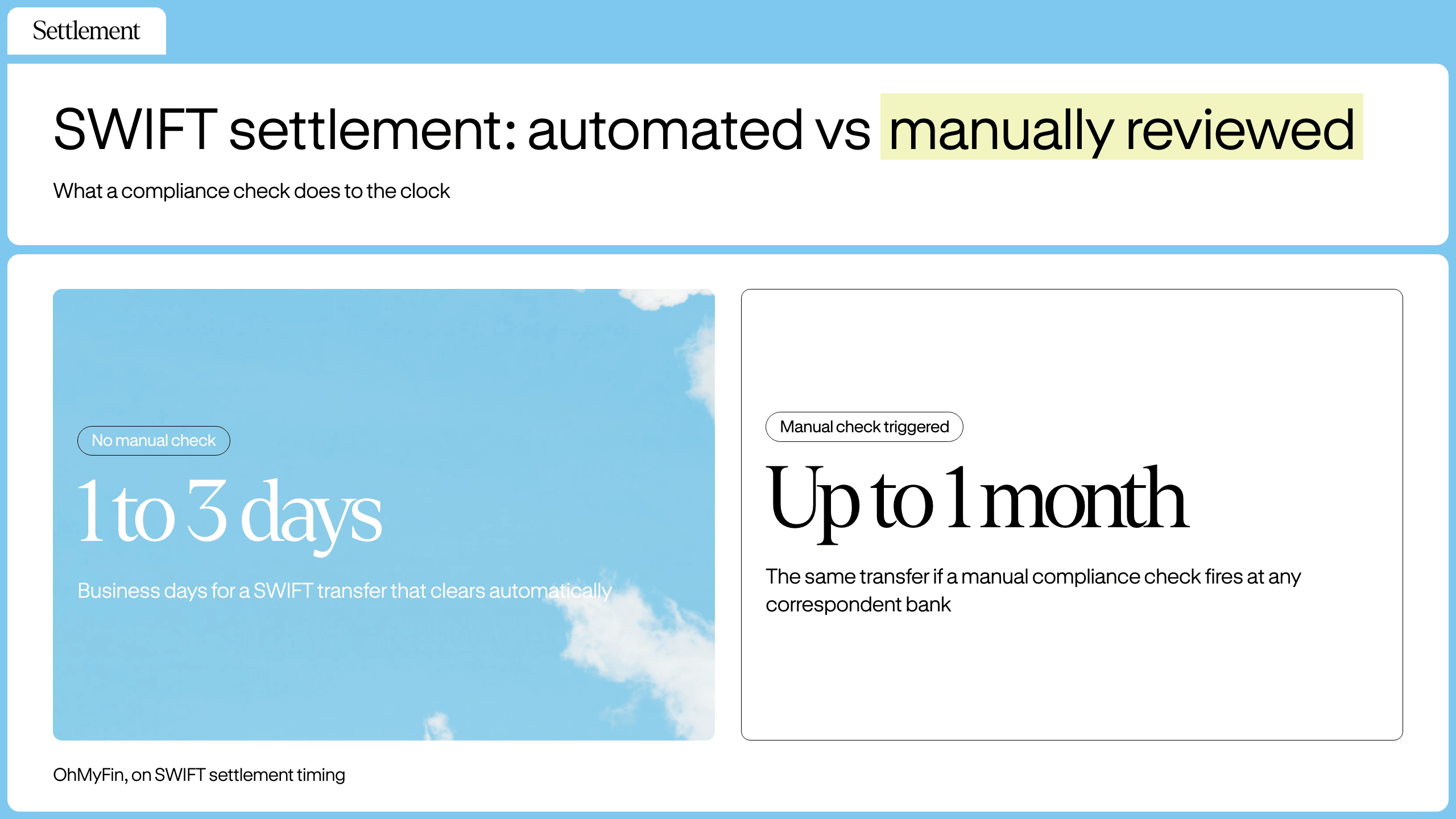
The network operates during business hours and respects bank holidays. A payment sent after a bank's daily cut-off waits for the next business day. Each intermediary processes on its own schedule, and compliance screening at each bank adds minutes to weeks. Funds transfers that don't involve manual checks take 1–3 business days, but a manual compliance check can extend that to one month, according to one practitioner's account of SWIFT settlement timing by OhMyFin.
B2B payment settlement via stablecoins
A stablecoin transfer moves a digital asset directly from the sender's wallet to the recipient's wallet on a blockchain network. The sender initiates the transfer, the network validates it, and the recipient receives the asset. No correspondent chain exists. No banking hours apply. On Solana, block time runs approximately 400 milliseconds with confirmation typically within a couple of seconds and full transaction finality in roughly 13 seconds. Altitude also supports stablecoin transfers on Ethereum-compatible chains, including Base, where settlement times vary by network conditions but typically confirm within seconds to minutes.
The recipient must have a stablecoin-compatible wallet or account. If they only hold a bank account, someone must convert the stablecoin to fiat before the payment reaches them. That conversion step determines when stablecoin transfers make sense and when they don't.
Settlement latency: stablecoin vs. SWIFT rails
Settlement time is where the comparison becomes most concrete. The table below shows the documented reality for both rails.
| Factor | SWIFT | Stablecoin (Solana) |
|---|---|---|
| Settlement time | 1–5 business days | Seconds to minutes |
| Operating hours | Banking hours, business days | 24/7, including weekends |
| Cut-off times | Daily, per bank | None |
| Correspondent chain | 1–4 intermediary banks | None |
| Weekend settlement | No | Yes |
Actual SWIFT transfer times by route
Settlement times vary by corridor. Typical international B2B settlement runs 1–5 business days, depending on corridor and compliance checks, with off-corridor or weekend wires extending to 5+ business days. SWIFT reported in October 2024 that 90% of cross-border payments on its network reach the destination bank within an hour, but only 43% reach the end customer's account within that window, as noted in a cross-border payments analysis by BlindPay. The gap between bank arrival and customer availability is where correspondent banking delays compound.
Reducing payment lag with stablecoins
Stablecoin transfers settle regardless of when they are initiated. A payment sent at 11pm on a Saturday completes as fast as one sent at 10am on a Tuesday. Solana and Ethereum-compatible chains such as Base don't observe banking cut-off times, holidays, or weekends.
In Q2 2026, 12% of Altitude's payment volume moved on weekends, when SWIFT and most bank transfers are closed, according to a post by Stepan Simkin, Altitude's CEO, published 2 August 2026. That volume represents real payment flows that would have waited for Monday settlement on traditional rails.
Managing urgent after hours payments
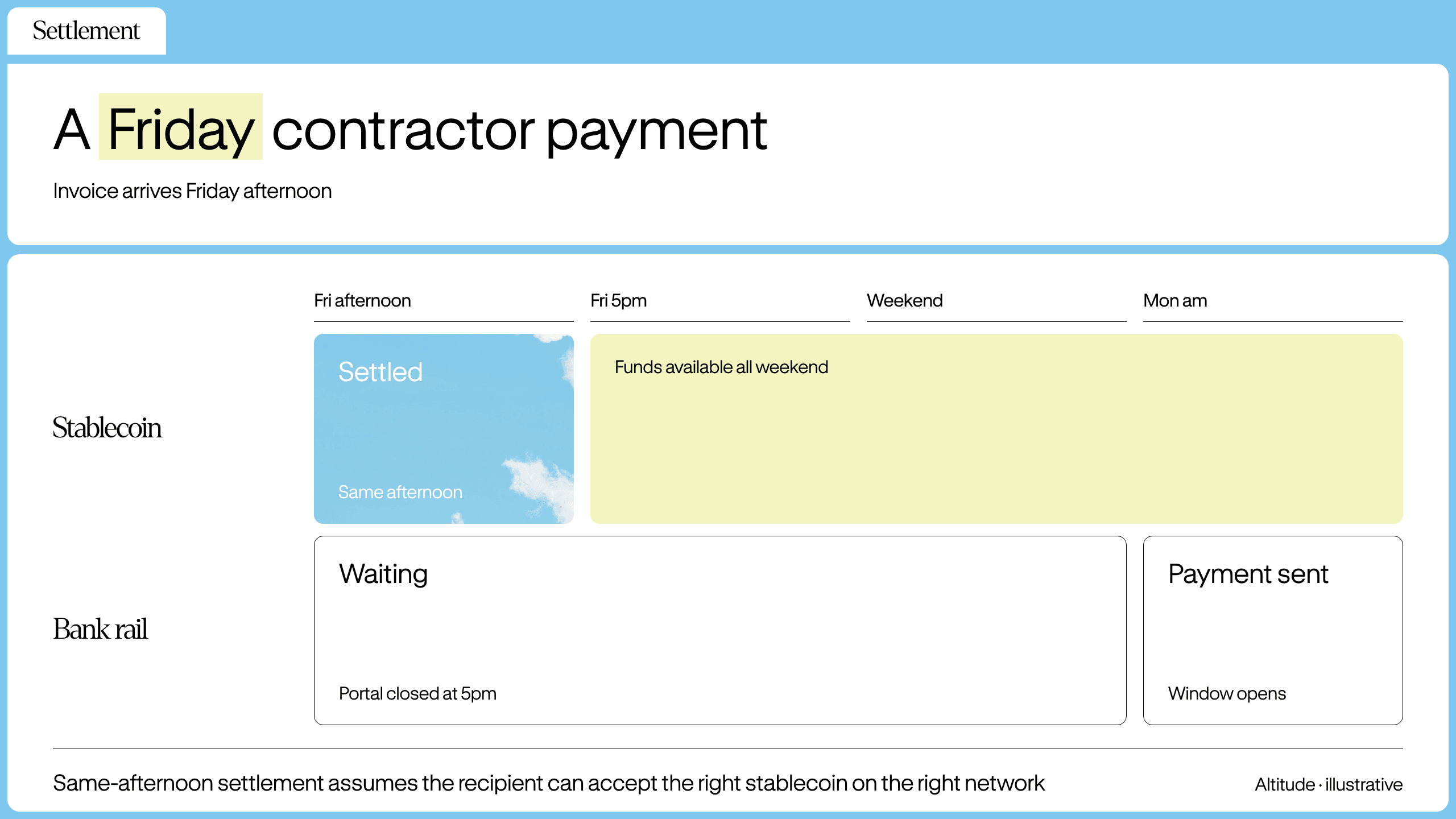
A contractor invoice arrives Friday afternoon, but the bank portal closes at 5pm, so the payment waits until Monday. If the recipient confirms that they can accept stablecoins on the right network with the right stablecoin, the same payment settles the same day. If they can't, SWIFT or a local rail remains the fallback, and the payment enters the correspondent banking queue on the next business day.
The decision point is whether the recipient's account can accept the payment method that matches the urgency of the payment.
Analyzing stablecoin vs. SWIFT payment expenses
Cost requires the most precision in this comparison. The headline fee on a SWIFT transfer is the starting point. Intermediary deductions, FX markup, and receiving fees layer on top. For stablecoin transfers, the fee structure is simpler but not free of conditions.
SWIFT wire fee and markup breakdown
Altitude's outbound SWIFT fee is $35, but some intermediary banks can still deduct charges, so full-value receipt isn't guaranteed. Under the Shared (SHA) charge option, intermediary bank charges are deducted from the payment amount, meaning the payment received may be less than the full amount expected.
Each correspondent bank in the chain can deduct $15 to $50 per intermediary, and the sender often doesn't know the exact total until the recipient confirms what arrived, according to a SWIFT payment guide by FedLaws. Even when the originator specifies the OUR charge bearer code, a Zanders analysis found that a significant number of corporates encounter cases where at least one bank in the chain ignores the code and deducts fees from the principal.
If the destination account is in a different currency, the recipient's bank sets the conversion rate and fees. That FX conversion is where the largest hidden cost typically sits.
Reducing B2B payment fee leakage
Altitude charges $0 for supported stablecoin transfers, with the network fee included. No correspondent chain exists, so no intermediary deductions apply. The recipient receives the full amount sent.
The stablecoin sandwich: on-ramp, transfer, off-ramp
When neither the sender nor the recipient holds stablecoins natively, a stablecoin payment involves three steps: converting fiat to stablecoin on the sending side (on-ramp), transferring the stablecoin across the network, and converting back to fiat on the receiving side (off-ramp). Each conversion carries a cost.
On-ramp fees typically run 0.5%–2% depending on the provider and funding method. The network transfer itself carries no Altitude fee. Off-ramp fees run 0.5%–5%. For a $10,000 payment, the combined conversion cost could reach $700 in a worst-case scenario, which narrows the cost advantage over SWIFT for recipients who need fiat delivery.
The sandwich only makes sense when the total conversion cost comes in below the SWIFT fee stack (platform fee, intermediary deductions, and FX markup combined), or when settlement speed justifies the cost. For counterparties who already hold stablecoins, the sandwich collapses to a single network transfer with no conversion cost on either side.
Hidden FX markup in correspondent banking
Banks embed FX margin in the exchange rate rather than listing it as a line item. Interbank spreads are typically a fraction of a percent, while retail banks and payment providers can mark up significantly above the mid-market rate, with the exact spread varying by provider and corridor. A 3% spread on a £100,000 transfer costs £3,000 in embedded markup, as documented in a CurrencyTransfer analysis. Stablecoin-to-stablecoin transfers avoid FX conversion entirely when both parties use the same stablecoin.
Transferring $10,000: SWIFT vs. stablecoin
The table below shows the documented cost structure for a $10,000 B2B payment on each rail.
| Fee type | SWIFT | Stablecoin |
|---|---|---|
| Platform fee | $35 | $0 |
| Intermediary deductions | $15–$50 per bank | None |
| FX markup | 2–4% (bank rate) | None (same stablecoin) |
| Network fee | Nominal per message | None |
| Recipient off-ramp | Bank receiving fees apply | 0.5%–5% if converting to fiat |
For a $10,000 payment, the SWIFT all-in cost runs roughly $265–$535: the $35 Altitude fee, plus $30–$100 across two intermediary hops, plus 2–4% FX markup ($200–$400) if the destination currency differs. The stablecoin total is $0 when the recipient holds stablecoins, or $50–$500 if they need to off-ramp to fiat. Altitude doesn't publish FX margins, so the FX figure reflects documented bank-rate ranges, not Altitude's specific rate.
Regulatory requirements for B2B transfers
Compliance is a workflow requirement. Both SWIFT and stablecoin transfers operate within regulatory frameworks, but the mechanisms differ.
Compliance controls in SWIFT transfers
SWIFT's compliance infrastructure is built on decades of bank-level KYC/AML processes. Every bank in the correspondent chain performs its own sanctions screening and regulatory checks. The audit trail runs through bank statements and SWIFT message records. This is the established system that regulators and auditors understand.
The trade-off is that compliance screening at each bank adds time. A payment that passes through three correspondent banks faces three separate screening processes, each on its own schedule.
Stablecoin regulatory status by jurisdiction
The GENIUS Act, signed on 18 July 2025, created a federal framework for dollar stablecoins in the US. Issuers must maintain reserves backing the stablecoin on a one-to-one basis using US currency or similarly liquid assets such as Treasury bills, according to a Wiley legal analysis. Payment stablecoins are not federally insured, as noted in the Federal Register implementation notice.
Stablecoin issuers can freeze addresses under legal orders. Circle's current USDC Terms of Service state that it can block certain addresses and freeze associated USDC in circumstances including legal requirements, illegal activity, and violations covered by its terms. Circle has indicated it requires a lawful order from relevant authorities before freezing an address.
Tracking stablecoin and SWIFT activity
Altitude provides configurable approval thresholds and role-based permissions that create an audit trail for every payment. The approval rules your team sets are applied automatically, every time.
For accounting, Altitude syncs one way to QuickBooks Online and Xero. Some transaction types are excluded from the sync. EUR postings require a QBO multi-currency subscription. Xero handles multi-currency natively. For any other ledger, the CSV export is compatible with most accounting systems, including ones the live sync doesn't support.
Evaluating stablecoin vs. SWIFT for B2B flows
The decision framework is straightforward: match the rail to the payment, not the other way around.
SWIFT settlement and compliance benefits
SWIFT's structural advantage is universal reach. Any bank account in the world can receive a SWIFT transfer. The compliance infrastructure is established, and every regulator and auditor understands it. For bank-only destinations, formal documentation-heavy corridors, and recipients who can't or won't accept stablecoins, SWIFT remains the default.
Wise Business, Airwallex, and Revolut Business offer multi-currency cross-border payments, and Altitude matches that with stablecoin transfers that settle in seconds to minutes at no Altitude fee, alongside SWIFT and local rails from the same account. Mercury and Brex provide US business accounts with domestic and international payment capabilities. Altitude opens accounts for eligible businesses from 200+ countries (product availability varies by country), with no US entity required, so foreign-incorporated teams access the same multi-rail dispatch without restructuring.
Evaluating stablecoin for B2B flows
Stablecoin transfers win when the counterparty can accept the right stablecoins on the right network, when the payment is urgent, when the payment falls on a weekend or holiday, and when the payment is a recurring contractor or supplier payout. The $0 Altitude fee and the elimination of correspondent banking deductions make the cost case straightforward for these flows.
Stablecoin transfers don't work when the recipient only has a bank account and can't or won't set up a stablecoin-compatible wallet. They also don't eliminate off-ramp costs for recipients who need fiat. The off-ramp cost should be part of the rail selection calculation, not an afterthought.
Blending stablecoins and SWIFT workflows
The practical approach is running both rails from the same account. Altitude's multi-rail dispatch lets finance managers toggle between USD ACH/wire, SWIFT, and stablecoin transfers from a single interface, with the exchange rate and both amounts shown before approval. The workflow comparison below shows the step count for a cross-border payment on each rail.
| Step | SWIFT workflow | Stablecoin workflow |
|---|---|---|
| Platform logins | 1 (bank portal) | Altitude |
| Data entry | Recipient details, SWIFT code, reference | Recipient details and wallet address |
| Approval handoffs | Manual or email-based | Configured thresholds, automatic |
| Settlement wait | 1–5 business days | Seconds to minutes |
| Reconciliation | Match bank statement to invoice | Receipt-to-transaction matching (unmatched items require review) |
The finance manager keeps SWIFT for bank-only vendors and uses stablecoins for crypto-ready counterparties. The recipient address book stores bank destinations and stablecoin addresses per recipient, so the rail selection happens at payment time, and not during vendor onboarding.
Risk management for cross-border payment shifts
The two risks that surface most often in CFO conversations are freeze risk and accounting integration. Both deserve direct answers.
Accounting for B2B stablecoin payments
Altitude's accounting sync is one-way, from Altitude to QuickBooks Online or Xero, and every posting requires your confirmation before it applies.
For businesses running other ledgers, the CSV export covers the same transaction data and is compatible with most accounting systems. Finance teams running multi-currency operations should review the accounting sync documentation for the full scope of what the QuickBooks or Xero sync covers before relying on it for FX-related entries.
Configuring payment approval workflows
Role-based permissions divide payment authority across configurable roles. Approval thresholds let you set the amount above which a second approver is required. Altitude applies your rules automatically, every time, without routing edge cases back to a single person. This structure matters for stablecoin payments because the settlement speed removes the natural review window that a 3-day SWIFT transfer provides. The approval workflow is the control that replaces the delay.
Onboarding vendors for stablecoin transfers
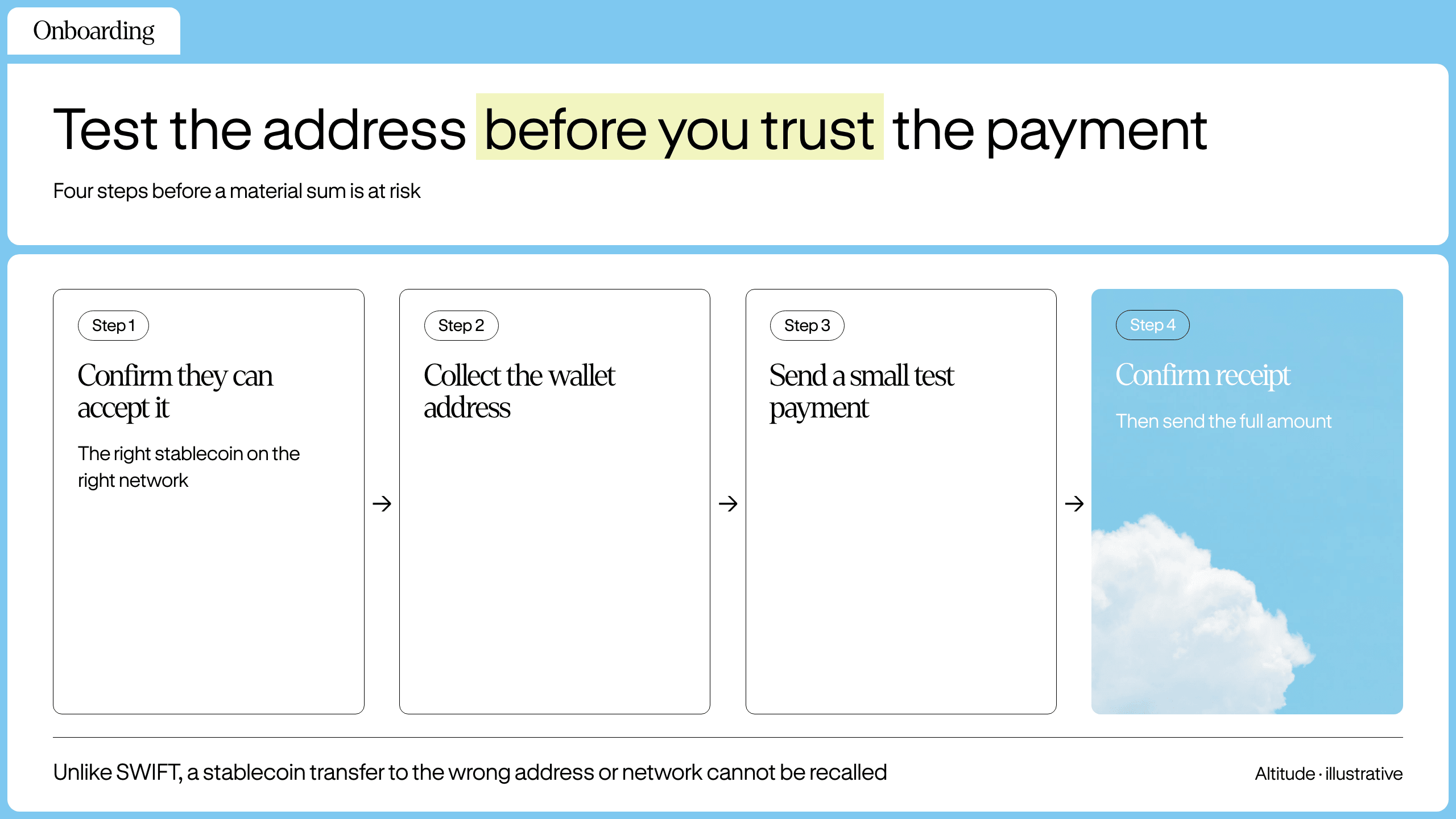
The recipient address book stores bank destinations and stablecoin addresses across rails. To onboard a vendor for stablecoin payments, confirm they can accept the right stablecoins on the right network, collect their wallet address, and test with a small payment before running the full amount.
This step matters because stablecoin transfers are irreversible. A payment sent to a wrong address or the wrong network cannot be recalled. Unlike a SWIFT transfer, which can sometimes be retrieved through the correspondent banking chain, a stablecoin transfer that leaves the correct wallet is final. The test payment confirms the address, the stablecoin, and network are correct before a material sum is at risk.
See how Altitude handles contractor and supplier payments across borders. Book a demo.
FAQs
Are stablecoin payments faster than SWIFT transfers?
Stablecoin payments on Solana settle in seconds to minutes, 24/7. Altitude also supports stablecoin transfers on Ethereum-compatible chains such as Base, with comparable settlement windows. SWIFT transfers settle in 1–5 business days during banking hours only. For urgent payments where the recipient can accept the right stablecoins on the right network, the speed difference is the deciding factor.
What are the total fees for a SWIFT wire transfer?
Altitude charges $35 for outbound SWIFT with a $100 minimum. Intermediary banks can deduct $15–$50 per hop. The recipient's bank may charge receiving fees. FX markup at the recipient's bank adds 2–4% if the destination currency differs from the sent currency.
Do stablecoin payments work on weekends and holidays?
Yes. Stablecoin networks operate continuously, including weekends and banking holidays. In Q2 2026, 12% of Altitude's payment volume moved on weekends. SWIFT follows banking hours and doesn't settle on weekends.
Which payment method has lower FX costs?
Stablecoin-to-stablecoin transfers avoid FX conversion entirely when both parties use the same stablecoin. SWIFT transfers involving currency conversion carry FX markup of 2–4% at the recipient's bank. Altitude doesn't publish FX margins, so compare against your bank's specific rate.
Can I use stablecoin transfers for all B2B payments?
No. Stablecoin transfers require the recipient to have a stablecoin-compatible wallet or account. For recipients who only hold bank accounts, SWIFT or local rails remain necessary. Altitude lets you run both from the same account and select the rail per payment at the time you initiate the transfer.
Key terms glossary
SWIFT: Society for Worldwide Interbank Financial Telecommunication. A messaging network that sends payment instructions between banks. Settlement happens separately through correspondent banking relationships, not through SWIFT itself.
Stablecoin: A digital asset designed to maintain a stable value relative to a reference currency, typically the US dollar. USDC and EURC are fully reserved stablecoins backed one-to-one by issuer reserves.
Correspondent banking: A system where banks hold accounts with each other to facilitate international payments. Each intermediary bank in the chain adds processing time and may deduct fees from the payment amount.
Settlement time: The time between payment initiation and the recipient's ability to use the funds. SWIFT settlement runs 1–5 business days. Stablecoin settlement on Solana runs seconds to minutes, as does settlement on Ethereum-compatible chains such as Base that Altitude supports.
FX markup: The difference between the mid-market exchange rate and the rate a provider applies to a currency conversion. It is embedded in the rate, not listed as a separate fee, making it the largest hidden cost in cross-border payments.
Altitude is a financial technology platform, not a bank or digital asset custodian.