
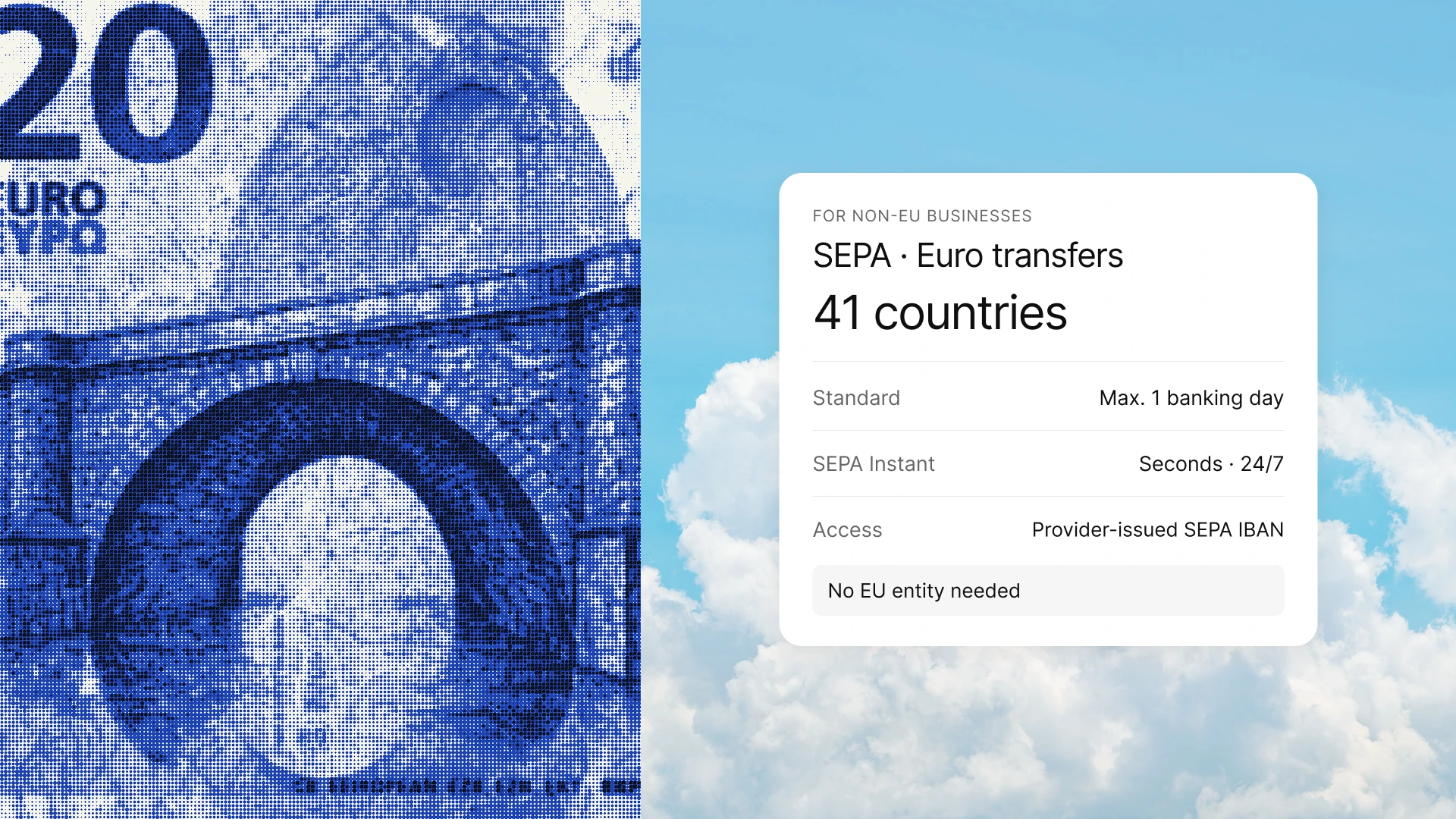
TL;DR: SEPA is the set of rules and standards for euro payments across 41 countries. A standard SEPA credit transfer takes a maximum of one banking day, and SEPA Instant settles in seconds, around the clock. Non-EU businesses don't need an EU entity to use SEPA. They need a provider that issues them a SEPA IBAN. Use SEPA for euro payments to recipients in the 41 countries, and SWIFT for other currencies or destinations.
A European supplier sends an invoice in euros, and your company is incorporated in Singapore. You've got three options: pay by SWIFT, where most payments arrive within a day but intermediary banks can deduct fees along the way, open a European account you might not qualify for, or send a SEPA transfer through a provider that issues non-EU businesses a SEPA IBAN.
Most SEPA guides assume an EU-based reader. This article covers what a non-EU finance manager needs to pay a European supplier or contractor by SEPA: what access requires, how long payments take, where the costs sit, and when SWIFT is the better choice.
Defining SEPA for global finance teams
Non-EU businesses can send and receive euro transfers through SEPA-compliant providers, but the access requirements, settlement windows and fee structures differ from SWIFT and domestic payment methods.
What SEPA is for non-EU businesses
SEPA stands for the Single Euro Payments Area. It's an EU initiative that sets common rules and standards for euro bank transfers so a cross-border euro payment works like a domestic one. The European Payments Council (EPC), created by the European banking sector in 2002, maintains the SEPA payment scheme rulebooks. SEPA itself isn't a bank. Banks and payment providers follow its rules.
Countries within the SEPA network
The SEPA region has 41 countries: the 27 EU member states, the three EEA members Iceland, Liechtenstein and Norway, and Albania, Andorra, Moldova, Monaco, Montenegro, North Macedonia, San Marino, Serbia, Switzerland, the United Kingdom and Vatican City.
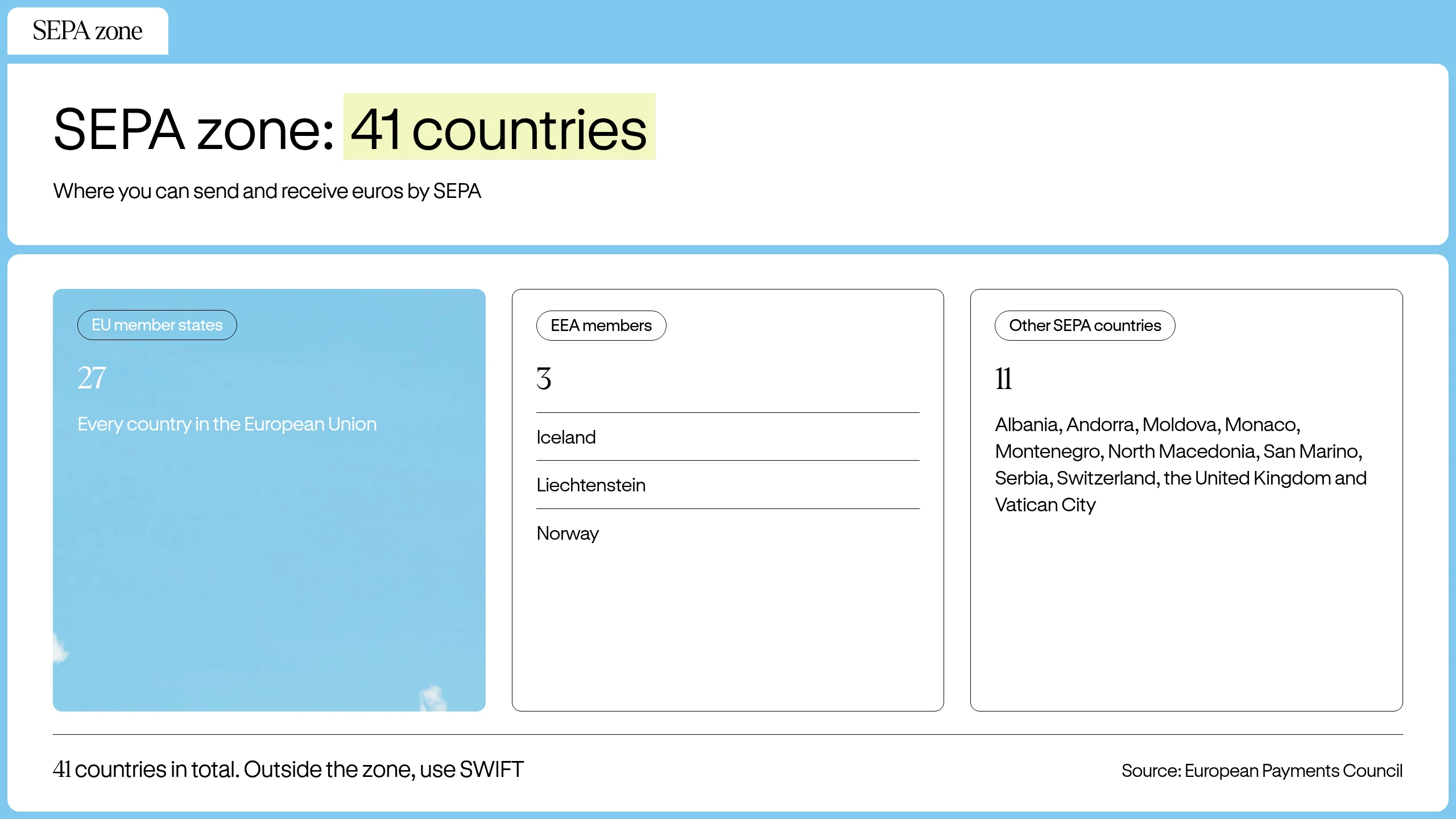
This list defines where you can send and receive euros by SEPA, and where to use SWIFT if the supplier is outside the SEPA zone.
Behind the scenes of SEPA payment routing
SEPA offers two main transfer types, each with its own speed and availability.
How SEPA credit transfers work
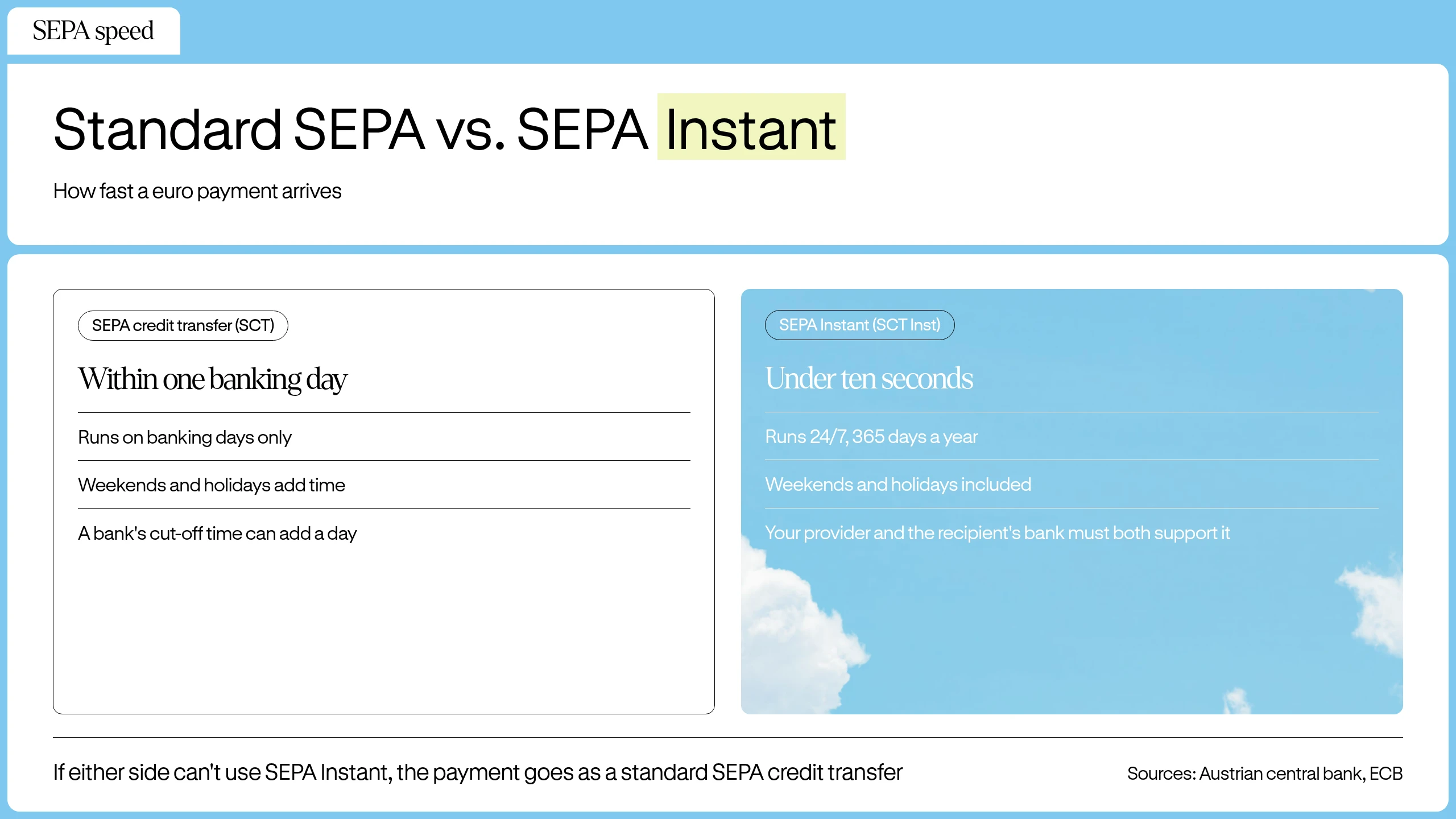
A SEPA credit transfer (SCT) is a standard euro transfer between two accounts in the SEPA zone. The sender starts the payment through their bank or payment provider, which checks the IBAN (International Bank Account Number) format and routes the transfer through a SEPA clearing house. The recipient's bank then credits the funds within one banking day.
The transfer needs the recipient's IBAN, the amount and the recipient's name. A payment reference is optional, but it helps the recipient match the payment to an invoice.
SEPA Instant is the first option when timing matters. It settles in seconds on any day, including weekends and holidays, provided both your provider and the recipient's bank support it. If either side can't use it, a standard SEPA credit transfer is the fallback, and it runs on banking days. The Austrian central bank says Saturdays, Sundays and public holidays aren't banking days, and a payment order received after the bank's cut-off time takes longer than one banking day. A standard transfer submitted on a Friday after the cut-off doesn't start until Monday.
How SEPA Instant works
A SEPA Instant credit transfer (SCT Inst) settles in under ten seconds, 24 hours a day, 7 days a week, 365 days a year. The scheme runs every day, including weekends and holidays, so no day adds a delay.
SCT Inst suits urgent payments where waiting a banking day costs you. Under the Instant Payments Regulation (EU) 2024/886, banks in countries that use the euro have had to offer sending SEPA Instant since 9 October 2025, and payment and e-money institutions in those countries have until 9 April 2027, according to the ECB's implementation table. Your provider must offer it and the recipient's bank must be able to receive it, and if either can't, a standard SEPA credit transfer is the fallback and arrives by the next banking day. Under the regulation, banks in countries that use the euro can't apply a default per-transaction cap to SEPA Instant payments, and customers can set their own limits.
How banking cut-offs affect transfers
Banks set their own daily cut-off times. That matters for a non-EU business working across time zones. 11pm in Singapore is 4pm or 5pm in Central Europe, depending on the season, so a transfer submitted then can land after a bank's cut-off and add a full banking day.
Whether a cut-off applies depends on the payment method. Standard SEPA settles on banking days, SEPA Instant runs around the clock, SWIFT transfers move through correspondent banks on each bank's own schedule, and stablecoin transfers also run around the clock.
SEPA access requirements for international firms
For a non-EU business, SEPA access is an operational question: you need a euro account with an IBAN from a provider in the SEPA zone. You can hold one as a non-EU-registered company, and a traditional European bank account is optional. SEPA's geographic scope includes non-EU countries, so a non-EU entity can use it once a provider is willing to issue an IBAN to your business.
Navigating correspondent bank transfers
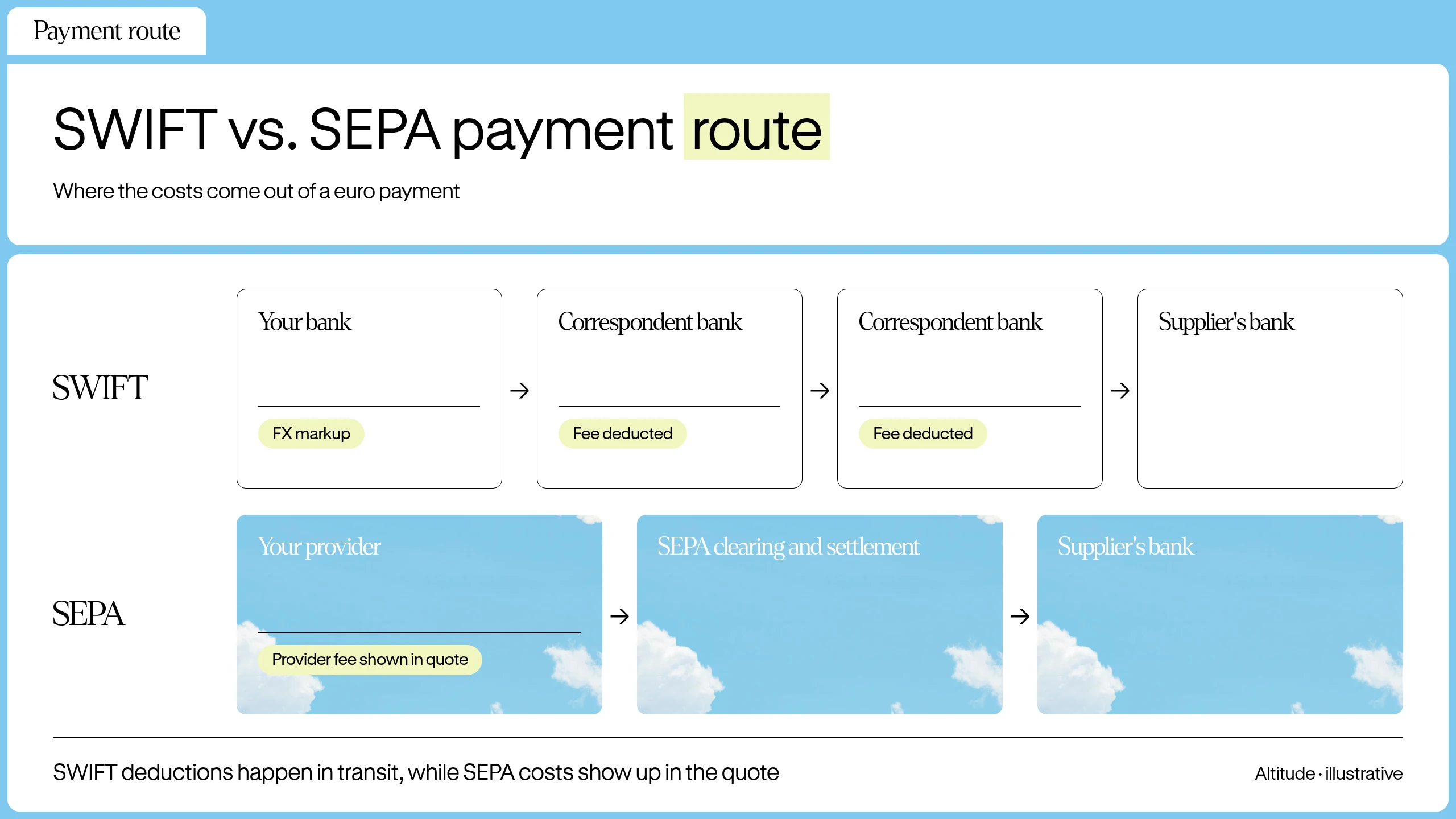
When a non-EU business sends euros through a traditional bank's international wire, the payment can route through correspondent banks, which sit between banks that don't have a direct relationship. Each intermediary can deduct a fee, and the sending bank can apply an FX markup when it converts the currency. Those deductions happen in transit instead of on the invoice, so the variance can surface at month-end without an explanation.
SEPA payments go through SEPA clearing and settlement instead of a chain of correspondent banks. The sender's provider can still charge for the payment, so check the quote before you approve it.
Choosing a provider for SEPA transfers
Look for a provider whose documentation says it works with non-EU businesses. Each provider sets its own eligibility rules, so confirm yours accepts your business before you commit. Compare providers on these points:
- IBAN issuance: a dedicated SEPA IBAN for your business.
- Name matching on incoming payments: how the provider handles a sender whose name doesn't match your legal entity name.
- Fee transparency: the fee, rate and recipient amount appear before you send.
- Approval controls: role-based permissions and configurable thresholds.
- Accounting connectivity: a sync with your accounting system.
What SEPA payments actually cost
SEPA credit transfers are usually free of charge, according to the Austrian central bank, but each provider sets its own pricing. The costs to watch are the currency conversion before the euros leave your account and the deductions on any SWIFT payment you send instead.
Direct costs of SEPA credit transfers
Some providers charge nothing for outgoing SEPA payments, while others charge a flat fee per transfer or bundle transfers into a monthly account plan. The Austrian central bank says cross-border euro transfers within the EU and EEA cost the same as domestic ones, while higher charges can apply to SEPA countries outside the EU and EEA. Check the provider's fee schedule for the rail, any minimum and any currency conversion before you approve a payment.
SWIFT charge codes decide who pays the bank fees. OUR means the sender covers the known fees, SHA splits them between sender and beneficiary, and BEN pushes them to the beneficiary. A SWIFT payment can carry a sending fee plus deductions by intermediary and recipient banks.
Hidden FX costs in euro transfers
The FX spread is the gap between the mid-market exchange rate and the rate a provider applies. A SEPA payment between euro balances needs no conversion, so it carries no FX spread. The cost appears when your business holds dollars or other currency and converts to euros before sending.
For example, on Altitude, a global business account, a SEPA payment from a USD account is priced at 0.4% above the mid-market rate, and the quote shows what the recipient gets before you send. With any provider, ask for the rate you'd get and compare it with the mid-market rate, because many providers build the spread into the exchange rate instead of listing it as a fee.
When to prioritize SEPA over SWIFT
SEPA and SWIFT serve different purposes. The choice depends on the recipient's location, the currency and the urgency.
Common SEPA credit transfer scenarios
Use SEPA when:
- The recipient is in a SEPA country that your provider supports.
- The payment is in euros.
- Settlement in seconds through SEPA Instant, or by the next banking day, works for you.
SEPA suits paying European suppliers, contractors and service providers, and it's the way to receive euro payments from European customers.
When SWIFT is the better choice
SWIFT reaches recipients and currencies outside SEPA. Use SWIFT when:
- The recipient is outside the SEPA zone.
- The payment is in a currency other than euros.
- The recipient's bank doesn't support SEPA.
Executing your first SEPA credit transfer
A SEPA transfer needs the recipient's IBAN, the payment amount and the recipient's name, and providers in countries that use the euro check the name against the IBAN before the payment goes out, so getting these details right avoids rejection and delay.
Essential SEPA beneficiary details
The beneficiary's name should match the name the beneficiary's bank holds on the account. Verification of Payee (VoP) is a check that providers in countries that use the euro have had to offer since 9 October 2025, according to the European Central Bank. Before a payer authorizes a SEPA credit transfer or SEPA Instant payment, the provider compares the payee's name with the IBAN. The check returns one of four results: match, close match, no match, or verification not possible.
A close match or no match triggers a warning but doesn't block the payment. The payer still decides whether to proceed with the payment, according to the Commission's Q&A.
Required IBAN segments for processing
An IBAN is a standardized format for identifying bank accounts across national borders. It contains three parts:
- Country code: two letters, for example DE for Germany or FR for France.
- Check digits: two numbers that validate the IBAN format.
- Basic Bank Account Number (BBAN): up to 30 alphanumeric characters that identify the bank and the specific account.
IBAN length and structure vary by country, so enter the IBAN exactly as the recipient provides it.
Verifying beneficiary routing codes
For SEPA payments within the EEA, the IBAN is the only account identifier a sender has to provide. For SEPA payments to countries outside the EEA, the Bundesbank says the BIC must be provided in addition to the IBAN. The BIC (Business Identifier Code) is an eight or eleven-character code that identifies the recipient's bank, so keep it with the IBAN when you add a recipient.
Choosing the right rail for euro payments
Use SEPA for euro payments to recipients in the SEPA zone. Before you plan a payment run, check that your provider issues a SEPA IBAN to your business, because eligibility rules differ by provider.
See how Altitude handles contractor and supplier payments across borders. Book a demo.
FAQs
Do I need a European bank account to send SEPA transfers?
No. You need a euro account with an IBAN from a provider in the SEPA zone, and you don't need to be an EU-registered company. Each provider sets its own eligibility rules, so check whether it issues SEPA IBANs to businesses incorporated in your country.
What happens if my provider or the recipient's bank doesn't support SEPA Instant?
SEPA Instant only works when both your provider and the recipient's bank support it, so confirm your provider's support before you send an urgent payment. If either side can't use SEPA Instant, send a standard SEPA credit transfer instead and submit it on a banking day before the cut-off. Weekends and holidays then add time, which they don't for SEPA Instant payments.
Are SEPA transfers free?
It depends on the provider. The costs section above covers the Austrian central bank's position on SEPA credit transfer charges, and some providers price SEPA per transfer or fold it into a subscription plan. A currency conversion before sending adds an FX spread, and a SWIFT payment can lose part of the amount to intermediary and recipient bank deductions on top of the sender's own fee.
Can I send SEPA transfers in currencies other than euros?
No. SEPA covers euro payments only. For other currencies, use SWIFT or a local payment method in the recipient's country, such as Faster Payments in the UK, SPEI in Mexico or Pix in Brazil. Which currencies and local routes you can send depends on your provider.
Key terms glossary
SEPA: Single Euro Payments Area, an EU initiative that sets common rules and standards for euro bank transfers across 41 countries. The European Payments Council (EPC), created by the European banking sector in 2002, maintains the SEPA payment scheme rulebooks.
SEPA credit transfer (SCT): A standard euro transfer between two accounts in the SEPA zone. It takes a maximum of one banking day.
SEPA Instant (SCT Inst): An instant euro transfer that settles in under ten seconds, 24 hours a day, 365 days a year, if both the sender's provider and the recipient's bank support it.
IBAN: International Bank Account Number, a standardized format for identifying bank accounts across national borders.
BIC: Business Identifier Code, an eight- or eleven-character code that identifies the recipient's bank.
BBAN: Basic Bank Account Number, the part of an IBAN, up to 30 alphanumeric characters, that identifies the specific bank and account.
EPC: European Payments Council, the private body that represents European payment service providers and maintains the SEPA scheme rulebooks.
T2: The Eurosystem's real-time gross settlement system, which replaced TARGET2 in March 2023. Retail payment systems route their fund transfers through it.
VoP: Verification of Payee, a check that compares the payee's name with the IBAN before a SEPA credit transfer or SEPA Instant payment is authorized.
SWIFT: The messaging network banks use to instruct international transfers. Funds move through correspondent banks, which can deduct fees.
Altitude is a financial technology platform, not a bank or digital asset custodian.