





 Startups
 Creative agencies
 Onchain teams
 European businesses
 AI
 Software
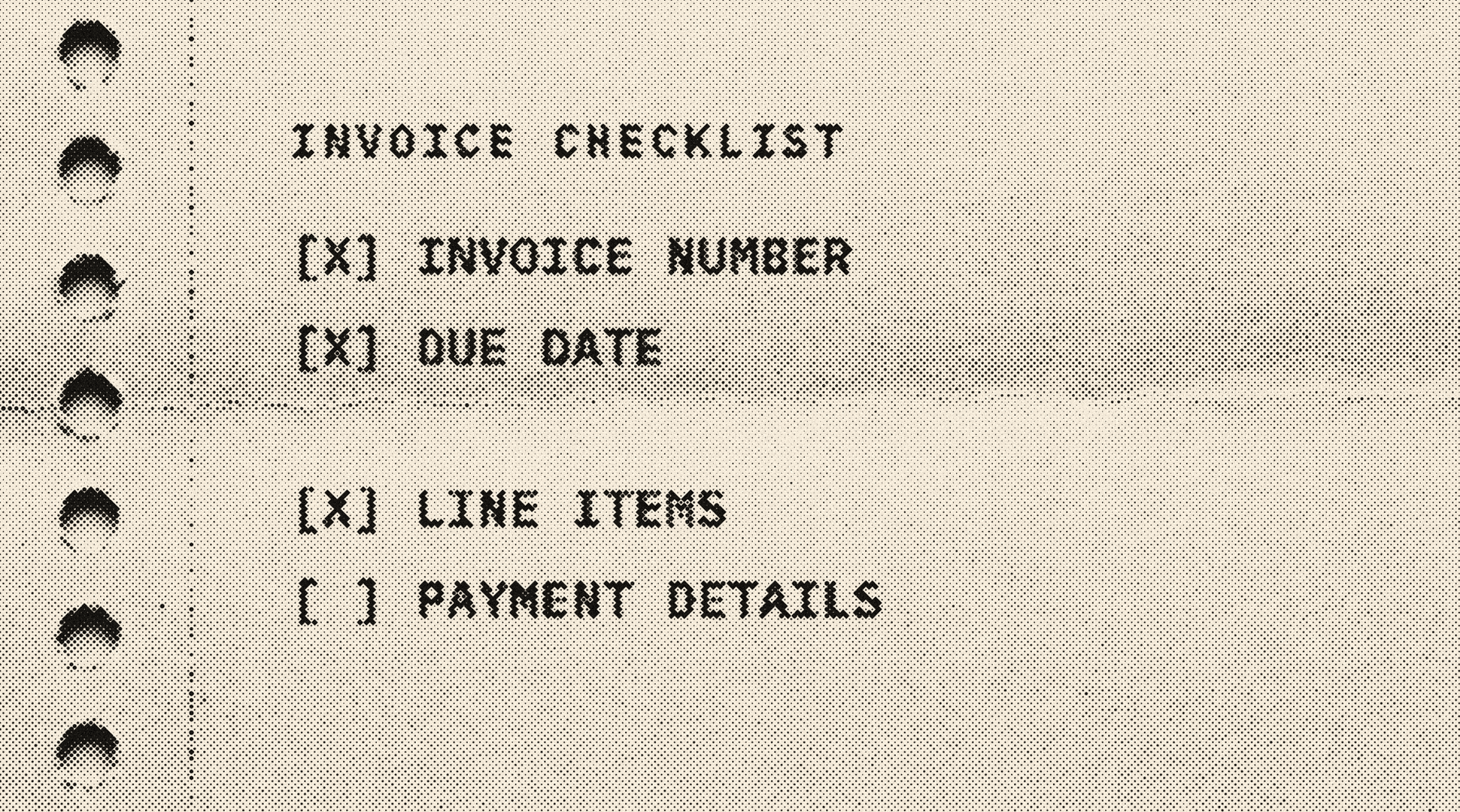
TL;DR: A valid invoice needs nine core elements: a unique invoice number, issue and due dates, sender details, recipient details, itemized line items, subtotal, applicable taxes, total amount due, and payment instructions. Payment details differ by rail: ACH needs routing and account numbers, wire needs SWIFT or domestic wire details, and USDC needs a wallet address. Altitude Invoicing generates invoices in USD or EUR and syncs confirmed postings to QuickBooks Online and Xero, with every posting requiring your confirmation before it applies.
A contractor invoice that arrives Friday afternoon shouldn't have to wait until Monday to be paid. The fields you include on the invoice determine whether it does. A founder who sends the wrong payment details can watch a single invoice bounce back two or three times, adding a week each time.
This article gives you the complete checklist and a template structure, with specific payment details for ACH, wire, and USDC, so your invoices settle on the first attempt.
Drafting a clear, compliant invoice
Most invoice advice treats the document as a compliance artifact. For a founder billing across borders, the invoice is a payment instruction. Every field exists to get money into your account faster and to make reconciliation automatic at month-end.
Standardizing your invoice header details
Your header carries your business identity. Include your legal business name exactly as it appears on your account, your registered address, and your tax identification number. For cross-border clients, add your country of incorporation. This stops the client's accounts payable team from rejecting the invoice for mismatched beneficiary details, one of the more common causes of multi-week payment delays.
The mandatory invoice data points
You need nine elements in every professional invoice: invoice number, sender details, recipient details, issue and due dates, itemized goods or services, subtotal, applicable taxes, total amount due, and payment terms. For tax compliance across jurisdictions, the fields remain universal even as labels vary by country.
Standardizing your invoice payment terms
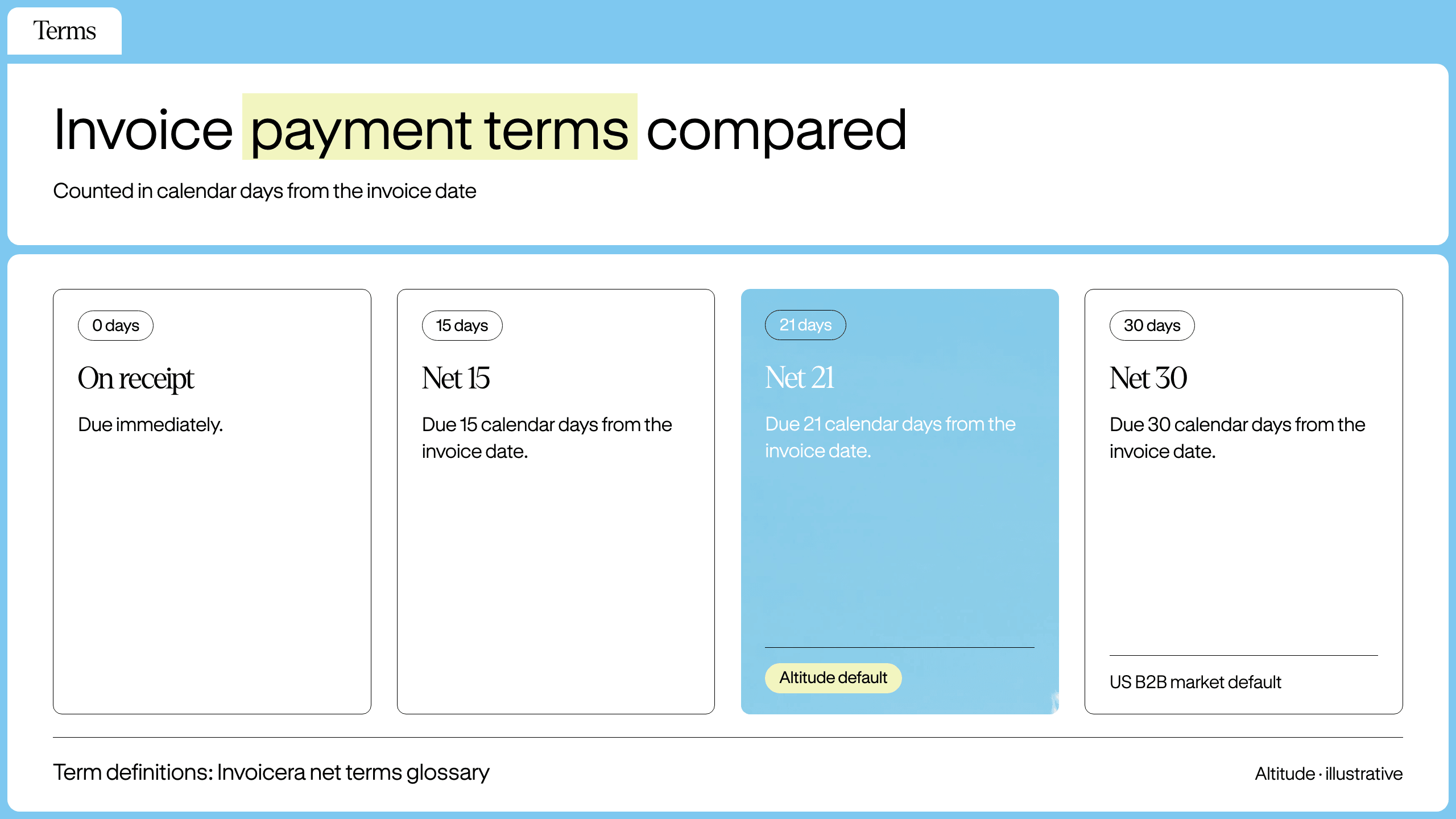
Payment terms define when you expect money to arrive. Standard options include On receipt, Net 15, Net 21, and Net 30. Net 30 is the market default across US B2B and the baseline most other terms are measured against, where Altitude defaults to Net 21. The number indicates calendar days starting from the invoice date unless you specify otherwise, per Invoicera's net terms glossary.
For a founder without a finance team, shorter terms improve cash flow but may strain client relationships. Net 21 offers a middle ground that acknowledges processing time without open-ended delay.
Must-have fields for valid invoices
This section covers the specific data points that determine whether your invoice gets paid on the first pass or bounces back with questions.
Invoice number and date
Every invoice needs a unique identifier. Sequential numbering (001, 002, 003) works for low volume. Date-based numbering (2026-10-12-01) helps when you issue multiple invoices daily. Enterprise ERP systems typically reject duplicate invoice numbers automatically, so a reissue adds days to settlement. The invoice date anchors the payment term calculation and determines the due date.
Accepted payment methods and details
Specify exactly how you want to be paid. Different rails require different information. Omitting a routing number or wallet address forces the client to email you, adding days to settlement. For ACH, you need your account number and nine-digit routing number. For SWIFT, you need your BIC code and often an IBAN.
Writing professional line item details
Itemize every charge. List the service or product, quantity, rate, and amount per line. Accounts payable teams query vague descriptions like "consulting services," adding weeks to approval. Specific descriptions like "October 2026 content strategy retainer, 20 hours at $150/hour" pass through approval workflows without manual review. Missing or mismatched details stall payments for weeks.
Setting your invoice currency and total
State the currency clearly (USD, EUR) and show the calculation from line items to subtotal, any applicable taxes, and the final total. For cross-border clients, indicate whether the amount is net of tax or includes VAT/GST. Ambiguity here causes FX confusion when the client's bank converts the payment.
Legal requirements for invoice validity
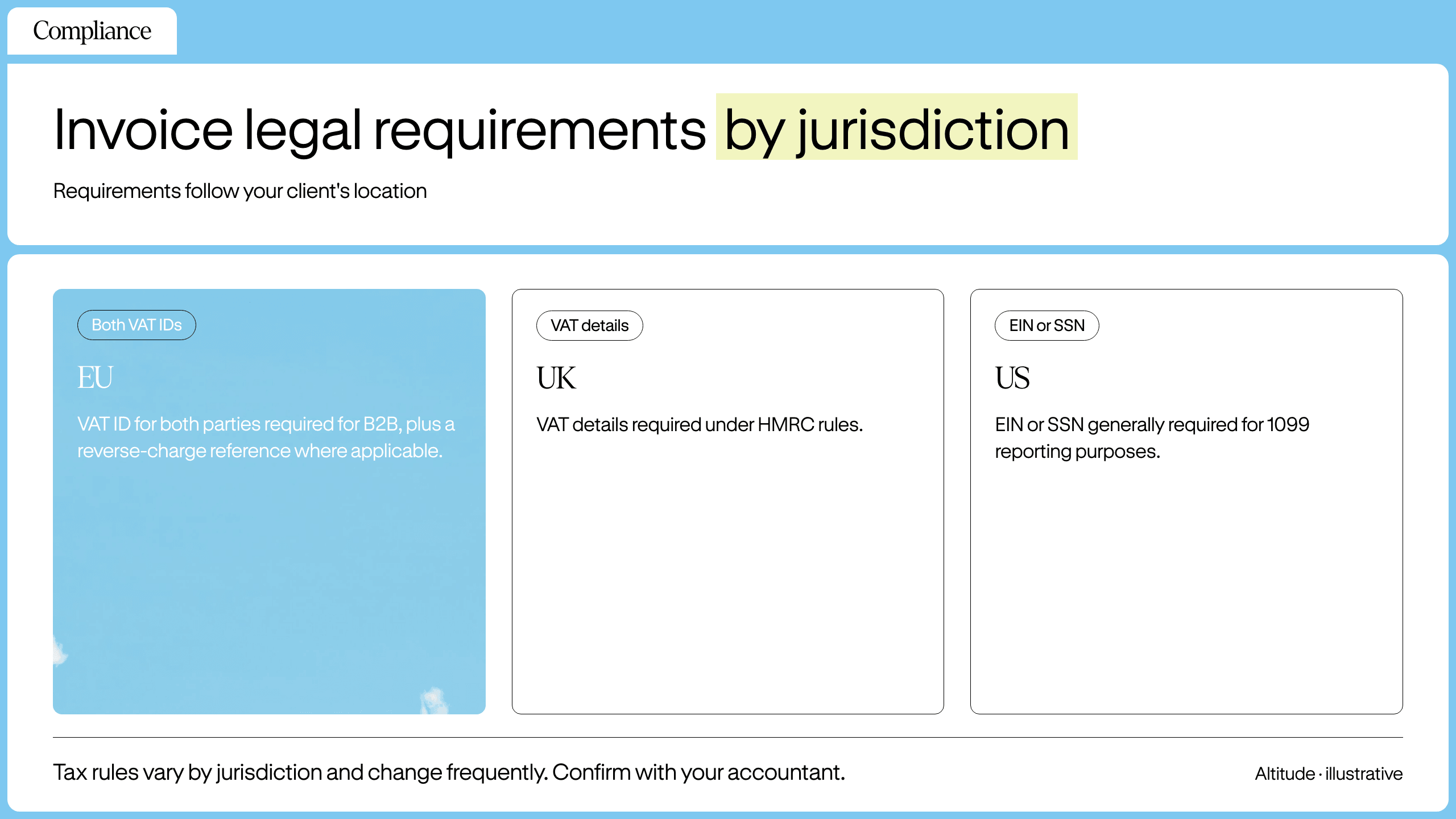
Legal requirements depend on your client's location. EU VAT invoices must include your VAT ID and the client's VAT ID for B2B transactions, plus a reverse-charge reference where applicable. UK clients expect VAT details under HMRC rules. US clients generally need your EIN or SSN for 1099 reporting purposes.
Setting up your invoice payment methods
The payment instructions section determines how fast money arrives. Each rail has different data requirements, timing, and costs.
Setting up ACH for client payments
ACH transfers typically take up to three business days and carry no Altitude fee. Same-day ACH is also available, which takes up one business day, and carries no Altitude fee. You need to provide your account number and routing number.
Essential wire transfer details
Domestic wire transfers typically settle in one business day with no Altitude fee. SWIFT international wires cost $35, carry a $100 minimum, and take up to five business days. SWIFT requires a third-party invoice attachment and uses the OUR convention, where the sender covers known fees, though some intermediary banks can still deduct charges, according to Altitude's international payment guide.
How to invoice for USDC payments
Stablecoin transfers settle in seconds to 15 minutes depending on the network, with no Altitude fee and a 1 USDC minimum. Include your USDC wallet address and specify the network (Solana, Ethereum, Base, Avalanche, or Tempo). Stablecoin transfers run continuously, including weekends, while bank payouts still observe banking cut-offs.
| Rail | Timing | Altitude fee | Minimum |
|---|---|---|---|
| ACH | Up to 3 business days | $0 | $5 |
| US domestic wire | Typically 1 business day | $0 | $5 |
| SWIFT | Up to 5 business days | $35 | $100 |
| SEPA | Typically 1 business day | €0 ($0) | €5 (~$5) |
| Stablecoin (USDC/EURC) | Solana instant, others up to 15 min | $0 | 1 USDC/EURC |
Handling multi-currency invoice details
Cross-border invoicing adds layers of tax and FX complexity that domestic invoices avoid.
Managing multi-currency invoice fields
When invoicing in USD or EUR, specify the currency in the total amount and in the payment instructions. Altitude Invoicing supports USD and EUR only. For FX transparency, fix either the amount you send or the amount the recipient receives, and show the effective rate before the client pays. This stops disputes when the client's bank applies its own conversion rate.
Essential tax data for foreign clients
You generally follow the customer's location for tax purposes when providing B2B cross-border services. Under the reverse charge mechanism, you issue the invoice with no domestic VAT while your client accounts for VAT in their country, according to Avalara's cross-border VAT guide. Include a note stating "Reverse charge applies" or the specific legal basis for zero-rating. The purchaser's identification number must appear on the invoice.
Tax rules vary by jurisdiction and change frequently. Confirm current requirements with your accountant before relying on this guidance.
When to expect international payments
Settlement times vary by corridor. SEPA typically settles in one business day. SWIFT takes up to five business days. Stablecoin transfers settle in seconds to 15 minutes, 24/7. If you invoice on Friday with Net 30 terms, the client's payment initiated on the due date may arrive on a weekend if using stablecoins, or the following Tuesday if using ACH.
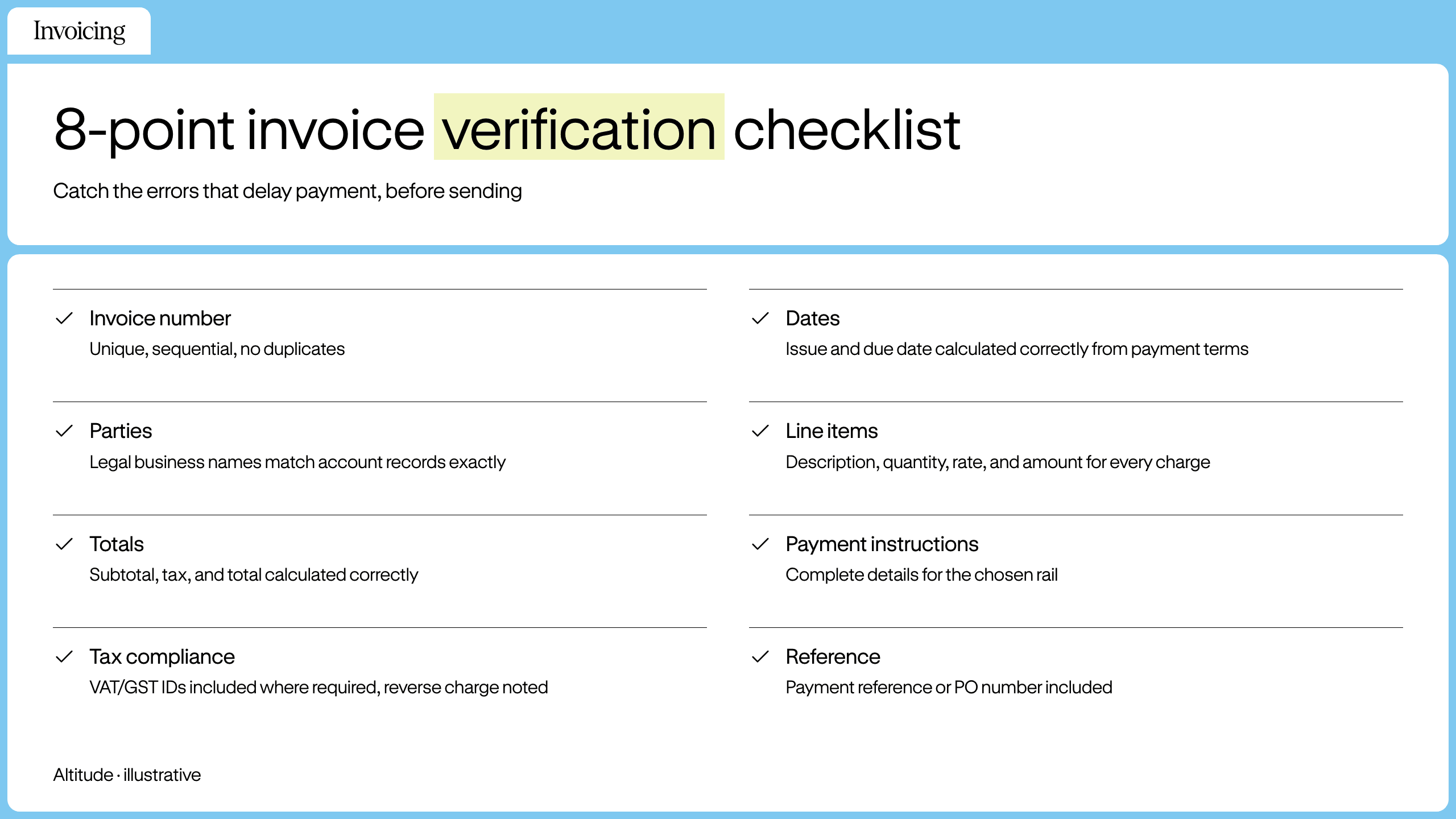
The 8-point invoice verification checklist
Before sending, run through this checklist to catch the errors that delay payment.
- Invoice number: Unique, sequential, no duplicates.
- Dates: Issue date and due date calculated correctly from payment terms.
- Parties: Your legal business name and client's legal entity name match your account records exactly.
- Line items: Description, quantity, rate, and amount for every charge.
- Totals: Subtotal, tax, and total calculated correctly.
- Payment instructions: Complete details for the chosen rail (routing/account for ACH, BIC for SWIFT, wallet address for USDC).
- Tax compliance: VAT/GST IDs included where required, reverse charge noted for cross-border B2B.
- Reference: Payment reference or PO number included for the client's reconciliation.
4 invoice mistakes that delay payment
- Duplicate invoice numbers: Enterprise systems reject these automatically, requiring reissue.
- Missing payment details: Clients can't pay what they can't route.
- Vague line items: Procurement teams query unclear descriptions, adding weeks to approval.
- Incorrect beneficiary names: SEPA and SWIFT rails reject payments on exact name mismatches and return funds to the sender.
Standardizing invoicing for high volume teams
Manual invoicing breaks down as volume grows. Recognize the signs before month-end becomes a scramble.
How to track unpaid client invoices
Invoices move through states: Draft, Open, Paid, and Void. Deposit matching is manual today, and automatic matching is coming soon. When a deposit is matched to an invoice, the invoice is marked as Paid in full. Altitude doesn't track partial payments, so a partial deposit that gets matched will mark the entire invoice as Paid, even if the amount received differs from the amount invoiced. If a client pays half the invoice, verify the deposit amount before matching to avoid closing out an invoice that still has an outstanding balance.
Syncing invoices with your ledger
Altitude syncs with QuickBooks Online and Xero one way, from Altitude to your ledger, and you confirm every posting before it applies. Card transactions, Rewards, SOL and cbBTC Holdings, and invoice objects don't sync. EUR postings require a QBO multi-currency subscription.
Signs your invoicing needs automation
Businesses relying on manual invoicing see longer payment cycles, with each manual step adding delay and error risk. Automated payment reminders reduce days sales outstanding compared to manual follow-up, though the exact reduction varies by business size, client mix, and reminder cadence. If your workflow depends on features Altitude Invoicing doesn't yet support, you will need a complementary tool. If you are logging into separate platforms to invoice in different currencies, or if you spend month-end manually matching invoices to bank statements, your process needs consolidation.
See how Altitude generates multi-currency invoices and syncs confirmed postings to QuickBooks Online and Xero. Book a demo.
FAQs
What is the difference between an invoice and a receipt?
An invoice requests payment before money changes hands. A receipt confirms the payment has been received. You issue an invoice to get paid, and you issue the receipt once you are paid.
How long should I keep invoice records?
Generally, keep invoice records for at least three years from the filing date, but longer in specific situations: six years if you omit more than 25% of gross income, and seven years for bad-debt or worthless-securities deductions, per IRS Publication 583. Cross-border invoices may require longer retention under foreign tax authority rules.
Can I invoice in multiple currencies?
Altitude supports USD and EUR only. You can separately pay out in GBP, MXN, BRL, or COP via Altitude's local rails, outside the invoicing flow.
What payment terms should I set?
Net 21 is the default for Altitude and balances cash flow speed with client processing time. Net 30 is standard for enterprise clients with formal procurement workflows.
Do I need different invoice templates for different countries?
The core fields remain universal, but tax data requirements vary. EU B2B invoices require VAT IDs and reverse-charge notation. UK invoices require VAT details under HMRC rules. US invoices don't require a tax ID on the document itself, but business clients who pay you will typically request your EIN via Form W-9 for 1099 reporting purposes.
Key terms glossary
Invoice: A payment instruction with legal weight that requests money for goods or services rendered.
ACH: Automated Clearing House, the US domestic bank transfer network. Settlement takes up to three business days.
Wire transfer: An electronic bank transfer. Domestic wires settle in one day, while SWIFT international wires take up to five.
SWIFT: The Society for Worldwide Interbank Financial Telecommunication network for international transfers. Requires a BIC code.
USDC: A fully reserved dollar stablecoin. Transfers settle in seconds to minutes, 24/7, with no Altitude fee.
EURC: A fully reserved euro stablecoin. Functions similarly to USDC for euro-denominated transfers.
Payment terms: The period a client has to pay, such as Net 30 (30 calendar days from invoice date).
Line item: An individual charge on an invoice, showing description, quantity, rate, and amount.
FX rate: The exchange rate applied when converting between currencies. Altitude shows the effective rate and both amounts before you approve a cross-border payment.
VAT/GST: Value-added tax or goods and services tax. EU and UK invoices must show VAT IDs and reverse-charge status for cross-border B2B services.
Altitude is a financial technology platform, not a bank or digital asset custodian.