
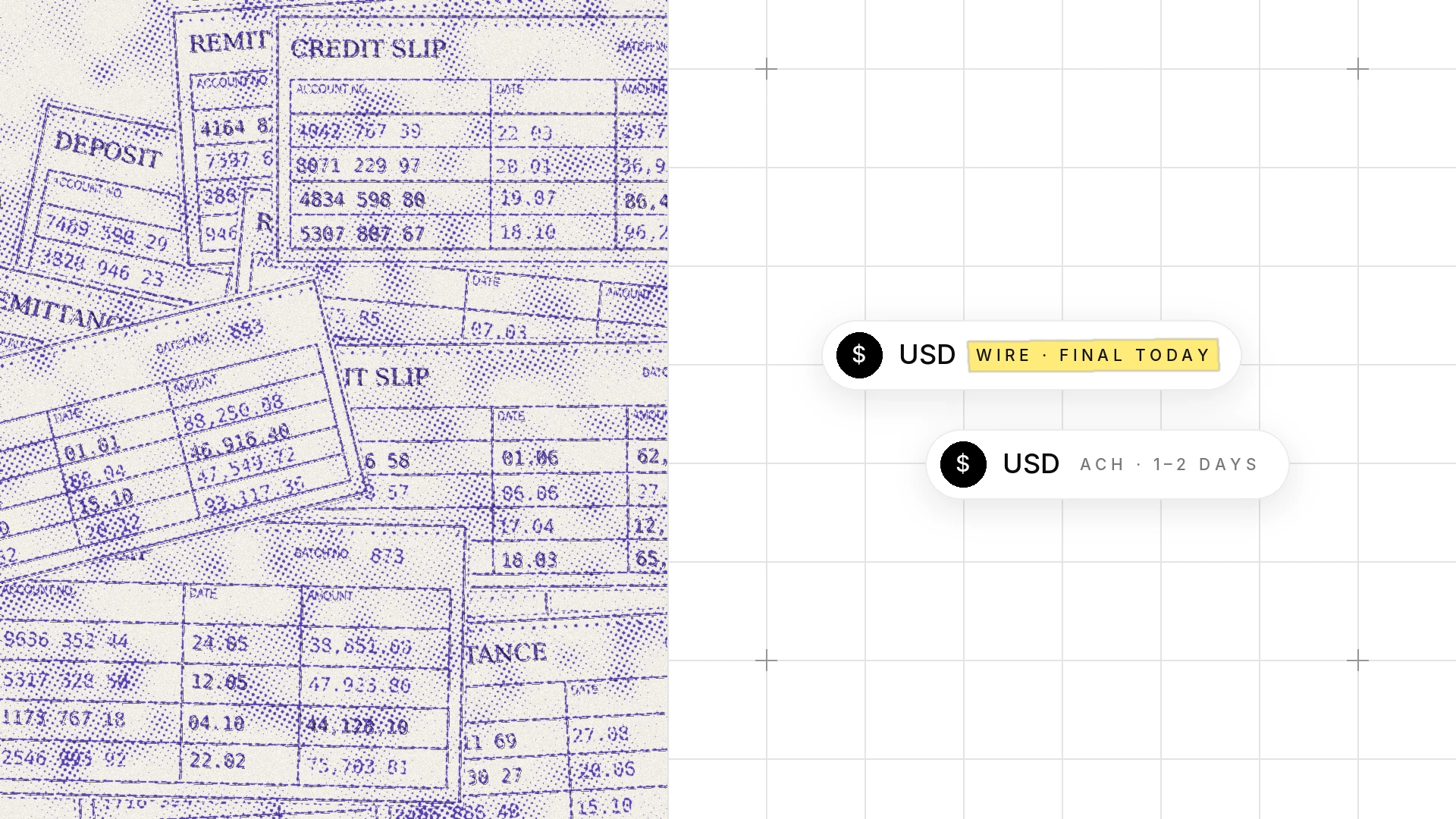
TL;DR: A wire transfer settles one payment at a time, and a Fedwire payment is final once the receiving bank's account is credited, which suits urgent payments that can't be pulled back. ACH moves in batches and carries a reversal window, so it suits payments that can wait a day or two. SEPA Instant settles in seconds, 24/7, while standard SEPA takes up to one banking day. Most SWIFT payments sent over Swift GPI reach the recipient within 24 hours, though FX conversion or compliance checks can add several business days, and intermediary banks can deduct fees. Stablecoin transfers run outside banking hours, including weekends, but can't be reversed once settled.
A SWIFT transfer can pass through intermediary banks before it reaches a supplier, and some of those intermediary banks can deduct a fee that was never quoted to you. Finance teams comparing a wire transfer with a bank transfer usually weigh three things: settlement finality, fee predictability, and reconciliation effort.
How wire transfers work
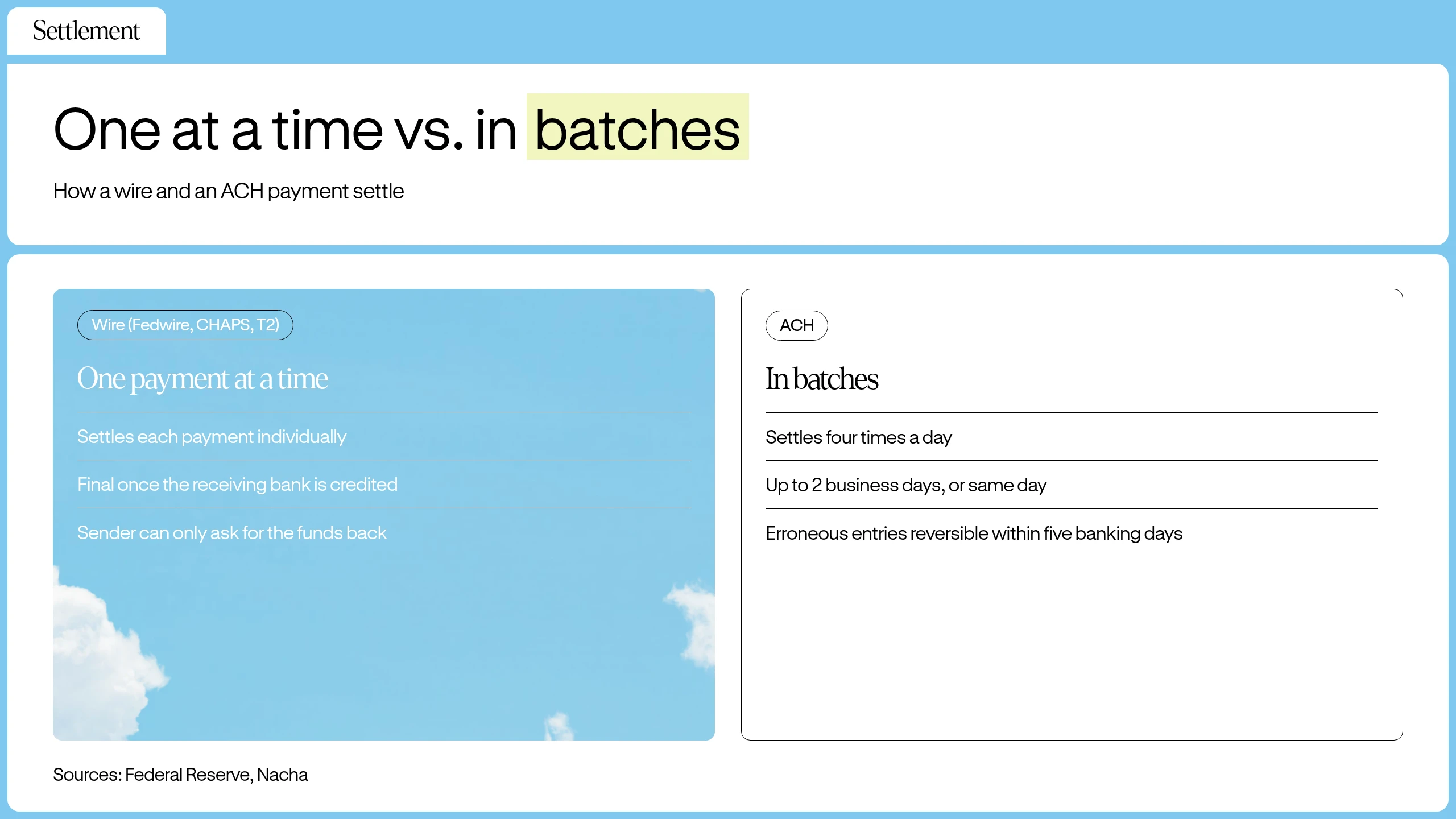
A wire settles each payment individually, unlike ACH and standard SEPA, which process payments in batches or on a fixed schedule.
Fedwire, CHAPS and T2
Fedwire, the Federal Reserve's real-time gross settlement system, settles each payment order individually. The Fedwire Funds Service disclosure states that payment to the receiving participant becomes final and irrevocable when the Federal Reserve credits the amount to the receiving participant's account.
Each wire is a discrete event: the Federal Reserve debits the sending bank's master account and credits the receiving bank's master account in real time. After the credit posts, the sender can't reverse the payment unilaterally. A sender can ask the receiving bank to return the funds, and the receiving bank decides whether to agree.
Other currencies have their own high-value wire systems. In the UK, CHAPS settles sterling payments individually and irrevocably on the same day, Monday to Friday. In Europe, T2, the Eurosystem's real-time gross settlement system, settles payments one by one with immediate finality, Monday to Friday.
Domestic vs international wire mechanics
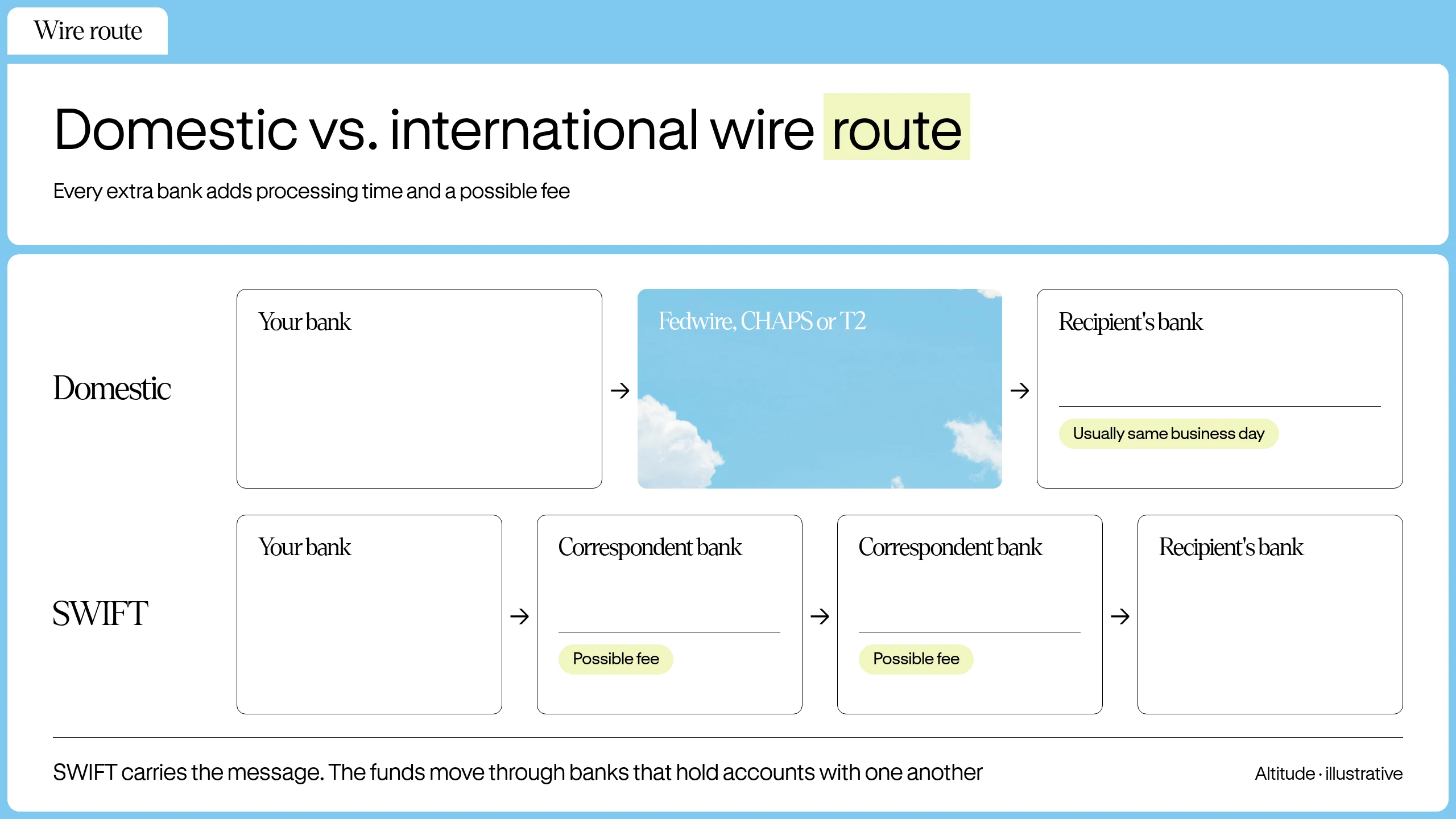
A domestic wire, such as Fedwire, CHAPS or T2, runs over a single system. The system debits the sending bank and credits the receiving bank directly, so the payment usually settles the same business day and no intermediary bank handles it. An international wire works differently. The SWIFT message passes between banks, and the funds move through correspondent banks that hold accounts with one another, so each extra bank adds processing time and a possible fee.
How SWIFT works
SWIFT is a messaging network. It transmits standardized payment instructions between financial institutions, and the funds move through correspondent banking relationships where banks hold accounts with one another.
Swift says nearly 60% of Swift GPI payments are credited to end beneficiaries within 30 minutes and almost 100% within 24 hours. Payments that need FX conversion or compliance checks can take several business days, and Swift explains that slower payments typically have clear known reasons, such as payment regulations in the receiving country. Each bank processes the message during its own business hours in its own time zone, and time zone differences can add delay at each step.
How bank transfers work
Bank transfer methods explained
Standard bank transfers (ACH, SEPA, Faster Payments) use clearing-house or scheme-based settlement. Wires use gross settlement. Nacha writes the operating rules for ACH, the main batch payment network in the United States, and says the network settles payments four times a day. ACH payments therefore move in settlement windows.
SEPA (Single Euro Payments Area) covers 41 countries and includes the SEPA Instant scheme for euro transfers. Faster Payments handles GBP transfers between UK bank accounts around the clock. Pay.UK, which runs the scheme, says funds are usually available almost immediately but can take up to two hours, and the scheme limit is £1 million per payment, though banks can set lower limits. ACH and SEPA both operate under scheme rulebooks, and individual banks set their own cut-off times for accepting payments.
ACH settlement and reversals
ACH works for domestic USD payments when you can wait for settlement in up to 2 business days. Same-day ACH settles the same business day, with a per-payment limit of $1 million that Nacha will raise to $10 million on September 17, 2027. Nacha rules let a sender reverse an erroneous entry, such as a duplicate payment, a wrong amount or a wrong account, but the reversal must reach the receiving bank within five banking days of the original settlement date.
SEPA payment settlement timelines
SEPA Instant settles in seconds, 24/7, and European banks have been required to offer sending it since 9 October 2025 under Regulation (EU) 2024/886. When a bank doesn't support SEPA Instant for a payment, a standard SEPA credit transfer is the fallback and takes a maximum of one banking day. Under the fallback, a payment submitted after the bank's cut-off starts its clock on the next banking day, and each bank sets its own cut-off.
Difference between local payouts and stablecoin transfers
Local payment routing
Local rails such as Faster Payments, SPEI, Pix and Bre-B settle in local currency inside the destination country, so they can avoid the correspondent-bank chain of a SWIFT wire where your provider supports the route. Timing, limits and FX pricing are set by the scheme and the provider.
Stablecoin transfers
A stablecoin transfer sends a dollar- or euro-backed stablecoin such as USDC or EURC and doesn't follow banking cut-off times, so it can settle on weekends and holidays while bank payouts keep their cut-off times. Before you send one, ask your provider which networks it supports, what the minimum amount is and what fees apply. Then confirm that your recipient's wallet supports the same token and network, because stablecoin transfers can't be reversed once settled. Test with a small payment first.
Wire vs bank transfer: a finance team guide
The choice between wire and bank transfer comes down to when the money arrives and whether the payment can be pulled back.
Settlement, finality and weekend availability by rail
| Rail | Settlement | Weekend | Finality | Reversal window |
|---|---|---|---|---|
| Fedwire | Same business day | No | Final on credit | None |
| CHAPS | Same business day | No | Final on credit | None |
| T2 | Immediate | No | Final on credit | None |
| SWIFT | Most GPI payments within 24 hours | No | Set by the banks that settle it | Stop and recall while in flight |
| ACH | Up to 2 business days | No | Provisional | Up to 5 banking days |
| Same-day ACH | Same business day | No | Provisional | Up to 5 banking days |
| SEPA | Up to 1 business day | No (standard SEPA) | Irrevocable once sent | Recall only with recipient consent |
| SEPA Instant | Within seconds | Yes | Irrevocable once sent | Recall only with recipient consent |
| Faster Payments | Usually almost immediately, up to two hours | Yes | Irrevocable once sent | None, though banks follow a recovery process for mistakes |
| Stablecoin transfer | Depends on the network and provider | Yes | Final once settled | None |
Evaluating wire and bank transfer fees
Sending, intermediary and recipient banks and providers can charge their own fees. A provider that sends SWIFT payments under the OUR convention covers the fees known at sending, though some banks or intermediaries may still deduct fees.
Fee allocation on an international wire follows one of three conventions. Under the OUR convention, the sender pays the fees known at sending. Under SHA, the sender pays their own bank's fee and the recipient bears the remaining charges. Under BEN, the recipient pays all fees and receives less than the amount sent.
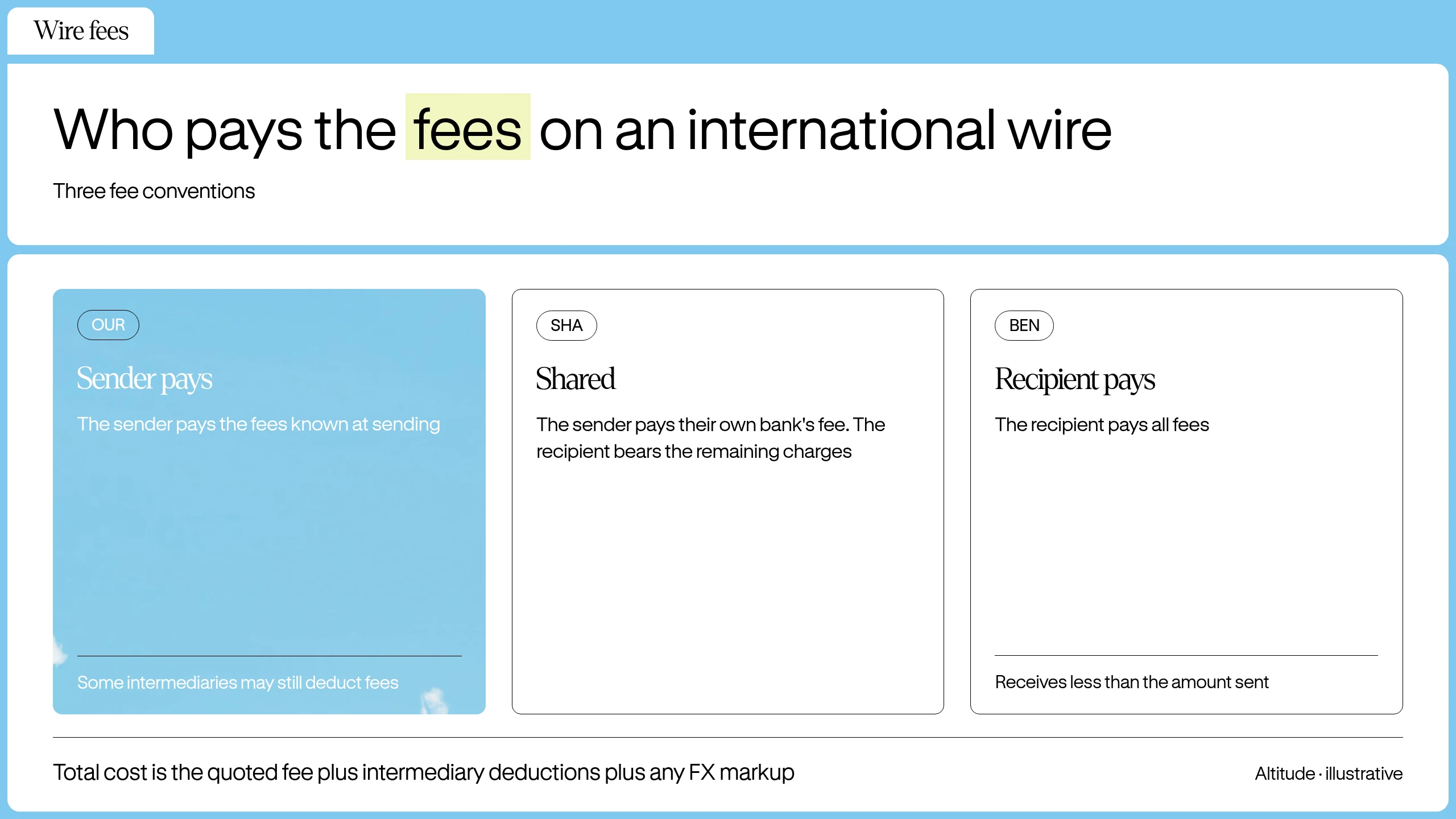
The total cost of a payment is the quoted fee plus any intermediary deductions plus any FX markup in the exchange rate. Consider a hypothetical $10,000 SWIFT transfer with a $35 quoted fee. If intermediary banks then deduct $50 or $85, the total cost rises to $85 or $120.
Timing transfers for same-day arrival
Payments approved after the cutoff, at a weekend or on a bank holiday can take longer. Fedwire runs Monday to Friday and closes at 7 p.m. Eastern Time, according to the Fedwire operating hours page, so a domestic wire approved on a Saturday waits until Monday.
Stablecoin transfers run outside banking hours because they don't follow banking cut-off times. If the recipient accepts the stablecoin you send, a contractor invoice that arrives Friday afternoon can be paid Saturday morning via stablecoin transfer without waiting for Monday's ACH window.
US: wire vs ACH
When a contractor or supplier needs same-day funds, use wire or same-day ACH. The choice between them comes down to timing and reversal risk.
Use wire when the recipient needs funds today and insists on irrevocable funds. Above same-day ACH's $1 million per-payment limit, a wire is the same-day option. Use same-day ACH when the recipient needs funds today and accepts that you can reverse an erroneous entry during the ACH reversal window. If the recipient can wait a day or two, use ACH or SEPA.
Europe: SEPA Instant vs SEPA vs SWIFT
For a euro payment to a recipient in the SEPA area, use SEPA Instant when the recipient's bank supports it. If the bank doesn't support Instant, use a standard SEPA credit transfer. Use SWIFT when the payment is outside SEPA or in a currency other than euro.
UK: Faster Payments vs CHAPS
For sterling payments in the UK, use Faster Payments for amounts up to the £1 million per-payment scheme limit. Faster Payments runs around the clock. Use CHAPS for larger payments or when you need irrevocable same-day settlement on a business day. The Bank of England says CHAPS has no minimum or maximum payment limit.
Managing recurring payment schedules
Recurring payments suit ACH and SEPA because they run on predictable schedules. A monthly retainer to a supplier is an ACH payment. A last-minute contractor payment to prevent a project delay is a wire payment.
Building a CFO-ready cost comparison
Calculate total cost as the quoted fee plus intermediary deductions plus any FX markup, then express it as a percentage of gross payment volume. For example, with $50,000 in monthly payment volume, $400 in combined fees and $600 in FX costs, the total cost ratio is 2% ($1,000 divided by $50,000). Track the ratio quarter over quarter.
Add reversal exposure on incoming payments as a second measure: the share of monthly incoming ACH volume that the sender could still reverse. The reversal right belongs to the sender, so outgoing payments inside the window aren't a risk to your company. If your company receives $50,000 by ACH, spread evenly across about 21 banking days, a five-banking-day reversal window would leave roughly $11,900 of received funds open to reversal at any time (5 : 21 × $50,000). Present both measures to your CFO: cost ratio and incoming reversal exposure.
Total cost also includes the cost of delay, such as late-payment interest from a supplier, and the staff time spent matching a payment that arrives without a reference. If matching a payment without a reference takes for example 15 minutes of a finance hire's time, that time alone can exceed the fee difference between an ACH payment with no provider fee and a wire with a clear reference.
How Altitude handles wires and bank transfers
Payment workflow on Altitude
The table below shows three key workflow features on Altitude, a global business account.
| Feature | How it works on Altitude |
|---|---|
| Fee visibility | Fee shown before approval |
| Approval | Payments follow the approval thresholds and role-based permissions (Propose, Approve, Submit, Read Only) your team sets |
| Reconciliation | Accounting sync to QuickBooks Online and Xero, with nothing posted until you confirm |
Altitude supports ACH, SEPA, SWIFT, Faster Payments, SPEI, Pix, Bre-B and stablecoin transfers from one account. Local payouts need workspace enablement and route approval. ACH, same-day ACH, US domestic wires, EURC-funded SEPA and supported stablecoin transfers carry no Altitude fee, and outbound SWIFT costs $35 with a $100 minimum per transfer. Sending, intermediary and recipient banks may still charge. Faster Payments, SPEI and Pix payouts are priced at an FX rate 0.4% above mid-market, and Bre-B at 0.6% above mid-market, per the help center (October 2026). Altitude shows the exchange rate and both amounts before you approve.
For stablecoin transfers, Altitude sends USDC and EURC, with a minimum of 1 USDC or 1 EURC. Altitude's help center lists transfers as typically seconds on Solana and up to 15 minutes on other networks.
In Q2 2026, 12% of Altitude's payment volume, sent by stablecoin transfer, was processed on weekends, according to a post by Altitude CEO Stepan Simkin on X dated August 2, 2026.
Reconciliation needs for wire vs ACH with Altitude
Wires on Altitude show your business legal name as the sender. ACH payments may show a partner entity as the sender, so add a payment reference to every ACH payment so the recipient can reconcile it.
Altitude's accounting sync connects to QuickBooks Online and Xero. It syncs bank payments (ACH, wire, SWIFT and SEPA), USDC and EURC transfers, card activity once your Altitude Card account is mapped, and Earn rewards, and nothing posts to your books until you confirm it. Synced entries can only be corrected in QuickBooks or Xero. Altitude also matches forwarded receipts to transactions by amount, merchant and date, and admins review unmatched items.
See how Altitude handles contractor and supplier payments across borders. Book a demo.
FAQs
What is the main difference between a wire transfer and a bank transfer?
Bank transfers such as ACH settle in batches and carry reversal or recall windows, while a wire is processed on its own rather than in a batch. Nacha's rules require an ACH reversal to reach the receiving bank within five banking days of settlement.
Are wire transfers more expensive than bank transfers?
It depends on the provider. Some banks charge a fee for each wire and little or nothing for ACH. For SEPA, Regulation (EU) 2024/886 says a SEPA Instant transfer can't cost more than a standard SEPA credit transfer of the same type. Sending, intermediary and recipient banks can add their own charges, so check each bank's fee schedule before you compare the options.
How long does each transfer type take to settle?
ACH takes up to 2 business days, same-day ACH settles the same business day if sent before the cutoff, a Fedwire payment usually settles the same business day, and SWIFT payments sent over Swift GPI are typically faster but can take several business days if they need FX conversion or compliance checks. Stablecoin transfer timing depends on the network and the provider.
Can I send international payments via ACH?
ACH is primarily a domestic US rail. Some banks offer International ACH Transactions (IATs), which Nacha excludes from Same Day ACH. ACH routes typically send USD to US bank accounts only. For international payments, use SWIFT, SEPA for euros, or local payouts through Faster Payments, SPEI, Pix and Bre-B where your provider supports them.
Which transfer method is best for paying contractors?
Use a wire or a stablecoin transfer for urgent same-day payments, since the contractor needs a bank account that can receive a wire or a wallet for the stablecoin transfer. Use ACH or SEPA when timing is flexible. For weekend payments, stablecoin transfers settle without waiting for Monday, provided the contractor accepts the stablecoin you send.
Key terms glossary
Wire transfer: A payment sent individually through a high-value system such as Fedwire in the US, CHAPS in the UK or T2 in Europe, or through SWIFT internationally.
ACH transfer: A batch-settled payment method for domestic USD transfers, governed by Nacha rules. Senders can reverse an erroneous entry only within a limited reversal window.
SWIFT: A global interbank messaging network that transmits payment instructions between financial institutions, with actual settlement occurring through correspondent banking relationships.
SEPA: Single Euro Payments Area, a scheme for euro transfers across 41 countries.
Settlement time: The elapsed time between payment initiation and final credit to the recipient's account, which determines when the recipient can access the funds.
Correspondent bank: An intermediary bank that holds accounts for other banks to facilitate cross-border transfers, often deducting fees that were not quoted to the original sender.
Altitude is a financial technology platform, not a bank or digital asset custodian.