

TL;DR: Stablecoin treasury management lets borderless startups hold and move balances in fully reserved stablecoins (typically USDC for dollars or EURC for euros). It solves three problems: account access for non-US entities, weekend settlement on stablecoin transfers, and transparent all-in costs. It introduces four risks: issuer failure, de-pegging, lost keys, and payment freezing by issuers or regulated partners. Each has a specific mitigation, and none of them is "trust the provider." Run a stablecoin treasury alongside an existing bank account, not as an immediate replacement.
A contractor invoice that arrives Friday afternoon doesn't have to wait until Monday. Stablecoin transfers settle the same day, because the network doesn't observe banking cut-off times. This article walks through how stablecoin treasury management works in practice: the specific checks a founder should run before the first dollar moves, and the exact risks to account for at each step.
How stablecoin treasury management works
Stablecoin treasury management is the practice of holding an operating balance in fully reserved stablecoins (typically USDC for dollars or EURC for euros) and using those balances to pay contractors, suppliers, and team members across borders. Depending on the custody model, the balance sits in an account controlled by keys your organization holds or keys your provider holds, instead of a bank account. In both cases, freeze risk shifts from your bank to the stablecoin issuer and your payment partners.
The core distinction from a traditional bank treasury is custody. In a bank treasury, deposits are a claim on the bank, insured by the FDIC up to $250,000 per depositor, per bank, per ownership category. A stablecoin is a claim on the issuer's reserves, with no deposit insurance, and for USDC those reserves are partly cash held at banks. Who controls the account and who approves each payment depends on the custody model you choose, covered below.
For treasury management for startups, this matters because the founder is often the only person managing finance. The founder needs an account that works with the entity they already have, pays people on time in the right currency, and doesn't freeze before payroll runs.
Understanding stablecoin custody risks
Custody is the first risk to check. In a stablecoin treasury, custody means who controls the keys that authorize payments.
Where your business controls the keys, lost keys can mean lost funds. Recovery depends on the setup: some providers offer a recovery method, such as a recovery email configured at onboarding, and without one no one may be able to recover the funds. A recovery method reduces this risk, but it doesn't remove it. Split signing, covered below, also removes the single point of failure of one key-holder.
Custody models: who holds the keys
Stablecoin accounts differ in who can move funds, and each custody model carries a different risk:
- Provider-held keys: the provider holds the keys on your behalf, often using MPC (multi-party computation) to split one key. You're exposed to the provider's own freezes and outages.
- Single key: one person holds the key, so the full loss risk sits with that person.
- Split signing: separate key-holders each sign a payment. This removes the single point of failure, but adds a recovery process you have to set up and test.
Stablecoin treasury versus bank transfers
A traditional bank treasury holds deposits in a bank account, settles payments on banking hours, and charges fees that compound across borders. A stablecoin treasury holds balances in USDC or EURC and settles payments on stablecoin transfers that run continuously.
The timing difference is material. ACH usually settles in one to two banking days, and same-day ACH is also available. SEPA typically settles the next business day and SEPA Instant settles in seconds. Most SWIFT payments arrive within a day, but some corridors still take several business days. Swift reports that nearly 60% of gpi payments are credited to the end beneficiary within 30 minutes and almost all within 24 hours. Stablecoin transfers on Solana settle in seconds, and on other networks in up to 15 minutes. For a founder paying a contractor in Brazil or a supplier in Germany, that difference decides whether the payment lands on Friday or Monday.
Settlement time by payment rail
| Rail | Settlement time |
|---|---|
| ACH | Usually 1 to 2 banking days, same-day ACH available |
| SEPA | Typically 1 business day |
| SEPA Instant | Within seconds |
| SWIFT | Most within a day, some corridors take several business days |
| USDC/EURC (Solana) | Within seconds |
Managing volatility with stablecoin treasuries
Volatility in a stablecoin treasury comes from two sources: the stablecoin itself, and the currencies you convert to and from. USDC and EURC are designed to hold a one-to-one peg with the US dollar and euro, but that peg can break under stress. USDC fell below 87 cents on March 11, 2023 after Circle disclosed $3.3 billion of reserves at Silicon Valley Bank (SVB), and it returned to about $1 after regulators guaranteed SVB deposits on March 12-13. Circle's March 13, 2023 release confirms the de-peg closed once the SVB reserve exposure was resolved.
Keep enough operating balance in stablecoins to cover near-term payroll and vendor payments, and hold reserve cash in a traditional bank account. This way, a temporary de-peg doesn't force you to convert at a loss to meet payroll.
Global eligibility for non-US entities
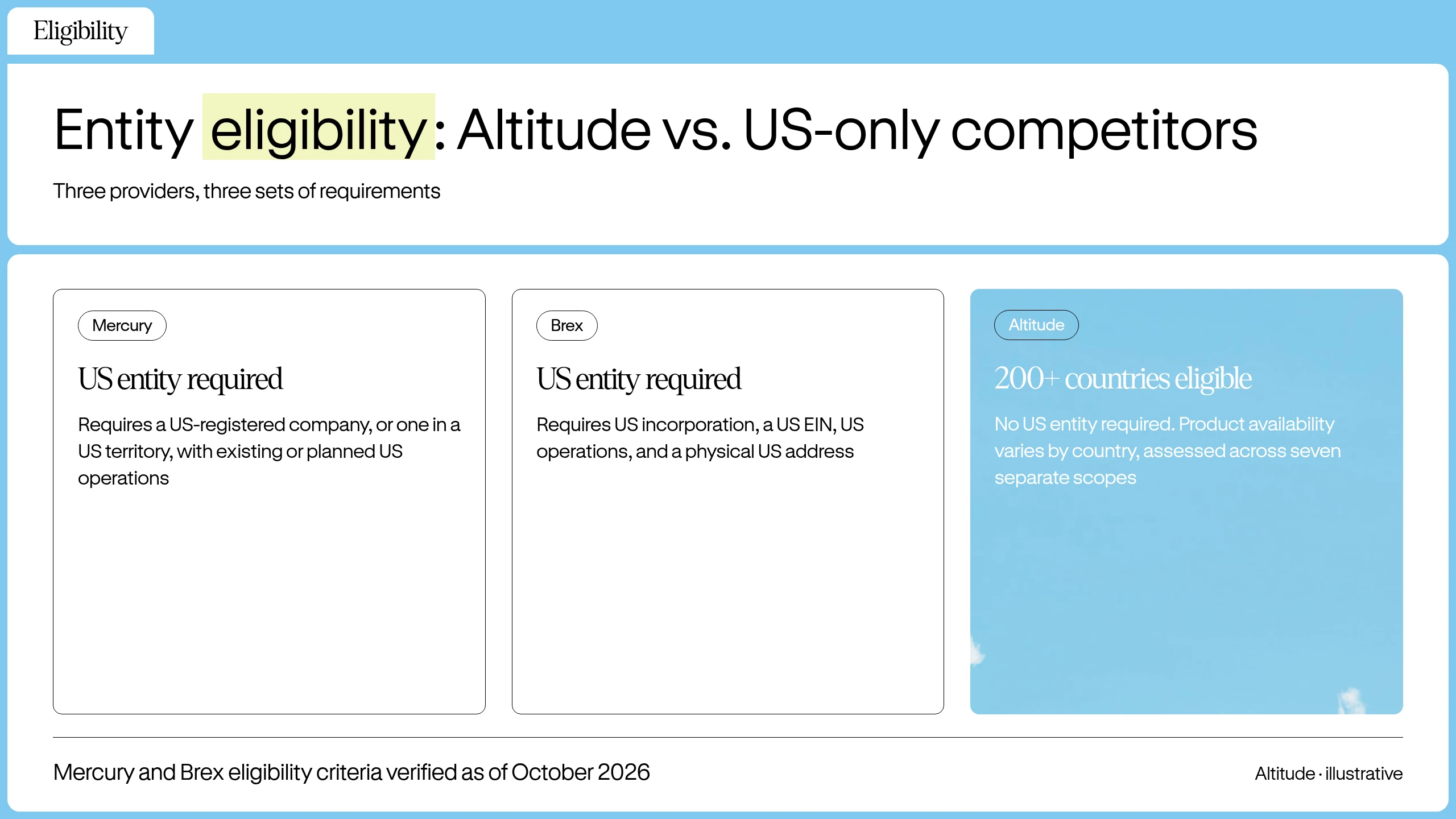
One of the specific problems stablecoin treasuries solve is account access for businesses incorporated outside the US. Mercury requires a US-registered company or one in a US territory, with existing or planned US operations. Brex documents US incorporation, a US Employer Identification Number (EIN), US operations, and a physical US address. Both providers publish these requirements in their eligibility documentation (Mercury eligibility, Brex eligibility), verified as of October 2026, and either provider can change them. For a founder incorporated in Brazil, Germany, or Nigeria, that is a structural barrier.
Altitude, a global business account, opens accounts for eligible businesses from 200+ countries, with no US entity required. Product availability varies by country, and every business goes through verification, which is a review. Business-incorporation eligibility, USD account eligibility, EUR account eligibility, payment-destination access, card-issuance eligibility, card merchant-spending access, and rewards eligibility are seven separate scopes. Meeting one doesn't guarantee access to another.
Stablecoin speed for vendor payments
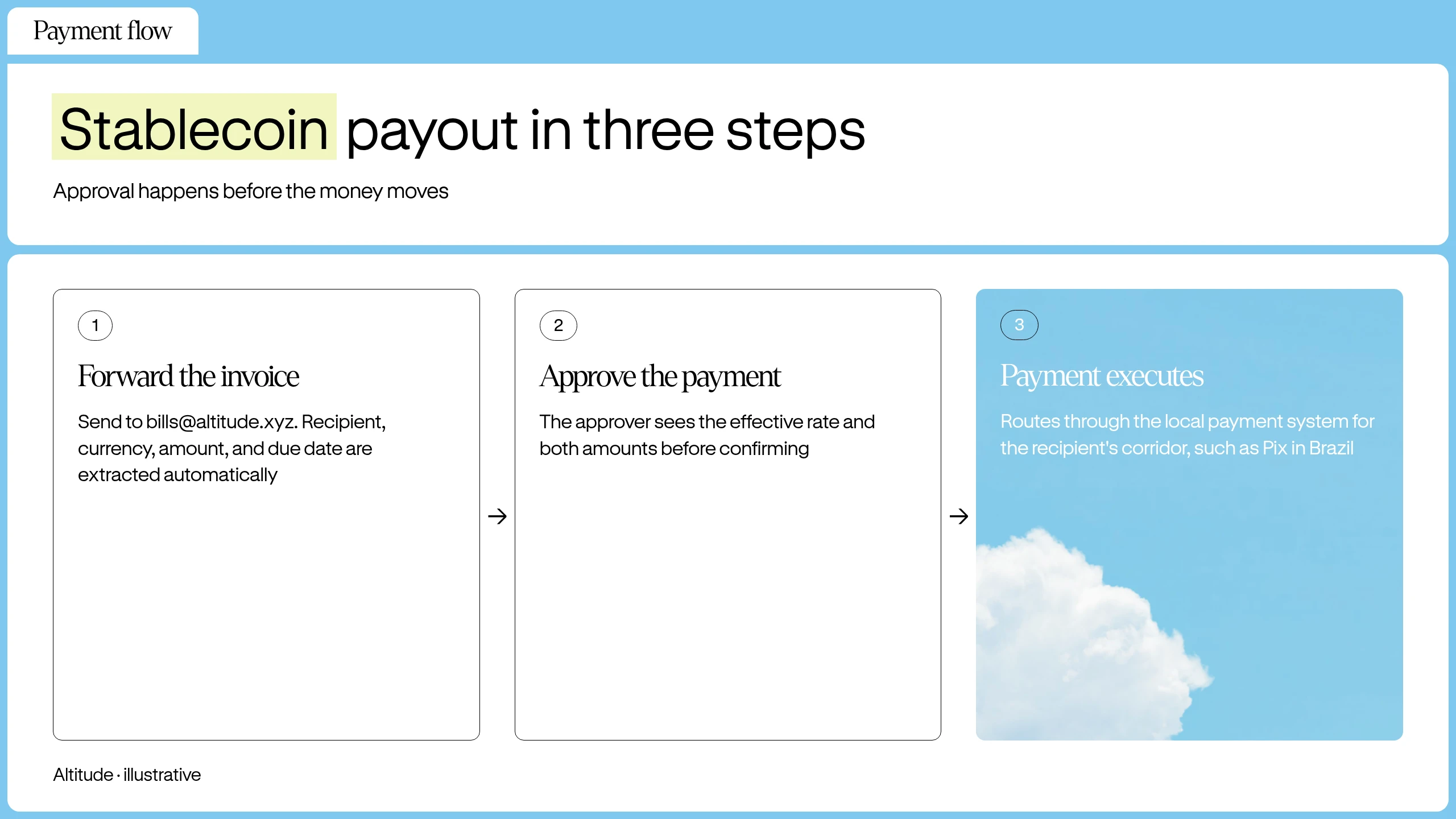
For a startup treasury management workflow, stablecoin settlement speed means a contractor invoice forwarded on a Friday can be paid the same day, because the network doesn't observe the 5pm banking cut-off. The speed matters most for recurring payments: monthly payroll in multiple currencies means FX conversion costs hit repeatedly, and settlement delays compound across time zones.
How to avoid unexpected debanking
Stablecoin issuers can freeze addresses under legal orders, and regulated partners can suspend services independently. Circle has this capability. Under the GENIUS Act (Public Law 119-27), permitted payment stablecoin issuers must have the technical ability to freeze, seize, or burn payment stablecoins to comply with lawful orders. The duty also reaches foreign issuers whose tokens are offered in the US, and most requirements take effect January 18, 2027.
How stablecoin transfers settle
Stablecoin transfers settle on a blockchain network, not through a correspondent banking chain. The sender signs a payment from an account, and validators on the network (Solana, Ethereum, or another) check that the balance covers it and record the transfer on a shared ledger. Once the network treats the transfer as final, the recipient's balance updates. Settlement time depends on the network: Solana settles in seconds, and other networks can take up to 15 minutes. The network doesn't observe banking hours, so a transfer sent on Saturday settles on Saturday. Transfers are irreversible once settled.
Key safeguards for stablecoin treasury management
A stablecoin treasury works only if the founder runs the specific checks before moving an operating balance. The risks are issuer failure, de-pegging, lost keys, and payment freezing by stablecoin issuers or regulated partners. Each has a specific mitigation, and none of them is "trust the provider."
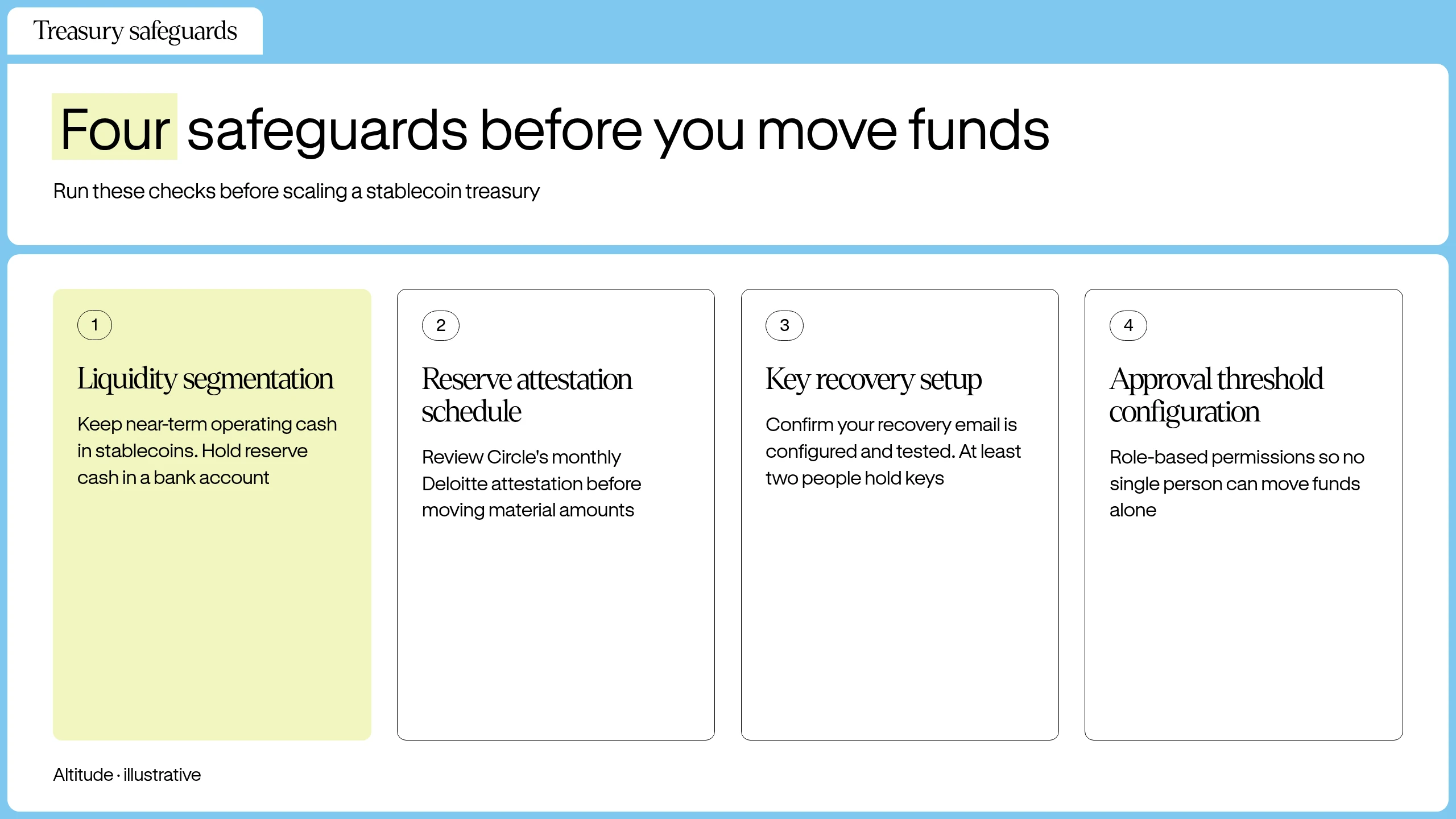
Before the money moves, run these four checks:
- Liquidity segmentation: Keep your near-term operating balance in stablecoins. Hold reserve cash in a traditional bank account.
- Reserve attestation schedule: Review Circle's monthly Deloitte attestation before moving material amounts. Set a calendar reminder.
- Key recovery setup: Confirm the recovery method (for example, a recovery email) is configured and tested. Ensure at least two people hold keys.
- Approval threshold configuration: Set role-based permissions so no single person can move funds alone. Test the workflow with a small payment.
Vetting stablecoin reserves for safety
Circle publishes monthly reserve reports with an independent accounting firm's attestation, showing USDC is backed by cash held at banks and the Circle Reserve Fund, a government money market fund. An attestation is an examination of the reserve report, not an audit of financial statements.
Review the attestation schedule and set a calendar reminder to read the most recent attestation before moving a material amount of your operating balance into stablecoins. If the attestation is late or qualified, that is a signal to hold off.
Redemption paths and counterparty risk
Holding a stablecoin and redeeming it with the issuer are different things. Circle Mint, Circle's direct mint and redeem service, is built for institutions, so most startups convert stablecoins back to local currency through an intermediary: their account provider, an exchange, or an off-ramp partner. Each intermediary adds its own counterparty risk, fees, and cut-off times. Before moving your operating balance, write down who converts it, at what cost, and how long it takes.
Network and smart-contract risk also sit outside the issuer's reserves. A transfer can fail or be delayed if the network or a contract that a provider relies on has an outage or a flaw.
This guide covers USDC and EURC only. Other stablecoins, such as USDT and PYUSD, and tokenized Treasury funds have different issuers, reserves, and redemption terms. Run the same reserve, redemption, and freeze checks on each one before holding it.
Who controls your treasury keys
Key management is the risk that most founders underestimate. Where your business holds the keys, lost keys can mean lost funds, and recovery depends on what your provider offers. If a recovery method such as a recovery email is available, set it up at onboarding. It reduces this risk, but it doesn't remove it.
At least two people in your organization should hold keys, so a single person going offline doesn't lock the account. Your approval threshold also needs to be configured so that no single person can move funds alone.
Accounting for stablecoin treasury assets
Stablecoin balances are digital assets, not bank deposits. Under the GENIUS Act, a "payment stablecoin" is a digital asset designed to be used as a means of payment or settlement, whose issuer is obligated to redeem it for a fixed amount of monetary value. The definition excludes national currency, deposits, and securities.
The legal definition doesn't settle the accounting question. FASB's ASU 2023-08 scopes out assets that give holders enforceable rights to underlying assets, so fiat-backed stablecoins generally fall outside fair-value crypto accounting. FASB also has an open proposal on classifying certain digital assets as cash equivalents, and that proposal could change the treatment.
The accounting treatment depends on your jurisdiction and your accountant. If you use accounting software, check which ledgers your provider syncs to and whether entries post automatically or after confirmation. As one example, Altitude's accounting sync moves data one way from Altitude to QuickBooks Online (QBO) and Xero.
Compliance risks for your stablecoin balance
The regulatory treatment of stablecoin rewards is unsettled. Rewards paid by an account provider rather than by the issuer sit in a different position from issuer-paid interest. The GENIUS Act, with most requirements applying from January 18, 2027, bars permitted issuers from paying interest or yield solely for holding a payment stablecoin, and it doesn't expressly settle how third-party rewards will be treated. In the EU, MiCA Article 50 bars both issuers and crypto-asset service providers from granting interest on e-money tokens. The treatment could change as stablecoin regulation develops.
The compliance risk is that the regulatory treatment of stablecoin rewards could change. The mitigation is to treat rewards as discretionary, not guaranteed, and to not rely on them as a treasury tool.
EU rules for euro-area businesses
Founders in Germany and the rest of Europe face EU rules for euro stablecoins in addition to the US framework above. MiCA Article 50 bars crypto-asset service providers, not only issuers, from granting interest on e-money tokens.
Regulated partners can also screen payments against sanctions lists and ask for counterparty information on a transfer under Travel Rule requirements. A payment that fails screening can be delayed or blocked, so build that review time into payment runs for new recipients.
Tax treatment of stablecoin balances
Tax treatment depends on your entity's jurisdiction. Ask your tax adviser how three events are treated: converting local currency into stablecoins and back, paying contractors in stablecoins, and receiving rewards.
Managing startup liquidity with stablecoins
Managing liquidity in a stablecoin treasury means deciding how much operating balance to hold in USDC or EURC, how to convert local currency in and out, and what each conversion costs. Compare the all-in cost and timing of each conversion route before moving money.
Converting local currency to stablecoins
Money enters a stablecoin balance through an account provider, an exchange, or an on-ramp partner, and each route has its own spread, fee, and cut-off time. Compare the effective rate and total cost of the full conversion, not the headline fee alone. A provider that converts pay-ins automatically removes one manual step. At Altitude, when a customer pays you:
- EUR by SEPA credits as EURC to your EUR account
- USD by ACH or wire credits as USDC to your USD account
For cross-border payments, check the effective rate and both amounts, because a low quoted fee can hide a wide spread.
Settling invoices with stablecoins
Paying invoices from a stablecoin balance works best when the invoice currency matches the balance you hold, so you avoid converting twice. Before a contractor payment run, check three things:
- Currency match: Pay from the USDC or EURC balance that matches the invoice where possible, since each extra conversion adds a spread.
- Rate in view: The approver should see the effective rate and both amounts before confirming.
- Small test first: Stablecoin transfers are irreversible once settled, so send a small payment to a new recipient before the full amount.
Converting stablecoins to local currency works through the same rails. You send USDC or EURC, and the recipient receives local currency through the local payment system: Faster Payments in the UK, SPEI in Mexico, Pix in Brazil, Bre-B in Colombia, or SEPA in Europe.
Off-ramp cost varies by corridor and provider. As one example, Altitude's supported payout corridors cover GBP, MXN, BRL, COP, and EUR. Per the help center (as of October 2026), Faster Payments, SPEI, Pix and Bre-B payouts are priced at an FX rate 0.4%–0.6% above mid-market, and SEPA payouts funded from USD at 0.4% above mid-market. Local payouts need workspace enablement and route approval, and they don't create local-currency balances.
Syncing stablecoin flows with accounting
Stablecoin flows reach your books only when each conversion, payment, and reward is recorded in your ledger, either by manual entry or through a sync between the treasury account and your accounting software.
Core benefits of stablecoin treasury tools
Stablecoin payouts for distributed teams
A founder paying contractors in Brazil, Germany, and the UK often logs into three platforms, one per corridor. A stablecoin treasury can replace that with one balance that funds payouts through local payment systems, provided the provider supports each corridor.
Approval controls matter as much as payout speed. As the team grows, payments need to reach the right approver without the founder acting as a manual bottleneck. Role-based permissions and configurable approval thresholds route each payment to an approver automatically, across timezones, in any setup that offers them.
Running a stablecoin treasury alongside a bank account
A stablecoin treasury doesn't require a switch. The adoption pattern is to prove the workflow on live flows, then migrate. Open the stablecoin account alongside your incumbent account, pay a few contractors by stablecoin transfer, and reconcile the transactions in your accounting software. Then migrate the workflows the incumbent can't handle: weekend payments, stablecoin revenue, and cross-border payouts.
Sample written treasury policy
A written policy keeps treasury decisions from depending on one person's memory. A one-page version covers these points:
- Operating balance: the amount held in stablecoins to cover near-term payroll and vendor payments, and who reviews it each month.
- Reserve cash: the amount held in a traditional bank account, and the trigger for moving funds between the two.
- Issuer checks: the date each month the owner reviews the latest reserve attestation, and what happens if it is late or qualified.
- Key holders: the names of at least two key-holders, the tested recovery email, and the review date for both.
- Approval thresholds: who can propose, approve, and submit payments, and the amounts that need a second approver.
- De-peg and freeze response: which obligations keep paying in stablecoins, and which draw on reserve cash.
- Exit path: how stablecoins convert back to local currency, through which provider, and at what cost.
- Records: who confirms each accounting sync posting, and who confirms the accounting and tax treatment with your advisers.
Before your next contractor payment run, review the supported payout corridors and the fee schedule, then prove the workflow on a small live payment alongside your existing account. See how Altitude handles contractor and supplier payments across borders. Book a demo.
FAQs
Are stablecoins safe for holding business balances?
Stablecoins can be safe for holding business balances if three conditions hold: the issuer publishes monthly reserve reports with an independent accounting firm's attestation, at least two people in your organization hold keys with a tested recovery path, and reserve cash sits in a traditional bank account. An attestation is not an audit of financial statements. Balances aren't FDIC or SIPC insured, so treat these as recurring checks rather than a one-time setup.
How do I account for stablecoin balances?
Treatment depends on your jurisdiction and your accountant, because stablecoin balances are digital assets rather than bank deposits. US GAAP doesn't currently treat stablecoins as cash, and FASB has an open proposal on classifying certain digital assets as cash equivalents. Keep a record of each conversion and payment so your accountant works from clean records.
Can I earn rewards on stablecoin treasury balances?
Rewards on stablecoin balances aren't deposit interest, and balances aren't FDIC or SIPC insured. The GENIUS Act bars permitted issuers from paying interest or yield solely for holding a payment stablecoin, and MiCA Article 50 bars issuers and crypto-asset service providers from granting interest on e-money tokens. Treat any rewards as discretionary, not guaranteed.
What happens if a reserve bank or the stablecoin issuer fails?
A reserve bank failure and an issuer insolvency are different events. In March 2023, USDC fell below 87 cents over a weekend after Silicon Valley Bank failed, because part of Circle's reserves sat there. Circle described the removal of that reserve risk and the closing of the de-peg, and contemporaneous reporting puts the recovery at roughly 72 hours. If the issuer itself became insolvent, the outcome would depend on how reserves are held, who can redeem, and holders' priority in insolvency, and a fast recovery wouldn't be guaranteed.
The GENIUS Act sets holder protections for permitted payment stablecoin issuers, with most requirements applying from January 18, 2027. Check its redemption and insolvency provisions in the statute text before relying on them. The liquidity segmentation described above applies in either scenario, so payroll doesn't depend on a redemption process or on converting at a loss.
Do I need a crypto wallet to use stablecoins?
It depends on the provider. Some setups need a self-managed wallet, where one person holds the keys. Others use a business account where signing is split across several key-holders. Check who holds each key, who approves a payment, and what the recovery path is if a key-holder leaves.
Key terms glossary
Stablecoin treasury management: The practice of holding and moving an operating balance in fully reserved stablecoins (typically USDC for dollars or EURC for euros) and using those balances to pay contractors, suppliers, and team members across borders.
De-pegging: The risk that a stablecoin trades below its one-to-one peg with the underlying currency. On March 11, 2023, USDC fell below 87 cents after Circle disclosed $3.3 billion of reserves at Silicon Valley Bank, and it returned to about $1 after regulators guaranteed SVB deposits on March 12-13.
Approval threshold: A configured rule that routes payments above a set amount to a designated approver before execution. Approval thresholds work across time zones, without routing every edge case back to the founder.
Liquidity segmentation: The practice of keeping an operating balance (near-term payroll and vendor payments) in stablecoins and reserve cash (the buffer beyond that) in a traditional bank account.
Reserve attestation: A monthly reserve report with an independent accounting firm's attestation, showing the stablecoin issuer holds assets backing the stablecoins in circulation. For USDC, those reserves are cash held at banks and the Circle Reserve Fund, a government money market fund. An attestation is not an audit of financial statements. Circle publishes monthly attestations on its transparency page. Review the most recent report before moving a material amount of your operating balance into stablecoins.
GENIUS Act: The US federal law (Public Law 119-27, signed July 18, 2025, with most requirements applying from January 18, 2027) that creates a licensing regime for permitted payment stablecoin issuers. It bars permitted and foreign payment stablecoin issuers from paying interest or yield to holders solely for holding the stablecoin.
Altitude is a financial technology platform, not a bank or digital asset custodian.