
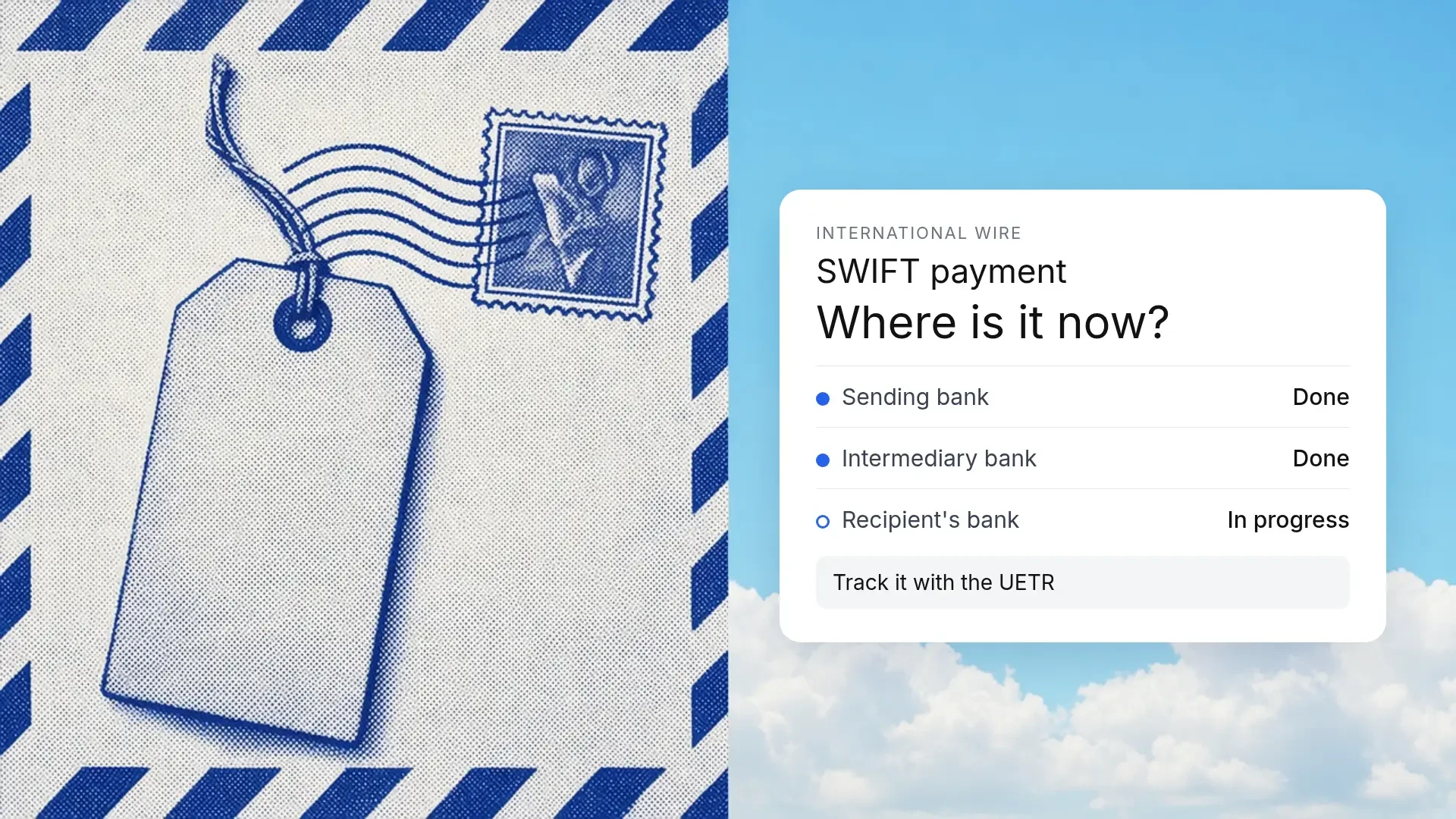
Here is how to track an international wire transfer: get its UETR number, the 36-character reference carried in every SWIFT payment instruction, and check it in the sending bank's portal or a tracker that accepts UETRs. The status tells you what stage the payment is at: ACSP means in progress, ACCC means credited and RJCT means rejected. If a payment is overdue and the status is unclear, the sender asks the sending bank to open a trace. If you are receiving, ask the payer for the UETR and ask your bank to check for the incoming payment.
When a supplier says your USD payment hasn't landed, or a client says "we sent it Tuesday," you need a status you can act on and proof you can forward. This Altitude guide covers which reference to ask for, how to track a wire as sender and as receiver, what each status means, when to raise a trace and what counts as proof.
What you need for wire transfer tracking
There is no single wire transfer tracking number. The UETR is the closest thing, backed by the references below. Collect these before you call a bank or open a tracker. Most appear on the payment message itself, which an MT103 example in Swift's message standards lays out field by field:
- UETR: field 121, for example d70044fe-ef81-40a3-8746-17798ed7ad8b.
- Sender's reference: field 20, the sending bank's own reference for the payment.
- A copy of the payment confirmation or MT103, if the sending bank can share one.
- Value date, currency and exact amount: field 32A. Trackers that search by amount need the exact figure, such as USD 12,480.50 rather than USD 12,480.
- Fed reference (IMAD): only if the payment had a US leg over Fedwire (see below).
The field numbers above come from the MT103 format. Since November 22, 2025, Swift requires ISO 20022 for cross-border payment instructions between banks, so customer payments travel as pacs.008 messages. Some banks still share an MT103-style copy. In a pacs.008, the UETR sits under the payment identification.
What is a UETR number and where do you find it?
A UETR (Unique End-to-end Transaction Reference) is a 36-character code of letters, numbers and hyphens, such as eb6305c9-117f-49de-aed0-16487c27b42d. Swift's rules require the bank that originates a SWIFT payment to create one, and every bank along the route passes the same UETR on. The reference you hold on day one is the same on the day the money lands.
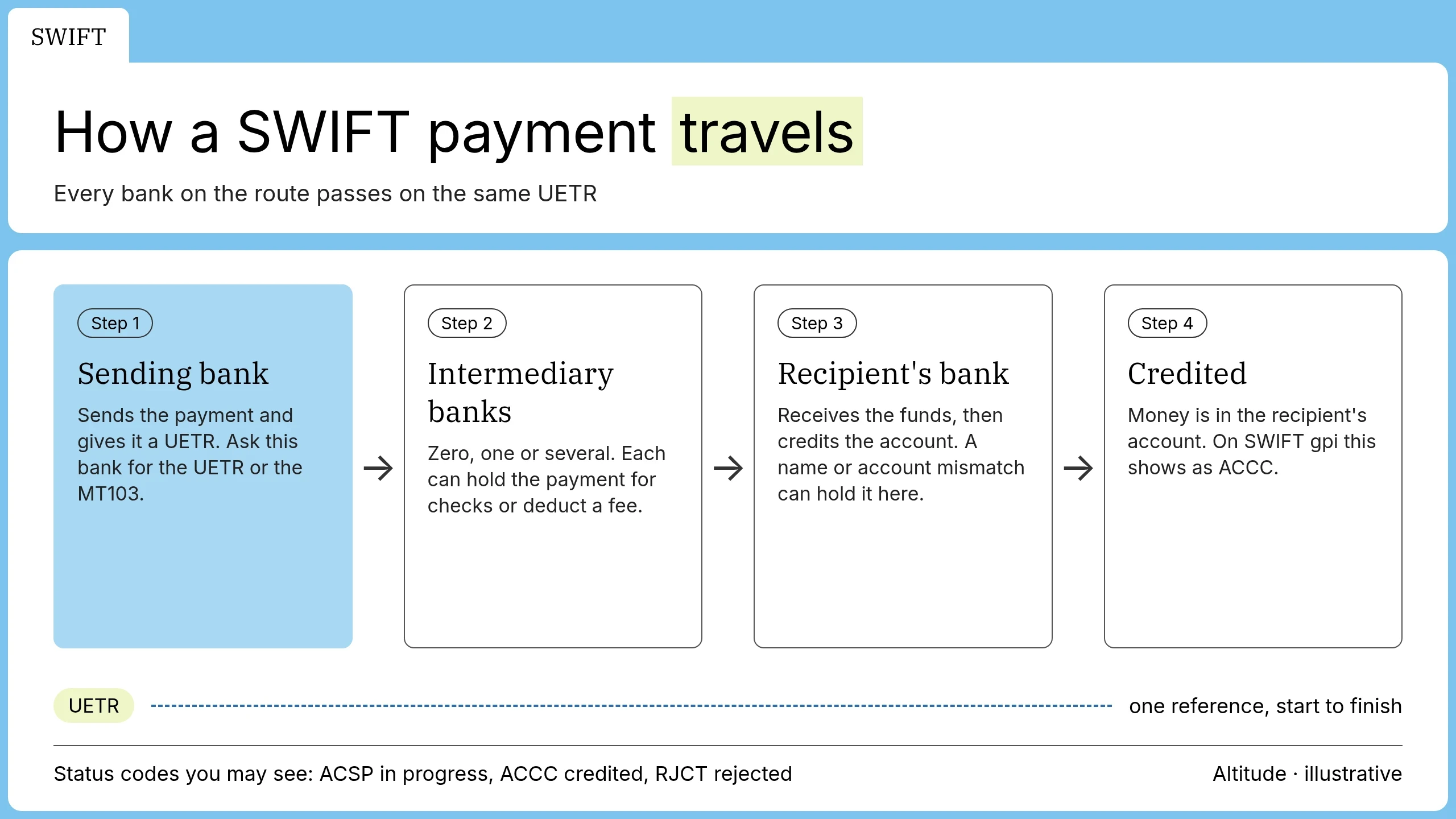
The same UETR follows the payment from the sending bank through any intermediary banks to the recipient's bank.
Where to find it:
- If you sent the payment: look on the payment confirmation, SWIFT receipt or MT103 for a field labeled UETR or field 121. If it isn't there, ask your bank or payment provider whether it can share the UETR. The bank that sent the payment into the SWIFT network created it.
- If you are receiving: ask the payer for the UETR and a copy of the MT103. Without it, your bank has to search incoming payments by details such as sender name, date and amount.
Fed reference (IMAD) for the US leg of a wire
Some USD payments pass between two US banks over Fedwire, the Federal Reserve's funds transfer service, before they reach the beneficiary. Each Fedwire payment message carries an IMAD (input message accountability data), which the Federal Reserve uses to identify the message, for example when a payment is returned. Ask for it when the money reached a US bank but your account shows nothing. An IMAD is 22 characters: an 8-digit date, an 8-character source ID and a 6-digit sequence number. It covers the Fedwire hop only and doesn't replace the UETR. ACH payments are a separate rail with their own trace numbers. Our guide to ACH vs wire transfers explains when each one fits.
How to track a wire transfer as a sender
- Start with your own bank or provider. It can check the outgoing instruction and request an investigation. Many business banks show a status in online banking or through a relationship team.
- Check a public tracker if you want a second view. Some large banks publish trackers that accept a full UETR, or the currency, exact amount and value date. Independent UETR trackers also exist, but they show only what banks have reported.
- Treat tracker data as a guide, not a record. Public tracker data can lag behind what the banks hold, so confirm anything important with the sending bank. Coverage also stops when a payment leaves the SWIFT network for a local rail.
How to track a wire transfer as a receiver
As the beneficiary, you see less of the route than the sender, so work from both ends:
- Ask the payer for the UETR and the MT103. With the UETR you can check a tracker yourself.
- Ask your own bank to search incoming payments by sender name, date and amount. If the account details may be wrong, ask the payer to contact the sending bank right away.
- Check how the money arrived. Many payers convert abroad and deliver locally, for example pesos by SPEI in Mexico or reais by Pix in Brazil. That last step never touches SWIFT, so a SWIFT tracker stops at the hand-off. Ask your bank using the local reference, such as the SPEI tracking key (clave de rastreo) or the Pix transaction ID.
What SWIFT gpi tracker statuses mean
SWIFT payment tracking runs on the Swift gpi Tracker, where banks report a payment's status against its UETR. Banks outside gpi can confirm payments there too. These are the statuses you are most likely to see, with meanings from the ISO 20022 status and reason codes that gpi uses:
- ACSP / G000, passed on and tracked: a bank passed the payment to the next bank. Credit isn't confirmed yet.
- ACSP / G001, passed on but not tracked: the next bank may not report updates to the tracker. Ask the sending bank to follow up if nothing changes.
- ACSP / G002, credit may not be confirmed today: an update should follow, so check again the next business day.
- ACSP / G003, waiting for documents: the bank reporting the status has asked the beneficiary for documents, such as an invoice or contract, before it credits the account. The beneficiary asks that bank exactly what it needs.
- ACSP / G004, waiting for cover funds: the bank reporting the status is waiting for funds sent separately by an earlier bank. The sender asks the sending bank about it.
- ACCC, credited: the money is in the beneficiary's account. Check the confirmed amount.
- RJCT, rejected: a bank on the route refused the payment. Read the reason code, wait until the sending bank confirms the funds are back, then fix the details and resend.
Some bank portals also show their own labels, such as "pending." Ask the bank holding the payment what the label means and why it is waiting. For a rejection, reason codes such as AC01 (account number invalid or missing) and BE01 (the beneficiary's name or ID doesn't match the account number) point to the fix. Ask the sending bank to translate the code before you resend, so the second payment doesn't fail the same way.
How to trace a wire transfer that hasn't arrived
Swift reports that almost all gpi payments are credited within 24 hours, and Swift measures banks on confirming 80% of their weekly payments within two business days, whether credited, rejected, on hold or passed outside Swift. Not every route is fully on gpi, though, and many providers quote 3 to 5 business days for SWIFT payments. Start from your bank or provider's delivery estimate:
- Day 1: check the status. ACSP with G000 means it is moving. Note any G003 or G004 hold.
- Past the delivery estimate with no ACCC status: ask the sending bank for the latest confirmed status.
- Still no answer on where the payment is: the sender asks the sending bank to open a trace.
- Rejected or sent to the wrong account: ask the sending bank about a return or a stop and recall.
The sender asks the sending bank to open the trace, because that bank holds the instruction and can follow up along the payment chain. A receiver can ask their own bank to search, but the payer's bank runs the investigation. Send the bank:
- The UETR and the MT103 or pacs.008.
- The exact amount, currency and value date.
- The beneficiary's name, account number or IBAN and SWIFT/BIC.
- The last status the tracker showed, with its reason code.
Trace times and any trace fees depend on the bank and how many banks sit on the route. Ask for a case number and the date of the next update. In the US, the CFPB's remittance rule covers consumer transfers, not business payments. For a business wire, ask your bank or provider which trace and error terms apply.
Why international wires are late or arrive short
A wire is usually late for one of these reasons:
- Compliance or document checks: a bank asked for an invoice, contract or purpose of payment (G003).
- A bank outside the tracker: the payment may still be moving, but updates stop after the hand-off (G001), so it can look late.
- Cut-off times and holidays: a payment sent after a bank's cut-off, or on a holiday in either country, moves to the next business day.
- Wrong beneficiary details: a bad account number, name or BIC often ends in a rejection and a return. A valid but wrong account number can send the money to the wrong account.
A wire arrives short when banks on the route take fees, or when the payment is converted at a different rate than expected. Field 71A of the MT103 sets who pays charges, and a pacs.008 uses DEBT, SHAR and CRED for the same three options. Under OUR (DEBT) the sender pays all charges, under SHA (SHAR) the sender pays its own bank's charges and other banks' charges can come out of the payment, and under BEN (CRED) the beneficiary pays all charges. Even under OUR, some intermediary or receiving banks deduct a fee, so the confirmed amount can be lower than the amount sent. Altitude sends SWIFT payments with OUR charges, though a receiving bank may occasionally deduct its own fee. Our guide to cross-border fees shows where each deduction comes from.
Is an MT103 proof of payment?
An authentic MT103 documents a payment instruction sent between banks. It shows the UETR, sender's reference, value date, amount and charge code. It doesn't prove the money reached the beneficiary. A payment confirmation PDF from your bank or provider shows the payment was sent, not that it arrived. If you pay from Altitude, you can download a confirmation PDF for each completed outgoing bank payment from the payment in Transactions.
Proof of receipt comes from the beneficiary's side: the ACCC status, which confirms the funds reached the beneficiary's account, or the beneficiary's bank statement or credit advice.
Be careful with documents you receive. The MT103 copy a payer sends you is usually a PDF or screenshot that anyone can edit, and Swift warns that scammers use forged prints of Swift messages. If a payer's MT103 doesn't match what the tracker or your bank shows, trust your bank. For audits, keep the MT103 or confirmation, the UETR and the ACCC status or credit advice together.
How to make your next international wire easier to track
- Share the UETR when you have it. If your bank or provider gives you the UETR, send it with the remittance advice so the supplier can check without emailing you.
- Quote the invoice number in the payment reference. Use one format, such as INV-2026-0142, so the payment matches the invoice on the first pass.
- Verify bank details before the first payment. Check the SWIFT/BIC with a SWIFT code lookup and confirm the account details with the supplier.
- Put your payment details on your invoices. When you are the one getting paid, list your account details, SWIFT/BIC and preferred reference. See what to put on an international invoice.
- Check the charge code. Where your bank or provider offers a choice, use OUR when the supplier needs the full invoice amount, and ask them to confirm the credited amount.
- Use a local rail where one exists. A local payment in the recipient's currency often arrives faster than a SWIFT wire and has fewer banks to trace. Altitude's international payments include local payouts such as MXN by SPEI, BRL by Pix and COP by Bre-B or bank transfer, which the app shows as arriving in up to 30 minutes.
FAQ
Can you track a wire transfer without a UETR?
You can track a wire transfer without a UETR, but only partly. Some bank trackers accept the sending bank's reference or the exact amount, currency and value date instead. The fastest route is still to ask the sending bank or provider for the UETR. A lookup without it may not show the full route.
Can the receiver track a wire transfer?
The receiver can track a wire transfer if the payer shares the UETR. Without it, the receiver's bank can search incoming payments by sender name, date and amount, but only the sending bank can trace the full route.
What is a SWIFT confirmation number?
A SWIFT confirmation number usually means the UETR or the sending bank's reference in field 20 of the MT103. The UETR stays the same at every bank, so it is the one to share.
How long does a wire trace take?
How long a wire trace takes depends on how many banks sit on the route and whether they use gpi. There is no standard turnaround. A trace is usually quicker when the tracker already shows where the payment stopped. Ask the bank running the trace for a case number and the next update date.
Is the tracker amount the same as the amount credited?
The tracker amount is not always the amount credited. The instructed amount is what was sent before charges, and the confirmed amount is what reached the beneficiary after deductions. Use the confirmed amount on the ACCC status or the bank's credit advice for reconciliation.